Choose year range

Research papers localized into Lithuanian

Browse AI-localized academic documents available in Lithuanian.

356 documents

EUROPOS KALBŲ LYGYBĖ SKAITMENINIAME AMŽIUJE: LIETUVOS ATVEJIS

Anželika Gaidienė · Aurelija Tamulionienė

2022Repository: Lietuvių kalbos institutas

The article addresses the current status of Lithuanian language technologies and presents the situation of European language equality in the digital environment. It investigates quantitative and qualitative indicators revealing language equality in the context of the European…

DOI: 10.35321/all86-08
Lietuvių moterų asmenvardžiai, kilę iš bendrinių žodžių ir vartojami kaip kultūriniai vardai: paveldimosios lietuvių kalbos kalbėtojų požiūris

Márcia Sipavicius Seide

2022Repository: Lietuvių kalbos institutas

There are Lithuanian female personal names derived from common nouns, as, for example the name Audra which cames from audra (storm). This kind of names corresponds to conventional female personal names, and some of them are exclusive to Lithuanian culture. Moreover, precise…

DOI: 10.35321/all86-06

UKRAINIEČIŲ FORMAVIMASIS MIKOŁAJ KRUSZEWSKI MOKSLINIAME PALIKIME

Zinaida Pakholok

2022Repository: Lietuvių kalbos institutas

The article for the first time examines the Ukrainian works in the scientific heritage of Mikołaj Kruszewski, who was born in a Polish-German family, spent his childhood and adolescence in Ukraine, received primary education and was influenced by the Ukrainian ethnos, which did…

DOI: 10.35321/all86-03

FIZĖS APRAIŠKA VILNIAUS APSKRITIES DREIMONIMIKOJE

Alisa Stunžaitė

2022Repository: Lietuvių kalbos institutas

The current research aims to shed some light on the conceptualization of physis1 in the drymonyms from present-day Vilnius County. The research is limited to the analysis of 65 names selected from the corpus of 787 drymonyms currently officially functioning in the territory of…

DOI: 10.35321/all87-08
PRECEDENTINIAI TIKRINIAI VARDai IR JŲ TARPKULTŪRINIS TRANSFERAS

Roman Vasko · Alla Korolyova · Tetiana Tolcheieva

2022Repository: Lietuvių kalbos institutas

The article deals with the problem of intercultural transfer of global and precedent proper names as reduced intertexts, which are signs and symbols in an outgoing culture and transmit new senses in perceiving cultures. As a general research idea, we suggest distinguishing the…

DOI: 10.35321/all87-06

BALTŲ *BALĀ „PURVAS, PELKĖ, RAISTAS“ INDOEUROPIEČIŲ KONTEKSTE

Václav Blažek

2022Repository: Lietuvių kalbos institutas

In this article the Baltic term *balā ‘mud, bog, marsh’ is analyzed from the point of view of its word-formation and etymology. The discussion of preceding etymologies leads to the choice of the cognates in Germanic *pōla-, and possibly Continental Celtic *bolā, all ‘swamp…

DOI: 10.35321/all87-01

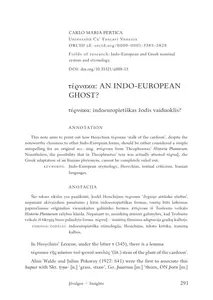
τέρνακα: indoeuropietiškas vaiduoklis?

Carlo Maria Pertica

2023Repository: Lietuvių kalbos institutas

This note aims to point out how Hesychian τέρνακα ‘stalk of the cardoon’, despite the noteworthy closeness to other Indo-European forms, should be rather considered a simple misspelling for an original acc. sing. πτέρνικα from Theophrastus’ Historia Plantarum. Nonetheless, the…

DOI: 10.35321/all88-13

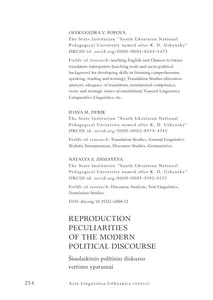
ŠIUOLAIKINIO POLITINIO DISKURSO ATKŪRIMO YPATUMAI

Oleksandra V. Popova · Ilona M. Derik · Natalya S. Zhmayeva

2023Repository: Lietuvių kalbos institutas

The article deals with the issues related to the concept of evaluative-attitudinal category represented in linguistics and its manifestation in political discourse. The authors investigate the structure of addressee’s positive and negative attitudes towards a certain situation…

DOI: 10.35321/all88-12

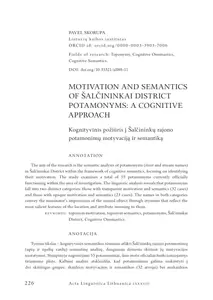
ŠALČININKŲ RAJONO POTAMONIMŲ MOTYVACIJA IR SEMANTIKA: KOGNITYVUSIS POŽIŪRIS

Pavel Skorupa

2023Repository: Lietuvių kalbos institutas

The aim of the research is the semantic analysis of potamonyms (river and stream names) in Šalčininkai District within the framework of cognitive semantics, focusing on identifying their motivation. The study examines a total of 55 potamonyms currently officially functioning…

DOI: 10.35321/all88-11

Vokiečių ir lietuvių vietovardžių darybos modeliai iš „Septynių kalbų žodyno“ (Sieben-Sprachen-Wörterbuch)

Dalius Jarmalavičius · Danguolė Straižytė · Virginija Jūratė Pukevičiūtė

2023Repository: Lietuvių kalbos institutas

This article analyses place nouns (Nomina Loci) in German and their derivational equivalents in Lithuanian. The objective of the paper is to ascertain the similarities and differences between place nouns in German and Lithuanian. The research material was collected from a…

DOI: 10.35321/all88-02

VILNIAUS APSKRITIES DREMONIMIKOS ATSKLEIDIMAS: METONIMIJOS ATVEJIS

Alisa Stunžaitė

2023Repository: Lietuvių kalbos institutas

The primary objective of this study is to provide insights into the metonymic patterns exhibited by drymonyms within present-day Vilnius County. The research focuses on a selection of 696 names extracted from a total of 787 officially functioning drymonyms found in the territory…

DOI: 10.35321/all89-11

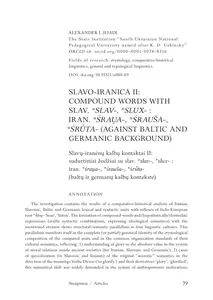
Slavo-Iranica II: slav. *slav-, *slux- : iran. *śrau ̯a-, *śrauša-, *śrū̆ta- sudurtiniai žodžiai (baltų ir germanų kalbų kontekste)

Alexander I. Iliadi

2023Repository: Lietuvių kalbos institutas

The investigation contains the results of a comparative-historical analysis of Iranian, Slavonic, Baltic and Germanic lexical and syntactic units with reflexes of Indo-European root *k ̑leu ̯- ‘hear’, ‘listen’. The formation of compound-words and (hypothetically) formulaic…

DOI: 10.35321/all89-03

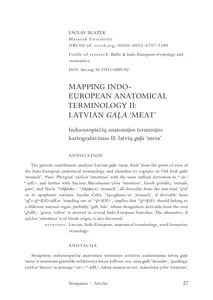
INDOEUROPIEČIŲ ANATOMINĖS TERMINOLOGIJOS ŽEMĖLAPIS II: LATVIŲ GAĻA ‘MĖSA’

Václav Blažek

2023Repository: Lietuvių kalbos institutas

The present contribution analyzes Latvian gaļa ‘meat, flesh’ from the point of view of the Indo-European anatomical terminology and identifies its cognates in Old Irish gaile ‘stomach’, ‘Para- Phrygian’ γάλλια ‘intestines’ with the same suffixal derivation in *-o-/-*-eH2-, and…

DOI: 10.35321/all89-02

Pavydas kaip psichologinis ir kognityvinis reiškinys ukrainiečių ir slovakų kalbinėje sąmonėje (asociacinio eksperimento duomenimis)

Andrea Grominova · Oleh Tyshchenko · Igor Korolyov + 1 author

2024Repository: Lietuvių kalbos institutas

The complex psychological, sociocultural and semiotic phenomenon of ENVY is explored in the paper. It is regarded as a mental correlating factor of cultural signs and symbolic stereotypes, norms and values. Additionally, it serves as the element of cognitive and evaluative…

DOI: 10.35321/all90-12

SCALED AIC TYRIMAS ANGLŲ KALBOS UŽDARUOSIUOSE JUNGINIUOSE

Chariton Charitonidis

2024Repository: Lietuvių kalbos institutas

The Akaike Information Criterion (AIC) is an established goodness-of-fit measure for selecting models in the analysis of empirical data. However, AIC is sensitive to sample size. Author’s previous research has shown that Scaled AIC, i.e. AIC divided by sample size, is an…

DOI: 10.35321/all90-11

SEMANTINĖS DINAMIKOS UNIVERSALUMAS: NUO „KŪNO“ PRIE „ASMENS“, „SAVĘS“, „SIELOS“

Alexander I. Iliadi · Ilona M. Derik

2024Repository: Lietuvių kalbos institutas

The research is aimed at describing a relevant regularity in semantics development tending to be universal due to the evidence in many languages. In the focus of the research, there is an identical sequence of stages of semantic evolution ‘body’, ‘corpus’ → ‘person’, ‘self’…

DOI: 10.35321/all90-07

VIETOVARDIS LEIPZIGAS IR GERMANIŠKASIS GARSŲ POSLINKIS

Jürgen Udolph

2024Repository: Lietuvių kalbos institutas

In diesem Beitrag geht es um die Etymologie des Ortsnamens Leipzig. Lange hat man angenommen, dass das slavische Wort lipa ‘Linde’ die Grundlage sei. Eine genauere Beachtung der historischen Schreibungen wie Libzi u.a., vor allem bei Thietmar von Merseburg, der das Slavische…

DOI: 10.35321/all90-03

Skaitmeninis profiliavimas kaip ankstyvųjų viduramžių diplomatistikos metodas. Remiantis Sankt Peterburge saugomu Otto I dokumentu

Marie-Luise Heckmann

2024Repository: Lietuvių kalbos institutas

Anhand einer Reihe von äußeren und inneren Kriterien wird eine in St. Petersburg aufbewahrte Urkunde Ottos I. analysiert und einem von 39 namentlich bekannten Schreibern der kaiserlichen Kanzlei zugeordnet. Grundlage der Identifizierung sind die Signa sowie Größe, Format…

DOI: 10.35321/all90-02

MEILĘ REIŠKIANČIŲ METAFORŲ TYRINĖJIMAS TARP MOMBASOS APYGARDOS SVAHILIŲ JAUNIMO, KENIJOJE: ĮŽVALGOS IŠ KONCEPTUALIŲJŲ ATVAIZDŽIŲ

Victor 0. Ntabo · Catherine W. Ndung’u

2024Repository: Lietuvių kalbos institutas

Swahili youths in Mombasa County to woo their beloved. The research was anchored within a descriptive research design. Primary data was collected from four purposively sampled Swahili male youths through an interview schedule. The collected data were then subjected to the…

DOI: 10.35321/all91-12

AUTOMATINĖS UKRAINIEČIŲ ŽINIASKLAIDOS TEKSTŲ STILOMETRINĖS ANALIZĖS SISTEMA TEXTATTRIBUTOR 1.0 (METODAI, PRIEMONĖS, FUNKCIONALUMAS)

Nataliia Darchuk · Oksana Zuban · Valentyna Robeiko + 3 authors

2024Repository: Lietuvių kalbos institutas

This paper presents the structure, algorithms, implementation, and experimental results of the automatic TextAttributor system developed by the authors of the paper for statistical Ukrainian-language text parameterisation using a multiparametric set of statistical indices…

DOI: 10.35321/all91-09

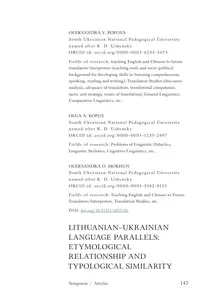
LIETUVIŲ–UKRAINIEČIŲ KALBŲ PARALELĖS: ETIMOLOGINIS SANTYKIS IR TIPOLOGINIS PANAŠUMAS

Oleksandra V. Popova · Olga A. Kopus · Oleksandra O. Morhun

2024Repository: Lietuvių kalbos institutas

The article aims to confirm an important hypothesis about the existence of separate parallels in the Lithuanian and Ukrainian languages. The absence of common areal boundaries of both languages with striking correspondences at different levels indicates the preservation of…

DOI: 10.35321/all91-06

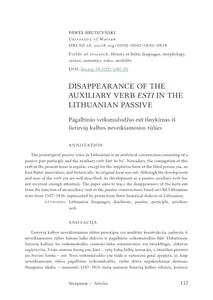
PAGALBINIO VEIKSMAŽODŽIO ESTI IŠNYKIMAS LIETUVIŲ KALBOS NEVEIKIAMOJOJE RŪŠYJE

Paweł Brudzyński

2024Repository: Lietuvių kalbos institutas

The prototypical passive voice in Lithuanian is an analytical construction consisting of a passive past participle and the auxiliary verb būti ‘to be’. Nowadays, the conjugation of this verb in the present tense is regular, except for the suppletive form of the third person yra…

DOI: 10.35321/all91-05

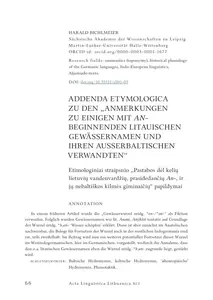
ETYMOLOGINIAI PAPILDYMAI PRIE „PASTABŲ APIE KAI KURIUOS LIETUVIŲ VANDENVARDŽIUS, PRASIDEDANČIUS AN- , IR JŲ NEBALTŲ GIMINAIČIUS“

Harald Bichlmeier

2024Repository: Lietuvių kalbos institutas

In einem früheren Artikel wurde die „Gewässerwurzel uridg. *en-/*on-“ als Fiktion verworfen. Folglich wurden Gewässernamen wie lit. Anatà, Anýkštė tentativ auf Grundlage der Wurzel uridg. *h2en- ‘Wasser schöpfen’ erklärt. Diese ist aber zunächst im Anatolischen nachweisbar, die…

DOI: 10.35321/all91-03

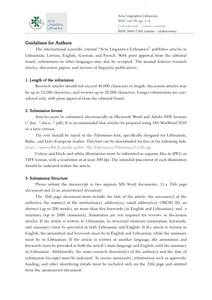
Nurodymai autoriams

Pavel Skorupa

2025Repository: Lietuvių kalbos institutas

DOI: 10.35321/all85-01

LINGVISTINIS WOKEIZMAS: GYPSY MOTH IR ASIAN CARP REVIZIONIZMAS BEI RUSSIAN SALAD LIKIMAS

Jaime A. Teixeira da Silva

2025Repository: Lietuvių kalbos institutas

The concept of wokeism in academia might represent two radically ideological poles: neoliberally, it is a symbol of socio-cultural liberation, but conservatively, it is a symbol of unnecessary revisionism that tests the limits of traditional culture. Academia is in the belly of…

DOI: 10.35321/all92-12

Varia Onomastica: sarmatoalanika (Danapria, Bohus)

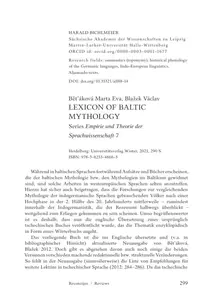
Alexander I. Iliadi

2025Repository: Lietuvių kalbos institutas

The research is aimed at singling out the Iranian language heritage in the toponymy of the Dnieper and the Bug regions. In particular, it dwells upon the reconstruction of the Sarmatian-Alanian lexical stratum, whose existence does not run counter to the data of the history and…

DOI: 10.35321/all92-05

SENPRŪSIŲ poaris

Václav Blažek

2025Repository: Lietuvių kalbos institutas

The article analyses the isolated Old Prussian word poaris ‘mole cricket’ from the point of view of word formation and etymology. For this reason, all published etymological attempts are collected and evaluated. Finally, a new solution is proposed, operating with the IE root…

DOI: 10.35321/all92-02

Dėl lietuvių alėti, almuo, almė, elmės ir kt. etimologijos ir jų sąsajos su vokišku vietovardžiu Ulm bei jo giminaičiais

Harald Bichlmeier

2025Repository: Lietuvių kalbos institutas

Lit. alėti ‘fließen, tröpfeln, laufen, eilen’, nualėti ‘überlaufen, (Felder) überschwemmen’, almuõ (3) m. ‘Eiter’, álmė (1), almė (4) f. ‘aus dem Körper austretende Materie’, elmės (4) f. Pl. ‘dass.’ werden traditionell auf Grundlage einer Wurzel etymologisiert, die ‘fließen’…

DOI: 10.35321/all92-01

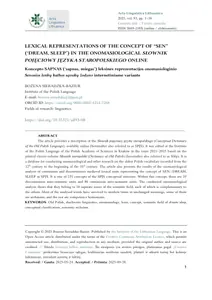
LEKSINĖ SEN // SAPNO, MIEGO SĄVOKOS REPREZENTACIJA ONOMASIOLOGINĖJE SŁOWNIK POJĘCIOWY JĘZYKA STAROPOLSKIEGO DUOMENŲ BAZĖJE

Bożena Sieradzka-Baziur

2025Repository: Lietuvių kalbos institutas

The article provides a description of the Słownik pojęciowy języka staropolskiego (Conceptual Dictionary of the Old Polish Language), available online (hereinafter also referred to as SPJS). It was edited at the Institute of the Polish Language of the Polish Academy of Sciences…

DOI: 10.35321/all93-08
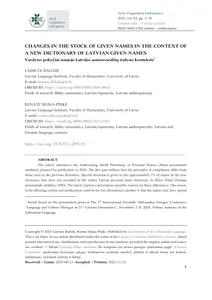
VARDŲ FONDO POKYČIAI NAUJO LIETUVIŠKŲ VARDŲ ŽODYNO KONTEKSTE

Laimute Balode · Renāte Siliņa-Piņķe

2025Repository: Lietuvių kalbos institutas

The article introduces the forthcoming Small Dictionary of Personal Names (Mazā personvārdu vārdnīca), planned for publication in 2026. The first part outlines how the principles of compilation differ from those used in the previous dictionary. Special attention is given to the…

DOI: 10.35321/all93-01

APIE LIETUVIŲ PRIELINKSNIO po REIKŠMĘ: KOGNITYVUSIS POŽIŪRIS

Ieva Stasiūnaitė

2026Repository: Lietuvių kalbos institutas

Studies of prepositional meaning are rather prolific in cognitive linguistics. However, the Lithuanian po ‘under’ still relies on intuitive explication rather than corpus-based evidence, reflecting the traditional line of investigation. Thus, the present paper focuses on: (1)…

DOI: 10.35321/all94-10

Pietų Estijos vietovardžiai Ludzos (Lutsi) regione Rytų Latvijoje (Latgaloje)

Simonas Noreikis

2026Repository: Lietuvių kalbos institutas

The article investigates Estonian toponyms in the Ludza area of Latvia’s Latgale region. Lutsi Estonians were a group of Estonians who moved to this area in the 17th and 18th centuries and were ultimately assimilated into the local population in the 20th century. The sources of…

DOI: 10.35321/all94-07

Kazachų ir anglų toponimikos lingvistinis pagrindas, Rytų temos ir etnokultūriniai bruožai Nuraly Nisanbayuly kūryboje

Balnur Karayeva · Baurzhan Nasirdinov · Akylbek Meirbekov + 3 authors

2026Repository: Lietuvių kalbos institutas

Nuraly Nisanbayuly (1858–1931) was a prominent Kazakh aqyn whose works reflect the transitional cultural and literary processes of the late nineteenth and early twentieth centuries. His dastans represent a valuable source for investigating the ethnocultural foundations of the…

DOI: 10.35321/all94-06

BALTIJOS SLUOKSNIS DNIEPRO UPĖS REGIONO HIDRONIMIJOJE

Alexander I. Iliadi

2026Repository: Lietuvių kalbos institutas

The research aims to identify the Baltic language heritage in the hydronymy of the Dnieper region. In particular, it dwells on the reconstruction of the Baltic lexical stratum, the existence of which is not at odds with the historical and archaeological data for the areas under…

DOI: 10.35321/all94-05

ONOMASTIKOS TERMINIJA: TARP SISTEMINIO GRIEŽTUMO IR NERIBOTO PLITIMO

Artur Gałkowski

2026Repository: Lietuvių kalbos institutas

This article examines contemporary onomastic terminology, focusing on the coexistence of systematic coherence and increasing terminological proliferation. It analyses the linguistic strategies underlying the formation of traditional and emerging (meta)onomastic terms…

DOI: 10.35321/all94-04