
Research papers localized into Italian
Browse AI-localized academic documents available in Italian.
2221 documents
Asta Leskauskaitė (a cura di). «Testi dei dintorni di Leipalingis»
DOI: 10.35321/all81-14
Laima Kalėdienė (a cura di). «Valerijus Čekmonas: contatti linguistici e sociolinguistica»
DOI: 10.35321/all81-13
Volker Kohlheim. “Il nome nella letteratura”
DOI: 10.35321/all81-12
LA LINGUA NELLA POESIA: FILOLOGIA VS. BIOFILIA
DOI: 10.35321/all81-11
IL RESPIRO DAUKANTIANO DI GRANAUSKAS
The article considers the impact of Lithuanian national historiography initiator and literary reformer Simonas Daukantas (1793–1864) on the creative writings of Romualdas Granauskas (1939–2014); it analyzes the short story of the writer with the focus on his Jaučio aukojimas…
DOI: 10.35321/all81-10
I CONTESTI IDEOLOGICI DELL’ATTIVITÀ SCIENTIFICA DI ANTANAS E JONAS JUŠKA A KAZAN’
The article attempts to answer the question why Kazan was the place where the works (Lithuanian folklore) compiled by the Juška brothers could be published in the Latin script in the period 1878–1882. The research focuses on the sociocultural conditions and ideological contexts…
DOI: 10.35321/all81-09
IMMAGINI DELLA PATRIA LINGUISTICA DEI GIOVANI AUKŠTAITIANI ORIENTALI – DI KUPIŠKIS E UTENA
The article presents a research study addressing the images of the linguistic homeland of the young Eastern Aukštaitians of Kupiškis and Utena. The material surveyed in the study consists of the data from the research conducted under the principles of perceptual dialectology…
DOI: 10.35321/all81-08
LA CATEGORIA DELLA RIPETIZIONE NEL DISCORSO LINGUISTICO
The article deals with the phenomenon of categories, type description of linguistic categories in the structure of the language, as well as the history of their study. Due to the fact that modern science is characterized not only by the formation of new concepts, but also by…
DOI: 10.35321/all81-07
MOTIVAZIONE DEGLI ELONIMI SUFFISSALI DELLA CONTEA DI MARIJAMPOLĖ
The article addresses suffixal helonyms, which constitute a peculiar and interesting layer of the so called non-equivalent lexis. In order to reveal the motivated connection between their formal structure and meaning, these representatives of the hydronym class are analysed…
DOI: 10.35321/all81-05
NOMI PERSONALI STORICI LITUANI NEL LIBRO DEL TRESSELER DI MARIENBURG DEGLI ANNI 1399–1409
Der vorliegende Aufsatz befasst sich mit den Neufunden der litauischen historischen Anthroponymie und zwar mit den Personennamen, die dem Marienburger Tresslerbuch der Jahre 1399–1409 entnommen sind. In den finanziellen Dokumenten des Deutschen Ordens handelt es sich…
DOI: 10.35321/all81-04
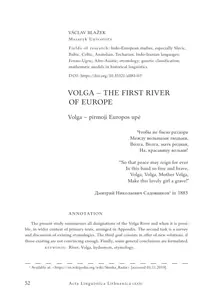
VOLGA – IL PRIMO FIUME D’EUROPA
The present study summarizes all designations of the Volga River and when it is possible, in wider context of primary texts, arranged in Appendix. The second task is a survey and discussion of existing etymologies. The third goal consists in offer of new solutions, if those…
DOI: 10.35321/all81-03
PRUSSICA E LITHUANICA NELLA BIBLIOTECA STATALE DI BERLINO – PATRIMONIO CULTURALE PRUSSIANO
Der Beitrag „Lithuanica und Prussica in der Staatsbibliothek zu Berlin – Preußischer Kulturbesitz“ besteht aus einer kurzen Einführung in die Überlieferungsumstände und einige Forschungsaspekte sowie in Kurzbeschreibungen von knapp dreißig Handschriften deutscher, lateinischer…
DOI: 10.35321/all81-02
IL PIÙ ANTICO TESTO BALTICO E I SUOI ANTROPONIMI
In 2013, a new linguistic and genre-related interpretation of the Trace of Basel (Dini 2004; 2014: 553–558) based on analogy with singing, recitative, texts akin to Christmas carols was put forward in the pages of Acta Linguistica Lithuanica (Lemeškin 2013: 11–29). The new…
DOI: 10.35321/all81-01
POESIE DALLA MEISTARNĖS
DOI: 10.35321/all82-10
La lingua “di medie dimensioni” del catalano (possibili parallelismi con il lituano)
DOI: 10.35321/all82-09
La questione dell’autore del “Dizionario della lingua lituana” manoscritto: nuovi fatti emersi dall’esame peritale della grafia
The archival document Dictionary of the Lithuanian Language (shelfmark IV A 11) is kept at the Department of Manuscripts and Early Printed Books of the Czech National Museum Library. This handwritten lexicographic relic is dated to the first half of the 19th century and contains…
DOI: 10.35321/all82-08
Nomi personali nelle famiglie lettoni di Būtingė e Šventoji nel XX–XXI secolo
The article covers the most popular Latvian personal names in the borderline area of Lithuania in the early 20th century. The ancient tradition of giving names in Kurzeme is explained, which is also noticeable in the Būtingė and Šventoji native. A study has been performed in the…
DOI: 10.35321/all82-07
LA MORFOLOGIA DEI TOPONIMI LITUANI – DIFFERENZE E PARALLELISMI TRA DIVERSE CLASSI DI NOMI
The participation in the project “Vakarinių pietų aukštaičių vietovardžių integravimas į Lietuvos vietovardžių geoinformacinę duomenų bazę ir jų kilmės bei motyvacijos tyrimai” [The integration of Western South Aukštaitian toponyms into the Lituanian geoinformational database…
DOI: 10.35321/all82-06
CONCETTO DELLA PAROLA AUGALAS (SULLA BASE DI UN’INDAGINE TRA GLI STUDENTI)
Lithuanian explanatory dictionaries (Dictionary of Modern Lithuanian, Dictionary of the Lithuanian Language) usually define the word augalas (plant) as a botanical term by mentioning its essential features: ‘organism’, which feeds on ‘inorganic nutrients’ and requires ‘the…
DOI: 10.35321/all82-05
PECULIARITÀ SINTATTICHE DEL DIALETTO LOCALE DI ŽAGARĖ (SULLA BASE DELLE REGISTRAZIONI DEL 1998–2003)
By this article the author finishes the description of Žagarė local dialect. The article analyzes its syntactic phenomena and discusses morphosyntactic constructions (perficientive, expression of necessity and condition, arthroid), which can also be found in another Baltic…
DOI: 10.35321/all82-04
IL GRUPPO LESSICO-SEMANTICO «AUSSIE» NELLO SLANG AUSTRALIANO CONTEMPORANEO
The aim of the article is to study the lexical-semantic group ‘Aussie’ in contemporary Australian slang (also strine). The objectives of the article are to determine the semantic structure of the lexeme Aussie and relations between its LSVs, to reconstruct the LSG ‘Aussie’ and…
DOI: 10.35321/all82-03
LE SFIDE DELL’ANALISI E DELLA CLASSIFICAZIONE DEI NUOVI COMPOSTI
The paper aims to review the atypical cases of Lithuanian neologisms that are coined from two or more words. The nouns, i.e. compounds and blends, collected in “The Database of Lithuanian Neologisms” until the beginning of 2019 are under investigation. The types of indigenous…
DOI: 10.35321/all82-02
NUOVE TENDENZE NELLA DIALETTOLOGIA LITUANA: MODELLO DI RICERCA MULTIMODALE
The modern trend of dialectology recognizes the shift and vitality of traditional dialects. The aim of this study is to submit a new dialect research model for modern language variations used by the researchers of the Centre of Geolinguistics in the Institute of the Lithuanian…
DOI: 10.35321/all82-01
Eugenijus Jovaiša. “Tombe e persone. Aesti, romani, goti e altre storie”
DOI: 10.35321/all83-18
SIGNIFICATO LEGATO AL SUONO: LA POESIA COME MUSICA
DOI: 10.35321/all83-15
Sulla questione del termine “žemė́vardis”
Straipsnyje aptariamas tarpukario mokslininko Kazimiero Alminauskio vartosenoje funkcionavusio savakilmio žodžio žemvardis terminologizavimosi procesas ir rezultatas, sąvoka, termino vieta savos terminijos sistemoje, santykis su kitais lietuvių toponomastikoje vartojamais…
DOI: 10.35321/all83-14
Locuzioni del gergo lituano avverbializzate e avverbi univerbati, e le loro caratteristiche di adattamento
Straipsnyje analizuojami lietuvių kalbos žargono ir nenorminės kalbos suprieveiksmėję žodžių junginiai ir suaugtiniai prieveiksmiai (205), atrinkti iš Lietuvių kalbos žargono ir nenorminės leksikos žodyno. Analize siekiama nustatyti sistemiškus prieveiksmėjimo ir skolinių…
DOI: 10.35321/all83-13
Cosa si può imparare dalle guide linguistiche dialettali per la dialettologia e la linguistica amatoriali
Phrase books for travellers or merchants have been typically oriented towards standard varieties and good language use. Dialectal phrase books are a relatively young phenomenon, at least as far as German is concerned. They seem to fulfil a different purpose than regular phrase…
DOI: 10.35321/all83-12
NOMINAZIONI E VALUTAZIONI DEI DIALETTI DEI RASEINIŠKIAI DELLA SAMOGIZIA MERIDIONALE
Straipsnyje, remiantis perceptyviosios dialektologijos metodologijomis, nagrinėjamos pietų žemaičių raseiniškių patarmės ploto (Kemės, Raséinių ir Taurags zonų) respondentų tarmių nominacijos ir jų vertinimai. Visų trijų zonų tiriamųjų sąmonėje įsitvirtinusi ryški žemaičių ir…
DOI: 10.35321/all83-11
LA RETRAZIONE DELL’ACCENTO NEI TESTI DEL SOTTODIALETTO ORIENTALE AUKŠTAITIANO DI ANYKŠČIAI
Remiantis rašytiniais šaltiniais – Leipcige vokiečių kalbininko Franco Špechto leidinyje Litauische Mundarten gesammelt von A. Baranowski publikuotais XIX a. 7–9 deš. tekstais, Lietuvių kalbos instituto Geolingvistikos centro Tarmių archyve saugomais XX a. 6–7 deš. anykštėnų…
DOI: 10.35321/all83-10
PRIMA DELLO SPATIAL TURN: L’ASPETTO AREALE NELL’ONOMASTICA TEDESCA DEGLI ANNI ’80 E LA SUA APPLICAZIONE NELLA RICERCA ATTUALE
Mapping isn’t just mapping. Far from an easy matter, presenting and analysing place names on maps is theoretically and practically challenging. In onomastic research at Leipzig, the areal aspect was concluded decades ago to be one of three main aspects useful for investigating…
DOI: 10.35321/all83-09
SULL’ORIGINE DEL NOME DEL VILLAGGIO ÝVOLIAI
Remiantis gyvosios kalbos ir istorijos šaltinių duomenų analize straipsnyje išsamiai aptariama Kelmės r. Kražių seniūnijoje esančio kaimo vardo Ývoliai kilmė ir raida. Apžvelgus oikonimo užrašymus iš gyvosios kalbos, įvertinus jų patikimumą daroma išvada, kad vardo forma su…
DOI: 10.35321/all83-08
Osservazioni sui nomi dei fiumi lituani “Liẽkė”, “Liekà” e la loro famiglia
Die Flussnamen lit. Liẽkė, Liekà (und ihre Sippe) begegnen bisweilen im Rahmen der Untersuchungen zur ‘alteuropäischen’ Hydronymie. Traditionell wird ihnen eine Etymologie auf Grundlage der Wurzel uridg. *(h1)lei̯k- ‘krümmen, biegen’ zugeschrieben. Diese Wurzel hat es allerdings…
DOI: 10.35321/all83-07
SULLA QUESTIONE DEI NOMI PROPRI BALTICI DELL’AREA RAGNIT E TILSIT NEI DOCUMENTI DELL’ORDINE DEI SECOLI XIV–XV
Der vorliegende Aufsatz befasst sich mit den Schwerpunkten von den Eigennamen zweier ausgewählter Gebiete des Preußisch-Litauens Ragnit und Tilsit. Der Ausgangspunkt der Arbeit war die Erforschung der baltischen Personen- und gegebenfalls auch der Ortsnamen, mit besonderem…
DOI: 10.35321/all83-06
ALCUNI POSSIBILI PRESTITI DALL’UNGHERESE AL LITUANO
Straipsnyje apžvelgiamos lietuvių kalbos leksemos, kurios yra vengrų kilmės arba buvo paskolintos iš kitų kalbų per vengrų kalbą. Dauguma šių leksemų į lietuvių kalbą pateko XVI–XVIII amžiais, dažniausiai netiesiogiai, tarpininkaujant lenkų, rečiau vokiečių, baltarusių arba rusų…
DOI: 10.35321/all83-04
LA RICHIESTA DI CHRISTOPH ERNST TIEDTKE DEL 12 DICEMBRE 1747: NUOVI FATTI SUL SEMINARIO DI LINGUA LITUANA DELL’UNIVERSITÀ DI HALLE
Straipsnyje analizuojamas ir publikuojamas Prūsijos kultūros paveldo Slaptajame valstybiniame archyve (vok. Geheimes Staatsarchiv Preußischer Kulturbesitz) Berlyne rastas dokumentas, atskleidžiantis naujų faktų apie 1727 m. Halės universitete įsteigtą Lietuvių kalbos seminarą…
DOI: 10.35321/all83-03
CIMBRI E TEUTONI
The well-known names Cimbri and Teutoni / Teutones are traditionally said to denominate two different Germanic tribes. Here a new idea is proposed, namely that they originally formed a syntagm consisting of both words, PGmc. *þeu̯đanōz kumƀrii̯ōn ‘chieftains of tribes’, which…
DOI: 10.35321/all83-02
Lith. “mirti” / lett. “mirt” ‘morire’ e lith. “miršti” / lett. “mirst” ‘dimenticare’ nel baltico orientale
The verbs Lith. miti / Latv. mirt ‘to die’ and Lith. (-)mišti / Latv. (-)mrst ‘to forget’ share several features in historical morphology: both take sta-present stem, in spite of their Indo-European cognates in the *-ye/o- present stem; the root-aorist in the middle voice…
DOI: 10.35321/all83-01
LO SPIRITO DELLA LINGUA SAMOGITICA NELL’OPERA DI ROMUALDAS GRANAUSKAS
DOI: 10.35321/all84-19
Ambiente informativo e della conoscenza: struttura e funzionamento
DOI: 10.35321/all84-17
LINGUAGGIO E REALTÀ
DOI: 10.35321/all84-16
Dalla Pastogės in bocca ai troll
DOI: 10.35321/all84-15
INCONTRI NEI PAESAGGI DELL’ANIMA E LA STORIA DI UNA PAROLA
DOI: 10.35321/all84-14