
Browse public research papers
Browse publicly accessible academic documents by date of catalogue entry.
368864 documents
Kruopščios ir sąžiningos kalbininkės jubiliejus
DOI: 10.35321/all91-14
Evolution of Abstracting Metaphors in Modern Japanese J-pop Lyrics: Analysis of Linguistic Devices
This study investigates the use of metaphorical language in the second single by 25ji Nightcord de, focusing on the identification and analysis of different metaphor types and their expressions. Through qualitative descriptive analysis employing listening and recording…
DOI: 10.35321/all91-13
Exploring Endearing Metaphors among Swahili Youths in Mombasa County, Kenya: Insights from Conceptual Mappings
Swahili youths in Mombasa County to woo their beloved. The research was anchored within a descriptive research design. Primary data was collected from four purposively sampled Swahili male youths through an interview schedule. The collected data were then subjected to the…
DOI: 10.35321/all91-12
Kontekstinė substantyvizacija aukštųjų mokyklų ir profesinio mokymo įstaigų interneto svetainėse
Straipsnyje, remiantis iš 25 Lietuvos švietimo įstaigų – aukštųjų mokyklų (universitetų, kolegijų) ir profesinių mokyklų – interneto svetainių surinkta empirine medžiaga, nagrinėjami kontekstinės substantyvizacijos klausimai. Aptarus daiktavardiškai vartojamų kitų kalbos dalių…
DOI: 10.35321/all91-11
The System for Automatic Stylometric Analysis of Ukrainian Media Texts TextAttributor 1.0 (Techniques, Means, Functionality)
This paper presents the structure, algorithms, implementation, and experimental results of the automatic TextAttributor system developed by the authors of the paper for statistical Ukrainian-language text parameterisation using a multiparametric set of statistical indices…
DOI: 10.35321/all91-09
Jaunųjų rytų aukštaičių – anykštėnų, kupiškėnų ir uteniškių – tarminės kalbos vaizdiniai: ribos ir objektyvusis tarmiškumas
Straipsnyje pristatomas jaunųjų rytų aukštaičių – anykštėnų, kupiškėnų ir uteniškių – tarminės kalbos vaizdinių tyrimas. Tiriamoji medžiaga – gimnazistų nuostatų duomenys, surinkti pagal perceptyviosios dialektologijos metodologiniais principais parengtą anketą. Duomenų analizė…
DOI: 10.35321/all91-08
Daiktavardžiai su priesaga -istas, -ė variantiškumo, normų ir dabartinės bendrinės lietuvių kalbos substandartizacijos aspektu
Straipsnio tyrimo objektas – dabartinėje lietuvių kalbos vartosenoje variantiškumu, normų svyravimais ir inovacijomis pasižymintys žodžiai su priesaga -istas, -ė, reiškiantys asmenų pavadinimus. Siekiama nustatyti galimas naujųjų hibridinių šios priesagos vedinių vartojimo…
DOI: 10.35321/all91-07
Lithuanian–Ukrainian Language Parallels: Etymological Relationship and Typological Similarity
The article aims to confirm an important hypothesis about the existence of separate parallels in the Lithuanian and Ukrainian languages. The absence of common areal boundaries of both languages with striking correspondences at different levels indicates the preservation of…
DOI: 10.35321/all91-06
Disappearance of the auxiliary verb esti in the Lithuanian passive
The prototypical passive voice in Lithuanian is an analytical construction consisting of a passive past participle and the auxiliary verb būti ‘to be’. Nowadays, the conjugation of this verb in the present tense is regular, except for the suppletive form of the third person yra…
DOI: 10.35321/all91-05
Lietuvių kalbos veiksmažodžių su priesaga -(i)uoti kirčiavimo raida
Straipsnyje nagrinėjama lietuvių kalbos veiksmažodžių su priesaga -(i)uoti kirčiavimo raida, lyginant šių dienų tarmių, bendrinės kalbos ir kirčiuotų senųjų tekstų duomenis su rekonstruojama prokalbės būkle. Dabartinėje kalboje priesagos -(i)uoti vediniams būdingas priesagos…
DOI: 10.35321/all91-04
Addenda etymologica zu den „Anmerkungen zu einigen mit An- beginnenden litauischen Gewässernamen und ihren außerbaltischen Verwandten“
In einem früheren Artikel wurde die „Gewässerwurzel uridg. *en-/*on-“ als Fiktion verworfen. Folglich wurden Gewässernamen wie lit. Anatà, Anýkštė tentativ auf Grundlage der Wurzel uridg. *h2en- ‘Wasser schöpfen’ erklärt. Diese ist aber zunächst im Anatolischen nachweisbar, die…
DOI: 10.35321/all91-03
Forma Chrikʃtima (1559) formaliuoju požiūriu. Kunigo M. Mažvydo akrostichas
Palyginimas yra pagrindinis tyrimo įrankis, tačiau palyginamojo pobūdžio procedūra turi būti nuosekliai stratifikuota. Nagrinėjant 1559 metų akrostichą, privaloma jį gretinti su: 1) kitais Martyno Mažvydo akrostichais; 2) su ankstesniais akrostichais, atstovaujančiais tą pačią…
DOI: 10.35321/all91-02
Brėžiant Vyžuonų ribą: šiaurės rytų Lietuvos XV a. asmenvardžiai ir (ne)pamirštas kelias
Straipsnis paremtas unikalių, Jogailos universiteto bibliotekoje Krokuvoje (Lenkija) saugomo rankraščio, duomenų analize. 1469–1477 metais datuojamame liudininkų apklausos protokole minimi du svarbūs istoriniai faktai, reikšmingi ir istorinių, ir lingvistinių tyrimų…
DOI: 10.35321/all91-01
Redakcinė kolegija ir turinys
DOI: 10.35321/all91
Guidelines for Authors
DOI: 10.35321/all85-01
Nijolė Tuomienė. Kalba ir tapatybė Pietryčių Lietuvos ir Baltarusijos paribiuose (XX a. II pusė – XXI a. pradžia). 1 dalis
DOI: 10.35321/e-pub.68.paribio-kalbos-tapatybe
Linguistic wokeism: Revisionism of the gypsy moth and Asian carp, and fate of the Russian salad
The concept of wokeism in academia might represent two radically ideological poles: neoliberally, it is a symbol of socio-cultural liberation, but conservatively, it is a symbol of unnecessary revisionism that tests the limits of traditional culture. Academia is in the belly of…
DOI: 10.35321/all92-12
Kalbos muzika
DOI: 10.35321/all92-11
Priebalsių balsingumo įtaka formantinei bendrinės lietuvių kalbos balsių struktūrai: faktorinė analizė
This study aims to continue experimental research on the dynamics of vowel formant distribution in Standard Lithuanian. The primary focus is on the interaction and hierarchy of factors that directly influence formant placement in the spectra of Lithuanian vowels. After CVC…
DOI: 10.35321/all92-10
Surinkimininkų repertuaro recepcija XIX a. antrosios pusės Prūsijos Lietuvos veikaluose
Straipsnio tikslas – tirti surinkimininkų giesmyno Visokios naujos giesmės arba evangeliški psalmai įtaką XIX a. antrosios pusės Prūsijos Lietuvos leidiniams, atskleisti lietuviškų parapijų dvasininkų, švietimo darbuotojų požiūrį į surinkimininkų repertuarą. Analizei pasirinkti…
DOI: 10.35321/all92-09
M. Petkevičiaus katekizmo (1598) denominatyviniai veiksmažodžiai
Straipsnyje pristatomas 1598 m. išleisto M. Petkevičiaus katekizmo (PK) denominatyvinių priesaginių veiksmažodžių tyrimas. Šiame šaltinyje rastas 70 tokių veiksmažodžių, jie yra pasiskirstę po keturias denominatyvų kategorijas – padaromosios reikšmės, būsenos atitikimo, būsenos…
DOI: 10.35321/all92-08
Kirčio atitraukimas XX a. 6–7 dešimtmečių rytų aukštaičių uteniškių patarmės rankraštiniuose šaltiniuose
The article examines manuscript sources of the Eastern Aukštaitian subdialect of Utena from the 1950s and 1960s, stored in the Dialect Archive of the Centre of Geolinguistics at the Institute of the Lithuanian Language, from the perspective of accentuation. The study aims to…
DOI: 10.35321/all92-07
Motinystė lietuvių kalbos pasaulėvaizdyje (remiantis žodžio mama asociacijomis ir žodžių motiniškas, -a, motiniškai junginiais)
The article describes part of the content of the concept MOTINA (En. MOTHER), which belongs to the Lithuanian worldview. Using the results of the analysis of the association field of the word mama (En. mom), all forms of the adjectives motiniškas, -a (En. motherly) and the…
DOI: 10.35321/all92-06
Varia Onomastica: Sarmato-Alanica (Danapria, Bohus)
The research is aimed at singling out the Iranian language heritage in the toponymy of the Dnieper and the Bug regions. In particular, it dwells upon the reconstruction of the Sarmatian-Alanian lexical stratum, whose existence does not run counter to the data of the history and…
DOI: 10.35321/all92-05
Benennung und Umbenennung von Fließgewässern. Der Fall Schwappach. Ein Nachtrag zum Deutschen Gewässernamenbuch
Wann und von wem warum die Fließgewässer so benannt wurden, wie sie jetzt heißen, können wir heute nicht oder nur mit Hilfe etymologischer Hypothesen nachvollziehen und vermuten. Warum wurde z.B. der Rhein zum ersten Mal *Reinos oder die Donau *Dānewjos genannt? Das Problem…
DOI: 10.35321/all92-04
The Radziwiłłs and Their Horses: Hipponyms in 17th- and 18th-Century Inventories of the Magnate Family’s Herds
The article examines the hipponyms (proper names for horses) recorded in the inventories of the Radziwiłł family’s herds in the 17th and 18th centuries, predominantly located in the Grand Duchy of Lithuania. A total of 434 lexical units were identified, consisting of 106 female…
DOI: 10.35321/all92-03
Old Prussian poaris
The article analyses the isolated Old Prussian word poaris ‘mole cricket’ from the point of view of word formation and etymology. For this reason, all published etymological attempts are collected and evaluated. Finally, a new solution is proposed, operating with the IE root…
DOI: 10.35321/all92-02
Zur Etymologie von lit. alėti, almuo, almė, elmės etc. und deren Zusammenhang mit dem deutschen Ortsnamen Ulm und dessen Verwandten
Lit. alėti ‘fließen, tröpfeln, laufen, eilen’, nualėti ‘überlaufen, (Felder) überschwemmen’, almuõ (3) m. ‘Eiter’, álmė (1), almė (4) f. ‘aus dem Körper austretende Materie’, elmės (4) f. Pl. ‘dass.’ werden traditionell auf Grundlage einer Wurzel etymologisiert, die ‘fließen’…
DOI: 10.35321/all92-01
Nurodymai autoriams
DOI: 10.35321/all85-01
Koreliaciniai priesagų vediniai, įvardijantys psichinių sutrikimų turinčius asmenis, pirmajame lietuviškame psiciatrijos vadovėlyje
The article examines correlative suffixal derivatives that designate persons with mental disabilities, as featured in Įvadas į psichiatriją (Introduction to Psychiatry; 1935), the first Lithuanian psychiatry textbook by Juozas Blažys. The study identifies their international…
DOI: 10.35321/all93-10
Pilypo Ruigio giesmių recepcija: nuo XVIII link XX amžiaus vidurio
Straipsnis skirtas Prūsijos Lietuvos kunigo Pilypo Ruigio (Philipp Ruhig, 1675–1749), vieno produktyviausių XVIII a. lietuvių raštijos kūrėjų, himnodiniam palikimui, tiksliau – jo giesmių recepcijai Prūsijos Lietuvos oficialiuosiuose bažnytiniuose evangelikų liuteronų…
DOI: 10.35321/all93-09
Lexical Representations of the Concept of “SEN” (‘dream, sleep’) in the Onomasiological Słownik pojęciowy języka staropolskiego Online
The article provides a description of the Słownik pojęciowy języka staropolskiego (Conceptual Dictionary of the Old Polish Language), available online (hereinafter also referred to as SPJS). It was edited at the Institute of the Polish Language of the Polish Academy of Sciences…
DOI: 10.35321/all93-08
Ukrainian-Lithuanian Linguo-Cultural Parallels and Differences in Ethnonymy and Related Lexical Units
The article offers a comparative linguo-cultural analysis of ethnonymic, and choronymic, lexicon, as well as word combinations containing related elements, in the Ukrainian and Lithuanian languages, along with facts from other, primarily neighbouring, languages of the European…
DOI: 10.35321/all93-07
Apie Jurgio Ambroziejaus Pabrėžos rankraščio Iźęgis Geograpyje ir Walenty Szacfajerio Geografiia krótko zebrana atitiktį
The article discusses the textual relationship between a 166-page manuscript, referred to as a geography textbook by Jurgis Ambroziejus Pabrėža, lacking a title page and beginning with the words Iźęgis Geograpyje, and a textbook by Walenty Szacfajer, which was especially popular…
DOI: 10.35321/all93-06
Ein Fall von „umgekehrter“ Etymologie? die Reduktion der verbalen Polymorphie am Beispiel von germanisch *klīƀ- ‘kleben bleiben’
The etymology of the German verb kleben (to stick) shows, against the background of the Indo-European root language, that German kleben is the last remnant of a polymorphy. Initially, separate Indo-European morphemes for aorist, present, perfect, causative, and essive are…
DOI: 10.35321/all93-05
Multimodalioji argumentacija socialinėje reklamoje
Straipsnyje pristatomo tyrimo problematika – multimodaliosios argumentacijos retorinės išgalės. Tikslinės multimodaliosios argumentacijos realizacijos ieškoma lietuviškos socialinės reklamos pavyzdžiuose. Siekiama nustatyti būdinguosius multimodaliosios argumentacijos modelius…
DOI: 10.35321/all93-04
Kai kurių lietuvių kalbos episteminio modalumo žymiklių ir modalinių frazių pagrindinis tonas ir intensyvumas
Straipsnyje aprašomu tyrimu siekiama nustatyti svarbiausius pagrindinio tono ir intensyvumo ypatumus modalinėse frazėse: koks pagrindinis tonas ir intensyvumas būdingas modalinėms frazėms, ar modaliniai žymikliai išsiskiria pagrindiniu tonu ir intensyvumu, ar šie požymiai gali…
DOI: 10.35321/all93-03
Dėl vieno Linkmenų parapijos oikonimo perkėlimo
The article examines the historical development of the name of the present-day village of Meironys, located in the territory of the Ignalina District Municipality and eldership. An analysis of records from 16th–18th century sources reveals that this oikonym can be classified as…
DOI: 10.35321/all93-02
Changes in the Stock of Given Names in the Context of a New Dictionary of Latvian Given Names
The article introduces the forthcoming Small Dictionary of Personal Names (Mazā personvārdu vārdnīca), planned for publication in 2026. The first part outlines how the principles of compilation differ from those used in the previous dictionary. Special attention is given to the…
DOI: 10.35321/all93-01
Redakcinė kolegija ir turinys
DOI: 10.35321/all93
Išėjusi pasilikti. In memoriam Kirstin Casemir
DOI: 10.35321/all94-11
On the Meaning of the Lithuanian Preposition po: A Cognitive Perspective
Studies of prepositional meaning are rather prolific in cognitive linguistics. However, the Lithuanian po ‘under’ still relies on intuitive explication rather than corpus-based evidence, reflecting the traditional line of investigation. Thus, the present paper focuses on: (1)…
DOI: 10.35321/all94-10
Slaviškos kilmės daiktavardžių morfologinės integracijos tendencijos K. Sirvydo Promptuarium dictionum Polonicarum, Latinarum et Lituanicarum
Straipsnyje tiriama Konstantino Sirvydo 1620 m. žodyne Promptuarium dictionum Polonicarum, Latinarum et Lituanicarum vartojamų slavizmų daiktavardžių morfologinė integracija į lietuvių kalbą, ryšys tarp slavų kalbų žodžių baigmenų bei giminės ir lietuvių kalbos kamienų, į…
DOI: 10.35321/all94-09
Rethinking Bezdónė, Dari̇̀nė, and Ìlma: Challenging Current Etymologies, Uncovering Cognitive Motivations
The article traces the historical development of Lithuanian onomastic studies, highlighting the importance of balancing tradition and innovation in the field. In Lithuania, onomastic studies traditionally adhered to the approach emphasising the etymological and derivational…
DOI: 10.35321/all94-08
On South Estonian placenames in Ludza (Lutsi) region in Eastern Latvia (Latgalia)
The article investigates Estonian toponyms in the Ludza area of Latvia’s Latgale region. Lutsi Estonians were a group of Estonians who moved to this area in the 17th and 18th centuries and were ultimately assimilated into the local population in the 20th century. The sources of…
DOI: 10.35321/all94-07
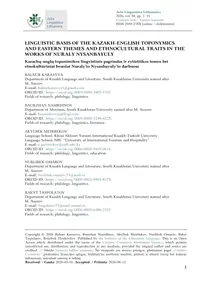
Linguistic Basis of the Kazakh-English Toponymics and Eastern Themes and Ethnocultural Traits in the Works of Nuraly Nisanbayuly
Nuraly Nisanbayuly (1858–1931) was a prominent Kazakh aqyn whose works reflect the transitional cultural and literary processes of the late nineteenth and early twentieth centuries. His dastans represent a valuable source for investigating the ethnocultural foundations of the…
DOI: 10.35321/all94-06
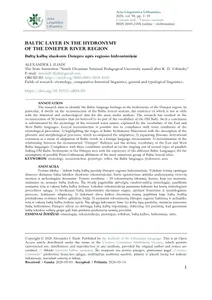
Baltic Layer in the Hydronymy of the Dnieper River Region
The research aims to identify the Baltic language heritage in the hydronymy of the Dnieper region. In particular, it dwells on the reconstruction of the Baltic lexical stratum, the existence of which is not at odds with the historical and archaeological data for the areas under…
DOI: 10.35321/all94-05