Innowacje metodologiczne w badaniach wariantywności językowej
DOI: 10.35321/bkalba.2024.97.11
Browse AI-localized academic documents available in Polish.
2210 documents
DOI: 10.35321/bkalba.2024.97.11
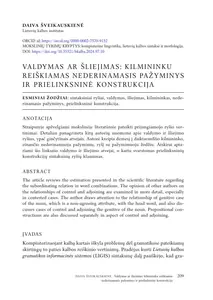
The article reviews the estimation presented in the scientific literature regarding the subordinating relation in word combinations. The opinion of other authors on the relationships of control and adjoining are examined in more detail, especially in contested cases. The author…
DOI: 10.35321/bkalba.2024.97.10
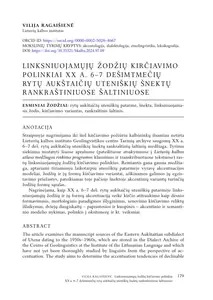
Straipsnyje nagrinėjama iki šiol kirčiavimo požiūriu kalbininkų išsamiau netirta Lietuvių kalbos instituto Geolingvistikos centro Tarmių archyve saugomų XX a. 6–7 deš. rytų aukštaičių uteniškių šnektų rankraštinių šaltinių medžiaga. Tyrimu siekiama nustatyti šiuose aprašuose…
DOI: 10.35321/bkalba.2024.97.09
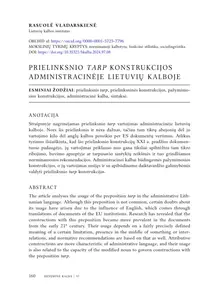
The article analyses the usage of the preposition tarp in the administrative Lithuanian language. Although this preposition is not common, certain doubts about its usage have arisen due to the influence of English, which comes through translations of documents of the EU…
DOI: 10.35321/bkalba.2024.97.08
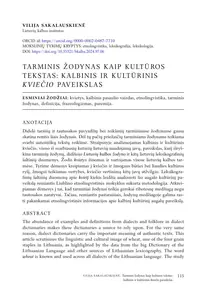
Didelė tarmių ir tautosakos pavyzdžių bei reikšmių tarminiuose žodynuose gausa skatina remtis šiais žodynais. Dėl tų pačių priežasčių tarminiams žodynams teikiama svarbi autentiškų tekstų reikšmė. Straipsnyje analizuojamas kalbinis ir kultūrinis kviečio, vieno iš svarbiausių…
DOI: 10.35321/bkalba.2024.97.06
The aim of the article is to present the folk image of a human based on the plant names used by Gorals from the north-west part of the Podhale region. The material was gathered through informal interviews with inhabitants of nine villages conducted between 2016 and 2017. The…
DOI: 10.35321/bkalba.2024.97.04
Following the methodology of the Lublin School of Ethnolinguistics, the article examines how Lithuanians understand the term cosmopolitanism. The study is based on Lithuanian lexicographic data, material from various texts, and the results of a young people's survey. The aim is…
DOI: 10.35321/bkalba.2024.97.03
Following the methodology of the Lublin School of Ethnolinguistics, the article focuses on the concept of discrimination, examining it in terms of what it means to Lithuanians. The study is based on Lithuanian lexicographic data, material from various texts, and the results of a…
DOI: 10.35321/bkalba.2024.97.02
Tiriant konceptų turinį dėl neapibrėžtų tiriamojo objekto ribų reikia pasitelkti daugiau ir įvairesnės medžiagos, kad būtų atskleista su konceptu siejamos informacijos įvairovė. Atlikus laisvųjų asociacijų eksperimentą išanalizuoti konkrečių leksinių vienetų asociacijų laukai…
DOI: 10.35321/bkalba.2024.97.01
DOI: 10.35321/bkalba.2025.98.09
This article discusses the relationship between oral history and linguistic and cultural studies. The author begins by presenting various definitions and approaches to oral history within these fields of knowledge. He focuses on the definitional and methodological proposals put…
DOI: 10.35321/bkalba.2025.98.08
Straipsnyje aptariamas būdvardžio žingeidus, ‑i ir jo vedinių atitikimas bendrinės lietuvių kalbos normoms. Šis XIX a. atsiradęs žodis jau daugiau nei 120 metų taisomas dėl kilmės, morfologijos ir semantikos, laikomas lietuvių kalbos darybos taisyklių neatitinkančiu vertalu iš…
DOI: 10.35321/bkalba.2025.98.07
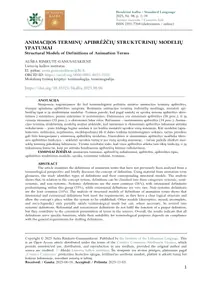
The article examines the definitions of animation terms that have not previously been analysed from a terminological perspective and briefly discusses the concept of definition. Using material from animation term glossaries, the study identifies types of definitions and their…
DOI: 10.35321/bkalba.2025.98.06
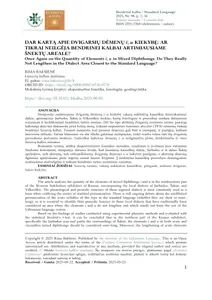
The article analyses the quantity of the elements of mixed diphthongs i and u in the northwestern part of the Western Aukštaitian subdialect of Kaunas, encompassing the local dialects of Jurbarkas, Šakiai, and Vilkaviškis. The phonological and prosodic structure of these…
DOI: 10.35321/bkalba.2025.98.05
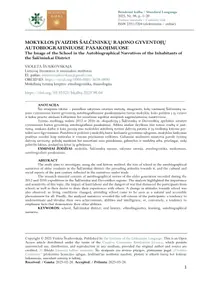
The study aims to investigate, using the oral history method, the role of school in the autobiographical narratives of older residents in the Šalčininkai district, the prevailing attitudes towards it, and the cultural and social aspects of the past century reflected in the…
DOI: 10.35321/bkalba.2025.98.04
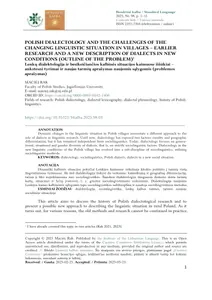
Dynamic changes in the linguistic situation in Polish villages necessitate a different approach to the role of dialects in linguistic research. Until now, dialectology has exposed two factors: rurality and geographic differentiation, but it has remained independent from…
DOI: 10.35321/bkalba.2025.98.03
Kalbos Patarimai (Language Recommendations) classifies parkingas ('parking') as a loanword that should be avoided in standard Lithuanian. Instead, it recommends using the phrase (automobilių) aikštelė ('(car) park') as the normative equivalent. However, language codification…
DOI: 10.35321/bkalba.2025.98.02
Straipsnyje rašoma apie pirmojo lietuviško psichiatrijos vadovėlio antroponiminius, t. y. iš vardų ir pavardžių kilusius, terminus. Aptariama, kaip antroponimai tampa vientisiniais terminais, kaip pritaikomi prie lietuvių kalbos morfologinės sistemos sudėtinių terminų rūšiniais…
DOI: 10.35321/bkalba.2025.98.01