Choose year range

Research papers localized into Swedish

Browse AI-localized academic documents available in Swedish.

1674 documents

OM BETYDELSEN HOS DEN LITAUISKA PREPOSITIONEN po : ETT KOGNITIVT PERSPEKTIV

Ieva Stasiūnaitė

2026Repository: Lietuvių kalbos institutas

Studies of prepositional meaning are rather prolific in cognitive linguistics. However, the Lithuanian po ‘under’ still relies on intuitive explication rather than corpus-based evidence, reflecting the traditional line of investigation. Thus, the present paper focuses on: (1)…

DOI: 10.35321/all94-10
TENDENSER I DEN MORFOLOGISKA INTEGRATIONEN AV SUBSTANTIV AV SLAVISKT URSPRUNG I K. SIRVYDAS PROMPTUARIUM DICTIONUM POLONICARUM, LATINARUM ET LITUANICARUM

Anželika Smetonienė

2026Repository: Lietuvių kalbos institutas

Straipsnyje tiriama Konstantino Sirvydo 1620 m. žodyne Promptuarium dictionum Polonicarum, Latinarum et Lituanicarum vartojamų slavizmų daiktavardžių morfologinė integracija į lietuvių kalbą, ryšys tarp slavų kalbų žodžių baigmenų bei giminės ir lietuvių kalbos kamienų, į…

DOI: 10.35321/all94-09

Om sydestniska ortnamn i Ludza (Lutsi)-området i östra Lettland (Latgale)

Simonas Noreikis

2026Repository: Lietuvių kalbos institutas

The article investigates Estonian toponyms in the Ludza area of Latvia’s Latgale region. Lutsi Estonians were a group of Estonians who moved to this area in the 17th and 18th centuries and were ultimately assimilated into the local population in the 20th century. The sources of…

DOI: 10.35321/all94-07

Den språkliga grunden för kazakisk-engelsk toponomastik samt österländska teman och etnokulturella drag i Nuraly Nisanbayulys verk

Balnur Karayeva · Baurzhan Nasirdinov · Akylbek Meirbekov + 3 authors

2026Repository: Lietuvių kalbos institutas

Nuraly Nisanbayuly (1858–1931) was a prominent Kazakh aqyn whose works reflect the transitional cultural and literary processes of the late nineteenth and early twentieth centuries. His dastans represent a valuable source for investigating the ethnocultural foundations of the…

DOI: 10.35321/all94-06

BALTISKT SKIKT I HYDRONYMIN FÖR DNIEPROFLODENS REGION

Alexander I. Iliadi

2026Repository: Lietuvių kalbos institutas

The research aims to identify the Baltic language heritage in the hydronymy of the Dnieper region. In particular, it dwells on the reconstruction of the Baltic lexical stratum, the existence of which is not at odds with the historical and archaeological data for the areas under…

DOI: 10.35321/all94-05

ONOMASTISK TERMINOLOGI: MELLAN SYSTEMATISK STRINGENS OCH OHÄMMAD SPRIDNING

Artur Gałkowski

2026Repository: Lietuvių kalbos institutas

This article examines contemporary onomastic terminology, focusing on the coexistence of systematic coherence and increasing terminological proliferation. It analyses the linguistic strategies underlying the formation of traditional and emerging (meta)onomastic terms…

DOI: 10.35321/all94-04

ÖSTBALTISKA ”SVÄRFAR” OCH ”SVÄRMÖDRAR”

Václav Blažek

2026Repository: Lietuvių kalbos institutas

The present contribution studies the Baltic kinship terminology, focusing on terms related to “parents-in-law”. Among them, one term is not transparent from the point of view of internal structure, nor etymology: Lithuanian m. úošvis ‘father-in-law, husband’s father’, f. úošvė…

DOI: 10.35321/all94-02

BEGREPPEN ”TID” OCH ”RUM” SOM EN REPRESENTATION AV MÄNSKLIG EXISTENS I KAZAKISK FILOSOFI OCH KAZAKISKA

Dinara Abitay · Saken Nurkabekuly · Assel Kukenova + 3 authors

2026Repository: Lietuvių kalbos institutas

The present article aims to examine the concepts of “time” and “space” as representations of human existence in Kazakh thought and language. The study employs an associative experiment as the primary empirical method, complemented by statistical and linguistic analyses based on…

DOI: 10.35321/all94-01

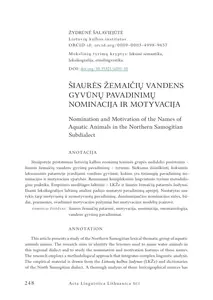
NOMINATION OCH MOTIVATION HOS NAMN PÅ VATTENDJUR I DEN NORDSAMOGITISKA SUBDIALEKTEN

Žydrūnė Šalaviejūtė

2024Repository: Lietuvių kalbos institutas

Straipsnyje pristatomas lietuvių kalbos zoonimų teminės grupės nedidelio posistemio – šiaurės žemaičių vandens gyvūnų pavadinimų – tyrimas. Siekiama išsiaiškinti, kokiomis leksemomis patarmėje įvardijami vandens gyvūnai, kokios yra tiriamųjų pavadinimų nominacijos ir motyvacijos…

DOI: 10.35321/all91-10

Om överensstämmelsen mellan ”Pamoksło Isz Prisakimu Diewa” [...] (1797), nedtecknad av Kiprijonas Lukauskas, och Karol Fabianis ”Missyi Apostolskiey Część II” (1783)

Jūratė Pajėdienė

2022Repository: Lietuvių kalbos institutas

Straipsnyje aptariama iki šiol originalios kilmės darbu laikytų Kiprijono Lukausko (1757–1815) Pamokslų (Karaciejus, par., 1996) struktūra ir paaiškėjusi dalies šio rankraščio tekstų turinio autorystė. Pagrindinės šio rankraščio dalies, turinčios antraštę Pamoksłas Isz Prisakimu…

DOI: 10.35321/all86-02

OM POLYSEMIBILDNING HOS MEDICINSKA TERMER FRÅN SLUTET AV 1800-TALET – BÖRJAN AV 1900-TALET

Palmira Zemlevičiūtė

2020Repository: Lietuvių kalbos institutas

Straipsnyje aptariami daugiareikšmiai medicinos terminai, kuriuos vartojo lietuviai gydytojai XIX a. pab. – XX a. pr. populiarinamuosiuose tekstuose medicinos ir sveikatos klausimais. Kalbamųjų terminų tiriamojo laikotarpio medicinos terminijoje nedaug. Skirtingos tokių terminų…

DOI: 10.35321/all83-05

SEMANTISKA OPPOSITIONER I TOPONYMER I VILNIUS LÄN

Pavel Skorupa

2019Repository: Lietuvių kalbos institutas

The current paper deals with (semantic) oppositions in the present-day Vilnius County toponyms (both settlement and non-settlement names). Although the traditional research into Lithuanian toponymy, esp. hydronymy, points out antonymic semantic relationships in certain place…

DOI: 10.35321/all81-06