
This journal is ©The Royal Society of Chemistry 2015 Chem. Commun., 2015, 51, 2907--2910 | 2907
Cite this: Chem. Commun., 2015,
51, 2907
Photoresponsive self-assemblies based on fatty
acids†
A.-L. Fameau,*
a
A. Arnould,
a
M. Lehmann
b
and R. von Klitzing*
b
Photoresponsive surfactant system based on fatty acids has been
developed by the introduction in aqueous solution of a photoacid
generator (PAG). Self-assembly transitions are triggered by UV
irradiation due to a pH change induced by the presence of PAG.
Stimuli-responsive soft materials are on the leading edge of
Materials Science and they have been recently the focus of
many studies.
1
Surfactants are frequently used in Materials
Science to produce self-assembly structures from nanometer to
micrometer length scales. Stimuli-responsive surfactants and
their potential applications have been described in two recent
reviews.
2,3
This exciting field of research has both economic
and environmental implications for reducing surfactant usage,
waste, process remediation costs and for developing new drug
delivery systems, new soft-materials, etc. The surfactant mole-
cular structure can be tuned in a predictive and controllable
way either by changes in environmental conditions (pH, ionic
strength, etc.) or by the application of an external stimulus
(temperature, light, magnetic and electric field).
3
The changes
occurring in the molecular structure of the surfactant can tune
the self-assembly structure by modifying the packing parameter
in solution and the interfacial activity, which can in turn affect
various macroscopic properties such as viscosity, foam and
emulsion stability.
4
Light as stimulus to trigger surfactant self-assemblies tran-
sitions displays many advantages over other external stimuli.
Light is a non-invasive trigger and avoid direct contact with
the sample. Moreover, light can be remotely and accurately
controlled with micrometer scale resolution.
5
There are two
ways to design photo-responsive surfactant systems, either by
the introduction of a responsive component into the surfactant
solution or by the introduction of a responsive group on the
surfactant molecule. Surfactants with incorporated photo-
active groups, either in the headgroup or the hydrophobic
chain, undergo reversible changes in conformation under UV
or visible light illumination.
3
Appropriate photo-active groups
include azobenzene, stilbene and spiropyran. Up to date, most
of these photoresponsive surfactants are not commercially
available. Their synthesis demands skills in organic chemistry,
expensive synthetic methodologies are needed and the actual
yield is relatively low.
3
There is a need for simpler low-cost
approaches to design photoresponsive surfactant systems by
adding a photoresponsive component into the surfactant
solution and by using molecules that are readily available.
For example, fatty acids are anionic surfactants with many
advantages due to their availability in large amount in nature
and their biocompatibility.
6
Fatty acids are a simple class of
pH-responsive surfactants.
4
Fatty acids are molecules with an
aliphatic tail and a polar headgroup, which can be protonated
(–COOH) or deprotonated (–COO
).
4
The pH of the aqueous
medium tunes the degree of ionization between the protonated
and deprotonated state, which modifies in turn the effective
headgroup area and the packing parameter. In the literature,
various examples have shown that by changing the ratio
between the two forms, it is possible to produce a wide range
of fatty acid self-assemblies.
4
The most common approach to
tune the pH is to introduce manually additives into the surfac-
tant solutions. Recently, carbon dioxide has been used to tune
the pH of surfactants solution.
7
This method has been applied
successfully to tune fatty acid self-assemblies based on erucic
acid molecules in aqueous medium from wormlike micelles to
spherical micelles.
8
However, to the best of our knowledge,
there is no example in the literature dealing with the light as a
trigger to tune self-assemblies based on fatty acid molecules.
Our approach to achieve photoresponsive self-assemblies based
on fatty acid molecules as surfactants was to combine fatty acid
self-assemblies with a photoacid generator (PAG) in solution.
PAGs are commercially available molecules, relatively inexpensive
a
UR1268 Biopolyme
`res Interactions Assemblages Institut National de la Recherche
Agronomique, rue de la Ge
´raudie
`re, F-44316 Nantes, France.
E-mail: anne-la[email protected]
b
Stranski-Laboratorium fu
¨r Physikalische und Theoretische Chemie,
Institut fu
¨r Chemie, TU Berlin, Strasse des 17. Juni 124, 10623 Berlin, Germany.
E-mail: klitzin[email protected]
†Electronic supplementary information (ESI) available. See DOI: 10.1039/
c4cc09842k
Received 9th December 2014,
Accepted 8th January 2015
DOI: 10.1039/c4cc09842k
www.rsc.org/chemcomm
ChemComm
COMMUNICATION
Published on 09 January 2015. Downloaded by TU Berlin - Universitaetsbibl on 15/06/2017 11:11:33.
View Article Online
View Journal
| View Issue
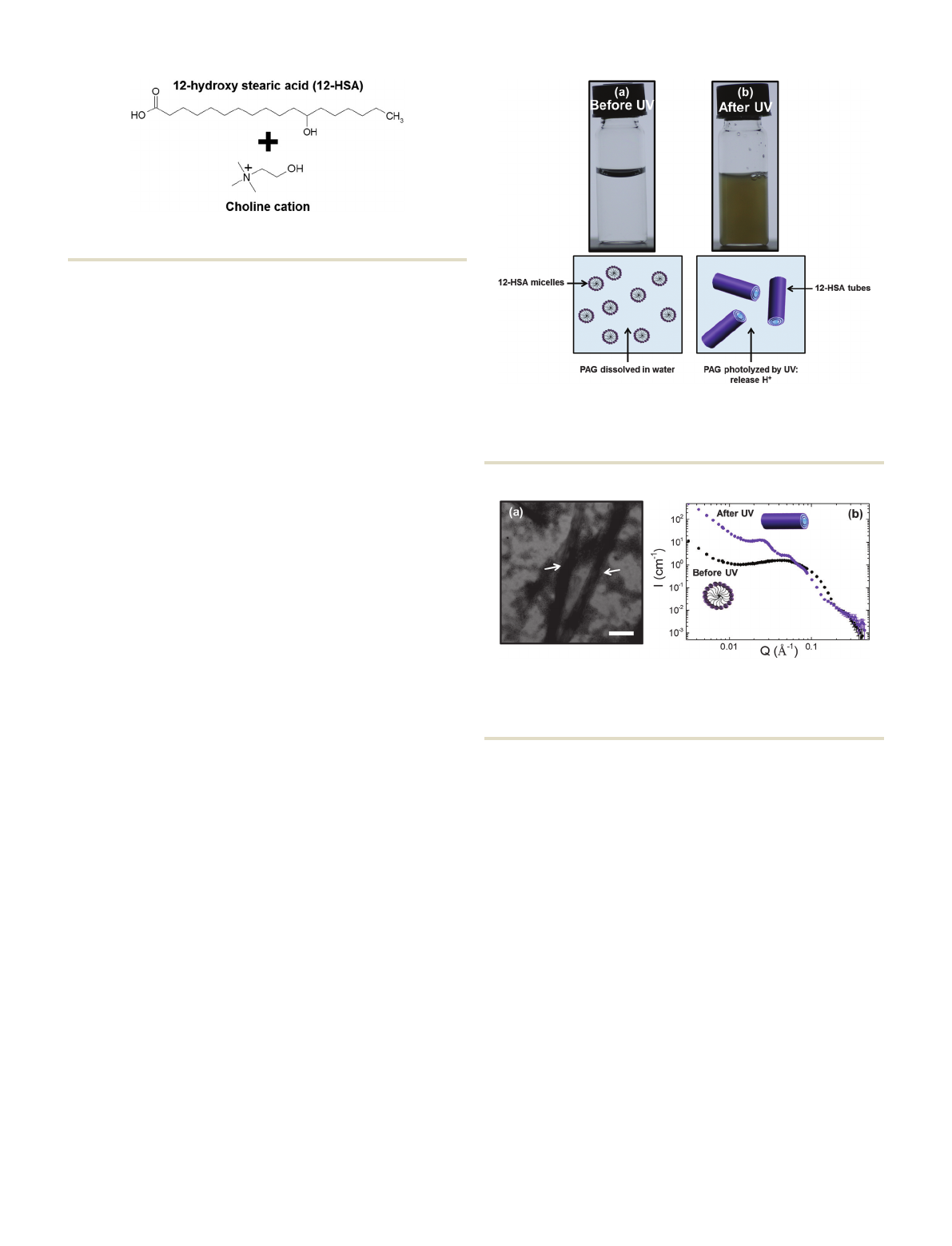
2908 |Chem. Commun., 2015, 51, 2907--2910 This journal is ©The Royal Society of Chemistry 2015
and they get photolyzed by UV light.
9–11
The photolysis of the PAG
in aqueous solution results in the generation of an acid and
causes a pH decrease. The photolysis of PAG has already been
used to produce photogelling colloidal dispersions,
9,10,12
to
induce the hydrogelation of dipeptide
11
and to produce photo-
responsive polyacrylamide hydrogel.
13
Here,wereporthowtheUV
light can control the structural fatty acid self-assemblies transi-
tions in solution by using a PAG as photoresponsive component,
which tunes the ratio between the protonated/deprotonated states
of the carboxylic acid.
To show the proof-of-concept of our approach, we used the
12-hydroxystearic acid (12-HSA) as model fatty acid system
(Fig. 1). The 12-HSA is an inexpensive molecular surfactant
available in large quantities and at low cost, derived by the
hydrogenation of a sustainable material – ricinoleic acid from
castor plants. This long chain fatty acid is insoluble in water at
room temperature. To disperse it, soluble organic counter-ions
can be used.
14
Choline, a quaternary ammonium ion, is a
counter-ion of biological origin, which is known to disperse
long chain fatty acids in water at room temperature (Fig. 1).
15,16
The corresponding fatty acid dispersions are considered to be
highly biocompatible.
17,18
For our study, the 12-HSA concentration was 8 g L
1
. The
molar ratio between the choline hydroxide and 12-HSA was
fixed at 1.6 in order to have all the 12-HSA molecules in their
deprotonated state. In these conditions at 25 1C, the 12-HSA
solution appeared limpid and the pH was around 12.3.
Spherical micelles with a diameter of 4.4 nm were present in
aqueous solution as determined by Small-Angle Neutron scat-
tering (SANS) experiments (Fig. S1, ESI†). Then, PAG (diphenyl-
iodonium nitrate) was added to the 12-HSA solution to reach a
PAG concentration of 10 mM. The PAG used in this study has a
relatively high solubility in water.
11
The addition of PAG had no
effect on dispersion stability. The 12-HSA solution remained
limpid after the PAG addition but a slight buffering effect was
observed as the pH of the solution slightly dropped around 12
(Fig. 2a). Spherical micelles with a diameter of 4.4 nm were still
present in solution after adding PAG (Fig. 3b). The 12-HSA
solution was then UV irradiated for approximately 12 hours.
After UV irradiation, the 12-HSA solution had a slight brown
color and was turbid (Fig. 2b). For the control sample without
PAG, nothing happened under UV irradiation; the 12-HSA
solution remained limpid. By adding PAG, the pH decreased
of 2.5 units under UV irradiation leading to changes in turbidity
and color detectable by visual inspection (Fig. 2).
We performed Fourier-transform infrared (FT-IR) spectroscopy
measurements in order to determine what happened in the
molecular scale due to the irradiation process. We compared
the FT-IR spectra obtained before and after UV irradiation (Fig. S2,
ESI†). Before UV irradiation, a peak at 1575 cm
1
, corresponding
to antisymmetric stretching mode of –COO
,waspresent.
19
Almost all the 12-HSA molecules were present in their deproto-
nated form (–COO
). After UV irradiation, a second peak appeared
at 1700 cm
1
, which corresponds to the characteristic bands of
–COOH (protonated form).
19
The peak at 1575 cm
1
was still
present and the wavenumbers at which the peak appears
was slightly shifted from 1575 cm
1
before UV irradiation to
1565 cm
1
after UV irradiation. In the literature, this shift is
attributed to the formation of hydrogen bonds.
19
After UV irradia-
tion, the 12-HSA molecules existed in two distinct forms: proto-
nated (–COOH) and deprotonated (–COO
). Upon UV irradiation,
the PAG dissociated to release H
+
ions, which reacted with the
deprotonated fatty acid molecules to form carboxylic acid.
To determine how this change at the molecular scale
affected the self-assembly, we observed the structure of the
Fig. 1 Chemical structures of the 12-hydroxystearic acid (12-HSA) and
the choline cation.
Fig. 2 Schematic and visual depiction of UV-induced self-assembly
transitions. The 12-HSA–choline mixture is combined with 10 mM of a
photoacid generator (PAG). Photographs of the sample (a) before UV
irradiation and (b) after 12 hours of UV irradiation.
Fig. 3 (a) TEM images of the solution after UV irradiation containing
12-HSA micron-size tubes. The scale bar represents 500 nm. (b) SANS
scattering spectra of the 12-HSA–choline mixture with PAG before UV
irradiation (black) and after 12 hours of UV irradiation (purple).
Communication ChemComm
Published on 09 January 2015. Downloaded by TU Berlin - Universitaetsbibl on 15/06/2017 11:11:33.
View Article Online

This journal is ©The Royal Society of Chemistry 2015 Chem. Commun., 2015, 51, 2907--2910 | 2909
self-assemblies by performing Transmission Electronic Micro-
scopy (TEM) measurements. After UV irradiation tubes of
several micrometers in length with an outer diameter of around
250 nm were present in solution (Fig. 3a). To gain insight into
the structure of these micron-size tubes at the microscopic
scale, we used SANS experiments. We recorded the scattering
spectrum after UV irradiation at 25 1C (Fig. 3b). The scattering
spectrum displayed a strong small-angle scattering signal and
two sharp peaks exactly in a ratio 1 :2 (Q
0
,2Q
0
) could be
identified. Those peaks indicated the presence of periodically
stacked bilayers separated by water layers. These tubes were
formed by multilamellar arrangement of fatty acid bilayers.
20
We determined that the bilayer thickness was around 4 nm
(Fig. S3, ESI†). The lamellar spacing was determined by the
position of the first sharp peak 2p/Q
0
= 24 nm.
21
By coupling
the information obtained by TEM and SANS, we concluded that
after UV irradiation micron-size multilamellar tubes were
formed and their walls consisted of concentric stacked bilayers
of fatty acid, each separated by a layer of water.
Based on the macroscopic behavior and microstructural
characterization, we propose the following mechanism. Before
UV irradiation, the 12-HSA are present under spherical micelles
since all the 12-HSA molecules are deprotonated leading to a
high headgroup area, which results to a low packing parameter
(Fig. 2). By applying UV irradiation, the PAG get photolyzed and
generate acid inducing a progressive pH decrease (Fig. 2). The
change of pH occurring during UV irradiation leads to the
protonation of some fatty acids under deprotonated form
(–COO
) to produce carboxylic group (–COOH). When the two
forms (protonated and deprotonated) coexist, hydrogen bond-
ing formation occurs which reduces the headgroup area,
leading to change of packing parameter to higher values and
in turn to a change of self-assembly toward micron-size multi-
lamellar tubes based on bilayer structures. It is important to
point out that this self-assemblies transition can be obtained
for a wide range of UV irradiation time by simply tuning the
12-HSA and PAG concentration.
In the literature, temperature is known to affect the fatty
acid self-assembled structure due to the chain melting process
occurring in the bilayers. During this transition, the hydrocar-
bon chains of fatty acids lose their ordered crystalline state to
gain a disordered liquid crystal state.
14
We studied the effect of
the temperature on these tubes produced by UV irradiation.
These micron-size tubes were present in solution until 60 1C,
a temperature at which spherical micelles were present in solution
asdeterminedbySANS(Fig.S4a,ESI†). By cooling down to 25 1C,
tubeswerereformedinsolutionwithexactlythesamestructureas
previously(Fig.S4b,ESI†). Then, in our system, the 12-HSA tubes
transit reversibly around 60 1C under spherical micelles due to the
chain melting process.
4
Spherical micelles could be recovered
reversibly by increasing the temperature.
Finally, we showed a potential application for this photo-
responsive system by demonstrating how the UV-induce change
in the self-assembled structure can tune the macroscopic
properties such as foaming properties. When self-assembled
structures and particles are blocked inside the foam liquid
channels, they can lead to an increase of the foam stability.
22–24
Fatty acids are surfactants known to easily produce aqueous
foams.
25
The foam stability depends mainly on the size of the
self-assembled structures present in the foam liquid channels
between the bubbles.
26
We studied the foaming properties of
the solution before and after 12 hours of UV irradiation. We
produced the foam by hand-shaking and we recorded by visual
inspection the evolution of the foam volume with time. In the
two cases, the foamability was high: a high quantity of foams
was easily obtained (Fig. 4a–d).
The foam produced with the solution before UV irradiation
containing spherical micelles was very unstable (Fig. 4b and c).
After ten minutes, almost all the foam disappeared. For the
foam produced from the solution after 12 hours of UV irradia-
tion containing micron-size tubes, the foam stability was very
high: after one week of conservation of the foam at room
temperature, the foam volume remained constant and the
appearance of the foam did not change (Fig. 4d and e). The
micron-size tubes were blocked inside the foam liquid channels
leading to the foam stabilization in contrary to the nanometric
spherical micelles.
25
By applying UV irradiation to the solution
just before foam production, the foam stability can be drasti-
cally changed from unstable to stable state due to the change
of self-assemblies occurring in bulk from nanometric to
micron-size. This example perfectly illustrates how the changes
occurring in the molecular structure of the surfactant under
stimuli, which tune the self-assembly structure in bulk, can in
turn affect various macroscopic properties such as foaming
properties.
We demonstrated that light can be used as a trigger to actuate
the fatty acid self-assembly transitions simply by the introduc-
tion of PAG in aqueous solution. The mechanism is based on the
pH change induced by UV irradiation due to the presence of
PAG. This method provides a new simple approach to produce
photoresponsive surfactant systems. In comparison to other
photoresponsive surfactant systems, the current one is easier
prepared because it can be formed by simply changing pH value
of environment-friendly fatty acid dispersions without the need
of complex organic synthesis. This approach should be generally
applicable to other commercially available surfactants with a
Fig. 4 Photographs of foams produced from 12-HSA–choline dispersion
in the presence of PAG after different period of time at room temperature.
(a–c) Foam produced from the solution before UV irradiation. (d and e)
Foam produced from the solution obtained after 12 hours of UV irradiation.
ChemComm Communication
Published on 09 January 2015. Downloaded by TU Berlin - Universitaetsbibl on 15/06/2017 11:11:33.
View Article Online

2910 |Chem. Commun., 2015, 51, 2907--2910 This journal is ©The Royal Society of Chemistry 2015
pH-sensitive headgroup. The remarkable simplicity of this
approach is an asset for potential applications in various fields
in which stimuli-responsive systems are needed.
Dr Fameau has received the support of the European Union,
in the framework of the Marie-Curie FP7 COFUND People
Programme, through the award of an AgreenSkills’ fellowship
(under grant agreement no. 267196). A. Arnould would like to
thank the region Pays de la Loire and l’INRA for the allocation of
her PhD grant. We acknowledge the experimental assistance of
B. Houinsou-Houssou. We thank the Laboratoire Le
´on Brillouin
for the beam time allocation on the spectrometer PACE.
Notes and references
1 F. D. Jochum and P. Theato, Chem. Soc. Rev., 2013, 42, 7468–7483.
2 S. Song, A. Song and J. Hao, RSC Adv., 2014, 4, 41864–41875.
3 P. Brown, C. P. Butts and J. Eastoe, Soft Matter, 2013, 9, 2365–2374.
4 A.-L. Fameau, A. Arnould and A. Saint-Jalmes, Curr. Opin. Colloid
Interface Sci., 2014, 19, 471–479.
5 Z. Chu, C. A. Dreiss and Y. Feng, Chem. Soc. Rev., 2013, 42,
7174–7203.
6 I. Johansson and M. Svensson, Curr. Opin. Colloid Interface Sci.,
2001, 6, 178–188.
7 Y. Liu, P. G. Jessop, M. Cunningham, C. A. Eckert and C. L. Liotta,
Science, 2006, 313, 958–960.
8 Y. Zhang, H. Yin and Y. Feng, Green Mater., 2014, 2, 95–103.
9 V. Javvaji, A. G. Baradwaj, G. F. Payne and S. R. Raghavan, Langmuir,
2011, 27, 12591–12596.
10 K. Sun, R. Kumar, D. E. Falvey and S. R. Raghavan, J. Am. Chem. Soc.,
2009, 131, 7135–7141.
11 J. Raeburn, T. O. McDonald and D. J. Adams, Chem. Commun., 2012,
48, 9355–9357.
12 L. Liu, F. Wu, X.-J. Ju, R. Xie, W. Wang, C. H. Niu and L.-Y. Chu,
J. Colloid Interface Sci., 2013, 404, 85–90.
13 E. M. White, J. E. Seppala, P. M. Rushworth, B. W. Ritchie, S. Sharma
and J. Locklin, Macromolecules, 2013, 46, 8882–8887.
14 A.-L.FameauandT.Zemb,Adv. Colloid Interface Sci., 2014, 207,43–64.
15 R. Klein, M. Kellermeier, M. Drechsler, D. Touraud and W. Kunz,
Colloids Surf., A, 2009, 338, 129–134.
16 R. Klein, D. Touraud and W. Kunz, Green Chem., 2008, 10, 433–435.
17 R. Klein, E. Mu
¨ller, B. Kraus, G. Brunner, B. Estrine, D. Touraud,
J. Heilmann, M. Kellermeier and W. Kunz, RSC Adv., 2013, 3,
23347–23354.
18 Y. Han, Z. Chu, H. Sun, Z. Li and Y. Feng, RSC Adv., 2012, 2, 3396–3402.
19 S. Song, Q. Zheng, A. Song and J. Hao, Langmuir, 2011, 28, 219–226.
20 A.-L. Fameau, F. Cousin, L. Navailles, F. d. r. Nallet, F. o. Boue
´and
J.-P. Douliez, J. Phys. Chem. B, 2011, 115, 9033–9039.
21 J. P. Douliez, C. Gaillard, L. Navailles and F. Nallet, Langmuir, 2006,
22, 2942–2945.
22 A. Stocco, F. Garcia-Moreno, I. Manke, J. Banhart and D. Langevin,
Soft Matter, 2011, 7, 631–637.
23 L. K. Shrestha, K. Aramaki, H. Kato, Y. Takase and H. Kunieda,
Langmuir, 2006, 22, 8337–8345.
24 D. Varade, D. Carriere, L. R. Arriaga, A. L. Fameau, E. Rio,
D. Langevin and W. Drenckhan, Soft Matter, 2011, 7, 6557–6570.
25 A.-L. Fameau, A. Saint-Jalmes, F. Cousin, B. H. Houssou, B. Novales,
L. Navailles, F. Nallet, C. Gaillard, F. Boue and J.-P. Douliez, Angew.
Chem., Int. Ed., 2011, 50, 8264–8269.
26 A.-L. Fameau, A. Carl, A. Saint-Jalmes and R. von Klitzing, Chem-
PhysChem, 2015, 16, 66–75.
Communication ChemComm
Published on 09 January 2015. Downloaded by TU Berlin - Universitaetsbibl on 15/06/2017 11:11:33.
View Article Online
Loading more pages...