
RESEARCH ARTICLE
Linking environmental management and employees'
organizational identification: The mediating role of
environmental attitude
Hans Jaich
Faculty of Economics and Management,
Technische Universität Berlin, Berlin, Germany
Correspondence
Hans Jaich, Faculty of Economics and
Management, Technische Universität Berlin,
Straße des 17. Juni 135 D-10623 Berlin,
Germany.
Email: [email protected]
Abstract
The fundamental research question in the present study is whether perceived envi-
ronmental management practices relate to employees' organizational identification.
Specifically, it is hypothesized that this relationship is mediated by employees' envi-
ronmental attitudes. The corresponding research model adopts a multi-theoretical
approach that combines two different theoretical lenses. Goal-framing theory is
introduced to predict whether perceived environmental management practices affect
employees' environmental attitudes, while green-person-organization fit is applied to
explain the relationship between employees' environmental attitudes and organiza-
tional identification. The research model was tested using a cross-sectional research
design with data from 206 employees from tourist service companies in Germany.
The results, which largely support the research model, shed light on a thus far
unexplored mechanism that mediates individual reactions to organizational practices
and contrasts the more established proposition that employees first identify with
their organization before they develop attitudes that are in accordance with
corresponding ingroup norms. Implications for both research and practice are
discussed.
KEYWORDS
corporate sustainability, environmental management, goal-framing theory, green-person-
organization fit, micro-CSR, organizational identification
1|INTRODUCTION
Due to growing stakeholder demands for environmental friendliness,
organizations are increasingly implementing environmental manage-
ment practices (EMP) (Sarkis, Gonzalez-Torre, & Adenso-Diaz, 2010;
Babiak & Trendafilova, 2011; Helmig, Spraul, & Ingenhoff, 2016;
Salim, Padfield, Hansen, Mohamad, Yuzir, et al., 2018). A growing
body of corporate greening and operational management literature
reflects this development. Investigations in this research stream
consider how EMP relate to firm-level outcomes, such as corporate or
environmental performance (Bacinello, Tontini, & Alberton, 2021; Latan,
Jabbour, de Sousa Jabbour, Wamba, & Shahbaz, 2018; Longoni,
Luzzini, & Guerci, 2018; Lundgren & Zhou, 2017; Pereira-Moliner,
Claver-Cortés, Molina-Azorín, & Tarí, 2012; Song, Zhao, & Zeng, 2017;
Wagner, 2007; Zhang & Ouyang, 2021), innovations (Hamdoun,
Jabbour, & Othman, 2018; Wagner, 2008; Wu, Liang, & Zhang, 2020), or
competitiveness (Lannelongue, Gonzalez-Benito, & Quiroz, 2017; Molina-
Azorín, Tarí, Pereira-Moliner, Lopez-Gamero, & Pertusa-Ortega, 2015;
Received: 12 March 2021 Revised: 25 July 2021 Accepted: 9 August 2021
DOI: 10.1002/csr.2201
This is an open access article under the terms of the Creative Commons Attribution License, which permits use, distribution and reproduction in any medium,
provided the original work is properly cited.
© 2021 The Author. Corporate Social Responsibility and Environmental Management published by ERP Environment and John Wiley & Sons Ltd.
Corp Soc Responsib Environ Manag. 2022;29:305–315. wileyonlinelibrary.com/journal/csr 305

Yang, Lin, Chan, & Sheu, 2010). Less attention has been paid to
intra-organizational processes and factors at the individual level
(Andersson, Jackson, & Russell, 2013; Yoon, Jang, & Lee, 2016). A lit-
erature review found no specific investigations into the relationship
between EMP and employees' organizational identification (OI), which
refers to a “perceived oneness with an organization and the experi-
ence of the organization's successes and failures as one's own”
(Mael & Ashforth, 1992, p. 103). This is surprising as OI is an impor-
tant factor for different employee level outcomes, and accordingly is
a topic that frequently gains attention from organizational scholars
(Albert, Ashforth, & Dutton, 2000; Glavas & Godwin, 2013). In this
context, investigations have shown that OI is positively associated
with employee job satisfaction (De Roeck, Marique, Stinglhamber, &
Swaen, 2014; Van Dick, Wagner, Stellmacher, & Christ, 2004), orga-
nizational citizenship behavior (Dukerich, Golden, & Shortell, 2002;
Farooq, Payaud, Merunka, & Valette-Florence, 2014), or an inten-
tion to stay (Cole & Bruch, 2006; Jones, 2010). Furthermore,
institutional theorists increasingly incorporate the concept of OI
into their work. OI is perceived as a critical source of agency
(Dejordy & Creed, 2016; Greenwood, Raynard, Kodeih, Micelotta, &
Lounsbury, 2011), intentionality (King, Felin, & Whetten, 2010), or
resistance to institutional pressure (Schilke, 2018). However, recent
research indicates that OI can also lead to lower performance, nega-
tive emotions, or reduced well-being (Conroy, Henle, Shore, &
Stelman, 2017).
Against this background, scholars have addressed the question of
which factors and mechanisms influence OI. Much of this research
focuses on corporate social responsibility (CSR) as an important driver
of OI (De Roeck, El Akremi, & Swaen, 2016; Glavas & Godwin, 2013;
Jones, 2010; Shah, Cheema, Al-Ghazali, Ali, & Rafiq, 2021). However,
the work of El Akremi, Gond, Swaen, De Roeck, and Igalens (2018)
revealed that employees perceive CSR not as a unidimensional con-
struct but rather as discrete practices (including EMP) that address dif-
ferent stakeholders. Practices that target different stakeholders in
turn influence OI to a certain degree via different mechanisms
(De Roeck & Maon, 2018; Farooq et al., 2014; Farooq, Rupp, &
Farooq, 2017). Unlike multidimensional stakeholder-based CSR con-
structs (El Akremi et al., 2018; Turker, 2009), EMP only comprises
practices targeted at a single stakeholder—the natural environment
(Cramer, 1998; El Akremi et al., 2018). Since individuals' attention
within an organizational context is cognitively ordered around percep-
tions of distinct stakeholder groups (Bundy, Shropshire, &
Buchholtz, 2013), employees perceive EMP as a unidimensional con-
struct that comprises a coherent set of practices (Rasmus &
Steger, 2000). The utilization of a construct with less facets or dimen-
sions can in turn increase the analytical precision of investigations into
the underlying mechanisms that mediate the relation between CSR
practices and OI (Farooq et al., 2017) and mitigate the risk of con-
founding effects (Jones & Rupp, 2017).
Based on this reasoning, the fundamental research question in
the present study is whether EMP relates to OI. It is expected that an
analytical focus on EMP as an antecedent to OI will deliver insights
into a thus far overlooked mechanism. Specifically, it is hypothesized
that the positive relationship between EMP and OI is mediated by
employees' environmental attitude (EA). The corresponding research
model adopts a multi-theoretical approach that combines two differ-
ent theoretical lenses. Goal-framing theory (Lindenberg & Foss, 2011;
Steg, Lindenberg, & Keizer, 2015) is introduced to predict that per-
ceived EMP affects employees' EA. Green-person-organization fit
(Hicklenton, Hine, & Loi, 2019) in turn is applied to explain the rela-
tionship between employees' EA and OI. The model is tested using a
cross-sectional, quantitative research design. All participants (n=206)
were employees of tourist service companies in Germany. The tourist
service sector is especially suitable for research on EMP since work
duties in this industry are not particularly specialized and those EMP
that do not rely on special technical requirements are similar across
different industries (Gil, Jiménez, & Lorente, 2001). Thus, it can be
assumed that the results of this study are transferable to other
industries.
This study contributes to the literature in several ways and has
practical implications. It broadens the agenda of research on EMP by
examining relations at the employee level. Such microlevel investiga-
tions deepen our understanding of the underlying psychological pro-
cesses that mediate individual reactions to practices at the
organizational level (Gond, El Akremi, Swaen, & Babu, 2017). By
empirically illustrating the links between EMP, EA and OI, this study
sheds light on a thus far unexplored mechanism across levels of
analysis.
Since EMP overlap with practices that are conceptualized as
external CSR (De Roeck & Maon, 2018; Farooq et al., 2017), CSR
directed at nonsocial stakeholders (Turker, 2009) or CSR directed at
the ecological environment (El Akremi et al., 2018), the theoretical
and empirical insights from this investigation can also be applied in
the growing field of micro-CSR research (Jones, Newman, Shao, &
Cooke, 2019). The vast majority of previous studies on the underlying
mechanisms that mediate the effects of CSR practices on employees
are guided by either social identity theory (Ashforth & Mael, 1989;
Tajfel & Turner, 1985) or social exchange theory (Blau, 1964;
Cropanzano & Mitchell, 2005). This study introduces a new theoreti-
cal rationale by applying goal-framing theory to explain the relation-
ship between perceived EMP and EA. This enables the
conceptualization of a new mechanism, which contrasts the more
established proposition that employees first identify with their organi-
zation and then develop attitudes that are in accordance with
corresponding ingroup norms (De Roeck & Maon, 2018; Dutton &
Dukerich, 1991; Fielding & Hornsey, 2016). By drawing on psycholog-
ical research, this study proposes a different relationship in which
environmental attitudes mediate between organizational practices
and employees' OI (Byrka, Hartig, & Kaiser, 2010; Cornelissen, Pan-
delaere, Warlop, & Dewitte, 2008; Glasman & Albarracin, 2006; Henn,
Otto, & Kaiser, 2020; Lacasse, 2015).
Further, the results of this investigation are also relevant for prac-
titioners who are responsible for the implementation of EMP in busi-
nesses. Corresponding investments involve both costs and benefits
which, for an effective calculation, must been known. However, the
calculation of the benefits in particular can be difficult due to a lack of
306 JAICH

specific assessment criteria, reference data, or knowledge of the out-
come categories (Alberti, Caini, Calabrese, & Rossi, 2000). This in turn
can result in a potentially misleading evaluation that EMP incur costs
with no feasible benefits (Song et al., 2017). Thus, recent investiga-
tions have been motivated to deepen the understanding of how EMP
affect organizational outcomes (Arda, Bayraktar, & Tatoglu, 2019;
Chen, Ong, & Hsu, 2016; Zhang & Ouyang, 2021). The present study
contributes to these research efforts by shedding light on employee
level outcomes.
The section below provides the theoretical background and
hypotheses and is followed by the methodology and results. Finally,
the implications for research and practice are discussed before the
study's limitations and the opportunities for future investigation are
outlined.
2|THEORETICAL BACKGROUND
2.1 |Goal-framing theory
Goal-framing theory suggests that individuals' cognitive and motiva-
tional processes are shaped by three different types of overarching
goals (Steg et al., 2015). The hedonic goal represents the desire to
improve one's immediate personal wellbeing, the gain goal motivates
individuals to expand their resources, and the normative goal
increases individual sensibility to normative beliefs and appropriate
behavior (Lindenberg & Steg, 2007). The goal frame, defined as the
relatively strongest goal in a given situation, exercises the strongest
influence on individuals' cognitive and motivational processes, mak-
ingthemespeciallysensitivetogoal-related information (Steg
et al., 2015). The strength of personal goals in turn is influenced by
contextual factors (Steg, Bolderdijk, Keizer, & Perlaviciute, 2014).
Within an organizational context, the strategic goals and
corresponding management practices of a firm are important factors
that shape the overarching goals of employees (Foss &
Lindenberg, 2013; Lindenberg & Foss, 2011).
2.2 |Environmental management practices and
environmental attitude
Employees are sensible to signals that reveal the normative beliefs of
management (Lindenberg, 2000). From their perspective, management
practices are examples of normative behavior that illustrate the cor-
rect way to behave (Pache & Santos, 2013; Thornton, 2004). EMP,
the technical and administrative practices aimed at minimizing pol-
luting externalities (Carmona-Moreno, Céspedes-Lorente, & De
Burgos-Jiménez, 2004; Cramer, 1998), correspondingly signal that
the organization cares about the environment (Norton, Zacher, &
Ashkanasy, 2014). The perception of what others approve of or dis-
approve of in turn influences individuals' normative goals and beliefs
(Farrow, Grolleau, & Ibanez, 2017; Keizer, Lindenberg, & Steg, 2013;
Lindenberg & Steg, 2007; Morris, Hong, Chiu, & Liu, 2015; Raineri &
Paillé, 2016). Beliefs about the environment are considered to be a
person's EA (Bamberg, 2003; Hawcroft & Milfont, 2010), which is
defined as a “psychological tendency expressed by evaluating the
natural environment with some degree of favor or disfavor”
(Hawcroft & Milfont, 2010, p. 143).
Research on the activation of and changes in EA has shown that
normative goal strengthening via contextual factors related to envi-
ronmental protection positively affects individuals' EA (Steg &
Vlek, 2009; Thøgersen, 2012). A meta-analysis of Glasman and
Albarracin (2006) revealed that signals related to attitude induce a
higher personal attitude. Recent investigations confirmed this result
by verifying the positive effects of corresponding framing events
(Detenber, Ho, Ong, & Lim, 2018), green media content (Trivedi,
Patel, & Acharya, 2018), experiences with nature (Byrka et al., 2010),
or an involvement in scientific arguments on environmental protection
(Faize & Akhtar, 2020) on people's EA.
As employees' goal, frames at work are subject to a contagion
process by the strategic goals and management practices of the
employing organization (Foss & Lindenberg, 2013), it can be assumed
that EMP affects employees' EA (Pellegrini, Rizzi, & Frey, 2018). The
congruence between employees' EA and a commitment to environ-
mental protection by the employing organization in turn predicts the
green-person-organization fit (Hicklenton et al., 2019).
2.3 |Green-person–organization fit and
organizational identification
The extent to which individual characteristics match the characteris-
tics of a specific situational context is described by the concept of a
Supplementary person–environment fit (Edwards & Shipp, 2007). This
approach is concretized in organizational contexts by a person–
organization fit. This refers to the congruence between an employee's
personal values and beliefs, and the work climate characterized by
management practices and policies (Kristof, 1996). More recent con-
tributions broadened this concept by the extent to which employees'
needs for work-specific resources are satisfied by the employing orga-
nization (Kristof-Brown, Zimmerman, & Johnson, 2005).
A subtype of person–organization fit is green-person–
organization fit, which “assesses the extent to which an organization's
commitment to environmental protection is congruent with its
employees' environmental values”(Hicklenton et al., 2019, p. 2).
Employees with a strong EA care about the environment (Dunlap, Van
Liere, Mertig, & Jones, 2000) and would therefore experience a high
fit with an organization that practices environmental protection
(Hicklenton et al., 2019). A high person–organization fit in turn means
employees feel involved in the overarching organizational mission
(Cable & DeRue, 2002). They perceive themselves as members of a
joint social category (Turner, 1984) and define themselves to a certain
degree in terms of this social category—the employing organization
(Saks & Ashforth, 1997). In line with these thoughts, previous research
has shown that a high person–organization fit relates to OI (Cable &
DeRue, 2002).
JAICH 307

Thus, it can be assumed that employees with a high EA are likely
to identify with their employing organization if that organization actu-
ally practices environmental protection. Perceived EMP in turn are
predicted to relate to employees EA. Accordingly, it is proposed that
the environmental protection of an organization shapes the
employees' attitudinal preconditions for a high OI. Based on this rea-
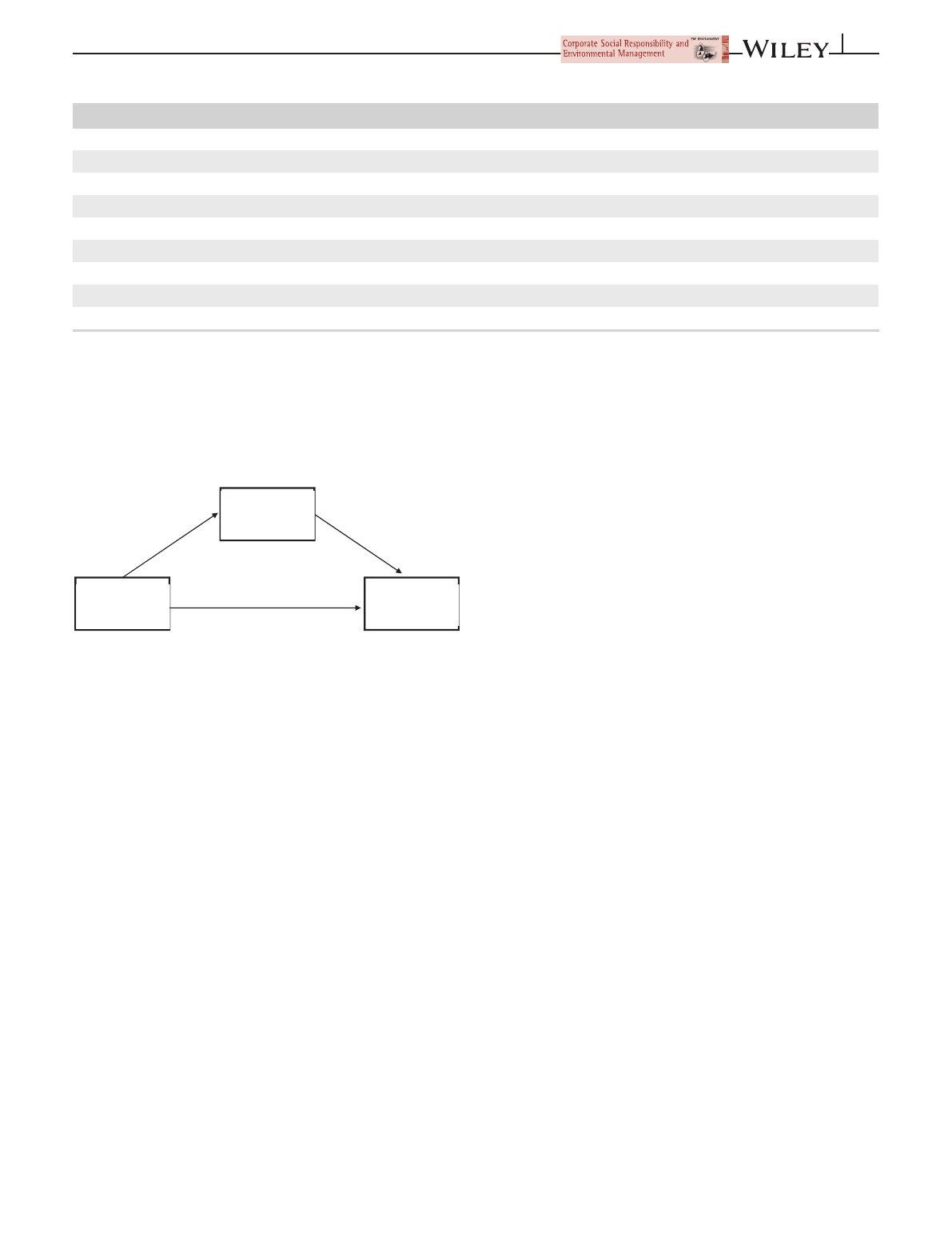
soning, the research model is established as illustrated in Figure 1 and
the following hypotheses are postulated:
H1. Perceived EMP relate to employees' OI.
H2. Employees' EA mediates the positive relationship
between perceived EMP and employees' OI.
3|METHOD
3.1 |Participants and procedure
All participants were employees from tourist service companies in
Germany, including hotels, commercial tourist attractions, and service
agencies. A total of 482 paper-pencil questionnaires were distributed
in the participating organizations. An accompanying letter explained
the purpose of the study without revealing the hypotheses and
assured anonymity and confidentiality. Questionaries were returned
in a sealed envelope that did not reveal the respondents' identity. A
total of 278 participants responded to all items (response rate of
57.7%). As in previous research on the effects of EMP on employees,
only data from subjects who spent a certain amount of time at work
were considered suitable for the study purpose (Norton et al., 2014).
Thus, the data of subjects who worked 10 h or less per week or who
were employed for less than a year were excluded from further analy-
sis, resulting in a final sample of n=206, of which the majority were
female (65.3%). To better preserve the participants' anonymity and
thereby increase the likelihood of unbiased responses (Podsakoff,
MacKenzie, Lee, & Podsakoff, 2003), questionnaires did not require
any specification of exact figures for age, household income, and
duration of employment, but instead used items that reflected a com-
plete range. The mean age was 30–39 years, the mean household
income was €2000–€2500 and the mean duration of employment was
4–6 years.
3.2 |Measures
This study followed the recommendations of Flynn, Sakakibara,
Schroeder, Bates, and Flynn et al. (1990) by strictly employing well-
established measures that have showed high reliability and validity in
previous research (e.g., Rasmus & Steger, 2000; Norton, Zacher, Par-
ker, & Ashkanasy, 2017; Bissing-Olson, Iyer, Fielding, & Zacher, 2013;
Hicklenton et al., 2019; Dunlap et al., 2000; Molina-Azorín et al.,
2008; Teresi, Pietroni, Barattucci, Giannella, & Pagliaro, 2019; De
Roeck et al., 2016). A committee approach with two professional
translators was applied for the translation of the items from English
into German (Sperber, 2004). All items used a five-point Likert-type
response scale from 1 for “strongly disagree”to 5 for “strongly
agree”. A complete list of the items is presented in the Appendix S1.
Perceived EMP was measured using 11 items from the scale of
Rasmus and Steger (2000). Cronbach's alpha was calculated at 0.92.
Sample items were: “Our company gives priority to purchasing eco-
logical products (biodegradable, reusable, recyclable …)”,“Our com-
pany reduces the use of toxic and unsustainable products”, and “Our
company gives priority to utilization of renewable energies like green
electricity”.
The New Ecological Paradigm Scale (Dunlap et al., 2000; Dunlap &
Van Liere, 1978) was used to measure EA. It is one of the most widely
used measures for EA in the field of environmental psychology
(Hawcroft & Milfont, 2010) and has recently been utilized in research
on green-person–organization fit (Hicklenton et al., 2019). As shown
by Milfont (2009), social desirability concerns are not a serious prob-
lem for people's response to the New Ecological Paradigm Scale. In
this study a 10-item version in accordance with the recommendations
of Hawcroft and Milfont (2010) was employed. Cronbach's alpha was
calculated at 0.72. Sample items were: “Plants and animals have as
much right as humans to exist”,“The earth is like a spaceship with
very limited room and resources”, and “The balance of nature is very
delicate and easily upset”.
OI was measured using a six-item scale from Mael and
Ashforth (1992). Cronbach's alpha was calculated at 0.84. Sample
items were: “When someone criticizes our company, it feels like a per-
sonal insult”,“I am very interested in what others think about our
company”, and “Our company's successes are my successes”.
3.3 |Common method variance
Research based on same-source data faces concerns about common
method variance (Conway & Lance, 2010; Podsakoff et al., 2003).
Hence, some scholars employ corresponding post hoc statistical
detection and correction techniques (e.g., Raineri & Paillé, 2016; Far-
ooq et al., 2014; Norton et al., 2014) However, the work of Richard-
son, Simmering, and Sturman (2009) revealed that such statistical
techniques can reduce the accuracy of estimates of relationships and
tend to incorrectly identify the presence of common method variance.
Therefore, the present study followed their recommendation and did
not conduct post hoc statistical techniques. Nevertheless, a priori
Research Model
EMP OI
EA
FIGURE 1 Research model
308 JAICH
procedural precautions to minimize potential common method vari-
ance were employed by assuring the respondents' anonymity and
confidentiality, by utilizing well-established measures, and by avoiding
conceptual overlaps in items of different constructs (Conway &
Lance, 2010; Podsakoff et al., 2003).
4|RESULTS
4.1 |Descriptive statistics and correlations
Table 1 summarizes the descriptive statistics and correlations
between the study variables.
4.2 |Mediation effects
This study hypothesized a positive effect of perceived EMP on
employees' OI. Further, it was predicted that perceived EMP would
have a significant indirect effect on employees' OI via EA. The
corresponding mediation effects were examined using the PROCESS
macro for SPSS developed by Hayes (2018), which uses ordinary least
squares regression analysis to estimate unstandardized coefficients
for all paths, as well as total, direct, and indirect effects. Bootstrapping
with 10,000 iterations, which makes no assumptions about the distri-
butional properties of the sample, was used (Preacher, Rucker, &
Hayes, 2007), yielding bias-corrected 95% confidence intervals for
inferring statistical significance. Mediation results were considered
significant if the confidence intervals did not include zero.
Analyses show that the perceived EMP had a positive effect on
employees' EA, which subsequently predicted employees' OI
(Figure 2). Accordingly, we found that the relationship between per-
ceived EMP and OI is partially mediated by EA, ab =0.050, 95% CI
[0.013, 0.107]. All path coefficients are summarized in Table 2.
5|DISCUSSION
The aim of this study was to examine whether EMP correlates to
OI. Further, it was hypothesized that this relationship is mediated by
employees' EA. A multi-theoretical approach was used to test the
research model. Goal-framing theory (Lindenberg & Foss, 2011; Steg
et al., 2015) was employed to predict that perceived EMP affects
employees' EA and a green-person–organization fit (Hicklenton
et al., 2019) was applied to explain the relationship between
employees' EA and OI. The results of the cross-sectional, quantitative
research design revealed that employees' EA partially mediates the
relationship between perceived EMP and OI. The theoretical and
managerial implications are discussed below.
5.1 |Theoretical implications
In light of exhausted planetary boundaries (Steffen et al., 2015), busi-
nesses are increasingly being held responsible for environmental
TABLE 1 Measures of central tendency, standard deviations, and correlations among study variables
12 3 4 5 6 7
1. Sex
2. Age
a
0.138*
3. Education
a
0.0060 0.154*
4. Household income
a
0.099 0.128 0.076
5. OI 0.037 0.234*** 0.043 0.210**
6. EA 0.107 0.346*** 0.013 0.220** 0.291***
7. EMP 0.114 0.256*** 0.108 0.128 0.269*** 0.234***
M/Mdn –30–39 years completed apprenticeship 2000–2500 Euro 3.870 4.185 3.338
SD –– – – 0.783 0.461 0.887
Note:
a
Ordinal measurement with Spearman rank correlation and median as measure of central tendency. Sex is coded as 0 being female and 1 male.
*
p< 0.05.
**
p< 0.01.
***
p< 0.001.
Mediation Model
EMP OI
0.122***
EA
0.407***
c = 0.238***
c’ = 0.188**
FIGURE 2 Mediation model: employees' EA mediates the
relationship between perceived EMP and employees'
OI. Unstandardized regression coefficients are reported; *p< 0.05,
**p< 0.01, ***p< 0.001
JAICH 309
Loading more pages...