
3rd PLATE Conference
September 18 – 20, 2019
Berlin, Germany
Nils F. Nissen
Melanie Jaeger-Erben (eds.)
Universitätsverlag der TU Berlin
Guzzo, Daniel; Jamsin, Ella; Balkenende, Ruud; Costa, Janaina: The use
of system dynamics to verify long-term behaviour and impacts of
circular business models: a sharing platform in healthcare . In: Nissen,
Nils F.; Jaeger-Erben, Melanie (Eds.): PLATE – Product Lifetimes And The
Environment : Proceedings, 3rd PLATE CONFERENCE, BERLIN, GERMA-
NY, 18 – 20 September 2019. Berlin: Universitätsverlag der TU Berlin, 2021.
pp. 309 – 315. ISBN 978-3-7983-3125-9 (online). https://doi.org/10.14279/
depositonce-9253.
This article – except for quotes, fi gures and where otherwise noted – is
licensed under a CC BY 4.0 License (Creative Commons Attribution 4.0).
https://creativecommons.org/licenses/by/4.0/.

309
3rd PLATE 2019 Conference
Berlin, Germany, 18-20 September 2019
The Use of System Dynamics to Verify Long-term Behaviour and
Impacts of Circular Business Models: a Sharing Platform in
Healthcare
Guzzo, D.(a,b,c), Jamsin, E.(b), Balkenende, R.(b), Costa, J.M.H.(a)
a) University of São Paulo, São Carlos, Brazil
b) Delft University of Technology, Delft, the Netherlands
c) Insper, São Paulo, Brazil
Keywords: Circular Economy; Business Model Innovation; Experimentation; System Dynamics.
Abstract: Static approaches for business modelling cannot cope with the increased complexity
commonly linked to Circular Business Model (CBM) innovation. In this research, we aim to investigate
whether System Dynamics (SD) modelling is suitable to verify the long-term behaviour and impacts of
CBMs by applying it to a particular case study. The dynamics of a closed sharing platform for
healthcare institutions are modelled and simulated. The dynamics of sharing durables and
consumables is represented through (1.) a causal explanation of the behaviour, (2.) the structure of
stock and flows and (3.) verification through simulation. Results indicate substantial potential impacts
for durable products. Products lifecycle time and the number of use cycles determine this behaviour.
The use of SD enables experimenting with CBM in this case by connecting the dynamics of sharing to
the use of resources and its impacts. Further research should verify the possibilities to design
enhanced CBMs from interventions evidenced by modelling.
Introduction
Business model innovation is the bottom-up
engine towards a Circular Economy (CE).
Circular business models (CBMs) provide the
rationale so that companies and individuals
can consistently operate and benefit from
value retained in products and materials
(Bocken et al., 2016; Lüdeke-Freund et al.,
2018). Increased complexity is commonly
linked to CBM innovation. It arises from the
need for collaboration in ever more complex
networks of stakeholders (Geissdoerfer et al.,
2018), the possibility of rebound effects
(Bocken et al., 2016), and from increased risk
due to capital tied up in resources and reliance
in future people behaviour inherent to solutions
of increased lifetimes (Linder and Williander,
2015).
Still, business modelling methods rarely focus
on sustainability (Evans et al., 2017) and
current research still offers a static view of
business model innovation for sustainability
(Roome and Louche, 2016). In this work, we
aim to investigate whether System Dynamics
(SD) modelling is suitable to verify the long-
term behaviour and impacts of CBMs by
applying it to a case study of a closed sharing
platform for healthcare institutions. SD, a
modelling paradigm used in environmental
sciences (Meadows et al., 1972) and business
management (Sterman, 2001), is used to
demonstrate the potential impacts of CBMs
while decreasing the efforts and risks of
experimentation. Through modelling and
simulation, the multiple parties involved in
business model innovation can further
understand the potential impacts and its
reasons when aiming for long-term
sustainability.
Background
System Dynamics (SD) is a continuous
modelling approach capable of representing
and simulating specific aspects of systems
based on feedback-rich structures and delays
among decisions and their effects (Sterman,
2001). Causal Loop Diagrams (CLDs) and
Stock and Flow Diagrams (SFDs) are the two
major diagramming conventions in SD. CLDs
use variables and links to represent the
feedback structure of a model (Lane, 2000).
SFDs enable simulations of stock
accumulations over time, according to
structures of inflows and outflows (Lane, 2000).

310
3rd PLATE Conference Berlin, Germany, 18-20 September 2019
Guzzo D., Jamsin E., Balkenende R., Costa J.M.H.
The use of System Dynamics to verify long-term behaviour and impacts of
circular business models: a sharing platform in healthcare
While the former is effective in communicating
and explaining the system’s behaviour, the
latter enables verification of behaviour through
time.
The SD lenses can be used to make sense of
the Circular Economy. The CE is a regenerative
system where the flow of resources, waste and
emissions are minimised through circular
initiatives (Geissdoerfer et al., 2017). Stocks
can be used to represent the many types of
resources in a system. Products, parts,
consumables constitute some of the stocks to
be maintained in a CE. By contrast, flows depict
the transformation processes that affect such
stocks: extraction, manufacturing, discarding.
The circular initiatives, in fact, slow or narrow
the flow of resources and closing their loops
(Bocken et al., 2016; Geissdoerfer et al., 2017).
In other words, the CE involves both creating
mechanisms to delay flows of resources as to
enabling outflows of a given stock to be used
as inflow of a less aggregated one. In order to
slow the flow of resources, delay systems can
be conceptualised to decrease throughput,
retaining the value of products. Maintenance
services work as delays for functional products
to become obsolete, increasing their lifetime as
useful stocks. In order to close the loops,
outflows of a given resource become inflow of a
less aggregated one, retaining value in the
parts or materials levels. Recycling makes use
of the outflow of obsolete products to be used
as inflow of material production.
This resource-oriented perspective, if
connected to the dynamics of a given business
model, enables the capability of verifying and
potentially experimenting with the impacts of
CBM implementation through the application of
SD.
Research Methodology
A case study of long-term behaviour and
impacts of the sharing platform provided by
Company A for healthcare institutions was
performed. The scope of analysis is the use of
a sharing platform in a small-sized hospital
with 400 employees.
Medical devices contribute to the high use of
resources and waste generation in diverse
ways (Moultrie et al., 2015): through recyclable
uncontaminated devices ending up treated as
hazardous waste, the release of toxic
substances from the end-of-life of PVC-based
devices, and the Waste Electrical and
Electronic Equipment (WEEE) from
electromedical equipment. Sharing assets is
one of the CE strategies that can be applied to
the medical industry towards a more
sustainable healthcare system.
A protocol using the SD modelling process
proposed by Pruyt (2013) was applied. The
following steps were employed: problem
identification, model conceptualisation, model
formulation and model testing. The sustainable
business model canvas presented in Bocken et
al. (2015) was applied in order to set the scope
of inquiry. Interviews (four) with the platform co-
founder, press releases and secondary sources
as research papers from the medical and SD
knowledge areas were used for model
conceptualisation and testing. Stock and Flow
Diagrams (SFDs) were developed to simulate
model behaviour over time. Causal Loop
Diagrams (CLDs) were employed to highlight
the structure originating such behaviour. The
reasons for the simulated long-term behaviour
are discussed. Recommendations for
intervention in the real system and initiatives for
model enhancement are pointed out. These are
derived from the increased understanding
enabled by modelling and simulation.
Results
Problem identification: articulating the
issue to be addressed
In the platform, different types of resources can
be shared: from low-value single-use products
to highly complex electromedical devices. Two
types of sharing platforms are available: (i.)
Closed sharing platforms - where customer
companies pay a tailoring fee and annual
maintenance fee for a platform to be used by
internal teams, and (ii.) Open sharing platforms
- where customer companies pay a monthly fee
to access products from a network of
healthcare institutions. Following five years of
market experience, where they mainly acted as
evangelists of Circular Economy and Sharing
Economy to clarify their business model,
Company A is focusing on implementing closed
sharing platforms in Hospitals.
Their current challenges towards expansion
are:
• Understand the dynamics of sharing in
a closed platform;
• Connect the dynamics of sharing to
potential environmental impacts of
platform use;
• Identify levers so that the potential
positive impacts of sharing can be
consistently improved.
311
3rd PLATE Conference Berlin, Germany, 18-20 September 2019
Guzzo D., Jamsin E., Balkenende R., Costa J.M.H.
The use of System Dynamics to verify long-term behaviour and impacts of
circular business models: a sharing platform in healthcare
Model conceptualisation: a theory of
behaviour
The model structure about the dynamic
aspects of product use dealt by the sharing
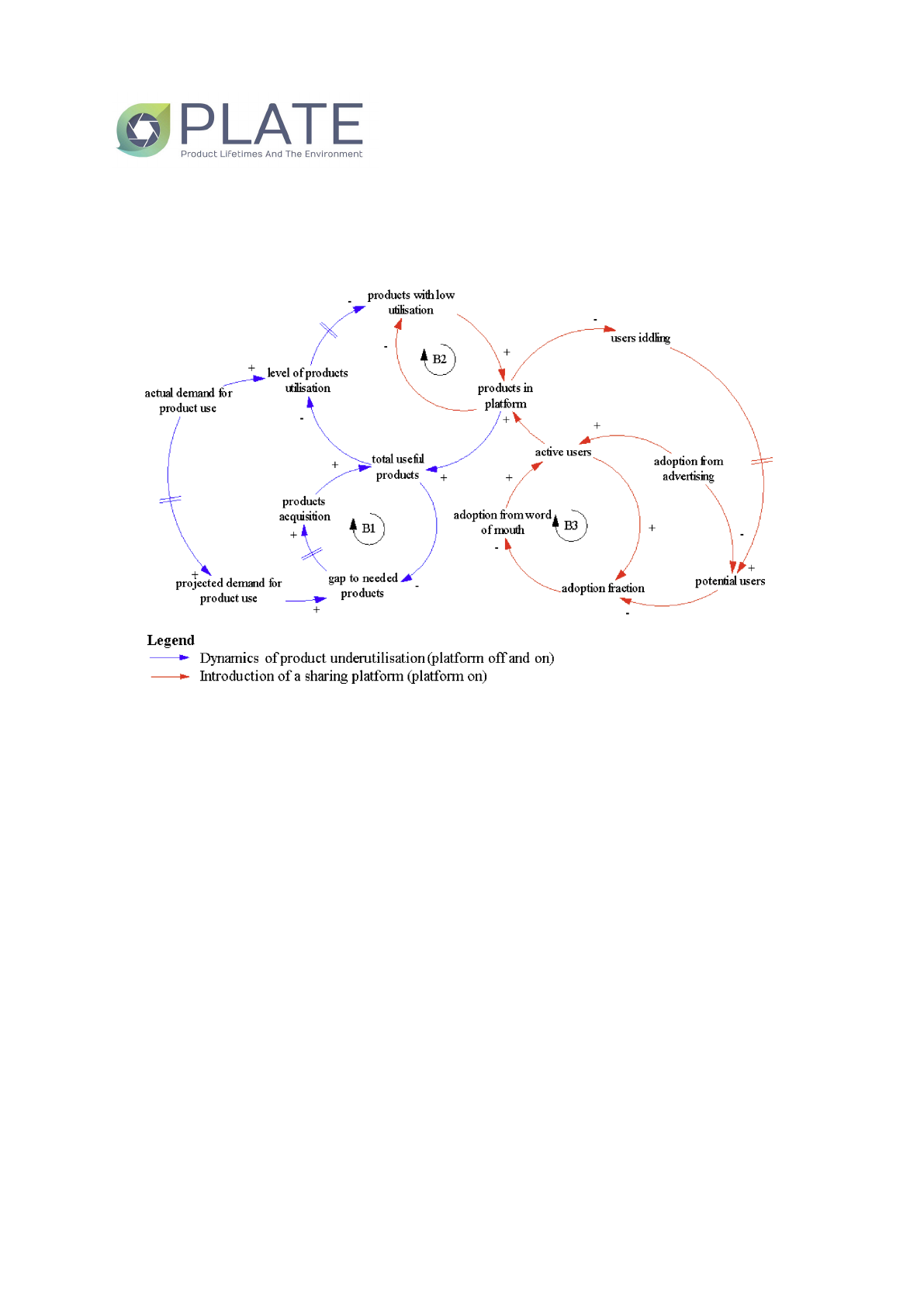
platform is represented in Figure 1.
Low utilisation occurs when the actual demand
for product use is lower than the total amount
of useful products. Products become
underutilised after a while in that condition. It is
worth distinguishing durables and
consumables. Durables may not be used
often – way less than their capacity, and
consumables may be kept away from use
while approaching the end of their shelf life.
In a hospital which does not use a sharing
platform, these underutilised products become
obsolete after little use, and the number of
total useful products is balanced by acquiring
new products to meet projected demand – see
B1 in Figure 1.
By contrast, in a hospital with a sharing
platform in place, products with low utilisation
can be turned into useful products for users that
otherwise would not have been able to access
them. This mechanism is of limited impact
because it is a balancing loop – see B2. Active
users in the platform register products and
make use of them. The mechanism of internal
user acquisition is thus critical. Users adopt the
platform through two mechanisms: word of
mouth and advertising. Adaption through
advertising occurs mainly exogenously. Word of
mouth is a powerful mechanism, which is
balanced when the adoption fraction is high –
represented by B3. Finally, users may get idle
and stop using the platform for some time when
they have a negative experience, i.e. when they
cannot find products they want in the platform.
Some idle users may never try the sharing
platform again because of the bad experience.
Model formulation: a simulation model of
the theory of behaviour
Towards simulation, the model is organised
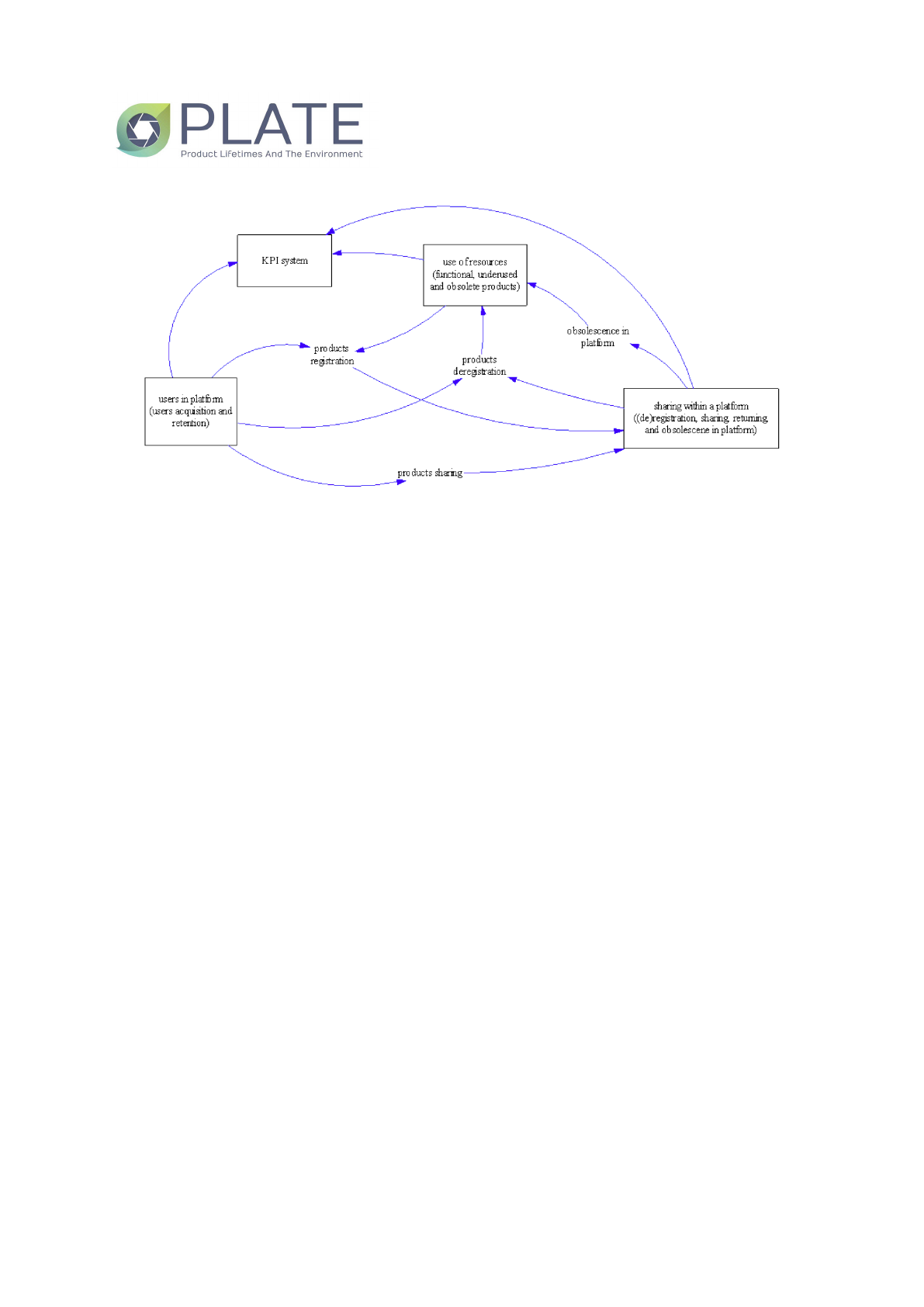
into four sub-models on the sector diagram
represented in Figure 2. Sub-models are parts
of the model that could be conceptualized and
tested separately, so that modelers could deal
with less complexity before assembling the full
model. It helps to provide a general description
of the Stock and Flow Diagram (SFD) model.
Sub-models are: ‘use of resources’, ’users in
platform’, ‘sharing within a platform’ and ‘KPI
system’. Variables that connect sub-models
are made explicit.
The ‘use of resources’ connects the model to
the CE framework by making the stocks the
and flows of resources explicit in a healthcare
institution. It contains the total stocks of
functional, underutilised, and obsolete
resources. Acquisition, obsolescence,
utilisation and discarding are the main flows.
Figure 1. Causal Loop Diagrams (CLD) of sharing platform use.
312
3rd PLATE Conference Berlin, Germany, 18-20 September 2019
Guzzo D., Jamsin E., Balkenende R., Costa J.M.H.
The use of System Dynamics to verify long-term behaviour and impacts of
circular business models: a sharing platform in healthcare
The ‘users in platform’ represent the
mechanisms for user acquisition and retention
in a closed platform. The Bass diffusion model
(Borshchev and Filippov, 2004; Sterman,
2001) is applied to represent the mechanisms
of word of mouth and saturation in such a
process. Advertisement efforts pushed forward
by Company A are used to initiate/reinforce
such dynamics.
The ‘sharing in platform’ represent the flow of
underutilised assets being registered in the
platform and their consecutive sharing. It
connects the two sub-models previously
presented. Products registration by users into
the platform work as a delay to products
acquisition as it rapidly balances the total
number of functional products. A balanced
ratio of products per users is necessary to
enable sharing. When users leave the
platform, the products under their responsibility
are automatically deregistered and become
underused again.
Finally, impacts are represented by the ‘KPI
system’ sub-model, which is fed by all the
other sub-models. Total sharing events, total
products acquired and discarded, and total
unmet demand are some of the KPIs defined
to assess resource effectiveness.
Model testing: assessing whether the
model is fit for purpose
Table 1 shows the parameters used to model
the behaviour of durables and consumables in
the 400 employees hospital using a closed
sharing platform. Durables account for
electromedical machines like MRI, Computed
Tomography, X-ray, and Mammography
machines. Consumables are single-use
devices such as sutures, syringes, and gloves.
The variables and parameters used represent
the demands and lifetimes of products –
durables and consumables.
Durables hold a high lifetime. They get the
status of ‘underutilised’ after 18 months of low
utilisation level and the decisions involved in
acquisition take longer. Consumables hold
shorter lifetimes and a safety stock policy is
maintained. Lifetimes of durables are drawn
based on the age profiling of imaging
equipment in Europe (COCIR, 2016).
Product acquisition is defined by the projected
demand for product use. Random time series
are used to simulate actual demand for product
use. The projected demand is a delayed
response to actual demand, considering the
time to acquire the product. The actual and
projected demands were defined based on a
case study for demand forecasting in
healthcare (Cote and Tucker, 2001).
For the sharing platform, registration relies on
the density of underutilised products per users.
Sharing relies on the probability of desired
product availability, which depends on the
types of products within a category – durables
or consumables. Finally, only durables are
returned as available products in the platform
for further sharing events. Consumables are
used only once.
Figure 3 and Figure 4 show the simulation
runs for the input parameters for durables and
consumables of a small-sized hospital. Two
scenarios are presented for each type of
product: one representing no sharing platform
and another with the sharing platform in place.
Figure 2. Sector diagram of the four conceptualised sub-models and relationships among them.
Loading more pages...