
Vol.:(0123456789)
Minerva (2022) 60:105–138
https://doi.org/10.1007/s11024-021-09451-8
1 3
REVIEW
The Independence ofResearch—A Review
ofDisciplinary Perspectives andOutline
ofInterdisciplinary Prospects
JochenGläser1 · MitchellAsh2· GuidoBuenstorf3 · DavidHopf4·
LaraHubenschmid5· MelikeJanßen6· GritLaudel1· UweSchimank7·
MarleneStoll5· TorstenWilholt4· LotharZechlin8· KlausLieb5,6,9
Accepted: 25 July 2021 / Published online: 8 September 2021
© The Author(s) 2021
Abstract The independence of research is a key strategic issue of modern socie-
ties. Dealing with it appropriately poses legal, economic, political, social and cul-
tural problems for society, which have been studied by the corresponding disciplines
and are increasingly the subject of reflexive discourses of scientific communities.
Unfortunately, problems of independence are usually framed in disciplinary contexts
without due consideration of other perspectives’ relevance or possible contributions.
To overcome these limitations, we review disciplinary perspectives and findings
on the independence of research and identify interdisciplinary prospects that could
inform a research programme.
Keywords Autonomy· Conflict of interest· Competition· Freedom of science·
Science in dictatorships· Academy-industry collaboration· Social epistemology·
Epistemic independence
* Jochen Gläser
Jochen.Glaeser@tu-berlin.de
1 TU Berlin, Berlin, Germany
2 University ofVienna, Vienna, Austria
3 University ofKassel, Kassel, Germany
4 Leibniz University Hanover, Hanover, Germany
5 Leibniz Institute forResilience Research, Mainz, Germany
6 German Centre forHigher Education Research andScience Studies (DZHW), Berlin, Germany
7 University ofBremen, Bremen, Germany
8 University ofDuisburg-Essen, Duisburg, Germany
9 Department ofPsychiatry andPsychotherapy, University Medical Centre Mainz, Mainz,
Germany

106 J.Gläser et al.
1 3
If you do not have the freedom to choose the subject of your research, the
chances of discovering something of importance will already be limited. If
your choice of methods is restricted as well, these chances are reduced even
further. And if, at last, you are not allowed to disclose the results because they
are inconvenient for some, many, or even all, it might be best for you to discard
your research altogether—and for those who fund your research, too. This is
what we have to prevent. (Hell 2019: 6, our translation)
Introduction
The independence of research is a key strategic issue in modern societies. Science
has become a major source of wealth and is increasingly seen as a possible source of
solutions to survival problems of contemporary societies. This has turned research
capacity into a major base of power for actors in the ‘knowledge society’; as a con-
sequence, attempts to instrumentalize science and neglect its autonomy have grown.
At the same time, the growth of science and the dynamics of its research technolo-
gies have turned it into a very expensive enterprise. It comes as little surprise that
the question as to who should be able to influence research and how influence can
be exercised without damaging the productivity and integrity of research becomes
more important.
Current political struggles have made the independence of research take centre
stage. The discourse on ‘fake news’ coincides with attempts by some governments to
limit the independence of research (Goldman etal. 2017; Barnett and Wiber 2018;
Rectors’ Conferences 2018; Enyedi 2018). Even in countries with a broad societal
consensus on the necessity to maintain academic freedom the actual extent of this
freedom and the ways in which it should be maintained is subject to continuous
negotiation, which is e.g. illustrated by legal challenges to some higher education
reforms in Germany (Zechlin 2017). In analyses of research as a source of power,
the independence of research from the state and industry is often seen as advan-
tageous because political and economic interests are seen as ‘corrupting’ science
(Lave etal. 2010), while independence from ‘the public’ (whatever it may be) and
civil society actors is considered problematic because stakeholders with legitimate
interests get disconnected from research (Brown et al. 2006; Frickel etal. 2010).
Among researchers, there is an increasing concern about becoming dependent on
incorrect or unreliable findings, whose growing number may disorient or slow down
the knowledge production of scientific communities (Kern 2012; Byrne 2019).
These concerns point to threats to the independence of research that emerge within
the science system itself.
Dealing with the independence of research appropriately poses legal, economic,
political, social and cultural problems for society, which have been studied by the
corresponding disciplines and are increasingly the subject of reflexive discourses
of scientific communities. Unfortunately, these perspectives are unevenly devel-
oped and insufficiently integrated. Problems of independence are usually framed in
disciplinary contexts without due consideration of other perspectives’ relevance or

107
1 3
The Independence of Research—A Review
possible contributions. Therefore, the aim of this paper is to overcome the limita-
tions of disciplinary perspectives by turning the independence of research into an
object of interdisciplinary study.1
We begin by identifying relevant disciplinary perspectives and findings on the
independence of research. Sociology specifies independence as the autonomy of
actors, which it has considered mostly in dyadic relationships between researchers
and their universities, industry the state or other actors. Economics conceptualises
independence in a similar way but focuses on strategic actions in competitive situ-
ations. Its perspectives on goal formation and on the process of competing facili-
tate the investigation of changing conditions for independence, some of which are
linked to intensifying and increasingly complex competitions in science. The most
important perspectives on the independence of research developed by the Philos-
ophy of Science are those of research ethics, the political philosophy of science,
and of social epistemology. The perspective of Legal Studies considers academic
freedom primarily as a personal defensive right, i.e. the right of the individual to
reject incursions on its academic freedom by other actors. At least in the German
case, which we exemplify here, the legal perspective can also be applied to organ-
izations (mainly universities) as guarantors of academic freedom and to the level
of the national science system whose independence is to be legally supported. The
History of Higher Education and Science emphasizes that academic independence
means different things under different historical circumstances, is granted academ-
ics to varying degrees, is not a necessary condition for high-quality research, and
can be abused to produce scientifically based claims that benefit specific commercial
or political interests. Self-reflections by research communities on the independence
of their research address biases in research that are caused by conflicts of interests,
which can be understood as researchers losing their independence. In addition, the
dependence of researchers in the Global South on the (Northern) cores of their com-
munities has been discussed by an increasing number of research communities.
We identify Interdisciplinary Prospects that could inform an interdisciplinary
research programme, namely the social construction of independence and the rela-
tionship between independence and the content of research. Finally, we draw some
Conclusions about the benefits of the concept ‘independence of research’ as a focus
of interdisciplinary studies.
The Independence ofResearch: Disciplinary Perspectives
In the most general sense, the independence of research refers to the extent to which
actors in science arefree from influences that alter their choices. Actors are com-
pletely independent if there are no such influences, or if they are able to resist such
influences. They are completely dependent if other actors make all their choices for
1 This paper is the result of a string of discussions the authors had among themselves and with partici-
pants of several workshops. We are particularly grateful to Martina Franzen, Fabian Hattke, and Simone
Rödder, who contributed ideas in the discussion process.

108 J.Gläser et al.
1 3
them. Neither extreme is likely to occur empirically, i.e. independence is always
a matter of degree. It is important to note here that there is no reason to assume
that beyond a minimum that guarantees the functioning of the science system, more
independence is always better. Indeed, it is also important to consider what research-
ers themselves do with their independence that might constrain research options
within the system.
This very general idea of independence has been specified by the disciplines for
investigations in their respective conceptual frameworks. Hereinafter, we consider
how sociology, economics, the philosophy of science, legal studies and the history
of science conceptualise the independence of research, which problems of independ-
ence they address and which gaps in disciplinary knowledge exist. We conclude this
section by an account of reflexive discussions of threats to independence by scien-
tific communities in the social sciences, sciences, and medicine.
Sociology
Sociology specifies independence as the autonomy of actors.2 Actors are never fully
in control of their own conditions of actions because they are always embedded in
sets of relationships with other actors and thus interdependent. Within these con-
stellations of interdependence, some actors intend to change others’ behaviour by
exercising influence. Autonomy refers to an actor’s handling of such influences and
is considered as the degree of control over the formation of goals and the choice of
approaches to achieving them that remains with an actor who is influenced by others
(Gläser and Schimank 2014).3
Autonomy thus is a property of all actors in the science system including individ-
ual researchers, research groups, research organisations (e.g. universities), and fund-
ing agencies. Although studies of these types of actors have rarely considered their
autonomy explicitly, several recurrent topics of science studies can be interpreted
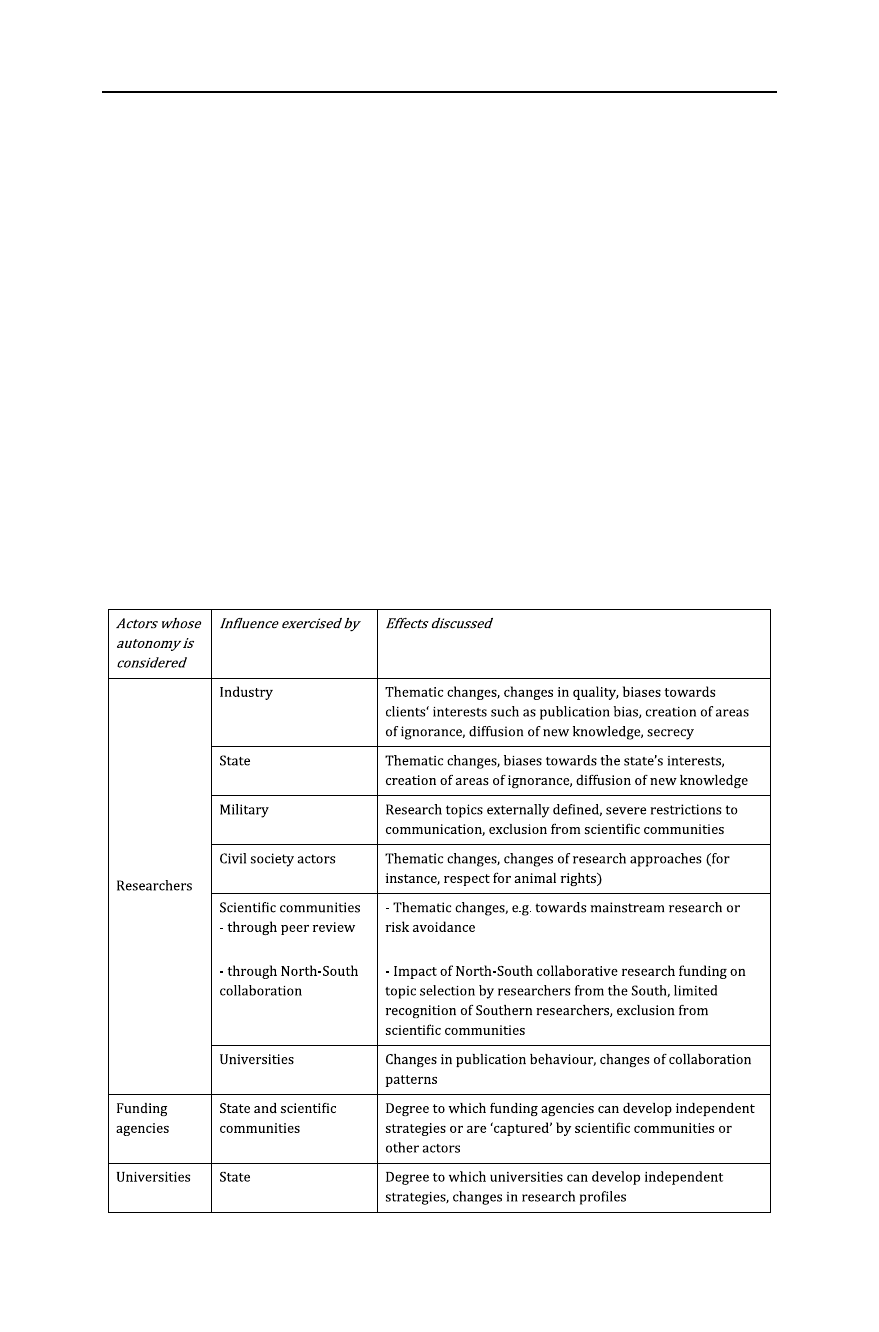
as addressing the autonomy of actors in science (Table1). These topics mostly con-
sider a specific relationship and the effects of dependencies on research.
Among the various actors influencing researchers, companies have received the
most attention. Researchers investigating the influence of pharmaceutical companies
on drug studies found “that study outcomes were significantly different in privately
funded versus publicly funded drug studies” (Krimsky 2013: 569; for the evidence
see e.g. Bekelman etal. 2003; Schott etal. 2010a, b). One of the causes of the fund-
ing effect is bias, which is defined as “the use of a method, data collection, data anal-
ysis, or interpretation of results that, in the consensus view of scientists of a disci-
pline, tends to yield results that distort the truth of a hypothesis under consideration”
2 For an alternative perspective, which considers the autonomy of social systems, see Luhmann (1995)
and Stichweh (2014).
3 This idea can be extended to sets of interdependent actors such as markets or communities. The auton-
omy of such an actor constellation could be understood as the extent to which external dependencies
leave the way in which this actor constellation ‘functions’ (its basic social order) intact (Gläser and Schi-
mank 2014).
109
1 3
The Independence of Research—A Review
(Krimsky 2013: 568). Furthermore, collaboration with industry was found to slow
the diffusion of new knowledge but not to limit it (Evans 2010a, b). Empirical stud-
ies also confirmed that collaboration with industry makes researchers withhold their
data from colleagues, although other reasons like the wish to maintain a competitive
advantage may lead to the same result (Blumenthal etal. 1997).
Dependencies on the state are rarely discussed. Recent studies focus on the align-
ment of state and industry interests and discuss effects of state influence similar to
those of industry influence, with the interesting additional twist of the production of
ignorance (Frickel etal. 2010). An interesting gap in studies of researchers’ depend-
ence on the state concerns the exclusion by the state of its own or foreign researchers
from the communication within their scientific communities through travel restric-
tions (but see Varma and Sabharwal 2018).
Effects of researchers’ and universities’ dependence on the military, which merit
separate treatment due to the specific interests and governance tools of this sector
of the state, have been mostly investigated from a historical perspective (see below,
History of Higher Education and Science), not least due to the problems of gaining
access (Rappert etal. 2008: 731–732). A sociological analysis shows how weapons
Table 1 Foci of science studies related to the autonomy of actors in science
Loading more pages...