Infrarot-Nanopolarimetrie: Anisotropie von
strukturierten Biooberflächen, dünnen
Polymerfilmen und Oxidschichten
vorgelegt von
M. Sc.
TIMUR SHAYKHUTDINOV
von der Fakultät II – Mathematik und Naturwissenschaften
der Technischen Universität Berlin
zur Erlangung des akademischen Grades
Doktor der Naturwissenschaften
- Dr. rer. nat. -
genehmigte Dissertation
Promotionsausschuss:
Vorsitzender: Prof. Dr. Andreas Knorr
Gutachter: Prof. Dr. Norbert Esser
Gutachterin: Prof. Dr. Janina Kneipp
Gutachter: PD Dr. Karsten Hinrichs
Tag der wissenschaftlichen Aussprache: 12.11.2021
Berlin 2021


Kurzfassung
UM
die Anisotropie nanostrukturierter Materie im infraroten (IR) Bereich auf ei-
ner lateralen Längenskala im Bereich von 10–100
nm
aufzuklären, werden neue
Methoden benötigt, die die Beugungsgrenze durchbrechen und hochempfindlich so-
wohl bezüglich der out-of-plane als auch der in-plane optischen Eigenschaften der
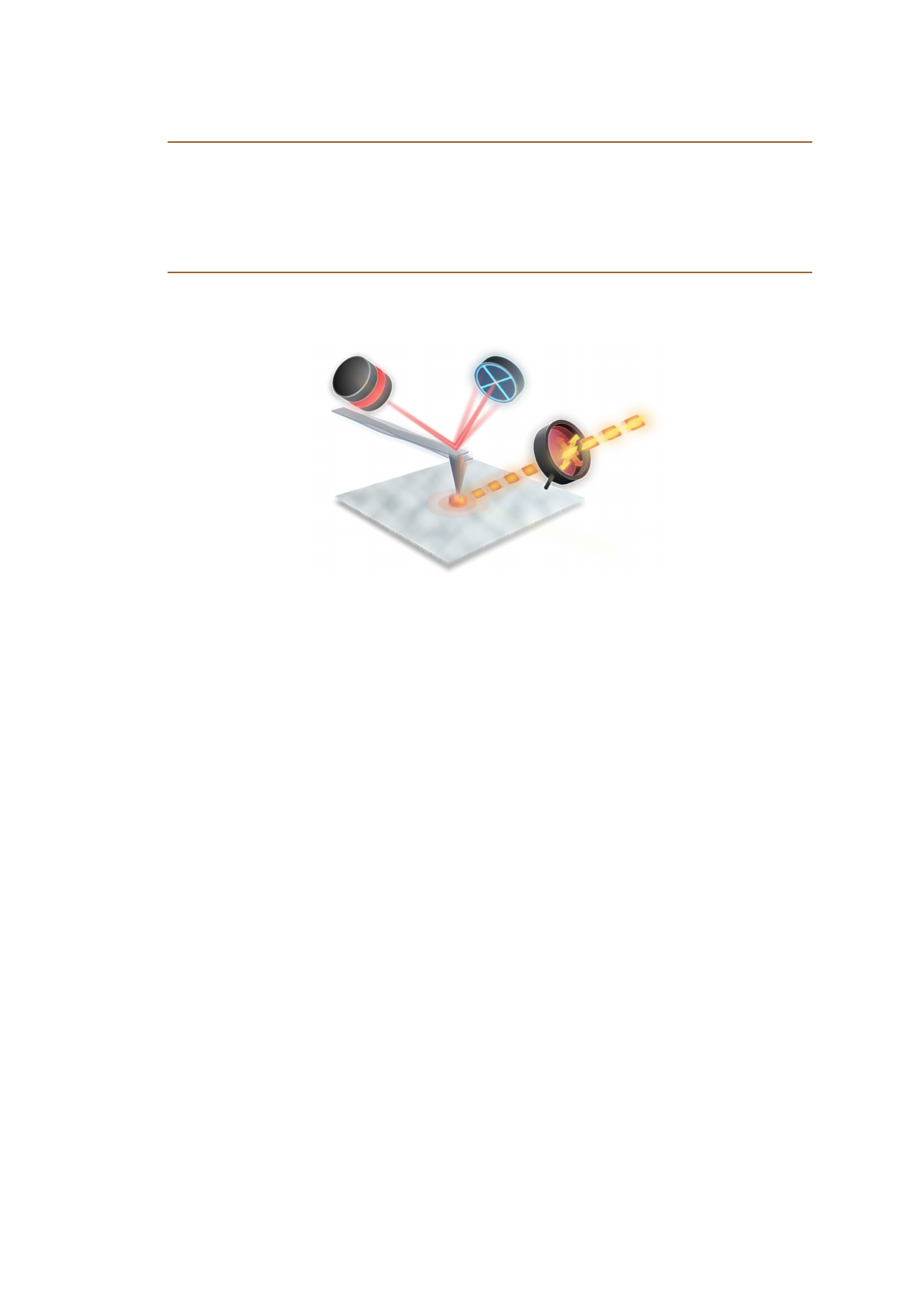
Probe sind. Diese Dissertation beschäftigt sich mit Infrarot-Nanopolarimetrie, einer
aufkommenden nanospektroskopischen Methode. Diese kombiniert die rasterkraft-
mikroskopie-basierte Infrarot-Spektroskopie (AFM-IR) mit polarisationsabhängiger Be-
strahlung mit durchstimmbaren, gepulsten IR-Quantenkaskadenlaserquellen (IR-QCL).
Die labelfreie Methode nutzt die AFM-Spitze zur direkten Untersuchung der lokalen
photothermischen Expansion der Probe hervorgerufen durch anisotrope Absorption
von p- und s-polarisierten Laserpulsen. Dies ermöglicht den Zugang zu polarisations-
abhängigen Schwingungssignaturen von Materialien unter Umgebungsbedingungen
und auf beliebigen Substraten bei einer typischen lateralen Auflösung im Bereich des
AFM-Spitzenradius um 30 nm.
Da die Messgröße in guter Näherung proportional zur IR-Absorption ist, liefert
IR-Nanopolarimetrie materialspezifische Peakpositionen und Bandenformen. Dies lässt
eine detaillierte Charakterisierung von Spektrum–Struktur-Korrelationen der Probe
zu. Der Fortschritt bei der IR-QCL-Technologie erlaubte eine Abstimmung der Puls-
frequenz des Lasers auf eine Kontakt-Eigenmode des AFM-Cantilevers und somit
eine starke Erhöhung der Messempfindlichkeit. Die so entstandene resonanzverstärkte
IR-Nanopolarimetrie nutzt IR-QCL-Pulse geringerer Leistung, was nichtdestruktive
Probenanalysen mit in einigen Sekunden aufgenommenen Einzelpunktspektren mög-
lich macht. Mit der in dieser Arbeit verwendeten Methode sind sowohl Bulk-Materialien
als auch dünne Proben bis hin zu Monolagen messbar.
In dieser Dissertation wird gezeigt, dass IR-Nanopolarimetrie einen tiefen Einblick
in die Struktur von anisotropen dünnen Filmen, Oberflächen und Aggregaten gewähren
kann. Hierzu zählen chemische Zusammensetzung, inter- und intramolekulare Wechsel-
wirkungen, molekulare Orientierung, Filmeffekte induziert durch hohe Oszillatorstärke
sowie eindeutige Identifizierung von Dünnfilm-Polaritonen. Um eine breite Anwend-
barkeit von IR-Nanopolarimetrie in den Polymerwissenschaften, supramolekularer
Chemie, Erforschung von Bio(makro)molekülen an Grenzflächen und IR-Nanophotonik
zu etablieren, werden folgende Phänomene auf der Nanoskala aufgelöst:
•
Anisotropie
von organisierten dünnen Polyimidfilmen;
•
orientierte Anlagerung als biomimeti-
scher Wachstumsmechanismus von supramolekularen Porphyrinaggregaten;
•
Homo-
und Heterogenität von geordneten Filmen von Peptidnukleinsäure auf modifiziertem
Graphen;
•
Ausrichtung von
β
-Faltblatt-reichen Proteinen bei der Adsorption bzw.
•Polaritonen in Siliziumdioxidschichten.
Die Interpretation von IR-nanopolarimetrischen Daten wird gestützt durch Ergebnis-
se erhalten mittels komplementärer Fernfeldmethoden, zu denen polarisationsabhängi-
ge IR-Mikroskopie und spektroskopische IR-Ellipsometrie gehören, sowie Rechnungen
von Molekülschwingungen wie auch elektrodynamischen Nah- und Fernfeldern. Letz-
tere basieren auf Dichtefunktionaltheorie (DFT) bzw. der Finite-Differenzen-Methode
im Zeitbereich (FDTD) und der rigorosen Analyse gekoppelter Wellen (RCWA).
Abschließend wird in dieser Arbeit das hohe Potential von IR-Nanopolarimetrie
in den Biowissenschaften, u.a. in der Alzheimer-Forschung, demonstriert sowie die
große Bedeutung von IR-nanopolarimetrischen Untersuchungen für die Entwicklung
von neuartigen plasmonischen Nanomaterialien und anisotropen optischen Sensoren.
iii

Abstract
RESOLVING
anisotropy of nanostructured matter in the infrared (IR) region at a lateral
length scale in the 10–100
nm
range requires new methods that overcome the
diffraction limit and exhibit high sensitivity to both the out-of-plane and the in-plane
optical properties of the sample. This thesis deals with infrared nanopolarimetry,
an emerging nanospectroscopic method. It combines atomic force microscopy-based
infrared spectroscopy (AFM-IR) with polarization-dependent illumination by tunable
pulsed IR quantum cascade laser (IR-QCL) sources. This label-free method uses the
AFM tip to directly probe local photothermal expansion of the sample resulting from
anisotropic absorption of p- and s-polarized laser pulses. This allows for accessing
polarization-dependent vibrational signatures of materials in ambient conditions on
arbitrary substrates with a typical lateral resolution in the range of the AFM tip radius
around 30 nm.
Since the measured quantity is proportional to IR absorption to a good approxima-
tion, the peak positions and band shapes obtained by IR nanopolarimetry are material-
specific. This enables detailed characterization of spectra–structure correlations of the
sample. Recent progress in IR-QCL technology has allowed for synchronizing the laser
pulse frequency with a contact eigenmode of the AFM cantilever, drastically increasing
the measurement sensitivity. The resulting resonance-enhanced IR nanopolarimetry
uses low-power IR-QCL pulses, making possible non-destructive sample analyses with
single-point spectra collected in seconds. The method applied in this work enables
measurements of bulk materials as well as of thin samples with thicknesses down to the
monolayer scale.
This thesis shows that IR nanopolarimetry can provide deep insights into the struc-
ture of anisotropic thin films, surfaces, and aggregates including chemical composition,
inter- and intramolecular interactions, molecular orientation, high-oscillator-strength in-
duced film effects as well as an unambiguous identification of thin-film polaritons. The
present work aims to establish a broad applicability of IR nanopolarimetry to polymer
sciences, supramolecular chemistry, studies of bio(macro)molecules at interfaces, and IR
nanophotonics by resolving the following phenomena at the nanoscale:
•
anisotropy
of organized thin polyimide films;
•
oriented attachment as biomimetic growth mech-
anism of supramolecular porphyrin aggregates;
•
homo- and heterogeneity of ordered
peptide nucleic acid films on modified graphene;
•
alignment of
β
-sheet-rich proteins
upon adsorption and •polaritons in thin silicon dioxide films, respectively.
The interpretation of IR nanopolarimetric data is supported by results obtained using
complementary far-field techniques including polarization-dependent IR microscopy
and IR spectroscopic ellipsometry as well as molecular vibrational modes and both
the near- and far-field electrodynamic calculations. The latter are based on density
functional theory (DFT), the finite-difference time-domain method (FDTD), and rigorous
coupled-wave analysis (RCWA), respectively.
Finally, this thesis demonstrates the high potential of IR nanopolarimetry in life
sciences including Alzheimer’s research as well as the great significance of IR nano-
polarimetric studies for developing novel plasmonic nanomaterials and anisotropic
optical sensors.
iv

Publikationsliste (nach Datum)
•
(Artikel im Tagungsband) K. Hinrichs, T. Shaykhutdinov, J. Rappich, C. Kratz, A.
Furchner, „IR laser polarimetry: breaking limits of FTIR polarimetry for thin film
studies,“ Proceedings of SPIE 2021,11635, 116350U, DOI f3fj.
•
(Artikel, ausgezeichnet als Front Cover of the May 2020 Issue)K. Hinrichs, J. Rappich,
T. Shaykhutdinov, „Field Manipulation of Infrared Absorption Properties in Thin
Films,“ Physica Status Solidi (b) 2020,257, 1900490, DOI dff9.
•
(Artikel) A. Tomasovic, T. Brand, C. Schanbacher, S. Kramer, M. W. Hümmert,
P. Godoy, W. Schmidt-Heck, P. Nordbeck, J. Ludwig, S. Homann, A. Wiegering,
T. Shaykhutdinov, C. Kratz, R. Knüchel, H.-K. Müller-Hermelink, A. Rosenwald,
N. Frey, J. Eichler, D. Dobrev, A. El-Armouche, J. G. Hengstler, O. J. Müller,
K. Hinrichs, F. Cuello, A. Zernecke, K. Lorenz, „Interference with ERK-dimeriza-
tion at the nucleocytosolic interface targets pathological ERK1/2 signaling without
cardiotoxic side-effects,“ Nature Communications 2020,11, 1733, DOI drfv.
•
(Review, ausgezeichnet als Editor’s Pick)K. Hinrichs, T. Shaykhutdinov, C. Kratz,
A. Furchner, „Brilliant mid-infrared ellipsometry and polarimetry of thin films:
Toward laboratory applications with laser based techniques,“ Journal of Vacuum
Science & Technology B 2019,37, 060801, DOI dfnj.
•
(Artikel) D. Gkogkou, T. Shaykhutdinov, C. Kratz, T. W. H. Oates, P. Hildebrandt,
I. M. Weidinger, K. H. Ly, N. Esser, K. Hinrichs, „Gradient metal nanoislands
as a unified surface enhanced Raman scattering and surface enhanced infrared
absorption platform for analytics,“ Analyst 2019,144, 5271–5276, DOI dfnk.
•
(Review) K. Hinrichs, T. Shaykhutdinov, „Polarization-Dependent Atomic Force
Microscopy–Infrared Spectroscopy (AFM-IR): Infrared Nanopolarimetric Analysis
of Structure and Anisotropy of Thin Films and Surfaces,“ Applied Spectroscopy
2018,72, 817–832, DOI dfnm.
•
(Buchbeitrag) K. Hinrichs, T. Shaykhutdinov, C. Kratz, F. Rösicke, C. Schöniger,
C. Arenz, N. H. Nickel, J. Rappich, „Electrochemical Modification of Large Area
Graphene and Characterization by Vibrational Spectroscopy,“ in Encyclopedia of
Interfacial Chemistry: Surface Science and Electrochemistry, (Ed.: K. Wandelt), Elsevier,
Oxford, 2018, pp. 80–94, DOI dfnn.
•
(Artikel, ausgezeichnet als Spotlight on Optics – Highlighted Articles from OSA Journals)
T. Shaykhutdinov, A. Furchner, J. Rappich, K. Hinrichs, „Mid-infrared nanospec-
troscopy of Berreman mode and epsilon-near-zero local field confinement in thin
films,“ Optical Materials Express 2017,7, 3706–3714, DOI dfnp.
•
(Artikel) F. Rösicke, M. A. Gluba, T. Shaykhutdinov, G. Sun, C. Kratz, J. Rappich,
K. Hinrichs, N. H. Nickel, „Functionalization of any substrate using covalently
modified large area CVD graphene,“ Chemical Communications
2017
,53, 9308–9311,
DOI dfnq.
•
(Artikel) T. Shaykhutdinov, S. D. Pop, A. Furchner, K. Hinrichs, „Supramolecular
Orientation in Anisotropic Assemblies by Infrared Nanopolarimetry,“ ACS Macro
Letters 2017,6, 598–602, DOI gbkp9d.
v
Loading more pages...