
energies
Article
Strengthening Gender Justice in a Just Transition: A Research
Agenda Based on a Systematic Map of Gender in Coal Transitions
Paula Walk 1,*, Isabell Braunger 1,2,3, Josephine Semb 1, Carolin Brodtmann 1, Pao-Yu Oei 1,2,3 and
Claudia Kemfert 3,4
Citation: Walk, P.; Braunger, I.; Semb,
J.; Brodtmann, C.; Oei, P.-Y.; Kemfert,
C. Strengthening Gender Justice in a
Just Transition: A Research Agenda
Based on a Systematic Map of Gender
in Coal Transitions. Energies 2021,14,
5985. https://doi.org/10.3390/
en14185985
Academic Editor: Maxim Tyulenev
Received: 5 August 2021
Accepted: 9 September 2021
Published: 21 September 2021
Publisher’s Note: MDPI stays neutral
with regard to jurisdictional claims in
published maps and institutional affil-
iations.
Copyright: © 2021 by the authors.
Licensee MDPI, Basel, Switzerland.
This article is an open access article
distributed under the terms and
conditions of the Creative Commons
Attribution (CC BY) license (https://
creativecommons.org/licenses/by/
4.0/).
1Workgroup for Economic and Infrastructure Policy (WIP), TU Berlin, Straße des 17. Juni 135,
10623 Berlin, Germany; [email protected] (I.B.); [email protected] (J.S.); [email protected] (C.B.);
[email protected] (P.-Y.O.)
2Center for Sustainable Energy Systems (ZNES), Europa-Universität Flensburg, 10117 Berlin, Germany
3Department of Energy, Transportation, Environment, DIW Berlin, Mohrenstraße 58, 10117 Berlin, Germany;
sekretariat-evu@diw.de
4Institute of Sustainability Governance, Leuphana University, 21335 Lüneburg, Germany
*Correspondence: [email protected]
Abstract:
For climate change mitigation, a rapid phase-out of fossil fuels such as coal is necessary.
This has far-reaching gender-specific consequences. This paper presents a systematic map of the
literature that examines the impact of historical coal phase-out processes on women and their role in
these processes. The search process consisted of screening over 3100 abstracts and reading 247 full-
text studies. The analysis of the 73 publications ultimately included in the systematic map shows that
past coal phase-outs meant both opportunities (e.g., increased labour market participation) as well as
burdens for women (e.g., double burden of job and household). It becomes clear that agency within
coal transitions was also gendered. For example, it was difficult for women to gain access to union
structures, which led them to organise themselves into grassroots movements. Our research shows
that policies aiming for a just sustainability transition should always be explicitly gender-responsive.
However, the impact of sustainability transitions on women’s lives remains largely under-researched.
Therefore, we propose a research agenda based on our findings containing six key issues that need to
be addressed scientifically.
Keywords: gender; coal phase-out; just transition; women; systematic map; research agenda
1. Introduction
All sectors of the economy (e.g., agriculture, transport, industry) will need to undergo
deep decarbonisation to achieve a limit of global warming below 1.5 or 2 degrees, as stipu-
lated in the Paris Agreement [
1
]. These low-carbon transitions have a gender dimension,
since they affect women in different ways than they affect men [
2
]. The changes might be
adverse for women because of their lower financial resources and thus their inability to
compensate for their emissions or to purchase low-emission technologies. Furthermore,
women are still responsible for the majority of care work (e.g., cooking, washing), which
leads to higher energy consumption and thus CO2emissions. Furthermore, women often
work in less secure jobs with a lower level of unionization, which could lead to (uncom-
pensated) job losses in case of structural change. These differences in conditions (lower
financial resources, less time available due to care work, etc.) also mean that women have
less agency and opportunity to promote their interests and viewpoints in the political
arena, where transition policies are decided [
3
]. However, low-carbon transitions could
also help overcome such gendered power structures. For example, there is evidence that in
the transport sector, the sustainability transition towards greater use of public transport
and increased development of cycling and walking infrastructure benefits women; men use
cars more often, while women are more likely to walk, cycle and use public transport [
2
].
Energies 2021,14, 5985. https://doi.org/10.3390/en14185985 https://www.mdpi.com/journal/energies
Energies 2021,14, 5985 2 of 27
Such examples show that a better understanding of the gender dynamics of low-carbon
transitions is very much needed to develop gender-sensitive transition policies [
3
]. There-
fore, a sound data basis is required. However, gender-segregated and gender-specific data
are lacking in most sectors and areas so far.
Our paper is an attempt to start filling in this research gap by systematically collecting
scientific evidence on the impact on women of low-carbon transitions and the role that
women played—referred to as agency. Based on that data collection, we develop a research
agenda to systematically advance research on gender and transitions. We focus on the
example of coal transitions, because they are essential building blocks on the way to a
sustainable economy. Coal is still responsible for more than 40% of global CO
2
emissions [
4
].
There will only be a chance to comply with the Paris Agreement if a global coal phase-
out is achieved in a timely manner [
5
,
6
]. Structural change processes from coal have a
gender dimension on several levels. There are significantly more men working in the coal
industry (e.g., in 2017, 78.4% of the workforce in the US coal industry was male [
7
]). The
division of labour between the sexes tends to be more pronounced in coal regions, as the
employment rate of women in coal regions is often lower than the national average (see,
e.g, [
8
] for Silesia, Poland and [
9
] for Appalachia, US). Furthermore, there is an increasing
amount of literature that elaborates on the connection of the coal industry with masculine
norms [10–12].
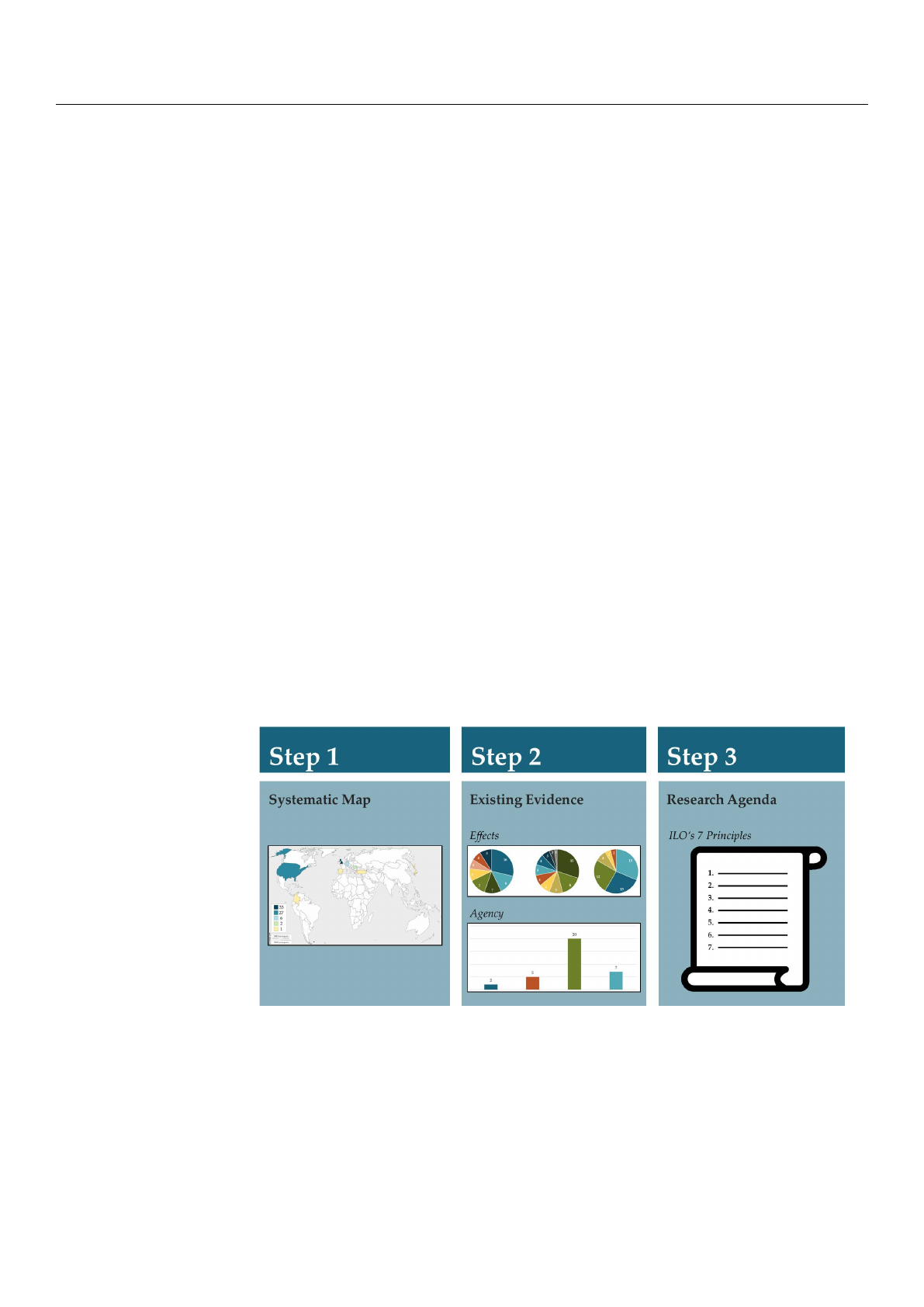
In the first step of our research approach (see Figure 1), we conducted a systematic
map [
13
,
14
] of the existing evidence on the nexus between gender and coal transitions
across a wide range of disciplines, such as anthropology, sociology, and economics. A
systematic map is a methodology to collect, describe, and catalogue existing evidence
on a specific topic in a comprehensive and repeatable way. Systematic maps provide
information about the state-of-the-art of the field of interest, such as the amount of existing
literature on methodological approaches and scientific disciplines [
13
,
15
]. Therefore, this
methodology fits well to answer our research question: What evidence exists about the
effects of coal transitions on women in contrast to men and about female agency during
coal transitions?
Figure 1. Overview of our research approach. Source: Own depiction, using resources from [16].
Our search strategy consisted of a database search in Scopus, EBSCO, Web of Science,
and ProQuest, a grey literature search, and a call for relevant literature in the scientific
community; this was supplemented by snowballing the references of relevant publications.
The literature search, and the subsequent full-text reading of 247 publications, yielded
73 relevant studies, mostly focusing on countries in the Global North (mainly the UK, the
USA, and Germany).
In a second step (see Figure 1), we systematically extracted all information in the
publications according to what impact historical coal transitions had on women and what

Energies 2021,14, 5985 3 of 27
role women played in each transition. We found that across country contexts, the long-term
employment effects of past coal transitions were that the (mostly male) miners in coal
regions increasingly left the labour force due to early retirement or redundancy, while
women increasingly sought employment—giving them an increased degree of financial
independence. However, many of them had to take up precarious jobs, which were
mainly located in the service sector and provided little financial and planning security.
Turning towards women’s agency, our analysis showed that women active in the political
struggle around various historical coal transitions tended to organise themselves in less
institutionalised ways compared to men (partly because institutions such as unions were
difficult for women to enter). Their activism, for example, in the miners’ strike in the UK
or in anti-coal activism opposing Mountain-Top Removal (MTR) in the USA, usually took
place in self-organised grassroots movements or through involvement in community work.
In recent years, there have been increasing calls to equitably share the costs and
burdens of a low-carbon transition among all stakeholders, which is summarised by the
term “just transition” [
17
–
19
]. We acknowledge that the design of a just transition depends
very much on the geographical, social, and political context [
10
]. The conviction that a
just transition also includes gender justice is fortunately becoming more widespread [
17
].
However, research looking at the social outcome of low-carbon transitions is often limited
to calculating net employment effects [
20
]. Therefore, based on our research results and
as the third step (see Figure 1) of our research approach, we develop a research agenda.
The agenda identifies where research is still lacking concerning the gendered aspects of
low-carbon transitions. Through the agenda, we aim to stimulate further research on this
topic, the results of which will help policymakers better incorporate gender considerations
into policies aimed to shape a just transition. To better systematise and structure the
research agenda, we use the International Labour Organisation’s (ILO) seven “Guidelines
for a just transition towards environmentally sustainable economies and societies for
all” [
17
] (p. 6). Although the ILO’s concept of just transition has some shortcomings, it has
been successfully anchored in important international policy documents by the UN and
the EU, such as the Paris Agreement [
20
–
22
]. Future research should ask about policies
designed to improve working conditions in the service sector and create well-paid jobs
for all genders in the Green Economy sectors. In addition, many studies reported an
increased total workload for women, as their domestic responsibilities remained, but a
new responsibility as wage earners was added. One important area of research to inform
policymakers is the availability of care services in carbon-intensive regions and the extent
to which missing support infrastructure prevents women from planning their own careers.
Furthermore, future research should investigate the main interests, needs, and concerns of
women affected by the transition and the kinds of activities and forms of organisation they
choose. First, this would make women’s activism more visible, and second, it would inform
state institutions how to make the transition process more inclusive. It is also important
to investigate how women’s access to resources, such as adequate funding or access to
policymakers and institutions, could be improved so that they are able to better integrate
their interests into the political process.
The remainder of the paper is structured as follows: Section 2presents our method-
ological approach—the systematic map. Section 3summarises the information we have
extracted from the publications. Based on those results, Section 4presents our research
agenda on how future research on just transition pathways can more comprehensively take
into account gender dimensions. Section 5concludes.
2. Methodology—Systematic Map
We answer our research question “what evidence exists about the effects of coal tran-
sitions on women in comparison to men and about female agency within coal transitions?”
using a systematic map. A systematic map is well-suited to answer this question, since
it is designed to collect, describe, and catalogue existing evidence on a specific topic in
a comprehensive and repeatable way. In doing so, it provides information about the

Energies 2021,14, 5985 4 of 27
current scientific state of the field of interest, such as the amount of existing literature,
as well as geographical foci, methodological approaches, and scientific disciplines. A
systematic map can also help to identify research gaps or controversies in the existing
literature [
13
,
14
,
23
]. The results of our systematic map therefore provide a good basis for
developing a research agenda.
To start our research process, we developed a systematic map protocol, which in-
cluded the research idea, question and aim, inclusion and exclusion criteria, and search
strategy. After having received feedback on it from experts in the field, it became the basis
of our methodological procedure. In the following, we describe the four stages of our
methodological approach.
2.1. Development of the Search String
Our research question includes the two basic terms: coal transition and agency. Before
we present our methodological approach, it is important to provide a definition of these
two terms and present our concept of gender, which is also essential to our work.
We define a coal transition as a (regional) decline in the extraction or combustion of
coal or a substantial loss of jobs in the coal industry. This definition allows us to include
smaller, regional coal transitions and honours the social significance they bear. We define
the concept of agency as “the property or capacity of actors to make things happen” [
24
]
(p. 11). We conceptualise actors not merely as individuals, separate from their society, but
as unique parts of a collective, who make choices based on the structurally presupposed
rationales surrounding them, rather than simply autonomously [25].
In our study, we use gender as an analytical tool to make socioeconomic inequalities
that affect women visible.We share the notions of modern feminist theories on the rela-
tionship between sex and gender; however, to be able to extract the relevant information
from existing literature for this study, we had to conceptualise the category “women” as
a socially constructed but direct consequence of the female sex. This is a very simplified
approach to gender, but we consider it appropriate for our research interest. It would be
beyond the scope of this paper to comprehensively present the findings of gender research
(for a more elaborate and differentiated discussion of gender, see for example [
26
,
27
]).
Being assigned to the category “woman” generally goes along with gendered norms that
lead to constraints, while being assigned to the category “man” commonly brings more
privileges [
28
]. One of the assumptions that goes along with the category “woman” is being
a caregiver and socially oriented. Thus, women are expected to do most of the unpaid care
work, related to both the physical as well as the emotional well-being of people. Care work
is essential for the functioning of a society, but its value is barely recognised, neither in
economic terms nor as a high-skilled and energy-intensive activity. The time and energy
women invest in care work is no longer available for other activities, which could bring
higher status, therefore limiting their own life chances in comparison to men. If a person
does not fulfil gendered norms, this behaviour is accompanied by social sanctions. It
is essential to note that women are not a homogeneous group, but have very different
life situations depending, e.g., on age, socioeconomic background, place of origin, and
race. Still, women have on average less access to resources (e.g., finances, influence on
decision-making) than men and consequently different opportunities in life. Women’s
social positioning not only influences how transitions affect them, but also their agency
within coal transitions, for example, regarding their political articulation, their forms of
organisation, or their representation in decision-making bodies.
In an iterative process, we developed a search string based on these three central
terms. A search string is designed to find as many relevant publications as possible when
using it in databases. It consists of several categories including synonyms or similar terms.
We used one category for coal (e.g., lignite, mining), one for gender (e.g., women, woman),
and one for transition and agency (see Table 1). Transition and agency were grouped into
one category to ensure that either a transition moment is directly covered or questions

Energies 2021,14, 5985 5 of 27
of agency are addressed, which might point towards a transition in process (e.g., strike,
activis *).
Table 1. Search terms by research category.
Transition and Agency Coal Gender
transition * coal gender *
transformation * lignite * woman *
change * mining women *
reform anthracite * (anthracites) female *
closure * miner mother *
decreas * miners femini *
declin * coalfield * * wives
collapse * coalmin * * wife
crises coalface
crisis AND NOT “data mining”
strik * AND NOT “text mining”
resistance
protest *
agency
activis *
oppos *
Note
: Terms within a category are connected using the Boolean operator OR. The categories are connected by
AND, requiring each record to refer to all three categories. Additionally, wildcards (*) serve to include different
endings to the same word stem.
We collected a broad range of relevant search terms for all three categories, which
allowed us to detect records across disciplines and times of publication—these might
differ starkly in their terminology while still addressing the same topics. A preliminary
search was conducted to evaluate the relevance of the terms, and a benchmark test with
five relevant publications was established (test list). Text mining software was used to
analyse the results of the test search and identify further relevant search terms. With
this process, we came up with a comprehensive as well as consistent search string (see
Table 1).
2.2. Inclusion and Exclusion Criteria
At first, unsystematic pre-tests allowed us to grasp an idea of the scope of existing
literature and the exact inclusion and exclusion criteria needed to identify relevant literature.
Following the PICO (Population, Intervention, Comparator (since our research is mostly
based on qualitative case studies, a Comparator is not applicable), Outcome) format, we
identified the key inclusion and exclusion criteria (Table 2) [
29
]: Population encompasses
people living in coal-intensive regions worldwide, Interventions includes coal transitions
as defined above, and Outcome relates to gender-related social, political, economic, and
demographic effects, as well as gendered agency within these transitions. To gather a
comprehensive literature base, books, reports, conference papers, theses, and working
papers as well as journal articles were included in the systematic map.
Combining this with the aforementioned PICO categories, we identified the following
inclusion/exclusion criteria.
Loading more pages...