
Synchronization in Networks With
Heterogeneous Adaptation Rules and
Applications to Distance-Dependent
Synaptic Plasticity
Rico Berner
1
,
2
* and Serhiy Yanchuk
1
1
Institut für Mathematik, Technische Universität Berlin, Berlin, Germany,
2
Institut für Theoretische Physik, Technische Universität
Berlin, Berlin, Germany
This work introduces a methodology for studying synchronization in adaptive networks
with heterogeneous plasticity (adaptation) rules. As a paradigmatic model, we consider a
network of adaptively coupled phase oscillators with distance-dependent adaptations. For
this system, we extend the master stability function approach to adaptive networks with
heterogeneous adaptation. Our method allows for separating the contributions of network
structure, local node dynamics, and heterogeneous adaptation in determining
synchronization. Utilizing our proposed methodology, we explain mechanisms leading
to synchronization or desynchronization by enhanced long-range connections in
nonlocally coupled ring networks and networks with Gaussian distance-dependent
coupling weights equipped with a biologically motivated plasticity rule.
Keywords: synaptic plasticity, adaptive networks, phase oscillator, synchronization, distance-dependent synaptic
plasticity, nonlocally coupled rings, master stability approach
1 INTRODUCTION
In nature and technology, complex networks serve as a ubiquitous paradigm with a broad range of
applications from physics, chemistry, biology, neuroscience, socioeconomic, and other systems [1].
Dynamical networks consist of interacting dynamical units, such as neurons or lasers. Collective
behavior in dynamical networks has attracted much attention in recent decades. Depending on the
network and the specific dynamical system, various synchronization patterns with increasing
complexity were explored [2–5]. Even in simple models of coupled oscillators, patterns such as
complete synchronization [6,7], cluster synchronization [8–11], and various forms of partial
synchronization have been found, such as frequency clusters [12], solitary [13–15], or chimera
states [16–20]. In particular, synchronization is believed to play a crucial role in brain networks, for
example, under normal conditions in the context of cognition and learning [21,22], and under
pathological conditions, such as Parkinson’s disease [23–25], epilepsy [26–29], tinnitus [30,31],
schizophrenia, to name a few [32].
The powerful methodology of master stability function [33] has been a milestone for the
analysis of synchronization phenomena. This method allows for the separation of dynamic
and structural features in dynamical networks. It greatly simplifies the problem by reducing
the dimension and unifying the synchronization study for different networks. Since its
introduction, the master stability approach has been extended and refined for various
complex systems [34–42], and methods beyond the local stability analysis have been
developed [43–47]. More recently, the master stability approach has been extended to
Edited by:
Jun Ma,
Lanzhou University of Technology,
China
Reviewed by:
Syamal Kumar Dana,
Jadavpur University, India
Gopal R.,
SASTRA University, India
*Correspondence:
Rico Berner
[email protected]rlin.de
Specialty section:
This article was submitted to
Dynamical Systems,
a section of the journal
Frontiers in Applied Mathematics and
Statistics
Received: 26 May 2021
Accepted: 21 June 2021
Published: 15 July 2021
Citation:
Berner R and Yanchuk S (2021)
Synchronization in Networks With
Heterogeneous Adaptation Rules and
Applications to Distance-Dependent
Synaptic Plasticity.
Front. Appl. Math. Stat. 7:714978.
doi: 10.3389/fams.2021.714978
Frontiers in Applied Mathematics and Statistics | www.frontiersin.org July 2021 | Volume 7 | Article 7149781
ORIGINAL RESEARCH
published: 15 July 2021
doi: 10.3389/fams.2021.714978

another class of oscillator networks with high application
potential, namely adaptive networks [48].
Adaptive networks are commonly used models for various
systems from nature and technology [49–57]. A prominent
example are neuronal networks with spike-timing dependent
plasticity, in which the synaptic coupling between neurons
changes depending on their relative spiking times [58–61].
There are a large number of studies investigating the dynamic
properties induced by this form of synaptic plasticity [62].
However, analysis is usually limited to only one or two forms
of spike timing-dependent plasticity within a neuronal
population. On the other hand, experimental studies indicate
that different forms of spike timing-dependent plasticity may be
present within a neuronal population, where the form depends on
the connection structure between the axons and dendrites [63].
Among all structural aspects, an important factor for the specific
form of the plasticity rule is the distance between neurons
[64–66]. More specifically, it has been found that the plasticity
rule between proximal or distal neurons, respectively, can change
from Hebbian-like to anti-Hebbian-like [67,68].
This work introduces a methodology to study synchronization
in adaptive networks with heterogeneous plasticity (adaptation)
rules. As a paradigmatic system, we consider an adaptively
coupled phase oscillator network [69–75], which is proven to
be useful for predicting and describing phenomena occurring in
more realistic and detailed models [76–79]. More specifically, in
the spirit of the master stability function approach, we consider
the synchronization problem as the interplay between network
structure and a heterogeneous adaptation rule arising from
distance- (or location-)dependent synaptic plasticity. For a
given heterogeneous adaptation rule, our master stability
function provides synchronization criteria for any coupling
configuration. As illustrative examples, we consider a
nonlocally coupled ring with biologically motivated plasticity
rule, and a network with a Gaussian distance-dependent
coupling weights. We explained such intriguing effects as
synchronization or desynchronization by enhancement of
long-distance links.
We introduce the model in Section 2. Building on findings
from [48], we develop a master stability approach in Section 3
that takes a heterogeneous adaptation rule in account. In Section
4.1, we provide an approximation of the structural eigenvalues
that determine the stability of the synchronous state. We then
consider two different setups: a nonlocally coupled ring in
Section 4.2 and a weighted network with Gaussian distance
distribution of coupling weights in Section 4.3. Both systems
are equipped with a biologically motivated plasticity rule. In
Section 5, we summarize the results.
2 MODEL
In this work, we study the synchronization on networks with
adaptive coupling weights, where the adaptation (plasticity) rule
depends on the distance between oscillators (neurons). We
consider the model of adaptively coupled phase oscillators,
which has proven to be useful for understanding dynamics in
neuronal systems with spike timing-dependent plasticity [77,79,
48]. The model reads as follows:
d
dtϕiω+
j1
N
aijκijgϕi−ϕj,(1)
d
dtκij −ϵκij +hijϕi−ϕj,(2)
where ϕi∈S1R/2πZ(i1,...,N) is the phase of the ith
oscillator, κij (i,j1,...,N) is the dynamical coupling weight
from oscillator jto i,ωdenotes the natural frequency of each
oscillator, and aij ∈[0,1]are the entries of the weighted
adjacency matrix Adescribing the network connectivity. The
time scales of the “fast”phase oscillators and “slow”coupling
weights are separated by the parameter ϵ, which we assume to be
small 0 <ϵ≪1. The functions gand hij denote the coupling and
the N2plasticity functions, respectively. For illustrative purposes,
the coupling function is set throughout the paper to g(ϕ)
−sin(ϕ+α)/Nwith the phase lag parameter α[80]. Such a
phase lag can account for a small synaptic propagation delay
[81,48]. For formal derivations, however, a generic coupling
function is used. Note that the system Eqs. 1,2is shift-symmetric,
i.e., invariant under the transformation ϕi1ϕi+ψfor any
ψ∈S1. This allows us to restrict our consideration to the case
ω0 by introducing a new “co-rotating”coordinate system
ϕi,new ψi−ωt.
The main difference of system Eqs. 1,2from the models
considered previously in the literature [40,70,71,74,82], is that
the plasticity functions hij can be different for each network
connection j→i.
A solution to Eqs. 1,2is called phase-locked if, for all
i1,...,N, the phases evolve as ϕiΩt+ϑiwith some
collective frequency Ω∈Rand ϑi∈S1.Ifϑiϑfor all
i1,...,N, the phase-locked state is called in-phase
synchronous or, short, synchronous state.
In the case of in-phase synchronous state, we can set ϑi0 for
each oscillator due to the shift symmetry of Eqs. 1,2. The in-
phase synchronous state is given as
ϕs(t)−wg(0)t,(3)
κs
ij −hij(0),(4)
where we assume that the weighted row sum wN
j1aijhij(0)is
constant for all. Such an assumption of constant row sum is
necessary for the existence of the synchronous state. Moreover, it
is satisfied for commonly considered cases of global or nonlocal
shift-invariant coupling.
In the following section, we show how the stability of the
synchronous state is determined in a master-stability-like
approach.
3 MASTER STABILITY APPROACH
In Section 2, we have introduced a general class of models
and the synchronous state, that are considered throughout
this paper. In this section, we derive a framework for the local
stability analysis of the synchronous states. We note that the
Frontiers in Applied Mathematics and Statistics | www.frontiersin.org July 2021 | Volume 7 | Article 7149782
Berner and Yanchuk Synchronization in Networks With Distance-Dependent Plasticity

master stability approach for homogeneous adaptations hij h
was introduced in [48,83]. Here we extend the methodology to
heterogeneous adaptation rules.
To describe the local stability, we introduce the variations ξi
ϕi−ϕsand χij κij −κs
ij. The linearized equations for these
variations can be written in the following matrix form
d
dtξ
χJξ
χDg(0)Lhg(0)B
−ϵC−ϵIN2ξ
χ,(5)
where ξ(ξ1,...,ξN)Tis N-dimensional vector containing the
perturbations ξiδϕiof the phases and χ(χ11,χ12,...,χNN )T
are N2- dimensional vectorized perturbations of coupling weights
χvec[δκij], respectively. The N×Nweighted Laplacian matrix
Lhhas the following elements
lh
ij ⎧
⎨
⎩−N
m1,m≠iaimhim(0),ij,
aijhij(0),i≠j.(6)
The time-independent matrices Band Care
B⎛
⎜
⎝a1
1
aN⎞
⎟
⎠,
C⎛
⎜
⎜
⎜
⎝(Dh)T
1
1
(Dh)T
N⎞
⎟
⎟
⎟
⎠−⎛
⎜
⎝diag (Dh)1
«
diag (Dh)N⎞
⎟
⎠,
where ai(ai1,...,aiN ),(Dh)i(Dhi1(0),...,DhiN (0)), and
diag (Dh(0))i⎛
⎜
⎝Dhi1(0)
1
DhiN (0)⎞
⎟
⎠.
Note that due to the shift symmetry of Eqs. 1,2, the Jacobian J
in Eq. 5 is time independent. Therefore, the real parts of the
N(N+1)eigenvalues λof Jare the Lyapunov exponents of the
synchronous state and hence determine its local stability. In the
following proposition, we exploit the fact that Jcontains a large
diagonal block −ϵIN2to reduce the dimension of the eigenvalue
problem for J.
PROPOSITION 1. Suppose ϕiΩt is an in-phase synchronous
state of Eqs. 1,2. Then its linear stability is determined by the
2N-dimensional linear system
d
dtvDg(0)Lhg(0)IN
ϵLDh−ϵINv,(7)
where Dg(0)and Lhare as in Eq. 5 and the N ×N weighted
Laplacian matrix LDhpossesses the following elements
lDh
ij ⎧
⎨
⎩−N
m1,m≠iaimDhim(0),ij,
aijDhij(0),i≠j.(8)
PROOF. We remind that system Eq. 5 determines the spectrum
(Lyapunov exponents) of the synchronous state. The Jacobian
matrix in Eq. 5 is sparse with a large N2×N2block given by the
simple diagonal matrix −ϵIN2. This implies that Eq. 5 possess
N2−Nstable directions with Lyapunov exponents −ϵ.Tofind
these directions, we substitute (ξ,χ)e−ϵt(ξ0,χ0)into Eq. 5 and
obtain the linear system
Dg(0)Lh+ϵINg(0)B
−ϵC0ξ0
χ00.(9)
This system has at least N2−Nlinearly independent solutions, since
the matrix in Eq. 9 is degenerate due to the large N2×N2zero block.
The structure of the invariant subspaces in system Eq. 5 allows for
introducing new coordinates, which separate the N2−Nstable
directions (corresponding to the eigenvalues −ϵ)fromthe
remaining 2Ndirections. Explicitly, this transformation is given by
ξ
χRξ
χ,RIN00
0(1/r)BTK
with (N2+N)×(N2+N)matrix R. Here Kis an (N2−N)×
(N2−N)orthogonal matrix with BK 0. Applying this
transformation, we obtain the following system
d
dt⎛
⎜
⎜
⎝ξ
χN
χN2−N⎞
⎟
⎟
⎠⎛
⎜
⎜
⎝Dg(0)Lhg(0)IN0
ϵLDh−ϵIN0
−ϵKTC0−ϵIN2−N⎞
⎟
⎟
⎠⎛
⎜
⎜
⎝ξ
χN
χN2−N⎞
⎟
⎟
⎠,
(10)
where (ξ,χN,χN2−N)T(ξ,χ)T,with χNand χN2−Nare an Nand
N2−N-dimensional vectors, respectively, and the N×Nweighted
Laplacian matrix LDhas given in Eq. 8. For more details on the
transformation, we refer the reader to [48,83]. We observe that the
variables (ξ,χN)are independent on χN2−N.Hence,separatingthe
master from the slave system, the resulting coupled differential
equations that determine the stability of the synchronous state are
given by system Eq. 7. This concludes the proof.
Proposition 1 reduces the problem’s dimension significantly
from N(N+1)to 2N. In the spirit of the master stability approach
[33], we aim for further decomposition of the 2N-dimensional
coupled system Eq. 7 into dynamically independent blocks of
dimension 2. For this, we restrict our consideration to the case
when Lhcan be diagonalized ShQ−1LhQby a nonsingular
complex-valued matrix Q. Note that the eigenvalues μiof Lhlie
on the diagonal of Sh.Ingeneral,thematricesLhand LDhdo not
commute. Therefore, Q−1LDhQis not necessarily of upper
triangular shape. Regardless of this fact, the following
proposition provides an explicit form for the eigenvalues of Jin
Eq. 5 in the limit of slow adaptation, i.e., ϵ≪1.
PROPOSITION 2. Assume that Lhis diagonalizable, with Sh
Q−1LhQ being the associated diagonal matrix and Q the
corresponding transformation. Let ϕiΩt be an in-phase
synchronous state of Eqs. 1,2Then, the local stability of this state
is determined by the solutions of N quadratic equations, which are
given up to the first order in ϵas
λ2+ϵ−Dg(0)μiλ−ϵDg(0)μi+g(0)]i0,i1,...,N,
(11)
where μiare the eigenvalues of Lhlocated on the diagonal of Shand ]i
are the corresponding diagonal elements of Q−1LDhQ.If Lhand LDh
commute, then Eq. 11 is exact, and ]iare the eigenvalues of LDh.
Frontiers in Applied Mathematics and Statistics | www.frontiersin.org July 2021 | Volume 7 | Article 7149783
Berner and Yanchuk Synchronization in Networks With Distance-Dependent Plasticity

PROOF. Due to Proposition 1, the eigenvalues of the Jacobian in
Eq. 5 are given by
det Dg(0)Lh−λINg(0)IN
ϵLDh−(ϵ+λ)IN
det Dg(0)Sh−λINg(0)IN
ϵQ−1LDhQ−(ϵ+λ)IN0,
where we have used the transformation Qthat brings Lhto the
diagonal form ShQ−1LhQ. Making further use of the Schur
complement [84], we obtain
det Dg(0)Sh−λINg(0)IN
ϵQ−1LDhQ−(ϵ+λ)IN
det(λ+ϵ)λIN−Dg(0)Sh−ϵg(0)Q−1LDhQ0.(12)
The latter equation is almost diagonal. The only off-diagonal
components remain from Q−1LDhQand scale with ϵ. Let
us consider the Leibniz formula for the determinant of an
N×Nmatrix Fwith entries fij, that reads
det(F)σ∈Perm(N)sgn(σ)N
i1fiσ(i). In the latter expression
Perm(N)denotes the set of all permutations σof the
integer numbers 1,...,Nand sgn(σ)∈{−1,1}is the sign
of the permutation. Since all off-diagonal terms of the
matrix considered in Eq. 12 scale with ϵ, for any but
the identical permutation each term N
i1fiσ(i)scales with ϵ2
or higher. Hence, we are left with det(F)N
i1fii +O(ϵ2)
and find
det (λ+ϵ)λIN−Dg(0)Sh−ϵg(0)Q−1LDhQ
i1λ2+ϵ−Dg(0)μiλ−ϵDg(0)μi+g(0)]i+Oϵ2
0,
(13)
where μiare the eigenvalues of Lh,]iare the diagonal elements
of Q−1LDhQand O(ϵ2)denotes higher order terms (ϵm,m>1).
If Lhand LDhcommute, both matrices share the same set of
eigenvectors and hence they can be brought to the diagonal
form with the same transformation Q.Inthiscase,the
diagonal elements ]iare the eigenvalues of LDhand the
higher order terms O(ϵ2)in Eq. 13 vanish.
The 2Nsolutions λiof the NEq. 11 determine the stability
of the synchronous state. More precisely, the real parts of
theses solutions determine the Lyapunov exponents. If
ΛmaxiRe(λi)<0, then the synchronous state is locally
stable, while for Λ>0 it is locally unstable. The case Λ0
provides the stability boundary.
Note that for a fixed time scale parameter ϵ≪1, the Eq. 11
and hence its solutions depend on the coupling function g,
the connectivity, and the adaptation structure. This
dependence, however, is only encoded in the two complex
parameters Dg(0)μand g(0)].Therefore,wedefine the master
stability function Λ:C2→Rwith Λ(Dg(0)μ,g(0)])
maxiRe(λi(Dg(0)μ,g(0)])) that maps each pair of
parameters (Dg(0)μ,g(0)])to the corresponding Lyapunov
exponent.
For an illustration, we consider a cross-section of
(Dg(0)μ,g(0)])- space by setting Im(μ)0 and Im(])0.
This cross-section is of particular interest in cases of symmetric
matrices Lhand LDhsince their eigenvalues are real. In Figure 1,we
present the master stability function for the coupling function
g(ϕ)−sin(ϕ+α)/Nand different values of the parameter α.In
case of real μand ], we obtain two explicit stability conditions from
Eq. 11: The synchronous state is locally stable (Λ<0) if
c1α,μcos(α)μ>−ϵ,(14)
c2α,μ,]cos(α)μ+sin(α)]>0.(15)
These conditions agree with the black dashed lines in Figure 1
and are used subsequently to describe stability for certain
network models.
4 SYNCHRONIZATION ON NETWORKS
WITH DISTANCE-DEPENDENT PLASTICITY
In the previous section, we established a generic analytic tool for
studying stability of synchronous states. In this section, we focus
on the application of the tool to certain network models. For the
rest of the work, we restrict our attention to the following
generalization of the Kuramoto-Sakaguchi system with
distance-dependent synaptic plasticity
d
dtϕiω−1
N
j1
N
aijκijsinϕi−ϕj+α,(16)
d
dtκij −ϵκij +hϕi−ϕj,dij.(17)
The plasticity function hdepends on the phase difference ϕi−ϕjand
on the distance dij . In this work, we associate the distance to the difference
of indices by dij j−i. For the plasticity function, we consider
hijϕhϕ,dij
N⎧
⎪
⎪
⎪
⎪
⎪
⎨
⎪
⎪
⎪
⎪
⎪
⎩hϕ,dij
Ndij ≤N2,
hϕ,1−dij
Ndij >N2.
(18)
With this form of the adaptation function, we have a
symmetric hij(ϕ)hji(ϕ)and a circulant hi+l,j+l(ϕ)hij(ϕ)
structure of the corresponding matrix with entries hij.
Particularly, for the numerical analysis, we use
hϕ,dijNsinϕ+βdijN,(19)
where the distance dependence is encoded in the phase shift function
βdij
N⎧
⎪
⎪
⎪
⎪
⎨
⎪
⎪
⎪
⎪
⎩2
Ndij −1π,Neven,
2
(N+1)dij −1π,Nodd.
(20)
Frontiers in Applied Mathematics and Statistics | www.frontiersin.org July 2021 | Volume 7 | Article 7149784
Berner and Yanchuk Synchronization in Networks With Distance-Dependent Plasticity
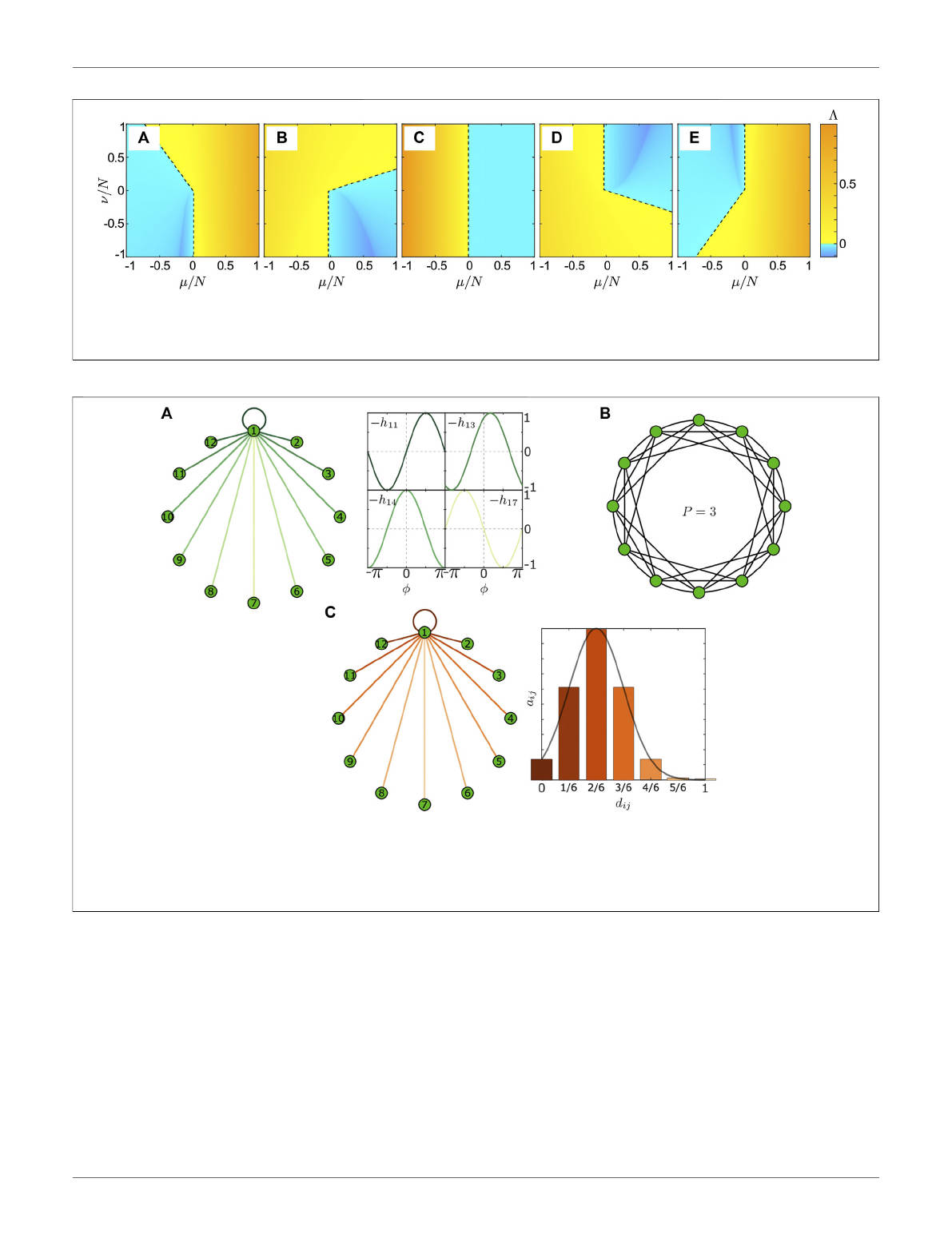
In Figure 2A, we illustrate the distance-dependent plasticity
function Eqs. 18–20 for a network of N12 nodes. The
illustration shows the different plasticity functions depending
on the distance between the nodes dij. The plasticity function
changes from a Hebbian to anti-Hebbian rule for proximal and
distal node, respectively. This change, particularly in the
proximity of ϕ0, is in qualitative agreement with the
experimental findings in [67]. Note the symmetry of the
plasticity function that renders the matrix with elements hij
circulant.
If not indicated differently, we consider the coupling structure
given by
aij adijN,(21)
where a:[0,1]→[0,1]is a bounded and piece-wise continuous
function. This corresponds to a distant-dependent coupling, and
it results to a dihedral symmetry in the coupling structure (ring-
like).
In the following section, we provide an approximation for the
eigenvalues of Lhand LDh for large networks with circulant
FIGURE 1 | The master stability function Λ(Dg(0)μ,g(0)])for the coupling function g(ϕ)−sin(ϕ+α)/Nand real μand ν(Im(μ)0, Im(])0). The values of the
master stability function are color-coded in all panels (A–E). The dashed black line describes the border between regions corresponding to local stability and instability,
respectively. Parameters: ϵ0.01, (A) α−0.8π,(B) α−0.4π,(C) α0, (D) α0.4π, and (E) α0.8π.
FIGURE 2 | Panel (A) shows the plasticity function h1jgiven in Eqs. 18–20 depending on the distance d1jexemplified for node i1 in a network with N12 nodes.
Note that the colors of the links in the network (left) correspond to the colors of the depicted plasticity function (right). Panel (B) displays the connectivity structure of a
nonlocally coupled ring network with N12 nodes and a coupling range P3. Panel (C) displays the weighted connectivity structure of a network with N12 nodes
(left) with distance-dependent Gaussian weight distribution (right). Note that the colors of the links in the network (left) correspond to the colors of the bars in the
weight distribution (right).
Frontiers in Applied Mathematics and Statistics | www.frontiersin.org July 2021 | Volume 7 | Article 7149785
Berner and Yanchuk Synchronization in Networks With Distance-Dependent Plasticity
Loading more pages...