
catalysts
Article
Highly Active TiO2Photocatalysts for Hydrogen Production
through a Combination of Commercial TiO2Material Selection
and Platinum Co-Catalyst Deposition Using a Colloidal
Approach with Green Reductants
Michael Schwarze 1, Charly Klingbeil 1, Ha Uyen Do 1, Edith Mawunya Kutorglo 1,2, Riny Yolandha Parapat 1,3
and Minoo Tasbihi 1,*
Citation: Schwarze, M.; Klingbeil, C.;
Do, H.U.; Kutorglo, E.M.; Parapat,
R.Y.; Tasbihi, M. Highly Active TiO2
Photocatalysts for Hydrogen
Production through a Combination of
Commercial TiO2Material Selection
and Platinum Co-Catalyst Deposition
Using a Colloidal Approach with
Green Reductants. Catalysts 2021,11,
1027. https://doi.org/10.3390/
catal11091027
Academic Editor: Ken-ichi Fujita
Received: 3 May 2021
Accepted: 16 August 2021
Published: 25 August 2021
Publisher’s Note: MDPI stays neutral
with regard to jurisdictional claims in
published maps and institutional affil-
iations.
Copyright: © 2021 by the authors.
Licensee MDPI, Basel, Switzerland.
This article is an open access article
distributed under the terms and
conditions of the Creative Commons
Attribution (CC BY) license (https://
creativecommons.org/licenses/by/
4.0/).
1Department of Chemistry, Technische Universität Berlin, Straße des 17, Juni 124, 10623 Berlin, Germany;
2Department of Chemical Engineering, University of Chemistry and Technology, Technická3, Dejvice,
166 28 Prague, Czech Republic
3Department of Chemical Engineering, National Institute of Technology (ITENAS), PHH Mustopha 23,
Bandung 40124, Indonesia
*Correspondence: [email protected]; Tel.: +49-30-314-25644
Abstract:
In this contribution, four different commercial TiO
2
catalysts (P25, P90, PC105, and PC500)
were screened for the photocatalytic production of hydrogen using ethanol as the sacrificial agent.
The physico-chemical properties of the TiO
2
powders were characterized by using different methods.
The photocatalysts mainly vary in the ratio of anatase and rutile phases, and in the surface area.
It was found that the photocatalytic activity is governed by the surface area of the photocatalyst.
Pure TiO
2,PC500
showed the best performance, and in comparison to P25, the activity was more
than ten times higher due to its high surface area of about 270 m
2
g
−1
. For further improvement of
the photocatalytic activity, platinum nanoparticles (PtNPs) were immobilized onto TiO
2,PC500
using
two methods
: a colloidal approach and a photodeposition method. For the reduction of the platinum
salt precursor in the colloidal approach, different green reducing agents were used in comparison
to ascorbic acid. The obtained platinum nanoparticles using natural reductants showed a higher
photocatalytic activity due to the formation of smaller nanoparticles, as proven by transmission
electron microscopy (TEM). The highest activity was obtained when mangosteen was used as the
green reducing agent. Compared to ascorbic acid as a classical reducing agent, the photocatalytic
activity of the Pt@TiO
2,PC500
prepared with mangosteen was about 2–3 times higher in comparison
to other as-prepared photocatalysts. The Pt@TiO
2,PC500
catalyst was further studied under different
operating conditions, such as catalyst and sacrificial agent concentration.
Keywords: commercial titania; green reductant; Pt nanoparticles; hydrogen production; co-catalyst
1. Introduction
Hydrogen is the most important clean energy source able to solve the increasing con-
cern of the declining fossil fuel reserves and environmental pollution. Nowadays, most of
the hydrogen is still generated through steam reforming and water electrolysis [
1
,
2
]. How-
ever, these processes are neither sustainable nor economical as they utilize nonrenewable
resources or have enormous energy consumption. The direct conversion of solar energy as
an abundant energy source into hydrogen via photocatalytic water splitting has attracted
many kinds of research because of its sustainable nature [
3
–
6
]. In 1972, Akira Fujishima
and Kenichi Honda, for the first time, performed artificial photosynthesis to produce
chemical energy from light energy [
7
]. They generated hydrogen in a photoelectrochemical
setup with titanium dioxide (TiO
2
) as the photocatalyst. TiO
2
was capable of using light
Catalysts 2021,11, 1027. https://doi.org/10.3390/catal11091027 https://www.mdpi.com/journal/catalysts

Catalysts 2021,11, 1027 2 of 15
to promote the chemical reaction. After this groundbreaking discovery, photocatalysis
became an important research field. It led to numerous new photocatalysts and methods
to improve the performance of existing photocatalysts [
8
–
11
]. Although much work has
been done in this field, the number of photocatalysts which can split water into hydrogen
and oxygen in a single step is still limited to a few examples. The best-known example is
(Ga
1−x
Zn
x
)(N
1−x
O
x
), studied by Domen [
12
–
14
]. The major challenge is the synthesis of
a catalyst
that can fulfill the requirements of visible light absorption and utilization of the
photo-generated electron–hole pairs for the water-splitting reaction without having the
drawbacks of hole-quenching and backward reactions [
15
,
16
]. If small alcohols are used as
sacrificial agents, e.g., methanol or ethanol, the efficiency for hydrogen production can be
significantly increased [
17
,
18
]. The sacrificial agent is usually oxidized faster by the holes so
that it replaces the challenging water oxidation step. A large number of photocatalysts are
available to perform water reduction in the presence of sacrificial agents [
19
,
20
]. During the
years, TiO
2
became one of the most investigated semiconductor materials in photocatalysis,
although it is only able to use UV light [
21
,
22
]. P25 is the most used type of TiO
2
, which
is a mixture of two structures: anatase (82%) and rutile (18%). However, other types of
commercially available TiO
2
have been rarely investigated in photocatalysis. Therefore, the
first goal of this contribution was to screen different types of TiO
2
for the water reduction
reaction and to identify the main TiO
2
parameter that governs the photocatalytic activ-
ity. As it is known that for water reduction, platinum nanoparticles (PtNPs) are usually
deposited onto the surface of the semiconductor to increase the activity, the second goal
of this contribution was to study the PtNPs’ loading in more detail. Based on our earlier
experience in the preparation of supported catalysts [
23
–
25
], a colloidal approach was
used to deposit PtNPs onto the surface of TiO
2
. This approach was also compared with
the photodeposition technique that is usually applied in photocatalysis for co-catalyst
loading [
26
]. The immobilization route and experimental conditions have an enormous
impact on the formation of PtNPs, as it has been reported by several researchers [27–31].
It was already shown by Schröder et al. for a carbon nitride photocatalyst that the col-
loidal approach for the immobilization of PtNPs results in a more active
photocatalyst [32]
.
Recently, it was shown by Parapat et al. that green reductants in the colloidal approach
outperform classical reducing agents in the preparation of PtNPs supported on alumina
(Pt@Al
2
O
3
) used as catalysts for the heterogeneously catalyzed hydrogenation of
α
-methyl
styrene (AMS) or levulinic acid (LA) [
33
]. To prepare a very active water reduction pho-
tocatalyst based on TiO
2
, the most active TiO
2
photocatalyst powder from the screening
experiments was further modified with PtNPs prepared using green reductants in the
colloidal deposition method. In summary, this contribution focuses on the combination of
material selection and co-catalyst deposition to obtain very active catalysts for photocat-
alytic water reduction.
2. Results and Discussion
2.1. Screening of TiO2Catalysts
In photocatalysis, P25 is the most investigated type of TiO
2
. However, there are other
types of TiO
2
commercially available. To investigate if one of these types is more suitable
for water reduction, four different TiO
2
powders, namely P25, P90, PC105, and PC500,
were screened for the water reduction reaction using ethanol as the sacrificial agent. In
heterogenous photocatalysis, many parameters can influence the photocatalytic activity,
and some of them are directly related to the semiconductor’s properties, e.g., surface
area, bandgap energy, crystallinity, etc. An overview on how the photocatalytic activity is
influenced is provided by Rajeshwar et al. [
34
]. The characteristic values of the investigated
TiO
2
photocatalysts are summarized in Table 1. Crystallite size (CS) and bandgap energy
(BGE) were obtained from previous publications [
35
]. BGE is about (3.2
±
0.1) eV, and UV
light is required for photocatalytic experiments, which was provided by the 300 W Xe lamp.
The used TiO
2
photocatalysts have different compositions (between 80% and 100% anatase
phase), as verified by the XRD (Supplementary Figure S3). However, the largest differences
Catalysts 2021,11, 1027 3 of 15
are in the surface area and crystallite size. The surface area changes from about 60 m
2
g
−1
for P25 to about 270 m
2
g
−1
for PC500. The largest TiO
2
particles are obtained for P25 and
PC105 (21.3 and 20.9 nm), followed by P90 (12.6 nm) and PC500 (6.0 nm). The characteristic
data show that PC500 consists of pure anatase phase, has the highest surface area, and
the smallest crystallite size. All these values should be beneficial toward photocatalytic
hydrogen production.
Table 1.
Characteristic values of commercial TiO
2
catalysts (CS: crystallite size, SA: surface area,
BGE: indirect bandgap energy), and H
2
productivity (c
TiO2
= 0.56 g
·
L
−1
, 300 W Xe full spectrum,
10 vol% ethanol).
TiO2CS
(nm) %Anatase BGE
(eV)
SA
(m2g−1)
H2
(µmol g−1h−1)
H2/SA
(µmol m−2h−1)
P25 21.3 82 3.19 56 48 0.86
P90 12.6 87 3.20 104 118 1.13
PC105 20.9 100 3.33 80 123 1.54
PC500 6.0 100 3.28 270 1222 4.52
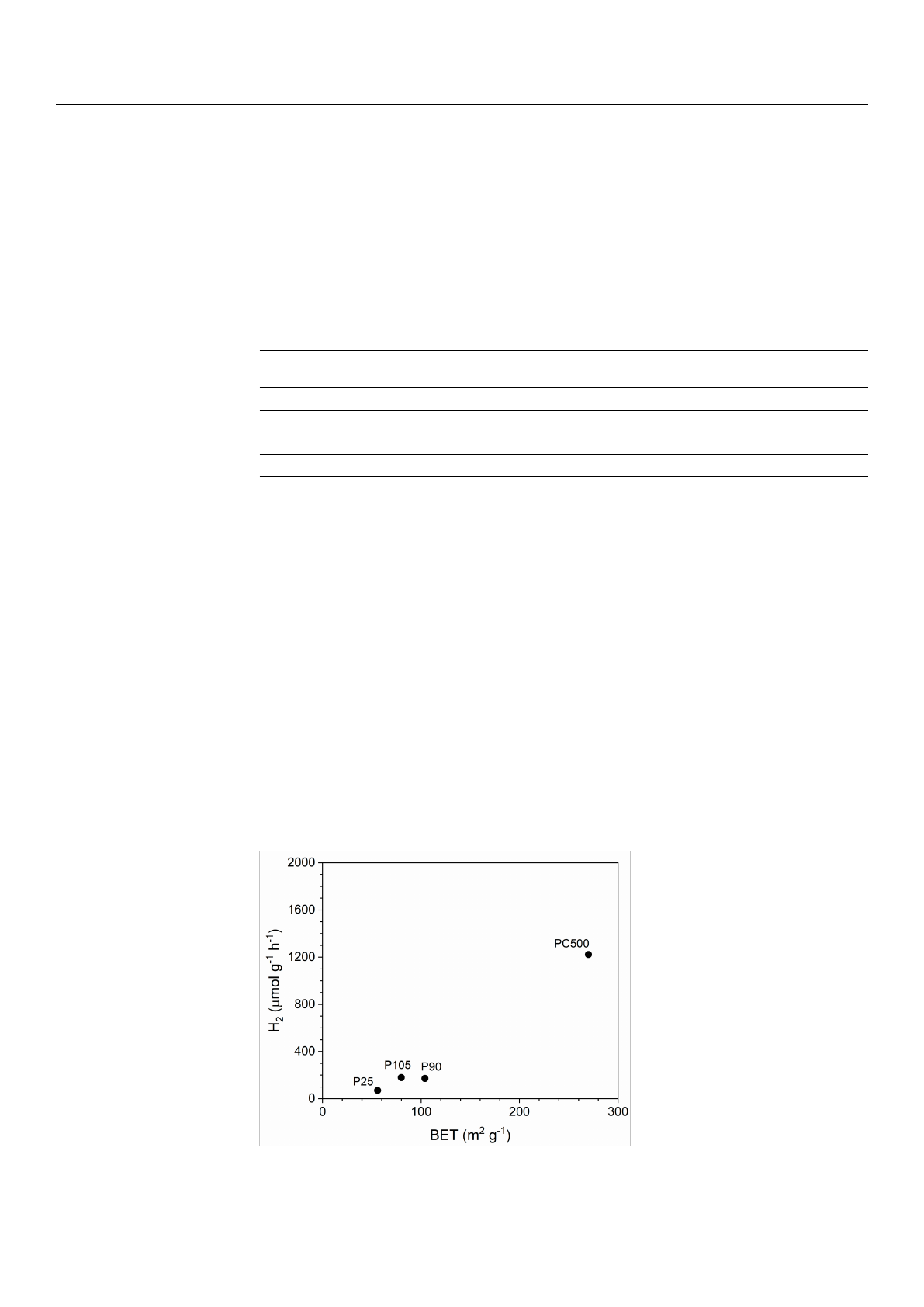
There are differences in the hydrogen productivity, as expected. The lowest rate is
observed for P25 (about 48
µ
mol g
−1
h
−1
), and the highest rate is obtained for PC500
(about 1222
µ
mol g
−1
h
−1
). The catalytic activity for all investigated titania catalysts is
in the following order: PC500 > PC105 > P90 > P25. The hydrogen productivity is plot-
ted vs. the surface area (Figure 1), and there is quite a good correlation between them.
When the surface area increases by a factor of about 5, the activity increases by a factor
of about 25. The surface area is crucial in catalysis because it provides better adsorption
abilities for the reactants. Increased activity has been reported, e.g., by Amano et al. for the
decomposition of acetaldehyde [
36
] or by Cheng et al. for the degradation of dyes [
37
]. Fur-
thermore, improved hydrogen production from high surface area carbon nitride prepared
via
a sol-gel
route is reported by Kailasam et al., that outperforms bulk carbon nitride [
38
].
For further evaluation, the H
2
activity was normalized to the surface area, showing an
over-proportional increase for PC500. If only the surface area is responsible for H
2
pro-
ductivity, a linear trend is expected, as shown by Amano et al. [
36
]. This is not the case,
and therefore other TiO
2
characteristics must be considered, too. It is assumed that here,
the smaller crystallite size (6.0 nm) of PC500 is responsible for the over-proportional H
2
productivity. A smaller crystallite size is better for the charge separation after irradiation
and lowers the probability of charge recombination.
Figure 1.
Hydrogen productivity as a function of the BET surface area for different commercial TiO
2
catalysts (cTiO2= 0.56 g L−1, 300 W Xe lamp (full spectrum), and 10 vol.% ethanol).
Catalysts 2021,11, 1027 4 of 15
Even though a high surface area material is beneficial for photocatalysis in most
cases, further modification of the photocatalyst is necessary. One technique is the modi-
fication of the photocatalyst using noble-metal nanoparticles as co-catalysts. The noble-
metal co-catalyst can act as an electron trap and thus lower the electron–hole charge
recombination [39].
2.2. Impact of Pt Immobilization
As TiO
2,PC500
showed the highest value for hydrogen productivity, it was used in the
further experiments. The main goal of the second step was the improvement of hydrogen
productivity by using a co-catalyst. For this purpose, PtNPs were immobilized onto
the surface of TiO
2,PC500
as it is well-known that PtNPs are the most active co-catalyst
for H
2
production [
40
–
42
]. Two methods were used for the immobilization of PtNPs:
(a) a colloidal
approach and (b) photodeposition. Further, besides the deposition method,
the reducing agent was also varied. Often, the metal salt precursor is simply reduced
to metal nanoparticles using an excess of sodium borhydride or ascorbic acid. Here,
the precursor is reduced using green reductants, e.g., grape seed, clove, or mangosteen.
These reducing agents contain polyphenols and have been reported as efficient to produce
active nanoparticles. Recently, Parapat et al. used the colloidal approach in combination
with green reductants to prepare Pt@Al
2
O
3
catalysts for the hydrogenation of a-methyl
styrene [33]. The catalysts prepared using the green reductants were more active than the
catalysts prepared with ascorbic acid. To follow the idea to produce a very active catalyst
for water reduction based on TiO
2
, this method was adopted. The hydrogen productivity
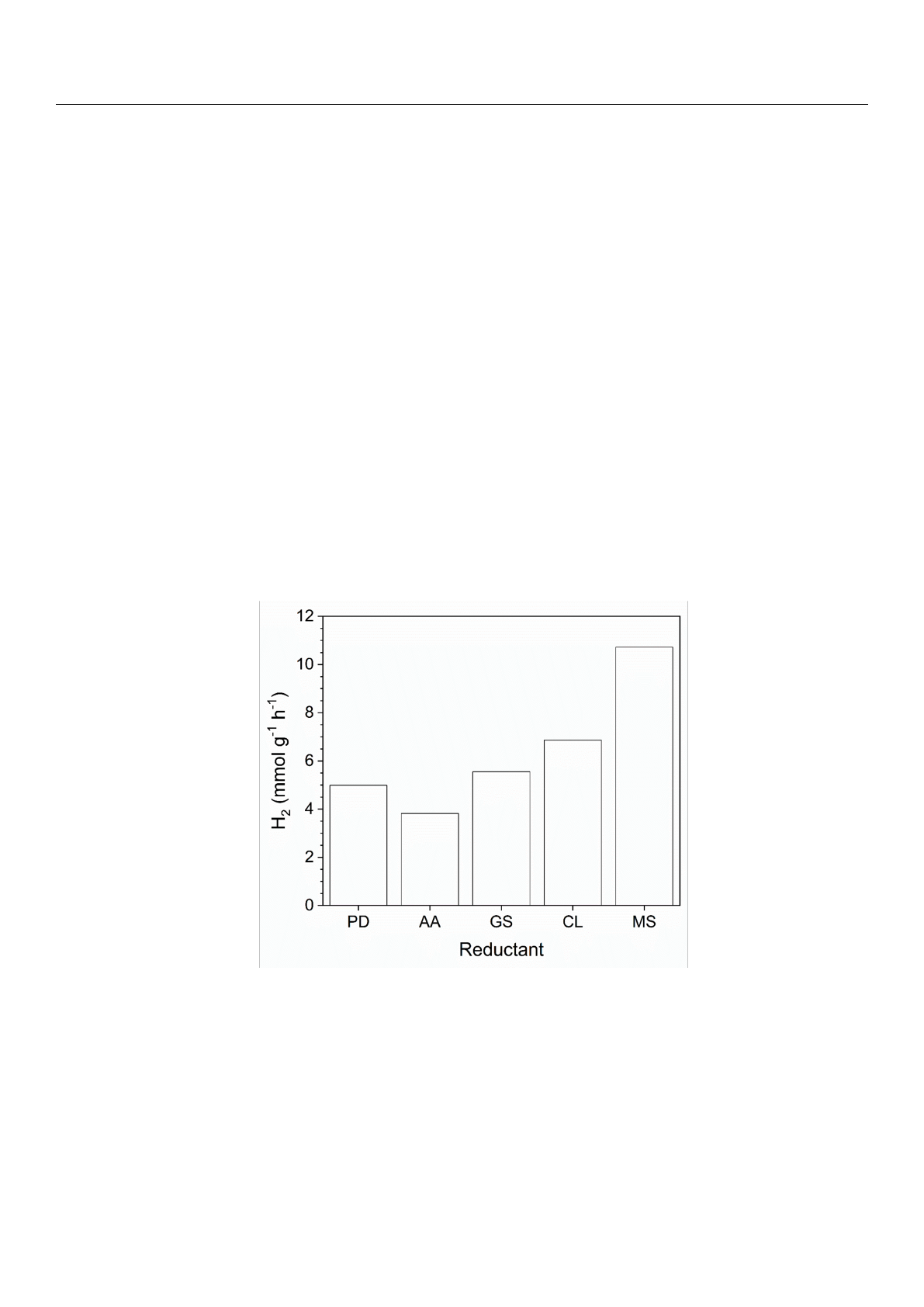
is shown in Figure 2.
Figure 2.
Hydrogen productivity with Pt@PC500 (T = 30
◦
C, c
Pt@PC500
= 0.5 g L
−1
) prepared by
photodeposition (PD), and the colloidal approach with different reductants (AA: ascorbic acid, GS:
grape seed, CL: clove, MS: mangosteen) measured with a 300 W Xe lamp (full spectrum) and ethanol
(10 vol.%) as the sacrificial agent.
As shown, the preparation conditions have an impact on the activity and hydrogen
productivity of Pt@PC500. Related to the amount of used catalyst, the activities were in the
following order: MS > CL > GS > PD > AA. The highest activity of about
10 mmol g−1h−1
was obtained for the catalyst that used mangosteen as the reducing agent. The activity
was about two times higher compared to ascorbic acid as the reducing agent and about
seven times higher compared to pure PC500. In comparison to the pure PC500 powder, the
individual properties of the prepared Pt@PC500 must be compared in detail to understand
the differences in the photocatalytic activity. The first parameter that can be responsible is

Catalysts 2021,11, 1027 5 of 15
the Pt loading. A nominal Pt loading of 1 wt.% was aspired for all samples, but the real
loading, determined by ICP-OES, was in the range of 0.3–0.5 wt.%. The highest loading
of about 0.49 wt.% was obtained for Pt@PC500 prepared by PD (Table 2,
Entry 2
). The
lowest loading of about 0.31 wt.% was determined for Pt@PC500 prepared via the colloidal
approach with AA as the reducing agent (Table 2, Entry 3). The loading of Pt@PC500
prepared by the colloidal approach with the natural reductants GS, CL, and MS was
about 0.37 wt.% (Table 2, Entry 4–6). The XRD spectra were recorded for Pt@PC500 (not
shown), but no change was observed. Due to both the low Pt loading and small size of Pt
nanoparticles, the Pt signal was not observed in XRD.
Table 2.
Hydrogen productivity (
±
10%) for as-prepared Pt@PC500 photocatalysts (T = 30
◦
C, c
Pt@PC500
= 0.5 g L
−1
, 300 W
Xe lamp (full spectrum), and 10 vol.% ethanol).
Entry Method Nominal Loading
(wt.%)
ICP-OES Loading
(wt.%)
SA
(m2g−1)
H2
(mmol g−1
cat h−1)
H2
(mol g−1
Pt h−1)
1 without Pt - - 270 1.4 -
2 PD 1.0 0.49 275 5.0 1.0
3 AA 1.0 0.31 239 3.8 1.2
4 CL 1.0 0.37 305 6.9 1.9
5 GS 1.0 0.36 247 5.6 1.5
6 MS 1.0 0.37 309 10.1 2.7
Non-quantitative loading of Pt for the two methods is known. The main reason is that
in both cases, the nanoparticles are firstly produced in solution, and secondly deposited
onto PC500. Therefore, the contact of the Pt precursor and the PC500 support material
before starting the reduction is low. As shown, the H
2
productivity does not only depend
on the Pt loading. The highest value of about 10 mmol g
−1
h
−1
was obtained for MS as
the reduction agent, which was not the highest loading among the produced catalysts. If
hydrogen productivity is normalized to the amount of Pt, the following order of activity
is obtained: MS > CL > GS > AA > PD. Still, the more active Pt@PC500 photocatalyst
is produced by the colloidal approach using a green reductant. If only the total amount
of immobilized Pt is responsible for the different activities, the H
2
values (
mol g−1
Pt h−1
)
should be similar. As it is obvious from Table 2, the PtNPs which are produced using the
green reductants as the reducing agent are used more efficiently than the PtNPs produced
by photodeposition. Such a difference can only be explained by the individual properties of
the produced nanoparticles, such as size, shape, and dispersion. To obtain more information
about the nature of the produced PtNPs, TEM measurements were performed. Figure 3
shows a larger section of the Pt@PC500 photocatalysts produced. From these images, first,
general information about the size and distribution of the PtNPs can be obtained.
As can be seen, there are clear differences in the PtNPs produced by photoreduction
and the colloidal method with different reductants. The PtNPs produced by photoreduction
are strongly agglomerated and form larger particles (Figure 3A,B). Further, they are not very
homogenously distributed. The PtNPs produced by the colloidal method with ascorbic
acid as the reductant are also large, however less agglomerated (Figure 3C). In comparison
to the photoreduction, in this case, the PtNPs are better distributed. All the PtNPs obtained
using the natural reductants in the colloidal deposition process are much smaller with
good distribution, and show no agglomeration.
For further evaluation, particle size and particle size distribution of PtNPs were
determined from TEM images using Digital Micrograph
®
from Gatan. The TEM images
with considered PtNPs (marked as red circles) and the respective histograms are shown
in Supplementary Figures S4–S8. Mean particle sizes and deviations are summarized
in Table 3.
Loading more pages...