
energies
Article
Co-Digestion of Rice Straw with Cow Manure in an Innovative
Temperature Phased Anaerobic Digestion Technology:
Performance Evaluation and Trace Elements
Furqan Muhayodin 1,2,*, Albrecht Fritze 1, Oliver Christopher Larsen 1, Marcel Spahr 3
and Vera Susanne Rotter 1
Citation: Muhayodin, F.; Fritze, A.;
Larsen, O.C.; Spahr, M.; Rotter, V.S.
Co-Digestion of Rice Straw with Cow
Manure in an Innovative
Temperature Phased Anaerobic
Digestion Technology: Performance
Evaluation and Trace Elements.
Energies 2021,14, 2561. https://
doi.org/10.3390/en14092561
Academic Editor: Daehwan Kim
Received: 30 March 2021
Accepted: 26 April 2021
Published: 29 April 2021
Publisher’s Note: MDPI stays neutral
with regard to jurisdictional claims in
published maps and institutional affil-
iations.
Copyright: © 2021 by the authors.
Licensee MDPI, Basel, Switzerland.
This article is an open access article
distributed under the terms and
conditions of the Creative Commons
Attribution (CC BY) license (https://
creativecommons.org/licenses/by/
4.0/).
1Department of Environmental Technology, Chair of Circular Economy and Recycling Technology,
2Department of Farm Machinery and Power, University of Agriculture, Faisalabad 38000, Pakistan
3Herbst Umwelttechnik GmbH, Goerzallee 305E, 14167 Berlin, Germany; [email protected]
*Correspondence: fur[email protected]
Abstract:
Rice straw is an agricultural residue produced in abundant quantities. Open burning and
plowing back the straw to the fields are common practices for its disposal. In-situ incorporation and
burning cause emissions of greenhouse gas and particulate matter. Additionally, the energy potential
of rice straw is lost. Anaerobic digestion is a technology that can be potentially used to utilize the
surplus rice straw, provide renewable energy, circulate nutrients available in the digestate, and
reduce greenhouse gas emissions from rice paddies. An innovative temperature phased anaerobic
digestion technology was developed and carried out in a continuous circulating mode of mesophilic
and hyperthermophilic conditions in a loop digester (F1). The performance of the newly developed
digester was compared with the reference digester (F2) working at mesophilic conditions. Co-
digestion of rice straw was carried out with cow manure to optimize the carbon to nitrogen ratio and
to provide the essential trace elements required by microorganisms in the biochemistry of methane
formation. F1 produced a higher specific methane yield (189
±
37 L/kg volatile solids) from rice
straw compared to F2 (148
±
36 L/kg volatile solids). Anaerobic digestion efficiency was about
90 ±20%
in F1 and 70
±
20% in F2. Mass fractions of Fe, Ni, Co, Mo, Cu, and Zn were analyzed over
time. The mass fractions of Co, Mo, Cu, and Zn were stable in both digesters. While mass fractions of
Fe and Ni were reduced at the end of the digestion period. However, no direct relationship between
specific methane yield and reduced mass fraction of Fe and Ni was found. Co-digestion of rice straw
with cow manure seems to be a good approach to provide trace elements except for Se.
Keywords:
rice straw; cow manure; anaerobic digestion; trace elements; temperature; methane;
nutrients; renewable energy
1. Introduction
Rice straw (RS) is an agricultural residue that is available in abundant supply. Ap-
proximately 846 million tons were produced in 2017 globally [
1
]. Present uses are limited
to cooking, feeding animals, constructing buildings, and making paper [
2
]. However, the
largest share of produced RS is left in the fields [
2
]. Open burning and plowing the straw
back to the fields are common practices for its disposal, contributing to greenhouse gas
emissions to the atmosphere [3,4], and its energy potential is also lost [5].
Anaerobic digestion (AD) may offer a promising approach to convert RS into biogas.
It can play a dual role in producing renewable energy and treating waste [
6
]. RS also
has good theoretical methane potential (TMP) and it can be calculated as proposed by
Baserga [
7
], resulting in 207 to 211 L/kg VS [
8
]. Moreover, the specific methane yield (SMY)
under different experimental conditions were reported by various authors in their studies,
such as 231 L/kg VS [9], 120 L/kg VS [10], 226 L/kg VS [11], and 100 L/kg TS [12].
Energies 2021,14, 2561. https://doi.org/10.3390/en14092561 https://www.mdpi.com/journal/energies

Energies 2021,14, 2561 2 of 20
Although AD seems an attractive option for energy recovery based on its SMY, the
main obstacle to this process is the microbial degradation of the lignocellulosic substrate
like RS [
5
]. Various types of pre-treatments have been used to separate lignin from the
cellulose so the cellulose can be anaerobically digested easily. The results of several studies
showed the effectiveness of physical, thermal, chemical, and biological pre-treatments of
RS [
13
–
16
]. Although pre-treatment of RS is effective, it often needs high energy input or
chemicals that are not feasible for farm-scale applications.
There have been other developments in the field of AD of RS apart from the various
pre-treatments. These developments include the usage of appropriate inoculum and co-
substrates, optimal selection of mixing in the digesters, suitable organic loading rate (OLR),
recycling of liquid digestate (LD) to the digesters, and supplementation of trace elements
(TEs). These developments have been used to enhance the energy recovery in the AD of RS
but are mostly implemented at the lab-scale or pilot-scale. The AD of RS at the farm-scale
is still minimal in practice [
17
]. There is a need for the development of AD technology
that can improve the degradation of RS without or with little pre-treatment and without
external supplementation of TEs to make it feasible for farm-scale applications.
In this work, an innovative temperature-phased anaerobic digestion (TPAD) tech-
nology named “loop digester” was developed by Herbst Umwelttechnik in the “BioRist
Project: A joint research project for innovative process technology for biogas production
from rice straw“ [
18
]. The TPAD was carried out in a “Loop-digester”, working in a contin-
uous process under circulating mesophilic and hyperthermophilic conditions. This process
aims to digestion a substrate under both temperature conditions (two microbial environ-
ments) to enhance energy recovery in the form of SMY. This technology is patented for the
European and Southeast Asian market with international patent no WO 2018/138368 AI
owned by Herbst Umwelttechnik.
AD is a complex biological process. Temperature is one of the most significant param-
eters affecting the activities, survival, and growth of microorganisms [
19
]. Traditionally,
thermophilic (55
◦
C) AD is less used than mesophilic (37
◦
C) because of its lower process
stability and higher energy demand [
20
]. Several studies reported the advantage of the
thermophilic AD by achieving higher biogas yield using the RS as a substrate [
11
,
12
,
19
].
However, temperature variation should not exceed 0.6
◦
C/day to maintain a stable pro-
cess [
21
]. The advantages of mesophilic AD include less energy demand and better stability
of the process. Therefore, combining mesophilic and thermophilic conditions by TPAD
could bring the advantages of both temperature conditions [
22
]. TPAD technology usually
consists of a first thermophilic stage with a short retention time. This stage acts as a pre-
treatment step to improve the hydrolysis rate. It is followed by a longer mesophilic stage
intending to effectively remove organic matter and degradation of soluble compounds
released under thermophilic conditions [23].
There have been some studies investigating the TPAD technology. Ge et al. [
22
]
evaluated a thermophilic-mesophilic TPAD technology against a mesophilic-mesophilic
TPAD during the treatment of primary sludge. Han et al. [
24
] compared the performance
of the TPAD technology (55
◦
C and 35
◦
C) with the conventional single-stage mesophilic
approach (35
◦
C) for the treatment of the mixtures of primary and waste activated sludge.
Similarly, Watts et al. [
25
] also compared the performance of the TPAD technology (47, 54,
and 60
◦
C) with the conventional single-stage mesophilic (36 and 37
◦
C) treating waste
activated sludge. Gianico et al. [
23
] proposed an inverse TPAD, different from the studies
mentioned above [
22
,
24
,
25
]. The technology is named ultrasound-mesophilic-thermophilic
(UMT) and is used for the treatment of sludge. The first step involves the hydrolysis of
particulate organic matter and performs mechanically using ultrasounds. The second step
occurs in a mesophilic digester. The third step is the thermophilic digester [23].
TPAD was carried out in two stages in these studies. Therefore, the substrate was
not subjected to microbes working on both temperature conditions in a continuous mode.
The working of these microbes in a continuous mode may have resulted in even better
performance. Furthermore, only various sludges were investigated in these studies. TPAD

Energies 2021,14, 2561 3 of 20
has not been applied for the AD of any lignocellulosic substrate such as RS, which is avail-
able in abundant quantity. It is, therefore plausible, to apply TPAD for RS in an innovative
continuous mode using a newly developed loop digester, The RS was co-digested with cow
manure (CoM), while all the studies mentioned above, were used only for the treatment
of various sludges [
22
–
25
]. The performance of the loop digester (F1) was compared with
a conventional mesophilic digester (F2) using the key performance indicators (KPI) SMY,
anaerobic digestion efficiency (ADE), and volumetric methane production rate (VMPR).
In addition to TPAD, the integration of appropriate microbes necessary to break down
the lignocellulosic substrates can also be achieved by co-digestion [
5
]. Co-digestion of RS
with various substrates has been proved to be very effective in both lab and pilot-scale
experiments [
5
,
26
–
28
]. Co-digestion improves substrates treatability since it provides
process stability, a better C/N ratio, increased biodegradation, adjust moisture content,
a supply of TEs, and, therefore, enhance energy recovery [
29
,
30
]. Several TEs such as
iron (Fe), nickel (Ni), zinc (Zn), molybdenum (Mo), selenium (Se), tungsten (W), cobalt
(Co), and copper (Cu) are essential for enzyme cofactors involved in the biochemistry of
methane (CH
4
) formation [
31
]. An appropriate amount of TEs is required to maintain
the effective growth and metabolism of microorganisms. Various authors have reported
the requirements of different TEs in the AD process [
32
–
35
]. A higher amount can cause
inhibition due to the disruption of an enzyme’s structure and function [
36
]. Apart from
these reported requirements of TEs in the AD process, some researchers also studied the
effect of supplementation of TEs (Fe, Co, Ni, and Se) on CH
4
yield during the mono-
digestion of RS. They observed improvement in CH
4
yield due to the supplementation of
these TEs [37,38].
Co-digestion of RS has usually been investigated to adjust the C/N ratio [
26
–
28
].
Co-digestion may or may not provide enough TEs. Furthermore, maybe, depletion of TEs
happened and adversely affected the performance of AD. These aspects were not well
considered by the researchers in their studies [5,26–28].
The main purpose of this study was to evaluate and compare the performance of
the newly developed F1 and the reference F2 during the co-digestion of RS with CoM.
Therefore, a hypothesis was formulated that the “F1 (TPAD technology) would increase
the performance of co-digestion of RS with CoM in terms of SMY, ADE, and VMPR”.
Overall, this research work aimed to (1) investigate the performance of the F1 and F2
during the co-digestion of RS with CoM by evaluating the KPI; (2) identify the possible
TEs accumulation/depletion and its effects on the CH
4
yield; (3) quantify the TEs in the
digesters and compare their concentrations with recommended literature values because a
sufficient amount is essential for stable CH4yield.
2. Materials and Methods
2.1. Substrates
A bale of RS (approximately 150 to 200 kg) was obtained from a farmer from northern
Italy. The collected RS was cut into 10–30 mm pieces by a straw cutter (includes chopping,
cutting, and milling) before adding to the digesters. The straw was stored in a dry place.
Fresh CoM was collected from a cow farm in Brandenburg near Berlin, Germany. The
collection of CoM was conducted in four sets (CoM
1
, CoM
2
, CoM
3
, and CoM
4
) and stored
in the lab during the experiment. The volume of each set varies on the duration of its usage
approximately from 60 to 80 L. CoM
1
was the first set of manure, and it was also used
during the commissioning of the experiment. The detail about the duration of usage and
storage of each set of manure is presented in Table 1The samples of each set were taken on
the first day of manure collection and used to analyze the reported parameters in Table 2.
The manure was kept in the lab for feeding the digesters. For sampling, about 15 to 20 kg
of RS was collected from random locations in the bale. It was size reduced with the straw
cutter. Then a representative sample from this sample was taken for the analysis of the
required parameters.

Energies 2021,14, 2561 4 of 20
Table 1. CoM used during the experiment.
Digester Experimental Day CoM
F1 and F2
1 to 50 CoM1
51 to 172 CoM2
173 to 245 CoM3
246 to 314 CoM4
CoM1,2,3,4, Cow manure in four sets.
Table 2.
The values represent the arithmetic mean (Avg) with the range (min/max) of double or triple determination. The
parameters with a single value have been received from an external lab.
Parameter RS
Avg (Min/Max)
CoM1
Avg (Min/Max)
CoM2
Avg (Min/Max)
CoM3
Avg (Min/Max)
CoM4
Avg (Min/Max)
TS (%) 89.7 (89.6/89.8) 5.8 (5.6/6.1) 7.8 (7.8/7.9) 8.4 (8.1/8.6) 8.6 (8.6/8.6)
VS (% of TS) 84.6 (84.6/84.6) 75.0 (74.6/75.5) 78.0 (78.0/78.0) 75.4 (74.9/76.0) 75.1 (74.9/75.4)
x_C (% of TS) 40.9 (40.9/40.9) 39.5 (39.4/39.6) 40.4 (40.4/40.4) 40.8 (40.6/41.1) 40.8 (40.6/41.0)
x_N (% of TS) 0.82 (0.82/0.83) 1.82 (1.75/1.88) 1.95 (1.93/1.97) 2.24 (2.22/2.27) 1.78 (1.77/1.80)
C/N_Calculated 49.6 (49.4/49.8) 21.8 (21.1/22.5) 20.7 (20.5/20.9) 18.2 (17.9/18.5) 22.9 (22.5/23.2)
x_XP (% of TS) 3.9 NA 19.4 22.7 21.5
x_XF (% of TS) 38.3 NA 17.9 26.1 17.4
x_XL (% of TS) 0.5 NA 2.9 2.2 2.3
x_XA (% of TS) 15.8 NA 22.3 23.8 24.5
Fe (mg/kg TS) 265 (262/267) NA NA 1115 (1058/1172) 1431 (1382/1480)
Ni (mg/kg TS) 1.69 (1.41/1.96) NA NA 2.62 (2.55/2.69) 2.85 (2.84/2.86)
Co (mg/kg TS) 0.59 (0.58/0.60) NA NA 0.88 (0.77/1.03) 1.15 (1.12/1.18)
Mo (mg/kg TS) 1.10 (1.08/1.11) NA NA 1.26 (1.23/1.29) 1.16 (-/-)
Cu (mg/kg TS) NA NA NA NA 72.9 (70.8/75.1)
Zn (mg/kg TS) NA NA NA NA 296 (288/303)
Se (mg/kg TS) BDL BDL BDL BDL BDL
RS, Rice straw; CoM
1,2,3,4
, Cow manure in four sets; TS, Total solids; VS, Volatile solids; x, Mass fractions; XP, Crude protein; XF, Crude
fiber; XL, Crude fat; XA, Crude ash; NA, Not analyzed; BDL, Below detection limit.
Prior to sampling, the CoM was mixed thoroughly. Several subsamples were taken
and mixed to make a composite sample and used for analysis.
The general characteristics of RS and CoM, such as total solids (TS), volatile solids
(VS), total C, total N, and C/N ratio, are presented in Table 2. Moreover, the content of
crude protein (XP), crude fiber (XF), crude fat (XL), crude ash (XA), and TEs are presented
in Table 2. All four sets of CoM were brought from the same source. All the analyzed
parameters were similar in all sets. Therefore, it was assumed to have similar content of
TEs in all sets of CoM and therefore only analyzed in CoM3and CoM4.
2.2. Experimental Setup
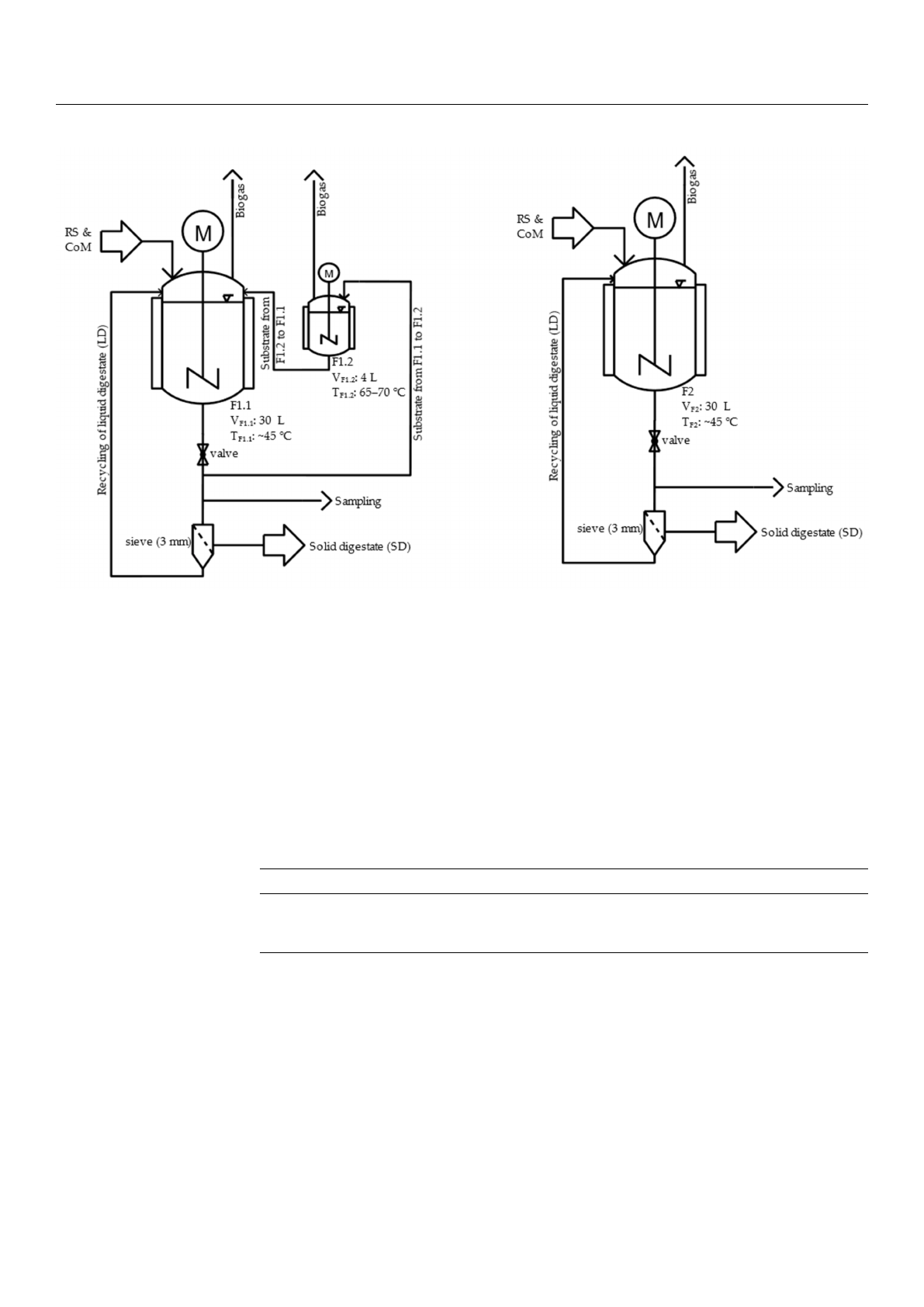
F1 consisted of two different continuously stirred tank reactors (CSTR) working in a
loop. The working net volume of the first CSTR of F1 (F1.1) was 30 L, and the second CSTR
(F1.2) was 4 L. These two CSTRs of F1 were operated at two temperature conditions. F1.1
was working at mesophilic (nearly 45
◦
C), while F1.2 was working on hyperthermophilic
conditions (65–70
◦
C). F2 was working as a reference at mesophilic conditions (45
◦
C)
with a net volume of 30 L. The digesters contained ports for various purposes such as
biogas collection, mechanical agitation, temperature control, feeding, and removal of the
substrates. The schematic diagram of both digesters is shown in Figure 1.
Energies 2021,14, 2561 5 of 20
Figure 1.
Schematic diagram of the experimental setup with a recycling of liquid digestate; RS, Rice straw; CoM, Cow
manure; F1.1 and F1.2, Loop digester; F2, Reference digester; LD, Liquid digestate; SD, Solid digestate.
2.3. Experimental Design and Operation
The digesters used in this study were already working with RS and CoM. The sludge
contained in both the digesters was used to continue the experiments in this study. There-
fore, no external inoculum was used in this study for the commissioning.
Co-digestion of RS with CoM was carried out for 314 days. About 45 days were used
for commissioning. The feeding was started with a relatively low OLR at 2.2 g VS L
−1
d
−1
.
The OLR and hydraulic retention time (tHR) during the experiment were changed in both
digesters, as presented in Table 3. While tHR was 3 to 4 days in F1.2.
Table 3. OLR and tHR during the experiment.
Digester Experimental Day OLR (g VS L−1d−1) tHR (Days)
F1 and F2
1 to 50 3.4 35
51 to 95 3.2 50
96 to 314 4.3 40
OLR, Organic loading rate; tHR, Hydraulic retention time.
Also, four sets of CoM were used in the experiment, as presented in Table 1.
F1 and F2 were fed once a day, seven days a week, with a freshly prepared mixture of
RS and CoM during the whole experiment. The amount of RS and CoM was different at
different OLR. About 1.0 to 1.1 L of the substrate from F1.1 was fed into F1.2, and an almost
similar amount was fed back to F1.1 daily. The LD was obtained manually by filtering the
digestate through a sieve with a 3 mm mesh size. The LD was recycled to both digesters
daily to dilute the substrates and to keep a constant TS content in the digesters. The solid
digestate (SD) remained after the filtration process was discarded.
2.4. Sampling Plan
The process parameters such as FOS/TAC ratio (Flüchtige Organische Säuren/Totales
Anorganisches Carbonat) and ammonium (NH
4+
) were analyzed every week while pH was
Loading more pages...