
sustainability
Article
Does Car-Sharing Reduce Car Ownership? Empirical Evidence
from Germany
Aaron Kolleck
Citation: Kolleck, A. Does
Car-Sharing Reduce Car Ownership?
Empirical Evidence from Germany.
Sustainability 2021,13, 7384. https://
doi.org/10.3390/su13137384
Academic Editors: Margareta Friman,
Lars Olsson and Hugo Guyader
Received: 31 May 2021
Accepted: 28 June 2021
Published: 1 July 2021
Publisher’s Note: MDPI stays neutral
with regard to jurisdictional claims in
published maps and institutional affil-
iations.
Copyright: © 2021 by the author.
Licensee MDPI, Basel, Switzerland.
This article is an open access article
distributed under the terms and
conditions of the Creative Commons
Attribution (CC BY) license (https://
creativecommons.org/licenses/by/
4.0/).
Abstract:
The sharing economy is making its way into our everyday lives. One of its business models,
car-sharing, has become highly popular. Can it help us increase our sustainability? Besides emissions
and vehicle miles traveled, one key aspect in the assessment regards the effect of car-sharing on
car ownership. Previous studies investigating this effect have relied almost exclusively on surveys
and come to very heterogeneous results, partly suggesting spectacular substitution rates between
shared and private cars. This study empirically explores the impact of car-sharing on noncorporate
car ownership and car markets in 35 large German cities. The analysis draws on publicly available
data for the years 2012, 2013, 2015, and 2017, including, among others, the number of shared cars
per operating mode (free-floating and station-based) and the number of cars owned and registered
by private individuals (i.e., excluding company cars). We find that one additional station-based car
is associated with a reduction of about nine private cars. We do not find a statistically significant
relation between car ownership and free-floating car-sharing. Neither type of car-sharing appears
to impact the markets for used and new cars significantly. Given the measurable impacts on car
ownership levels, this result is surprising and invites future research to study car-sharing’s impact
on the dynamics of car markets.
Keywords: car-sharing; sharing economy; economic impact; car ownership; first difference
1. Introduction
The sharing economy is considered a trend that fundamentally disrupts consumer
habits, the organization of value chains, and economic activities. Through sharing instead
of owning, the sharing economy promises temporary and flexible access to often expensive
resources. Car-sharing has been available as a mobility service in many cities worldwide
for quite some time [
1
]. Some of its users see it as an alternative to owning a car [
2
]. From
a societal perspective, shared use of cars can reduce the number of vehicles required to
serve mobility demand. This can reduce (external) costs associated with production and
relieve notoriously scarce parking capacities. In order to assess these benefits, the decisive
question is whether car-sharing represents a substitute for private car ownership.
Many survey-based studies show that car-sharing can substantially reduce car owner-
ship among members [
3
–
7
]. However, as car-sharing has long been a niche phenomenon,
the environmental and economic implications have been marginal. Furthermore, findings
among early adopters might not always be generalizable to mass markets, and surveys
can be prone to different biases. Now, in some parts of the world, including Germany,
car-sharing has experienced considerable growth. With more than 2.5 million, the num-
ber of registered users in Germany has increased more than 15-fold in the past ten years
(multiple registrations possible), and the number of shared cars has increased more than
five-fold (see Section 2.2). Therefore, potential effects must be measured not only in surveys
but also empirically. This work revisits the body of interview-based studies and, for the
first time, tests the estimated substitution rates from these studies empirically. Instead of
using self-reports of the users, we assess the impact by observing city-level changes in
car-sharing, linking these to ownership rates and registrations of used and new cars. With
Sustainability 2021,13, 7384. https://doi.org/10.3390/su13137384 https://www.mdpi.com/journal/sustainability

Sustainability 2021,13, 7384 2 of 17
this approach, we focus on the gap between survey-based car-sharing studies and studies
empirically researching the impact of the sharing economy on incumbent industries [8].
Using panel data from Germany and a first-difference estimator, we investigate the
relation between car ownership, car registrations, and car-sharing for 35 large German
cities. The analysis draws on publicly available data for 2012, 2013, 2015, and 2017 and
includes the number of shared cars per operating mode and different controls. This study
focuses on shared cars that are either operated in a free-floating or station-based mode,
which covers the vast majority of shared cars in Germany.
We confirm previous findings to the extent that station-based car-sharing correlates
with a reduction in private car ownership (i.e., the stock of noncorporate cars). The effect
roughly corresponds to a replacement of nine private cars by one station-based shared car.
In contrast, we do not find a significant relation between car ownership and free-floating
car-sharing. Furthermore, neither type of car-sharing appears to have a significant and
reliable impact on the markets for used and new cars (i.e., the flow of privately purchased
cars). Given the measurable impacts on car ownership levels, this result is surprising and
invites future research to study car-sharing’s impact on the dynamics of car markets.
This paper is organized as follows. In Section 2, we introduce related research streams
and the development of car-sharing in Germany. Section 3then introduces the materials and
method. Section 4presents the results. We discuss and conclude our findings, implications,
limitations, and potential future research in Section 5.
2. Literature
This paper intends to integrate two literature streams: the impact of car-sharing and
substitutions between traditional markets and sharing platforms. The latter shares a similar
methodological approach and will be discussed in the following subsection. In the second
subsection, we will first give a short overview of car-sharing in Germany. Third, we give
an overview of the mainly survey-based research on station-based car-sharing. Ultimately,
in the fourth subsection, focusing on their impacts, we highlight differences between
station-based and free-floating car-sharing.
2.1. The Sharing Economy and Its Impacts
Airbnb is probably the most prominent example of the sharing economy and has
served as a “Guinea pig” for several empirical impact studies [
9
]. As such, Zervas et al. [
8
]
provided one of the first empirical studies to quantify the impact of the Sharing Economy
on an incumbent industry. Using a fixed-effects model, they find that a 1% increase in
Airbnb listings is related to a 0.05% decrease in quarterly hotel revenues in Texas, U.S. This
substitutive relation is most substantial among low-end hotels (economy, budget), while
higher-priced hotels are almost unaffected.
In a methodologically comparable manner, Barron et al. [
10
] provide strong empirical
evidence that Airbnb increases house prices and rents. They conclude that Airbnb listings
cause replacements of long-term rentals with short-term accommodation. Methodologically,
Barron et al. use a fixed-effects model with an instrument variable. The collected data
from 2012 to 2016 includes monthly zip code-level data on Airbnb listings, house prices
and rents, and several controls. Other literature on shared housing quantifies the relation
between shared lodging and crime [
11
] and between Airbnb offerings and hotel pricing in
Italy [12].
Airbnb is not the only example of the sharing economy whose impact has been
studied empirically. Some studies examine ride-hailing services, such as Uber’s effect on
the number of business start-ups [
13
] and its effect on traffic congestion [
14
]. These studies
typically interpret the entry of Uber into a city as a form of treatment and combine this
information with publicly available data, for example, by scraping information on the
number of funding campaigns or traffic congestion.
Sustainability 2021,13, 7384 3 of 17
2.2. Car-Sharing in Germany
There are two major operating modes for car-sharing in Germany: free-floating and
station-based. Free-floating cars can be found and parked in a predefined business area,
usually city centers. Members typically locate and rent cars via smartphone. In contrast
to station-based car-sharing, they usually pay a moderate registration fee and per trip
fees (distance or time) but no annual fee. Large-scale free-floating car-sharing started in
Germany in the year 2011 [15].
Station-based car-sharing started much earlier, the first offers launched in the 1980s.
Similar to car rental services, cars must be picked up and brought back to a station. The
differences between station-based car-sharing and car rental lie in the number of stations
and the rental process. Car-sharing stations are usually not staffed and consist of one or
two parking spaces. Customers usually book, pay, and open cars via a smartphone app,
sometimes combined with a customer or key card. Since most station-based firms charge a
basic fee, the share of inactive users is probably lower than among free-floating operators.
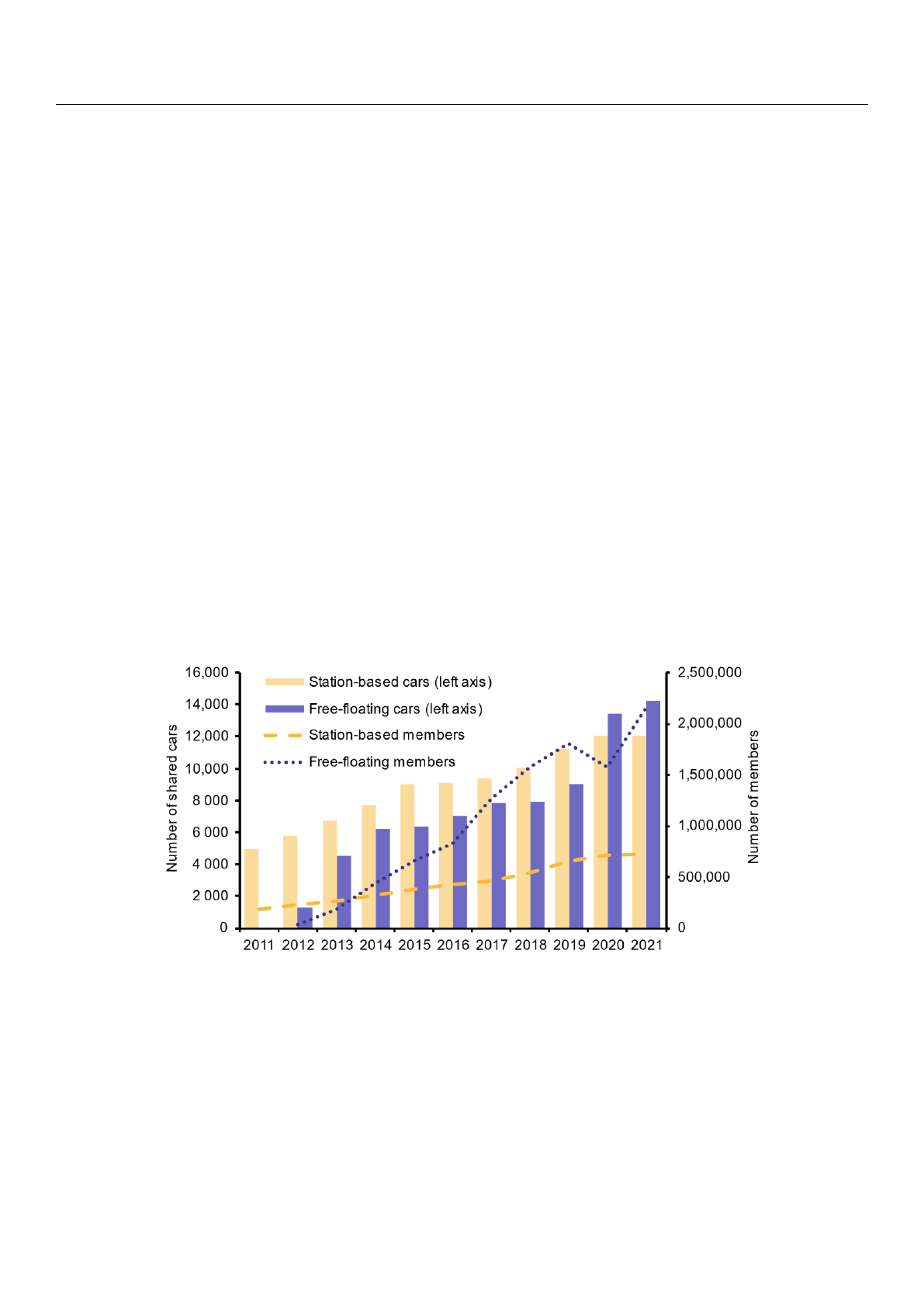
While station-based car-sharing was predominant for a long time, free-floating has
recently outnumbered station-based car-sharing regarding cars and users in Germany.
Figure 1illustrates this trend. As of 2021, free-floating car-sharing sums up to a total
of roughly 14,000 cars, which are available in 15, mainly large cities, operated by five
companies [
16
]. In contrast, station-based car-sharing is more decentralized than free-
floating car-sharing. There are over 200 providers at more than 6000 locations in 855 German
cities, operating 12,000 cars [
16
]. For comparison, the 82.8 million inhabitants of Germany
owned 40.5 million noncorporate cars (excluding motor homes), of which 8.5 million were
registered in district-free cities in 2017. Combined business models and private car-sharing
(peer-to-peer) played a marginal role in the observed years, so we counted combined cars
as free-floating and left privately shared cars out.
Sustainability 2021, 13, x FOR PEER REVIEW 3 of 17
information with publicly available data, for example, by scraping information on the
number of funding campaigns or traffic congestion.
2.2. Car-Sharing in Germany
There are two major operating modes for car-sharing in Germany: free-floating and
station-based. Free-floating cars can be found and parked in a predefined business area,
usually city centers. Members typically locate and rent cars via smartphone. In contrast to
station-based car-sharing, they usually pay a moderate registration fee and per trip fees
(distance or time) but no annual fee. Large-scale free-floating car-sharing started in Ger-
many in the year 2011 [15].
Station-based car-sharing started much earlier, the first offers launched in the 1980s.
Similar to car rental services, cars must be picked up and brought back to a station. The
differences between station-based car-sharing and car rental lie in the number of stations
and the rental process. Car-sharing stations are usually not staffed and consist of one or two
parking spaces. Customers usually book, pay, and open cars via a smartphone app, some-
times combined with a customer or key card. Since most station-based firms charge a basic
fee, the share of inactive users is probably lower than among free-floating operators.
While station-based car-sharing was predominant for a long time, free-floating has
recently outnumbered station-based car-sharing regarding cars and users in Germany.
Figure 1 illustrates this trend. As of 2021, free-floating car-sharing sums up to a total of
roughly 14,000 cars, which are available in 15, mainly large cities, operated by five com-
panies [16]. In contrast, station-based car-sharing is more decentralized than free-floating
car-sharing. There are over 200 providers at more than 6000 locations in 855 German cities,
operating 12,000 cars [16]. For comparison, the 82.8 million inhabitants of Germany owned
40.5 million noncorporate cars (excluding motor homes), of which 8.5 million were regis-
tered in district-free cities in 2017. Combined business models and private car-sharing
(peer-to-peer) played a marginal role in the observed years, so we counted combined cars
as free-floating and left privately shared cars out.
Figure 1. Development of shared cars and members in Germany by year and mode (data from Bundesverband CarSharing
e.V. [17]).
2.3. Station-Based Car-Sharing
Research on the use of car-sharing and its (possible) effects on private car ownership
is as old as car-sharing itself (see, e.g., [18], p.186 ff.). With the rise of the internet and
mobile access options in the first decade of the millennium, both station-based car-sharing
and its research became increasingly popular. A little less than a decade ago, the launch
of free-floating options sparked further interest, particularly regarding differences be-
Figure 1.
Development of shared cars and members in Germany by year and mode (data from Bundesverband CarSharing
e.V. [17]).
2.3. Station-Based Car-Sharing
Research on the use of car-sharing and its (possible) effects on private car ownership
is as old as car-sharing itself (see, e.g., [
18
], p.186 ff.). With the rise of the internet and
mobile access options in the first decade of the millennium, both station-based car-sharing
and its research became increasingly popular. A little less than a decade ago, the launch of
free-floating options sparked further interest, particularly regarding differences between
free-floating and station-based car-sharing. Almost all studies use customer surveys, asking
participants about their habits and their willingness to (not) own a private car given a
car-sharing option [
6
]. Nevertheless, in measuring, incentivizing, and isolating the actual
effects (e.g., using a control group), both the studies and their results differ considerably.

Sustainability 2021,13, 7384 4 of 17
Among the earliest and most prominent studies are those by Cervero et al. [
3
,
19
,
20
].
The three consecutive and survey-based studies analyze different effects of introducing a
station-based car-sharing service in the San Francisco Bay Area. Using non-members as
counterfactuals, the authors find that car-sharing reduces one or more cars in more than
20% of households [
3
]. Furthermore, 4.8% of participants claim they would have increased
the number of cars without car-sharing. Overall, the authors estimate 28 fewer cars per
100 members two years after introducing car-sharing, which corresponds to seven to ten
private cars replaced by one shared car (calculated from the reported numbers of shared
cars and members). Nonetheless, four years after introducing car-sharing, as part of the
third study, Cervero et al. found that the replacement rate had dropped: with a constant
user-to-shared-car ratio, one shared car replaces roughly five private cars. The authors
concluded that most of the reduction in private cars occurs one to two years after the
launch of a car-sharing service [20].
Similar studies followed, for example, a study that examines a station-based car-
sharing service in Philadelphia, Pennsylvania, U.S., finding a replacement rate of one to
23 [
4
]. This unusually high result is perhaps rooted in the lack of a control group and a
very optimistic set of early adopters. With a large-scale survey of roughly 6000 members of
different station-based car-sharing services in North America, Martin et al. found that the
average number of cars per member-household drops from 0.47 to 0.24 [
2
]. The authors
estimate that one shared car replaces between nine and thirteen private cars.
The specific context where car-sharing is offered might play a central role. Within
a station-based car-sharing scheme, addressing university members in Ithaca, NY, U.S.,
Stasko et al. estimate a reduction rate of 0.19 cars per member [
21
]. This reduction
corresponds to a replacement rate of one to 15 [
21
]. However, the authors note that
frequent users are more likely to participate in the survey, which may confirm concerns that
surveys are not representative of the population of car-sharing users. Other context-specific
factors are the availability of public transport and parking spaces, the types of shared cars,
and the cultural context. Two studies analyze station-based car-sharing in Seoul, South
Korea, and find that good public transport and parking space problems are critical to
motivating people to abandon cars [
22
,
23
]. The authors estimate that one station-based
car replaces three to five private cars, for the latter assuming a member-to-car ratio of 40:1,
which is the median ratio of all reviewed studies that report members and vehicles. Most
studies concern the early phase of sharing services, rendering the ratio low compared to
more current figures (see Figure 1). However, the share of active subscribers is unknown,
and survey participants are disproportionately active. Therefore, we consider a ratio of 40:1
as a conservative but reasonable benchmark [
22
,
23
]. Another study from China suggests
that the potential savings in the number of cars can be even greater in developing countries,
as most households do not yet own a car [24].
Many European studies on station-based car-sharing are not published in academic
journals but as final reports for various commissioned studies (see, e.g., [
25
,
26
]). One
exception investigates station-based, round-trip, and peer-to-peer car-sharing in the Nether-
lands [27]. While focusing on economic impacts, the study reports a total reduction in car
ownership of 0.4 cars per member [
27
], corresponding to a replacement rate of one to 16
(assuming a user-to-car ratio of 40:1).
Only a few studies use data sources other than surveys. One exception combines
Canadian census data, household surveys that feature travel data (“origin-destination”),
and data from a car-sharing service in Montreal [
28
]. The authors do not report substitution
rates but find that the number of private cars shrinks significantly in areas with high
availability of station-based shared cars [
28
]. Another non-survey-based study relies on
answers from the California Household Travel Survey, finding that users of car-sharing own
on average 0.27 fewer cars [
29
]. Attributing this difference to car-sharing and assuming
that one shared car serves 40 members, one shared car is equivalent to eleven private cars.

Sustainability 2021,13, 7384 5 of 17
In summary, all reviewed studies find a pronounced impact, ranging between three
and 23 replaced cars per station-based shared car. The average of the eight studies above,
in which substitution rates can be found or calculated, is 1:11.7 (median 1:11).
2.4. Differences between Station-Based and Free-Floating Car-Sharing
Ulm, Germany, was one of the first cities that witnessed the launch of a free-floating car-
sharing scheme. Following this development, Firnkorn and Müller analyzed the ecological
impact of the new free-floating car scheme in two subsequent studies [
30
,
31
]. The first study
relies on a cross-section survey, asking pedestrians about their willingness to abandon car
ownership. Correcting the answers with a flat rate, the authors estimated that roughly
2300 cars would be replaced on a five-year horizon, corresponding to a replacement rate of
one to 19. In the second study, one and a half years after introducing the car-sharing service,
the authors measured the actual reductions. Further, they asked members for a Likert scale
assessment of how causal car sharing was to any reduction. By only accounting for narrow
causality (high Likert values), the authors estimate a comparably low replacement rate
(1:2–4). With a broader interpretation of causality, they appraise the rate between five and
ten but acknowledge the estimate’s sensitivity against the share of inactive members.
A commissioned study accompanied the introduction of car2go, a free-floating car-
sharing service, in Frankfurt, Stuttgart, and Cologne, Germany [
25
]. Based on panel
interviews and controlling (among others) for demographic factors and difficulties with
the individual parking situation, they find that one car2go car substitutes between 0.3 and
0.8 private cars. Therefore, including the registrations of the shared cars, the number of
cars on the streets would increase.
Besides asking for actual behavior, for example, plans to scrap a car, some studies
apply discrete choice experiments, encountering participants with different travel modes
for a hypothetical trip. Such an experiment was conducted to estimate market potentials
and impacts of both car-sharing modes in London, UK. Most private cars are abandoned
due to station-based car-sharing (3.5%), while free-floating effects are relatively marginal
(0.5%) [
5
]. Another example comes from South Korea: while mainly focusing on the
environmental effects and choice patterns given different vehicle configurations, Jung and
Koo report that 16% of car-sharing users would abandon an existing car or forgo a planned
car purchase [
32
]. They find that one-way and delivery services increase the likelihood
of using car-sharing, thereby exacerbating car-sharing’s overall negative environmental
impact [32].
Le Vine and Polak find that 37% of users (are willing to) displace a car or did not
purchase a car due to a newly launched free-floating service in London [
33
]. With 40 mem-
bers per car, this reduction corresponds to a replacement rate of one to 15. The individual
probability of reducing car ownership due to car-sharing decreases with higher income
and higher education. A different study from Vancouver, Canada, mainly focuses on
differences between free-floating and station-based car-sharing users. The number of
cars per household decreases more among users of station-based car-sharing than among
free-floating users [
7
]. However, the estimated replacement rate of free-floating car-sharing
(1:6) is higher than for station-based car-sharing (1:5) [
7
]. This difference is due to relatively
more free-floating users serviced by relatively fewer cars.
Among the most comprehensive studies are those by Becker et al. [
6
,
34
], investigating
car-sharing in Basel, Switzerland. The authors include an untreated control group (non-
users of car-sharing), use a panel design (only [
6
]), travel diaries (only [
6
]), and incentivize
survey participation (only [
6
]). In their first study, Becker et al. find that more users of
station-based car-sharing (19%) than users of free-floating car-sharing (8%) would buy a
car if the service did not exist [
34
]. Assuming that 40 members share one car, this would
correspond to a replacement rate of roughly 1:7.6 and 1:3.2, respectively. The second study
follows a panel design. That is, Becker et al. measure actual ownership changes within
one year after the launch of a free-floating service. The reported total reduction of 6%
Loading more pages...