Nova Acta Leopoldina NF Nr. 425, 67–95 (2020), doi:10.26164/leopoldina_10_00275
67
Chimeras in Physics and Biology:
Synchronization and Desynchronization of Rhythms
Eckehard Schöll (Berlin)
Das Video zum Vortrag ist verfügbar unter https://doi.org/10.26164/leopoldina_10_00292.

Eckehard Schöll
68 Nova Acta Leopoldina NF Nr. 425, 67–95 (2020)
Abstract
Rhythms influence our life in various ways, e.g., through heart beat and respiration, oscillating brain currents, life
cycles and seasons, clocks and metronomes, pulsating lasers, transmission of data packets, and many others. The
physics of complex nonlinear systems has developed methods to describe and analyze periodic oscillations and
their synchronization in complex networks, which are composed of many components. Synchronized oscillations
as well as completely asynchronous chaotic oscillations play a major role in many networks in nature and technol-
ogy. For instance, the synchronous firing of all neurons in the brain represents a pathological state, like in epilepsy
or Parkinson’s disease, and should be suppressed, as well as the synchronous mechanical vibration of bridges. On
the other hand, synchronization is desirable for the stable operation of power grids or in encrypted communication
with chaotic signals. In networks composed of identical components, intriguing hybrid states (“chimeras”) may
form spontaneously, which consist of spatially coexisting synchronized and desynchronized domains, i.e., seemingly
incongruous parts. This might be of relevance in inducing and terminating epileptic seizures, or in unihemispheric
sleep which is found in certain migratory birds and mammals, or in cascading failures of the power grid.
Zusammenfassung
Rhythmen prägen unser Leben auf vielfältige Weise, z. B. durch Herzschlag und Atmung, oszillierende Gehirnströ-
me, Lebenszyklen und Jahreszeiten, Uhren und Metronome, pulsierende Laser, Übertragung von Datenpaketen, und
vieles andere. Die Physik komplexer nichtlinearer Systeme hat Methoden entwickelt, wie periodische Schwingungen
und deren Synchronisation in komplexen Netzwerken, die aus vielen Bestandteilen zusammengesetzt sind, beschrie-
ben und analysiert werden können. Synchronisierte Oszillationen, aber auch völlig desynchronisierte, chaotische
Oszillationen spielen eine große Rolle in vielen Netzwerken in Natur und Technik. Beispielsweise ist das synchroni-
sierte Feuern aller Neuronen im Gehirn ein pathologischer Zustand, etwa bei Epilepsie oder Parkinson-Erkrankung,
und sollte unterdrückt werden, wie auch synchrone mechanische Schwingungen von Brücken. Andererseits ist die
Synchronisation erwünscht beim stabilen Betrieb von Stromnetzen oder bei der verschlüsselten Kommunikation mit
chaotischen Signalen. In Netzwerken aus identischen Komponenten können sich überraschenderweise auch spontan
Hybrid-Zustände („Schimären“) bilden, die aus räumlich koexistierenden synchronisierten und desynchronisierten
Bereichen bestehen, welche scheinbar nicht zusammen passen. Diese könnten relevant sein bei der Auslösung oder
Beendigung epileptischer Anfälle, oder beim halbseitigen Schlaf einer Gehirnhälfte, der bei bestimmten Zugvögeln
oder Säugetieren auftritt, oder beim kaskadenartigen Zusammenbruch des Stromnetzes.
Chimeras in Physics and Biology: Synchronization and Desynchronization of Rhythms
Nova Acta Leopoldina NF Nr. 425, 67–95 (2020) 69
1. Synchronization of Rhythms in Complex Networks
Synchronization phenomena in nonlinear dynamical systems (Haken 1983, Pikovsky et
al. 2001, Mosekilde et al. 2002, Haken 2008, Balanov et al. 2009, Schöll et al. 2016,
Boccaletti et al. 2018) are of great importance in many areas ranging from physics and
chemistry to biology, neuroscience, socio-economic systems, and engineering. Probably the
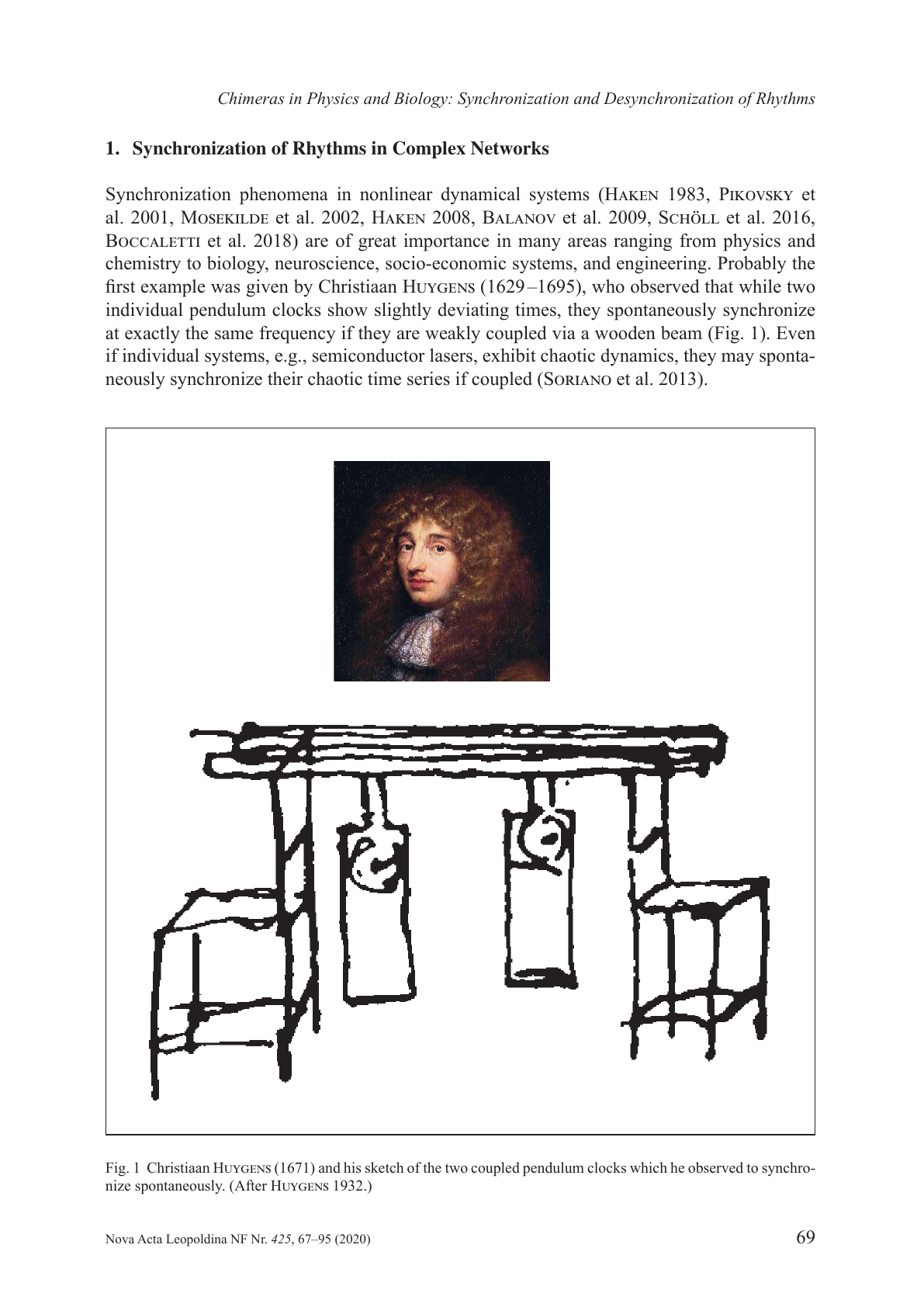
first example was given by Christiaan Huygens (1629 –1695), who observed that while two
individual pendulum clocks show slightly deviating times, they spontaneously synchronize
at exactly the same frequency if they are weakly coupled via a wooden beam (Fig. 1). Even
if individual systems, e.g., semiconductor lasers, exhibit chaotic dynamics, they may sponta-
neously synchronize their chaotic time series if coupled (Soriano et al. 2013).
1
Fig. 1 Christiaan Huygens (1671) and his sketch of the two coupled pendulum clocks which he observed to synchro-
nize spontaneously. (After Huygens 1932.)
Eckehard Schöll
70 Nova Acta Leopoldina NF Nr. 425, 67–95 (2020)
Synchronization of rhythms is also observed generally if more than two oscillating elements
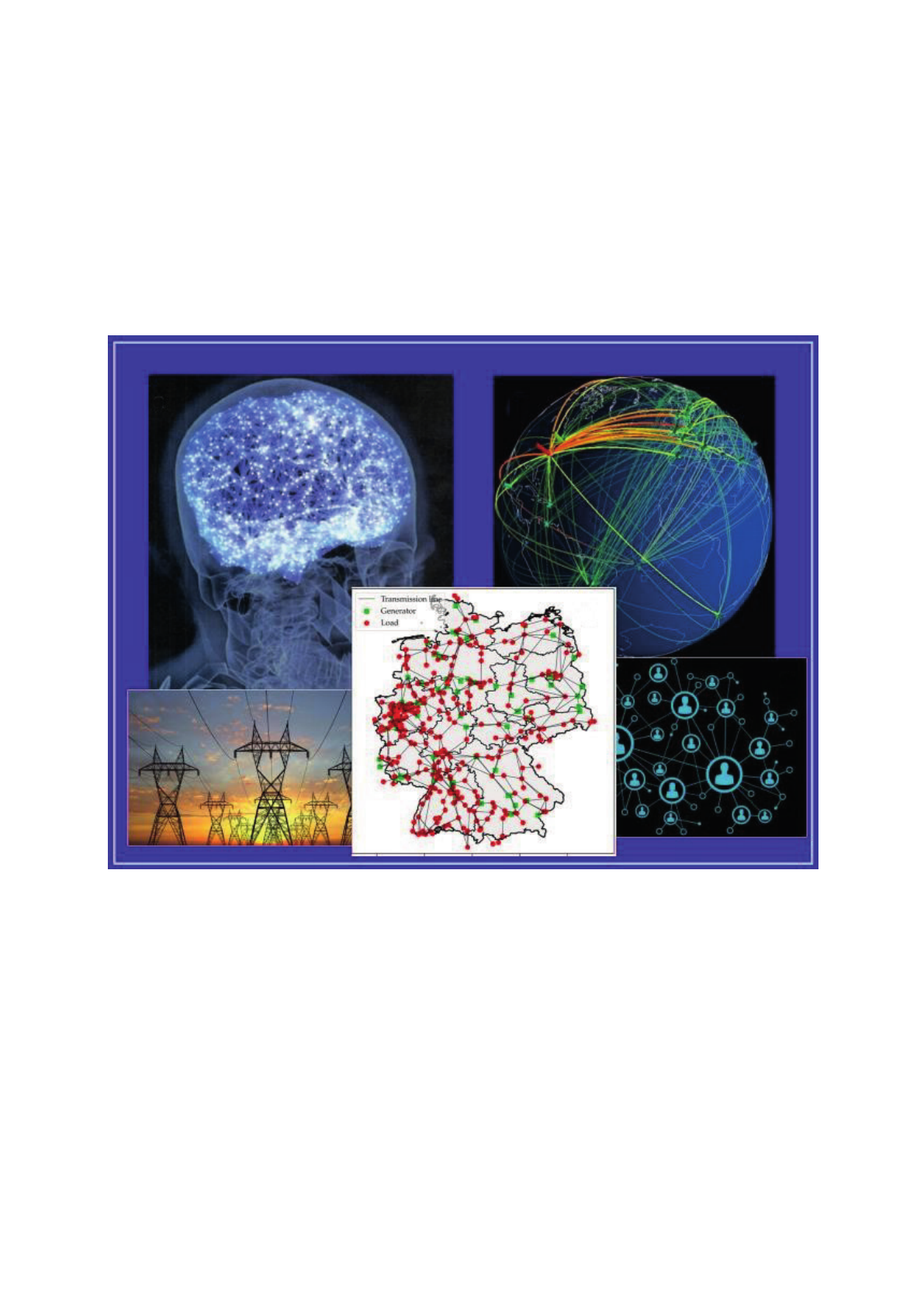
are coupled in a network, even for large and complex networks. Complex networks are a
ubiquitous paradigm in nature and technology, and a central issue in nonlinear science with
applications to different fields ranging from natural to technological and socio-economic
systems (Fig. 2). The interplay of nonlinear dynamics, network topology, naturally arising
delays, and random fluctuations results in a plethora of spatio-temporal patterns (Schöll et
al. 2016).
2
Fig. 2 Complex networks exist in many diverse fields: (A) brain, (B) internet, (C), (D) power grids (panel D shows
the high-voltage power grid of Germany [Taher et al. 2019]), (E) social network.
There exist many applications of synchronization in various nonlinear systems, and so-
metimes synchrony is desirable, whereas sometimes it may be undesirable. Synchronization
of lasers with chaotic dynamics, for instance, may lead to new secure communication sche-
mes (Cuomo and Oppenheim 1993, Boccaletti et al. 2002, Argyris et al. 2005, Kanter et
al. 2008). The London Millenium Bridge was opened in the year 2000, but had to be closed on
the same day, after pedestrians experienced an alarming lateral swaying motion, and it took
almost two years while modifications and repairs were made to keep the bridge stable. The
instability was explained by a simple network model leading to spontaneous collective crowd
synchronization at a critical density of the pedestrians streaming onto the bridge (Strogatz
et al. 2005). Synchronization of power grids to the nominal frequency of 50 Hz is essential
A B
C
D
E

Chimeras in Physics and Biology: Synchronization and Desynchronization of Rhythms
Nova Acta Leopoldina NF Nr. 425, 67–95 (2020) 71
for their stable operation (Motter et al. 2013, Tumash et al. 2019, Taher et al. 2019). The
synchronization of neurons (Vicente et al. 2008) is believed to play a crucial role in the brain
under normal conditions, for instance in the context of memory, cognition and learning (Sin-
ger 1999), and under pathological conditions such as Parkinson’s disease (Tass et al. 1998) or
epilepsy (Andrzejak et al. 2006, Jiruska et al. 2013, Jirsa et al. 2014). Fireflies are known
to synchronize their flashing (Buck and Buck 1968). Especially in biology, rhythms and bio-
logical clocks play an important role and have given the name to a whole discipline, namely
chronobiology (Peschke 2011), see also the Abstracts by Jessica Grahn, Steve Kay, and
Russell Foster, in this Meeting. Examples are the circadian rhythms in single-cell organisms,
plants, fruit flies, mammals, and humans; the high relevance of chronobiology is documented
by the award of the 2017 Nobel Prize for Physiology or Medicine to Jeffrey C. Hall, Michael
Rosbash, and Michael W. Young for their discoveries of molecular mechanisms controlling
the circadian rhythm.
In many realistic dynamical networks time delay effects are a key issue (Just et al. 2010,
Flunkert et al. 2013, Schöll 2013). For example, the finite propagation time of light bet-
ween coupled semiconductor lasers (Wünsche et al. 2005, Carr et al. 2006, Erzgräber
et al. 2006, Fischer et al. 2006, D’Huys et al. 2008, Soriano et al. 2013) significantly in-
fluences the dynamics on networks. Similar effects occur in neuronal (Rossoni et al. 2005,
Masoller et al. 2008, Schöll et al. 2009) and biological gene expression networks (Tiana
and Jensen 2013) due to signal processing and propagation delays. Time delay has two com-
plementary, counterintuitive and almost contradicting facets. On the one hand, delay is able
to induce instabilities, generate new dynamical behavior, e.g. periodic and quasiperiodic time
evolution, multistability and chaotic motion. On the other hand, delay can suppress instabi-
lities, stabilize unstable stationary or periodic states and may control deterministic chaos.
Both facets open up efficient methods of designing and controlling nonlinear dynamics by
time-delayed feedback (Schöll and Schuster 2008, Sun and Ding 2013).
There exist different forms of synchronization, i.e., complete or isochronous (zerolag)
synchronization, generalized synchronization (where the oscillations of the individual ele-
ments of the network are not identical, but functionally related), phase synchronization (whe-
re only the phases but not the amplitudes of the oscillations are synchronized), cluster or
group synchronization (Sorrentino and Ott 2007, Dahms et al. 2012, Williams et al. 2013,
Taylor et al. 2011, Nkomo et al. 2013) (where within each cluster all elements are comple-
tely synchronized, but between the clusters there is a phase lag), and many other forms. Some
progress has been made in generalizing this work, for instance, towards adaptive networks
(Lehnert et al. 2014, Kasatkin et al. 2017, Berner et al. 2019a, b, 2020) (where the strength
of the links is adapted dynamically), inhomogeneous local dynamics (Sorrentino and Pe-
cora 2016) and heterogeneous delay times (Cakan et al., 2014), distributed (Kyrychko et
al. 2014, Wille et al. 2014), state-dependent, or time-varying delays (Gjurchinovski et al.
2014). In general, the stability of synchronization in delay-coupled networks of oscillators
depends in a complicated way on the local dynamics of the nodes and the coupling topology.
However, for large coupling delays synchronizability relates in a simple way to the spectral
properties of the network topology, characterized by the eigenvalue spectrum of the coupling
matrix. The master stability function (Pecora and Carroll 1998) used to determine the
stability of synchronous solutions has a universal structure in the limit of large delay: it is ro-
tationally symmetric and monotonically increasing. This allows for a universal classification
of networks with respect to synchronization properties (Flunkert et al. 2010). For smaller
Loading more pages...