
Article
Uncovering the Nexus
Between Attitudes,
Preferences, and Behavior
in Sociological Applications
of Stated Choice Experiments
Ulf Liebe
1
, Petr Mariel
2
, Heiko Beyer
3
,
and Ju
¨rgen Meyerhoff
4
Abstract
Multifactorial survey experiments such as stated choice experiments are
used more and more frequently in social science research. In this article,
based on an experimental study on ethical and political consumption, we
explore the potential of hybrid choice models to explicitly model latent
psychological factors such as attitudes, overcoming a possible endogeneity
bias and misrepresentation of causality. To this end, we employ a hybrid
latent class choice model (HLCCM) in which the latent class structure
allocates individuals to classes according to underlying latent attitudes that
also influence the answers to attitudinal questions. This allows, in line with
sociological action theories, a theory-guided testing of preference segmen-
tation and modification caused by attitudes. We compare the complex
1
Department of Sociology, University of Warwick, Coventry, United Kingdom
2
Department of Applied Economics III (Econometrics and Statistics), University of the Basque
Country, Leioa, Spain
3
Institute for the Social Sciences, Heinrich Heine University Du¨sseldorf, Du¨sseldorf, Germany
4
Institute for Landscape Architecture and Environmental Planning, Technische Universita
¨t
Berlin, Berlin, Germany
Corresponding Author:
Ulf Liebe, Department of Sociology, University of Warwick, Coventry CV4 7AL, United
Kingdom.
Email: [email protected]
Sociological Methods & Research
2021, Vol. 50(1) 310-347
ªThe Author(s) 2018
Article reuse guidelines:
sagepub.com/journals-permissions
DOI: 10.1177/0049124118782536
journals.sagepub.com/home/smr

HLCCM with less complex models that do not take the latent variable nature
of attitudes into account and discuss in which cases less complex models
might be more appropriate. However, the HLCCM always has the advantage
of providing structure for theory testing and is therefore a useful tool to
uncover preference heterogeneity, preference modification, and decision-
making processes in sociological and other social science research.
Keywords
attitudes, hybrid choice model, latent class analysis, stated choice experi-
ment, stated preferences
While factorial surveys have been widely used in sociological research since
decades (see Wallander 2009 for an overview), other multifactorial survey
designs such as stated choice and conjoint experiments are still novel for
most sociologists (but see Auspurg and Hinz 2014, 2015; Beyer and Liebe
2015; Liebe et al. 2016). In stated choice experiments (SCEs), respondents
are asked to choose from an array of behavioral alternatives, which vary in a
number of attributes, the alternative they favor most. This design allows
researchers to estimate the effect of each attribute on respondents’ stated
choices. SCEs originated in marketing and transportation economics (Lou-
viere, Hensher, and Swait 2000) and became popular in many subfields of
economics including transportation, health, and environmental economics
because they provide a means of measuring preferences for product attributes
even if the good in question is hypothetical. It is important to stress that SCEs
are not identical with or a special case of conjoint experiments. The main
difference is the theoretical foundation of SCE, which is based on random
utility theory (see Auspurg and Hinz 2015; Louviere, Flynn, and Carson 2010
for a detailed discussion). This theoretical foundation—a rational-choice
framework—is in-principle in line with many sociological action theories
assuming that individuals choose from behavioral alternatives the one that gives
the highest level of satisfaction or utility (Bruch and Feinberg 2017; Kroneberg
and Kalter 2012). Applications of SCE in sociology include studies on the social
embeddedness in trust situations (Buskens and Weesie 2000), ethical consump-
tion (Andorfer and Liebe 2013), and discrimination (Beyer and Liebe 2015).
Both, SCE and conjoint experiments are also used in political science research,
for example, regarding the admission of immigrants (Bansak, Hainmueller, and
Hangartner 2016; Hainmueller and Hopkins 2015), climate agreements (Bech-
tel and Scheve 2013), and ethnic voting (Carlson 2015).
Liebe et al. 311

Most studies using SCEs focus on the main effects of choice attributes.
However, more recently, the relationship between those attributes and further
explanatory variables such as sociodemographics and attitudinal concepts
became a major concern, since it is more realistic and theoretically mean-
ingful to assume preference heterogeneity within a given population. Theo-
retically derived explanatory variables such as attitudes can be expected to
considerably increase the explanatory power of choice models. In principle,
these variables can be directly included in a choice model. Yet some authors
have questioned this approach because the integration of attitudinal questions
as error-free explanatory variables in a choice model biases model results
(Ben-Akiva, McFadden, et al. 2002, Ben-Akiva, Walker, et al. 2002). These
authors argue that it is crucial to account for the fact that attitude measures
must be understood as latent indicators of an unobserved “true” (psychic)
state. To add attitude measures directly to the models could potentially lead
to an endogeneity bias and misrepresentation of causality. Endogeneity bias
means that errors of the structural equation of indicators for attitudes might
be correlated with the error of the choice model (“[ ...] unobserved effects
that influence both a respondent’s choice and his/her responses to indicator
questions,” Daly et al. 2012:269). Misrepresentation of causality refers to the
argument that responses to indicator questions do not necessarily have a
causal relationship with behavioral choices.
In this article, we demonstrate that, based on an action-theoretic frame-
work, hybrid choice models can be a useful tool to model preference hetero-
geneity and modification in a population and hence to overcome potential
endogeneity bias and causal misrepresentation regarding attitudinal effects.
Hybrid choice models extend the specification of the traditional random
utility model by incorporating additional decision protocols and enrich the
underlying behavioral characterizations. These extensions comprise, among
others, flexible disturbances (e.g., factor analytic) to mimic more complex
error structures and to allow for the explicit modeling of latent psychological
factors such as attitudes. However, the term “hybrid choice model” is an
umbrella concept for different choice modeling techniques. In the following,
we focus on latent class structures to uncover preference heterogeneity and
segmentation as well as latent variable approaches to integrate attitudinal
effects and to investigate preference modification. We demonstrate that this
type of hybrid choice model, an integrated choice and latent variable model,
is especially valuable for sociological and other social science research.
In our empirical application, we investigate the relationship between atti-
tudes and choice behavior in an SCE study of ethical and political consump-
tion that was carried out in Germany in 2012 and investigates the preferences
312 Sociological Methods & Research 50(1)

for so-called Peace Products—goods that are jointly produced by Israeli and
Palestinian producers. Ethical and political consumption research deals with
consumer behavior that takes not only a product’s quality and price into
account but also the political, social, and environmental effects of its pro-
duction and marketing (e.g., Andorfer and Liebe 2012; Stolle, Hooghe, and
Micheletti 2005). Friedman (1996) distinguishes between “boycotts,” or
negative buying behavior, and “buycotts,” or positive buying behavior. Boy-
cotting denotes refusal to buy products and services that are associated with
negative political, social, and environmental (i.e., external) effects. Buycot-
ting refers to the deliberate purchase of products that are perceived to reduce
negative or generate positive external effects. Organic production is another
ethical product characteristic considered in our study; organic crops are
grown without pesticides and herbicides and are therefore associated with
environmental and human health benefits compared with conventionally
produced crops.
In our study, respondents had to evaluate different types of olive oils that
varied regarding production method (organic and nonorganic), origin (Italy,
Israel, Palestinian Territories, and jointly produced by Israeli and Palestinian
producers, so-called Peace Products), and price. Theoretical determinants
explaining the purchase of products with ethical attributes include pure altru-
ism; impure altruism or warm glow giving, social, and personal norms; trust;
and object-related attitudes (Liebe 2014; Stolle et al. 2005). In our case, we
concentrate specifically on relevant discriminatory attitudes toward Jews,
Arabs, and attitudes toward the Israel–Palestinian conflict, all of them can
be expected to affect stated preferences for products from Israel, Palestinian
territories, and Peace Products.
In the following, we discuss how the hybrid choice modeling framework
relates to economic and sociological theory. This is followed by a presenta-
tion of our SCE, a description of the results, and a discussion on the advan-
tages and disadvantages of hybrid choice modeling as a method to uncover
processes of decision-making, which are closely linked to action theories.
The Interplay of Attitudes, Preferences, and
Choice Behavior
We discuss the relationship between attitudes, preferences, and choice beha-
vior (decision-making) within the hybrid choice modeling framework as
pictured in Figure 1. The standard explanatory chain in social science
research holds that attitudes affect preferences, which in turn affect behavior.
However, what makes behavioral research difficult is the fact that attitudes
Liebe et al. 313
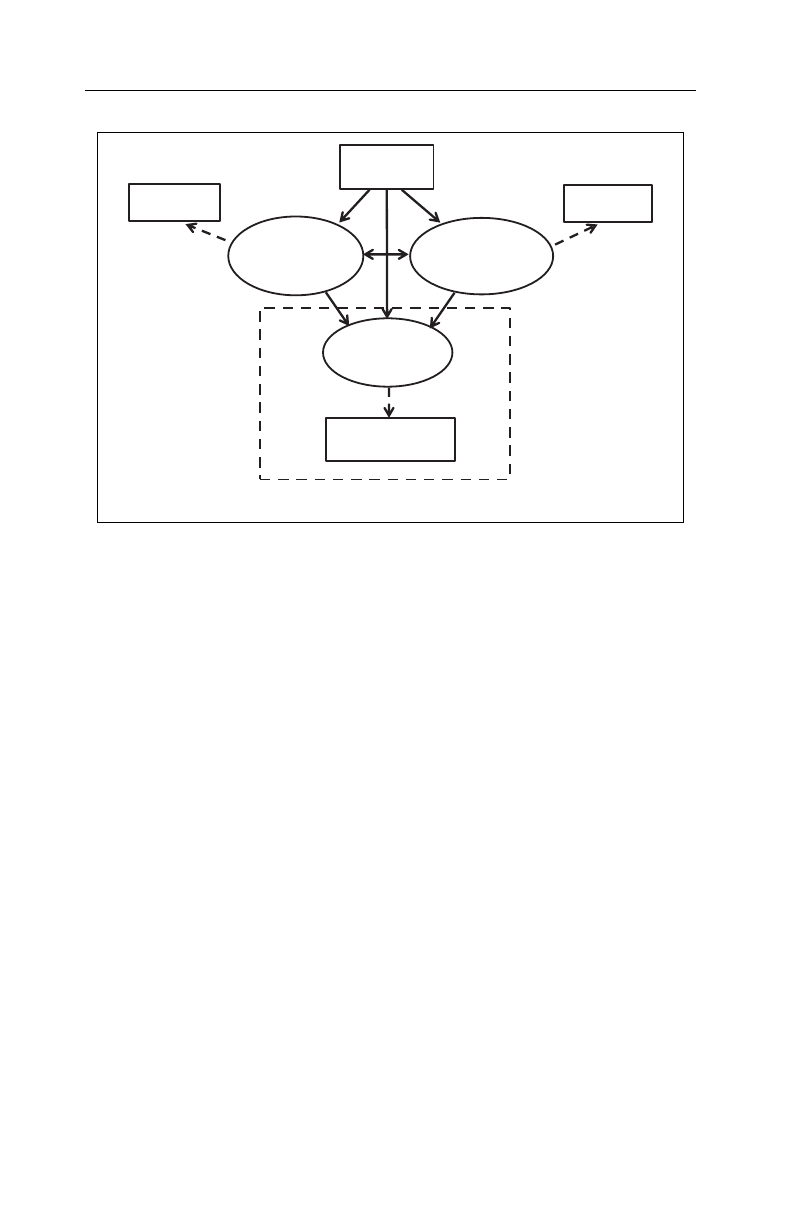
and preferences are theoretical, latent constructs that cannot be directly
observed by researchers. This has consequences for the adequate modeling
of decision and action theories in sociology and other social sciences. We
therefore first introduce the basic theoretical idea behind the SCE method, as
it was developed in economic research. Second, we discuss one specific
approach for capturing preference heterogeneity in a population (i.e., not all
individuals have the same “tastes”), an assumption that is very plausible in
most behavioral studies. Third, we specify how attitudes can be linked to
preferences and choice behavior by taking into account that they are latent
variables. It has to be stressed that in what follows, theory and statistical
modeling are discussed hand in hand because the statistical models are used
to represent the theoretical arguments. This is one strength of choice modeling
compared to other modeling approaches for testing theories in social science
research such as including theory-oriented variables in a regression model
without taking the underlying behavior model or assumptions into account.
Theory-guided Mapping of Preferences
Many theoretical explanations of sociological phenomena rest on the idea
that behavioral choices are associated with outcomes that can be expressed in
Explanatory
Variables
Latent Classes
/ Preference
Segmentation
Heterogeneity
Latent Variable
/ Attitudes
Decision
Process
Choice Indicators:
Stated
ledoMssalCtnetaL
l
edoMelb
air
a
V
tn
e
taL
Choice Model
Indicators
Indicators
Figure 1. Hybrid choice model of decision-making (simplified, Adapted from Walker
and Ben-Akiva 2001; Ben-Akiva, McFadden, et al. 2002).
314 Sociological Methods & Research 50(1)
Loading more pages...