
sustainability
Article
Advances of 2nd Life Applications for Lithium Ion Batteries
from Electric Vehicles Based on Energy Demand
Aleksandra Wewer, Pinar Bilge * and Franz Dietrich
Citation: Wewer, A.; Bilge, P.;
Dietrich, F. Advances of 2nd Life
Applications for Lithium Ion Batteries
from Electric Vehicles Based on
Energy Demand. Sustainability 2021,
13, 5726. https://doi.org/10.3390/
su13105726
Academic Editors: Knut Blind,
Simone Wurster, Rainer Walz,
Katrin Ostertag and Henning Friege
Received: 23 March 2021
Accepted: 16 May 2021
Published: 20 May 2021
Publisher’s Note: MDPI stays neutral
with regard to jurisdictional claims in
published maps and institutional affil-
iations.
Copyright: © 2021 by the authors.
Licensee MDPI, Basel, Switzerland.
This article is an open access article
distributed under the terms and
conditions of the Creative Commons
Attribution (CC BY) license (https://
creativecommons.org/licenses/by/
4.0/).
Institute for Machine Tools and Factory Management (IWF), Technische Universität Berlin,
*Correspondence: [email protected]; Tel.: +49-(30)-314-27091
Abstract:
Electromobility is a new approach to the reduction of CO
2
emissions and the deceleration
of global warming. Its environmental impacts are often compared to traditional mobility solutions
based on gasoline or diesel engines. The comparison pertains mostly to the single life cycle of a
battery. The impact of multiple life cycles remains an important, and yet unanswered, question.
The aim of this paper is to demonstrate advances of 2nd life applications for lithium ion batteries
from electric vehicles based on their energy demand. Therefore, it highlights the limitations of a
conventional life cycle analysis (LCA) and presents a supplementary method of analysis by providing
the design and results of a meta study on the environmental impact of lithium ion batteries. The study
focuses on energy demand, and investigates its total impact for different cases considering 2nd life
applications such as (C1) material recycling, (C2) repurposing and (C3) reuse. Required reprocessing
methods such as remanufacturing of batteries lie at the basis of these 2nd life applications. Batteries
are used in their 2nd lives for stationary energy storage (C2, repurpose) and electric vehicles (C3,
reuse). The study results confirm that both of these 2nd life applications require less energy than
the recycling of batteries at the end of their first life and the production of new batteries. The paper
concludes by identifying future research areas in order to generate precise forecasts for 2nd life
applications and their industrial dissemination.
Keywords:
circular economy; remanufacturing; multiple life cycles; electromobility; lithium ion bat-
tery
1. Introduction
Electromobility is an approach that aims to reduce CO
2
emissions and to decelerate
global warming. Scientific papers, reports and news often compare the environmental
impacts of electromobility to traditional mobility solutions with gasoline or diesel en-
gines [
1
–
5
]. Some of these investigations address the question of whether electromobility
has, among others, a better CO
2
footprint. Regardless of whether it is better, the same or
even worse than combustion technology, electromobility will be present in the future and
continue to gain importance following a political urge and past investments. In any future
case, large quantities of used batteries will occur that need to be treated. The total demand
for batteries is estimated to be 200 GWh by the year 2025, four-fold more than in the year
2020 [
6
]. If the total impact can be robustly assessed, it can influence the decision for or
against a specific 2nd and End of Life (EoL) strategy. The total environmental impact of a
battery, considering multiple life cycles with various 2nd and EoL applications, remains an
important, and yet an unanswered, question.
The aim of this paper is to demonstrate the advances of 2nd life applications for
lithium ion batteries from electric vehicles based on their energy demand within various
multiple life cycles. The total impact of a product consists of multiple factors including
environmental, social and economic factors such as the production costs, supply and
demand, which are influenced, among other things, by the customers’ acceptance. This
Sustainability 2021,13, 5726. https://doi.org/10.3390/su13105726 https://www.mdpi.com/journal/sustainability
Sustainability 2021,13, 5726 2 of 22
study is based on the impact of the energy demand in order to present the potential of 2nd
Life applications in a comprehensible way. Economic factors such as the influence and
costs of supply chain will be considered in further research activities and publications. For
the demonstration, it presents the design and results of a meta study on the environmental
impact of lithium ion batteries. The study focuses on energy demand, and investigates this
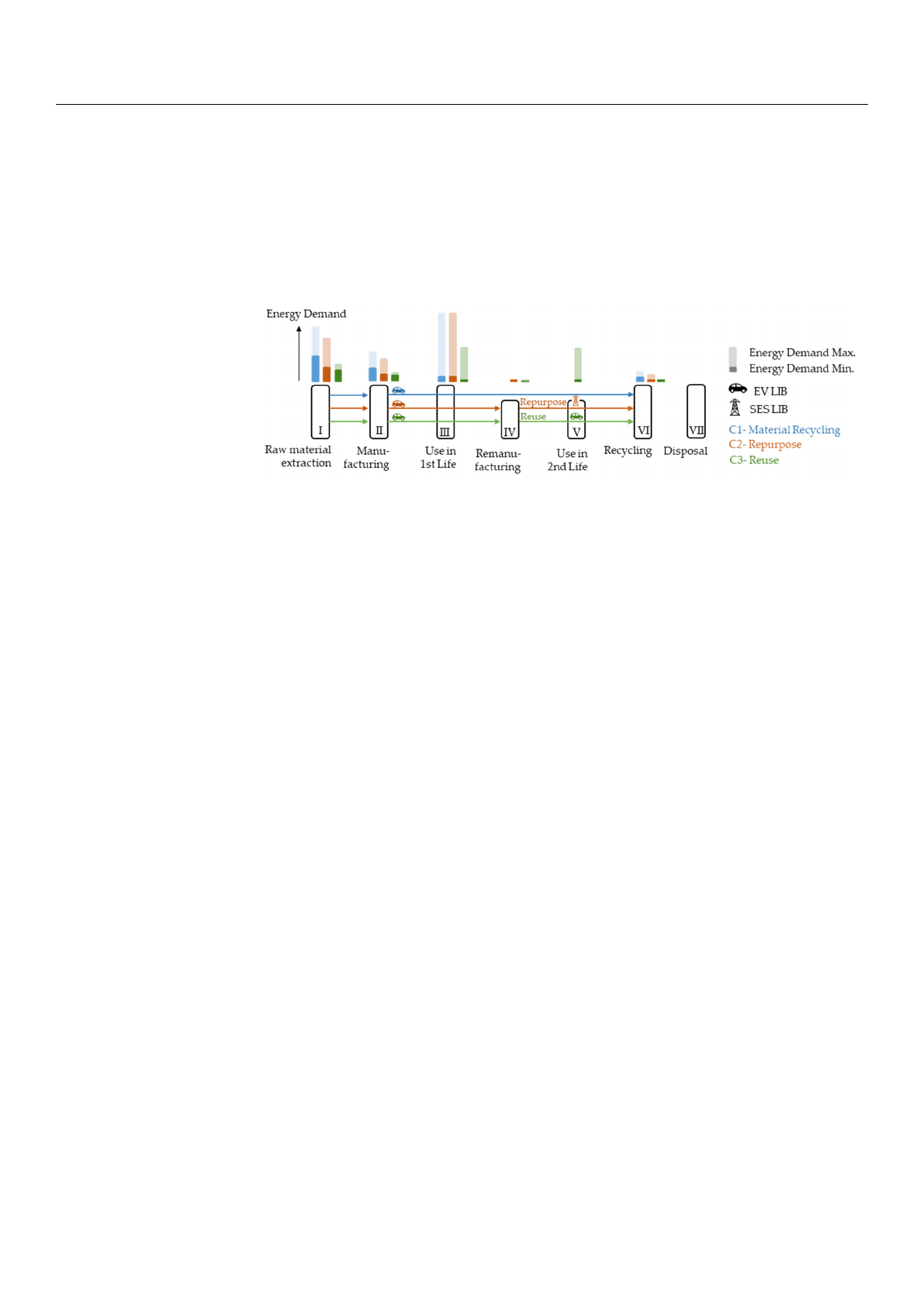
demand for three different cases, namely (C1) material recycling, (C2) repurposing and
(C3) reuse, as visualized in Figure 1and described in Section 3.2 in detail.
Sustainability2021,13,xFORPEERREVIEW2of24
environmental,socialandeconomicfactorssuchastheproductioncosts,supplyand
demand,whichareinfluenced,amongotherthings,bythecustomers’acceptance.This
studyisbasedontheimpactoftheenergydemandinordertopresentthepotentialof
2ndLifeapplicationsinacomprehensibleway.Economicfactorssuchastheinfluence
andcostsofsupplychainwillbeconsideredinfurtherresearchactivitiesand
publications.Forthedemonstration,itpresentsthedesignandresultsofametastudy
ontheenvironmentalimpactoflithiumionbatteries.Thestudyfocusesonenergy
demand,andinvestigatesthisdemandforthreedifferentcases,namely(C1)material
recycling,(C2)repurposingand(C3)reuse,asvisualizedinFigure1anddescribedin
Section3.2indetail.
Figure1.Exemplarycases:C1—materialrecycling,C2—repurposing,C3—reuse.
2.Method
Ametastudyisdesignedtocreateadatabasisthatallowstheenergydemandof
theindividuallifecyclestagestobeestimatedinagenerallyvalidmanner,ratherthan
justforaspecificcase.TheresultsaredescribedindetailinSection2.1.Basedonthe
results,amathematicalalgorithmispresentedinSection2.2,whichcalculatestheenergy
demandformultiplelifecycles.
2.1.MetaStudy
Theenvironmentalimpactofaproductisdependentontheprocessesusedwithin
thelifecyclestages,butalsoonlocation‐specificfactorssuchastheavailableenergymix.
ReportingoftheenvironmentalimpactinunitsasforexampletheCO
2
equivalentallow
thecomparisonofthetotalimpactforaspecificcase,buthinderstheanalysisofthe
magnitudeoftheprocessesitself.Inordertodecidewhetherotherprocesses,suchas
remanufacturing,shouldbepursuedinthefuture,theinfluenceoftheseprocessesmust
beestimated.Onlysubsequentlyshouldthelocation‐specificimpactbeconsidered.This
assumptioniscontrarytothewayofpresentingtheresultsofanalysisonenvironmental
impact.
Withinthismetastudy,31scientificarticlesontheenvironmentalimpactoflithium
ionbatterieswereanalyzed[1,2,7–35].Forthestateoftheart,adesktopresearch
performedwithGoogleScholarusingcombinationsofkeywordssuchaslifecycle
assessment,LCA,lithium‐ion‐battery,electricvehicle,impactandemissionswas
conducted.Theliteraturefromthelastdecadeandadditionallythemostcited
publications,despitethepublicationdate,wereconsidered.Themajoritystatetheir
resultsinavarietyofunits,suchastheCO
2eq
.,whichcannotbeunambiguously
convertedintoaprocessspecificunitwithoutfurtherinformation.Otherpublications
usesecondarydata.Onlyeightarticleshavereportedprimarydatastatedintheenergy
demand[7–14]andwereselectedtobeconsideredinthefurtheranalysis.
ThemajorityofcomparisonsregardingmobilitysolutionsisbasedonLCA,
includingthefollowinglifecyclestages:(I)rawmaterialextraction,(II)manufacturing,
(III)usein1stlife,(IV)remanufacturing,(V)usein2ndlife,(VI)materialrecyclingand
(VII)disposal.Nevertheless,studiesonLCAaddressalloronlyafewofthesestages.
Figure 1. Exemplary cases: C1—material recycling, C2—repurposing, C3—reuse.
2. Method
A meta study is designed to create a data basis that allows the energy demand of the
individual life cycle stages to be estimated in a generally valid manner, rather than just
for a specific case. The results are described in detail in Section 2.1. Based on the results, a
mathematical algorithm is presented in Section 2.2, which calculates the energy demand
for multiple life cycles.
2.1. Meta Study
The environmental impact of a product is dependent on the processes used within
the life cycle stages, but also on location-specific factors such as the available energy mix.
Reporting of the environmental impact in units as for example the CO
2
equivalent allow the
comparison of the total impact for a specific case, but hinders the analysis of the magnitude
of the processes itself. In order to decide whether other processes, such as remanufacturing,
should be pursued in the future, the influence of these processes must be estimated.
Only subsequently should the location-specific impact be considered. This assumption is
contrary to the way of presenting the results of analysis on environmental impact.
Within this meta study, 31 scientific articles on the environmental impact of lithium
ion batteries were analyzed [
1
,
2
,
7
–
35
]. For the state of the art, a desktop research performed
with Google Scholar using combinations of keywords such as life cycle assessment, LCA,
lithium-ion-battery, electric vehicle, impact and emissions was conducted. The literature
from the last decade and additionally the most cited publications, despite the publication
date, were considered. The majority state their results in a variety of units, such as the
CO
2eq
., which cannot be unambiguously converted into a process specific unit without fur-
ther information. Other publications use secondary data. Only eight articles have reported
primary data stated in the energy demand [
7
–
14
] and were selected to be considered in the
further analysis.
The majority of comparisons regarding mobility solutions is based on LCA, including
the following life cycle stages: (I) raw material extraction, (II) manufacturing, (III) use
in 1st life, (IV) remanufacturing, (V) use in 2nd life, (VI) material recycling and (VII)
disposal. Nevertheless, studies on LCA address all or only a few of these stages. Out of
the eight selected articles, five consider (I) extraction of raw materials; eleven concentrate
on (II) material, component production and/or on battery assembly. (III) The use stage is
considered in two studies for a single case. Two studies focus on (VI) recycling. None of
the evaluated studies consider the environmental impact of life cycle stages such as (IV)

Sustainability 2021,13, 5726 3 of 22
remanufacturing and (V) use in 2nd life applications or (VII) disposal. Table 1summarizes
the assumptions and the availability of data for the life cycle stages of the selected studies.
Table 1. Scope of the selected eight studies.
Material Capacity
[kWh]
Weight
[kg] (I) (II) (III) (IV) (V) (VI) (VII)
[7] LiMn2O434.2 300 - Yes - - - - -
[8]
LiMnO2- - Yes Yes Yes - - Yes -
Li-NMC - - Yes Yes - - - Yes -
LiFePO4- - Yes Yes - - - Yes -
[9] Li-NMC 26.6 253 - Yes - - - - -
[10]
NiMH - - - Yes Yes - - - -
Li-NMC - - - Yes Yes - - - -
LFP - - - Yes Yes - - - -
[11] LMO-graph. 24 290 Yes Yes - - - - -
[12] NMC111 23.5 165 Yes - - - - - -
[13] LMO/NMC 24 303 - Yes - - - - -
[14]NMC - - - - - - - Yes -
LFP - - - - - - - Yes -
The energy demand can be divided into the primary energy and process electrical
energy. Within this meta study, we consider the measurable energy demand required for
the process. For the life cycle stages (I) raw material extraction and (VI) material recycling,
the primary energy demand is considered. The required energy for these processes cannot
be precisely converted into electrical energy, as other types of energy are indispensable in
addition to it. For the life cycle stages (II) to (V), the process electrical energy demand is
considered, as it is directly measurable. For these processes, the primary energy demand is
dependent on the available energy mix and is therefore location-dependent.
The available data of the studies are stated in different units as MJ/km, MJ/kg,
MJ/kWh or kg oil eq/kg. Therefore, the data are converted into a consistent unit of kWh/kg.
The exact conversion can be found in Appendix A. The available values for the life cycle
stages are summarized in the Tables 2–4.
Table 2. Data on energy demand for (I) raw material extraction.
(I) Raw Material Extraction [8] [8] [8] [11] [12]
LiMnO2LI-NCM LiFePO4LMO-gr. NMC111
Primary Energy in kWh/kg 30.22 42.92 43.63 28.6 44.55
Table 3. Data on energy demand for (II) manufacturing.
(II) LIB
Manufacturing [7] [8] [8] [8] [9] [10] [10] [10] [11] [13]
LiMn
2
O
4LiMnO2Li-NCM LiFePO4Li-NCM NiMH Li-NCM LFP LMO-gr. LMO
Process Energy
in kWh/kg 10.1 3.70 15.71 20.14
17.11
28.03
67.69
21.98 19.13 18.72 50.17 11.67
Table 4. Data on energy demand for (VI) recycling.
(VI) LIB Recycling [8] [8] [8] [14] [14]
LiMnO2LI-NCM NMC NMC LFP
Primary Energy
in kWh/kg
Total −5.81 −12.05 −13.00 −4.49 −7.99
Effort - - - 10.50 4.55
Benefit - - - −14.97 −12.55

Sustainability 2021,13, 5726 4 of 22
Three studies provide values for “primary energy for material extraction”, convertible
into a comparable unit of kWh per kilogram of battery, as summarized in Table 2. The values
vary considerably, the maximum value being more than 50% higher than the minimum.
However, the distribution is symmetrical to the mean value and can be described as mean
value +/
−
20%. Due to the small number of values, this description cannot be verified for
its general validity.
Table 3shows the process energy demand for the life cycle stage (II) battery man-
ufacturing. Five studies provide values for this stage. The value varies considerably
beginning at 3.70 kWh/kg and reaching up to 67.69 kWh/kg. The median of these values is
18.93 kWh/kg. Based on these values, no generally valid estimation of the average energy
demand can be made. The study of Ellingsen et al. [
9
] provides an explanation that the
values vary greatly even within the same process. This study is fundamental, as the actual
energy consumption in a factory was measured over a period of 18 months, and not only
mathematically calculated. The measured values vary greatly even for the same type of
battery, with the value for the most energy efficient month being 17.11 kWh/kg and the
average value being 67.69 kWh/kg.
Only two studies have published the energy needed for the life cycle stage (VI)
recycling of a battery, as summarized in Table 4. The values are strongly dependent on the
specific recycling process and can hardly be compared. Furthermore, on the one hand, the
recycling process requires energy but, on the other hand, it saves energy in relation to the
new production of the materials. This distinction was made in only one study [14].
In order to understand the environmental impact of batteries, on the one hand, the
influence of all processes within the life cycle stages must be estimated. Yet, the results
from the meta study provide information on the life cycle stages (I) raw material extraction,
(II) manufacturing and (VI) recycling. On the other hand, different cases of a life cycle have
to be considered in order to estimate the total environmental impact of the product and to
provide sufficient information for its further development [
36
]. In the analyzed articles,
only one case is considered for the (III) use stage. However, this does not correspond to
the reality, in which a wide range of users, from rare to frequent users, coexist. Further, no
information on optional life cycle stages such as (IV) remanufacturing and (V) use in 2nd
life is provided. The consideration of several different cases within a conventional LCA
is difficult due to its functional unit [
37
,
38
]. It means that a new LCA would have to be
calculated for each case separately.
In contrast to an LCA, where the functional unit describes the amount of a defined
use, for example a single targeted mileage [
37
,
38
], we extend the definition and set the
functional unit as the combination of a continuously operating lithium ion battery of an
electric vehicle (EV LIB) and a continuously operating lithium ion battery for a 2nd life
application, where the use of 2nd life batteries is conceivable, in a defined time period;
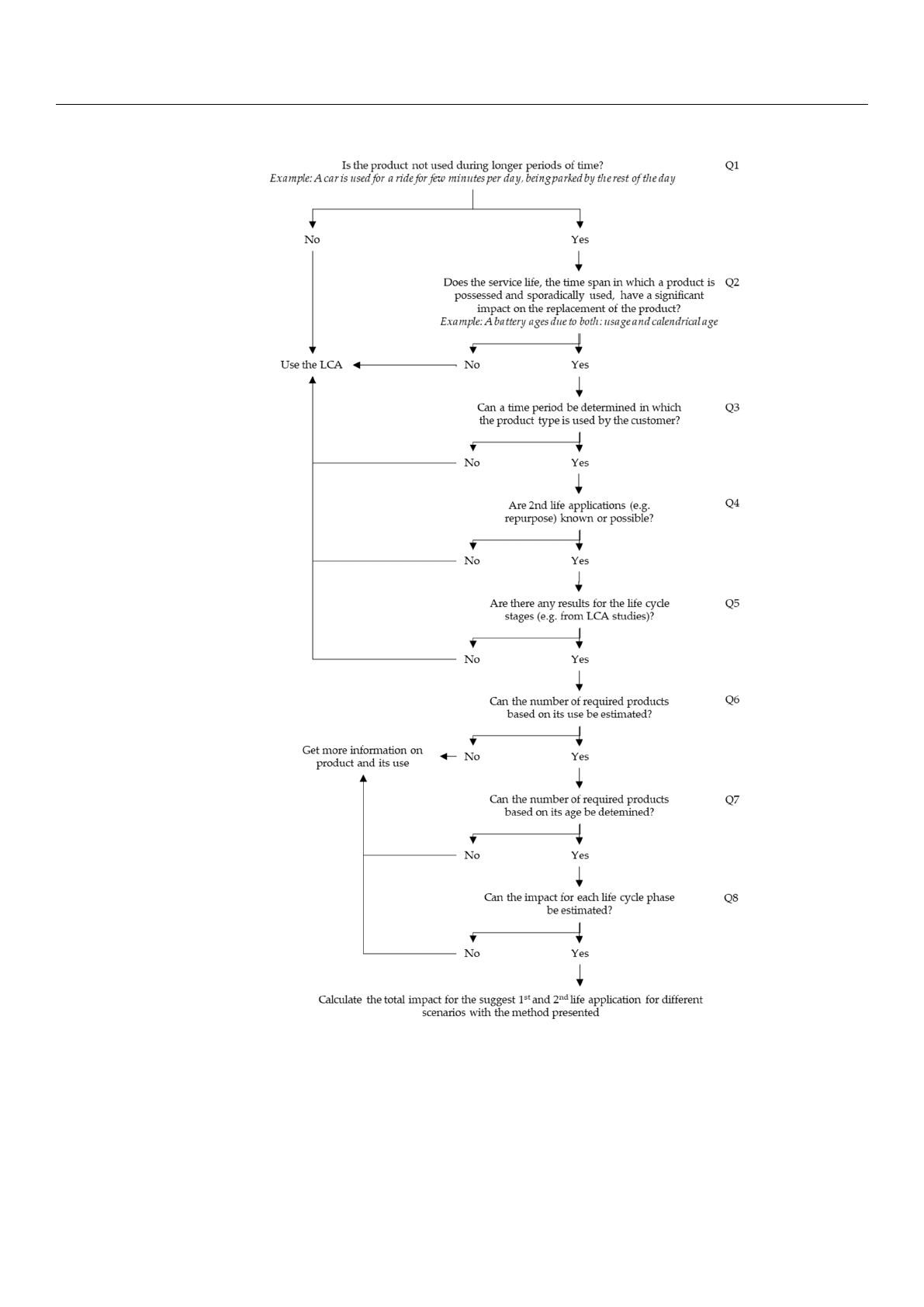
compare with Q4 from Figure 2. It allows the functionality to be variable. Further, it
includes the influence of time, as asked in Q2, as well, it considers that more than one
device has to be used to fulfill the requirements for use; compare with Q6. It shifts the
perspective, as not only the impact during the use (value creation) is considered, but rather
the impact during the life cycle of a product, where the product is often not used, but still
in the possession of the user and therefore not available for others. In the calculated cases,
we consider a stationary energy storage (SES LIB) as a conceivable 2nd life application.
This approach allows easy variation of the parameters, to create different cases and to
consider the optional life cycle stages. The results, however, do not calculate the exact valid
values for the processes, but show the tendencies and the interrelation between the stages.
Chapter 2.2 presents the proposed mathematical algorithm.
Sustainability 2021,13, 5726 5 of 22
Sustainability2021,13,xFORPEERREVIEW5of24
butstillinthepossessionoftheuserandthereforenotavailableforothers.Inthe
calculatedcases,weconsiderastationaryenergystorage(SESLIB)asaconceivable2nd
lifeapplication.Thisapproachallowseasyvariationoftheparameters,tocreatedifferent
casesandtoconsidertheoptionallifecyclestages.Theresults,however,donotcalculate
theexactvalidvaluesfortheprocesses,butshowthetendenciesandtheinterrelation
betweenthestages.Chapter2.2presentstheproposedmathematicalalgorithm.
Figure2.Flowchartfortheproposedmethodwithquestions(Q).
Figure 2. Flow chart for the proposed method with questions (Q).
The following flowchart (see Figure 2) presents the approach for the proposed method
including the algorithm. The method provides the values for the variables in the algorithm
by answering eight questions (Q1 to Q8). Figure 2also presents the difference to LCA.
If the answers from Q1 to Q5 are denied, LCA remains the only applicable method. In
the case of denying any answers between Q6 and Q8, further information about a certain
product and its use are required to continue with the proposed method.
Loading more pages...