
Renewable and Sustainable Energy Reviews 154 (2022) 111713
Available online 18 November 2021
1364-0321/© 2021 The Authors. Published by Elsevier Ltd. This is an open access article under the CC BY license (http://creativecommons.org/licenses/by/4.0/).
The design of technical requirements in public solar auctions: Evidence
from India
Florian Anselm Münch
a
,
*
, Adela Marian
b
,
**
a
Technical University Berlin, Chair of Innovation Economics, Straße des 17. Juni 135, Berlin, 10623, Germany
b
Institute for Advanced Sustainability Studies, Berliner Str. 130, Potsdam, 14467, Germany
ARTICLE INFO
Keywords:
Solar energy
Public auctions
Quality standards
Local content requirements
Industrial development
Technological upgrading
Derisking renewable energy investment
India
National Solar Mission
ABSTRACT
Solar technology diffuses across the globe as countries transition from fossil to renewable energy. Little solar-
specific experience and capacity in newly adopting countries can result in technical failures and lower solar
plant performance. This contributes to making the investment in solar plants in newcomer countries risky and
may undermine political targets of solar energy deployment. One solution suggested by international organi-
zations is for policymakers in adopting countries to include international quality standards as technical re-
quirements in public auctions. Here, we develop a conceptual framework on how international quality standards
could help build a solar sector. As a case study, we analyze the explanatory factors of technical requirements in
100 public auctions of utility-scale solar photovoltaic plants carried out in India between 2013 and 2019. Our
findings suggest that more international quality standards are required in auctions in which the government
rather than a private actor ultimately carries the commercial risk. On the other hand, local content requirements
and attracting foreign investors do not correlate with technical requirements. We argue that using minimal
quality standards is unlikely to promote local technological catch-up or attract long-term foreign investments but
transfers the techno-commercial risk from the government to the private sector.
1. Introduction
Solar photovoltaic (PV) technology is currently diffusing across the
globe [1], with 106 countries having held renewable energy auctions by
the end of 2019 to foster the transition from fossil to renewable energy
[2]. However, evidence suggests that solar PV projects may underper-
form in many low- and middle-income countries, including India. For
example, it was reported that 30% of nearly 100 analyzed projects in
different countries indicate severe defects [3]. Furthermore, a study of
the National Metrology Institute of Germany (PTB) and PI Berlin, a
global quality assurance provider, found in all six examined
grid-connected solar PV plants in India “sporadic or systemic failures
with impact on performance” [4]. Thus, if solar PV projects fail to
perform as expected, investors may not recoup their money, under-
mining future investments and, in turn, political goals for renewable
energy deployment [5–7].
One solution recommended by international organizations such as
the International Renewable Energy Agency (IRENA) and PTB is that
policymakers in adopting countries include international quality stan-
dards
1
as technical requirements in the design of public auctions [4,7,8].
For instance, it was suggested “that strict technical requirements [ …]
should be part of tender requirements [ …]. [ …] Lax tender re-
quirements should be avoided as they give comfort to module suppliers
and installation companies as no legal framework is forcing them to
provide evidence of long-term durable products and failure free instal-
lation works” [4, p.6]. Similarly, it was proposed that “the auctioneer
can also define other technological requirements, [ ….], such as speci-
fications on the equipment used. Imposing equipment specifications can
help ensure that the sector will be developed using state-of-the-art
technology and appropriate quality of components” [8, p.32]. Hence,
compliance on the part of solar PV plant developers with specific quality
* Corresponding author.
** Corresponding author.
E-mail addresses: [email protected] (F.A. Münch), [email protected] (A. Marian).
1
International quality standards are defined here as formal standards issued by the International Electrotechnical Commission (IEC) and the International
Standardisation Organization (ISO) pertaining to solar PV plant component performance and durability, their transport, installation and commissioning. For example,
IEC 61215 “solar PV modules peak and life performance ratio” defines the tests and procedures to assess the performance of solar PV modules. We also included
national standards (i.e. UL 1541, IEEE 2030.5, EN 1991 and EN 1997) that are broadly recognized internationally.
Contents lists available at ScienceDirect
Renewable and Sustainable Energy Reviews
journal homepage: www.elsevier.com/locate/rser
https://doi.org/10.1016/j.rser.2021.111713
Received 17 February 2021; Received in revised form 21 August 2021; Accepted 26 September 2021

Renewable and Sustainable Energy Reviews 154 (2022) 111713
2
standards is expected to reduce quality defects and technical failures. In
turn, investor confidence and trust will increase, as uncertainty about
generated electricity decreases [7].
However, the existing literature on renewable energy auctions offers
few insights related to the optimal integration of technical requirements
into auction design. The effectiveness of renewable energy auctions is
widely found to depend on their design, which varies across countries
[8–17]. Yet, very few authors [17,18] have examined how specific
auction design elements condition their effectiveness. Publications have
rather focused on comparing auctions with feed-in tariffs [6,11,19,20].
As a result, there is a knowledge gap on designing renewable energy
auctions optimally, and on how different design elements (e.g. auction
mechanism, qualification criteria and bid evaluation, legal/contractual
clauses, local content requirements etc.) shape auction outcomes.
To close this gap and help policymakers choose technical re-
quirements for solar PV auctions in a more strategic way, we develop a
conceptual framework on how technical requirements could help build
up a domestic solar sector. Based on the framework, we derive three
hypotheses on how policymakers can choose to use international quality
standards as technical requirements in the design of public auctions for
solar PV plants. The three hypotheses are empirically verified in a
regression analysis of 100 public auctions for industrial, utility-scale
solar PV projects with a total capacity of 51 GW carried out in India
between 2013 and 2019. We also examine whether other potential risks
such as exclusion of bidders have materialized upon including interna-
tional quality standards.
Interestingly, “most African countries that held renewable energy
auctions (dominated by solar) in 2017–2018 did so for the first time” [2,
p.11]. Policymakers in these countries need to choose how to introduce
technical requirements and their design choice likely affects the devel-
opment of a national solar sector. India graduated from virtually zero
solar energy to the fifth largest photovoltaic market worldwide within
less than a decade. The Indian experience with designing technical re-
quirements to mitigate underperforming solar PV plants can help newly
adopting countries avoid similar mistakes.
In the following, section 2 illustrates the contextual background and
relevant literature. Section 3 outlines the conceptual framework and
develops our three hypotheses on the use of international quality stan-
dards by Indian policymakers. Section 4 presents and discusses the re-
sults of the empirical analysis. Finally, section 5 concludes with policy
implications and a research outlook.
2. Background
2.1. Public auctions as an instrument for the global energy transition
In the last two decades governments have increasingly used public
auctions rather than other policy tools to guide the expansion of solar
and wind energy [2,11–13,21]. Several recent publications emphasized
the ongoing need for further research on the recent experience with
public auctions for renewable energy [6,9,11,14].
Public auctions for solar PV plants work as follows. The responsible
government institution allocates the right to build a renewable energy
plant to the private company with the best bid. In a reverse auction, as
conducted in India, selection is based on price alone and the bidder who
offers the lowest price wins. The most general contractual agreement for
large-scale utility solar PV projects is Build-Own-Operate (BOO) asso-
ciated with a power-purchasing agreement (PPA). The PPA stipulates
that the government, mostly represented by a public utility, buys the
produced electricity for the following 25 years. Another contractual
format is Engineering-Procurement-Construction (EPC), which is less
frequent but crucial to our analysis. EPC contracts are associated with a
specified Operation and Maintenance (O&M) period, after which
ownership and liability for the solar PV plant are transferred to the
auctioneer.
The prevalent perception is that policymakers have increasingly
adopted public auctions to create a domestic market, reduce the pro-
curement price of electricity, avoid excessive subsidy levels and be able
to better steer and plan the expansion and integration of renewables into
national electricity grids (e.g. Refs. [2,6,14,15]). Several authors have
examined whether auctions represent a more effective policy tool than
the previously dominant options of bilateral negotiations with project
developers, quota and feed-in tariffs [6,11,19,20]. There seems to be a
consensus that auctions, if well designed, are a powerful, cost-effective
policy tool to create a domestic market and provide a necessary level
of investment certainty. Reverse public auctions have led to fierce price
competition and historically low electricity tariffs around the globe
[22]. For example, the highest winning bids in Indian solar auctions
were on average 36 percent lower than the feed-in tariff [23]. Although
this is less emphasized, the use of public auctions also led to a trans-
formation of ownership structures in the electricity sector, bringing
about a transition from public ownership to increased private ownership
[24]. While the EU and US markets are already dominated by private
power producers, with a 75% and 80% market share respectively, this
share is much lower in developing countries and emerging markets like
India and China - around 30 and 40%, respectively [24].
Yet, this consensus on the effectiveness of renewable energy auctions
has emerged in the context of a simultaneous decrease in international
prices for solar PV modules, the main cost factor of solar PV plants, and
the expansion of public auctions in several countries (proof-by-associ-
ation). Only few authors were cautious enough to underline that there is
no rigorous, counterfactual-based, causal identification of the effect of
public auctions on electricity price [15]. The concerns or potential
drawbacks of public auctions for the development of renewable energy
mentioned in the literature are (1) low(er) project realization rates, as a
consequence of adventurous or strategic underbidding, (2) a lack or
excess of competition, which may lead to market consolidation over
time in both cases, and, as a result, (3) insufficient incentives for dy-
namic learning-by-doing and innovation [10,15,17,25–28]. Lower
project realization rates have received most scholarly attention, with
most studies focusing on countries in the global north [10,15,16,26,
28–31], while the dynamic effect of auctions on competition/market
consolidation [11,32] and local learning-by-doing and innovation have
been understudied (excepting [18]). For instance, prices of initially
List of abbreviations
BOO Build-Own-Operate
EPC Engineering-Procurement-Construction
GW Gigawatt
IEC International Electrotechnical Commission
IRENA International Renewable Energy Agency
ISO International Organization for Standardization
LCR Local content requirement
MNRE Ministry of New and Renewable Energy
MW Megawatt
O&M Operation and maintenance
PPA Power-purchasing agreement
PV Photovoltaic
SECI Solar Energy Corporation of India
F.A. Münch and A. Marian

Renewable and Sustainable Energy Reviews 154 (2022) 111713
3
23–35% below competitive tariffs were found in the first reverse auc-
tions in India and were attributed to underbidding by inexperienced
players [5,26]. Several authors have noted that auctions are not a
panacea for successful renewable energy deployment given that
different countries had varying success rates [6,8,15,25,33]. One
conclusion may be that it is crucial to design auctions in line with a
country’s local institutional and industrial context. Auction design ele-
ments, such as technical requirements, may be one powerful mechanism
for policymakers to improve the effectiveness of auctions, i.e. reduce or
prevent low project realization rates and promote local
learning-by-doing (see section 3.2). Several authors noted that countries
choose slightly differing auction designs, which makes it difficult to
conduct cross-country comparisons, but also suggests that policymakers
adjust the auction design to the specific institutional and market context
[8–11,19]. Unfortunately, there are only few dedicated studies, mostly
based on one or at most a handful of countries for which several auctions
at best are observed over time [9,13–16,29]. Hence, there is only a
limited understanding of the incentives and rationale driving the auc-
tion design choices made by policymakers (exceptions are [17,25]).
This shortcoming has first been acknowledged in Refs. [8,10], which
both provide theoretical frameworks for auction design. Quantitative
evidence of the specific effect of auction design elements on the auction
outcome was first given in Refs. [17,18]. By comparing the project
realization rates for auctions in different countries and years in a
regression framework, it was found that pre-qualification measures and
penalties are positively correlated with realization rates [17]. Moreover,
local content requirements were shown to increase the bidding price in
Indian solar PV auctions [18]. Thus, it is a promising avenue for future
research to investigate how specific auction design elements condition
both the opportunities and the shortcomings associated with renewable
energy auctions. This paper contributes to closing this gap by investi-
gating the factors motivating the use of technical requirements in Indian
solar auctions.
2.2. Solar energy development in India: National Solar Mission
India’s domestic solar power generation before 2009 was negligible
and consisted only of a few mini-grid projects [19,34]. In 2009, the
Government launched the National Solar Mission. Its objective is to
install 100 GW solar PV capacity by 2022 and build up local, globally
competitive manufacturing. While about 20 export-oriented solar
module manufacturers existed already at the outset of the Solar Mission,
there was virtually no large-scale solar PV generation in India [34,35].
No cell manufacturing existed yet.
The Ministry of New and Renewable Energy (MNRE) through its
executive agency - the Solar Energy Corporation India (SECI) - has
managed to nurture and expand solar energy production. Yet, it remains
a challenge to establish globally competitive solar component
manufacturing at a large scale in India. Initially, MNRE relied on feed-in
tariffs and other policy tools (i.e. purchasing obligations for India’s
federal governments). Reverse public auctions and their eligibility
criteria have become the major policy tool to guide the development of
solar electricity production and component manufacturing [18,26,35,
36]. Among the eligibility criteria used by SECI are local content re-
quirements, restrictions on foreign bidders, and technical requirements.
While the initial approach to technical requirements can be charac-
terized as “laissez-faire”, there have been more recent efforts to foster
quality assurance and quality upgrading. In 2017, MNRE published the
national “Lab Policy for Testing, Standardisation and Certification for
Renewable Energy Sector” [37]. The aim is to upgrade the performance
quality of solar PV components and turn testing laboratories into centers
of global excellence. The policy also requires all components, in
particular PV modules, to be tested for reliability and performance in
India again. However, execution was postponed on several occasions
due to feedback from manufacturers and testing laboratories about
insufficient local testing capacity. In 2020, MNRE created a “Renewable
Energy Standardisation Cell”, which shall push for further quality
upgrading and public policies.
3. Conceptual framework and hypotheses
3.1. Technical requirements in public auctions of solar PV plants as a
policy tool for sustainable, industrial development
Green industrial development at the global frontier focuses on
inventing and patenting technologies that are new to the world. In
developing and emerging economies, green industrial policy deals
mostly with adapting, disseminating and finally catching up with the
global technology frontier [38,39]. International quality standards are
one mechanism to disseminate state-of-the-art technology and produc-
tion methods, and foster investment in product testing for trial-and-error
innovation in developing and emerging economies [40,41].
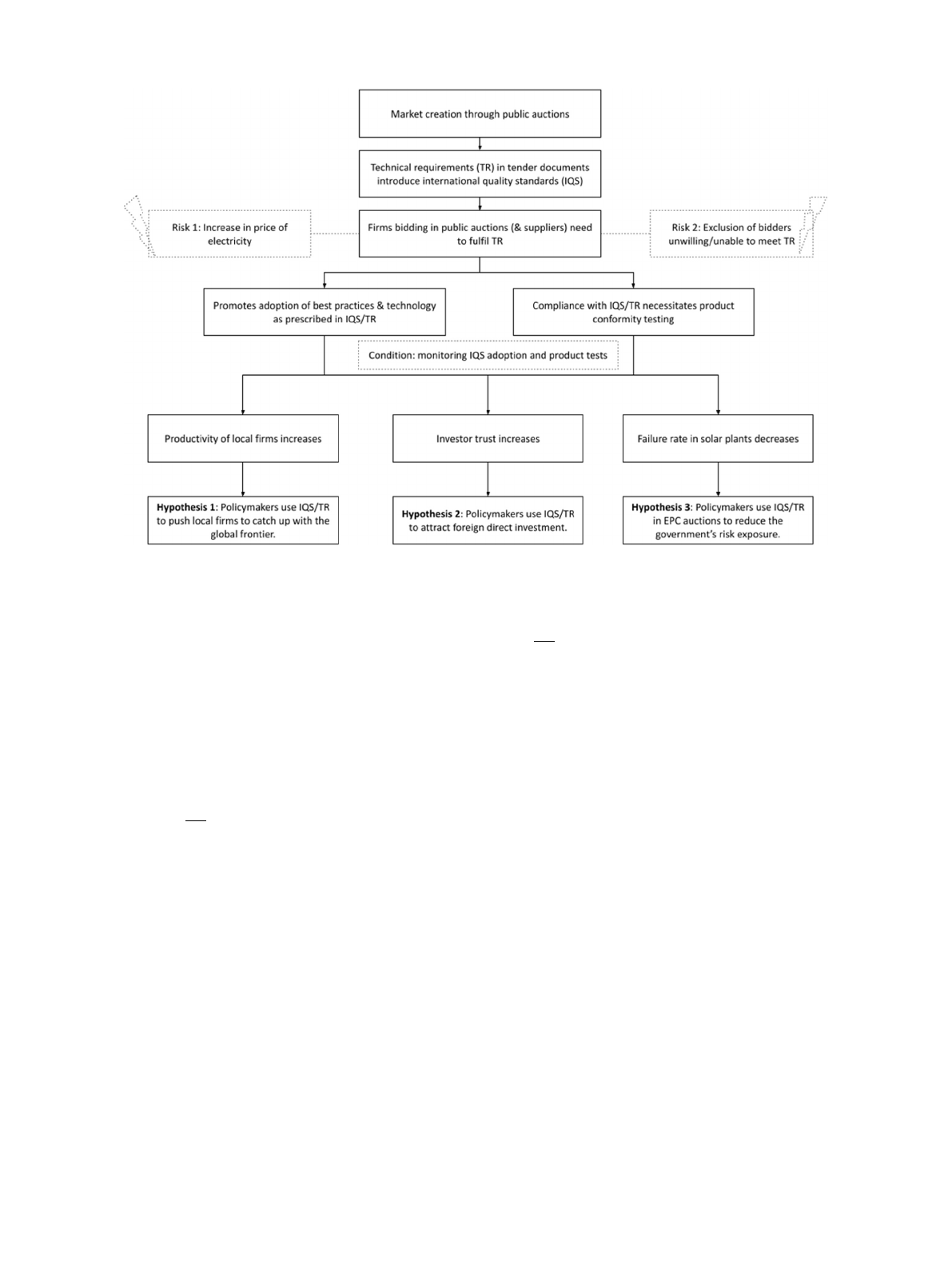
Fig. 1 illustrates how governments can require compliance with in-
ternational quality standards in public auctions for solar PV plants.
Firms bidding to develop solar PV plants will need to choose components
in compliance with specific technical requirements. Firms have an
incentive to invest in upgrading their production methods and product
quality accordingly, given that government procurement of electricity
creates business opportunities [40,42–45].
The benefits to local industrial development are twofold [41,46–49].
Firstly, international quality standards promote productivity (see sec-
tion 3.2.). The productivity increase can come from adoption of inter-
national best practices and from product tests in accredited laboratories
as defined in international quality standards. Product tests are an op-
portunity for domestic firms to trial-and-error test their products and
compare their quality against international benchmarks. For example,
less than a handful of Indian companies conducted in-house research
and development in 2012 [18,34]. Secondly, quality standards should
have a strong positive signaling effect (see section 3.3). Buyers (in-
vestors) have incomplete information about the quality of the sellers’
production processes, and thus are either unwilling to buy or only
willing to pay less [50]. Incomplete information is particularly prob-
lematic when a country enters solar PV energy production, given that
there is little local data about potential electricity yields and technical
component resilience (i.e. in tropical climate conditions) [51]. Scarce
information is also likely to be often paired with investors’ mistrust
against the general investment climate and institutional context of most
developing and emerging countries. Hence, adherence to international
quality standards is likely to have a strong, positive signaling effect to
investors or banks.
Finally, there are also some risks related to the use of (international)
quality standards in public auctions to promote green industrial devel-
opment. Firstly, quality standards exclude non-compliant competitors.
This may be a concern for governments in developing and emerging
countries, particularly in smaller countries that may only have a few
competitors, especially during the initial transition to solar PV [49,52].
Secondly, international quality standards may notably hurt local firms if
there are insufficient, costly, or slow testing services available, while
idiosyncratic national standards may scare away international compet-
itors [49,53]. Limited local testing capabilities are a common problem in
developing and emerging countries, given that testing equipment has
high capital costs and requires specialized personnel [7]. Idiosyncratic
national quality standards, by contrast, create additional costs for in-
ternational competitors, which may prevent them from entering a
market, particularly if the market is very small. Thirdly, quality stan-
dards may raise the bidding price, which in turn raises the cost of
electricity for the government. While this is in principle true, engi-
neering studies suggest that the benefits of stringent quality assurance,
at least at the project level, outweigh the additional costs of quality [4,
54]. Ultimately, a crucial concern anchored in the industrial policy
literature is that policymakers may not possess the capabilities to
determine which standards should be selected at what stage of industrial
F.A. Münch and A. Marian
Renewable and Sustainable Energy Reviews 154 (2022) 111713
4
development [55]. In conclusion, too stringent quality standards could
force nascent players to exit the market, while too lenient quality
standards may entail that there is no local industrial learning along with
reluctance from buyers to invest in solar PV projects.
In the following, we formulate three hypotheses related to the use of
international quality standards in public auctions for solar PV plants in
India.
3.2. International quality standards as technical requirements: a
performance benchmark to complement local content requirements?
The Indian government aspires to expand domestic solar PV elec-
tricity production and create globally competitive domestic
manufacturing. Therefore, local content requirements (LCR) were
introduced in India’s public auctions for solar PV plants. LCRs obligate
independent power producers and project developers to source solar PV
modules and/or cells in India [18,35].
LCRs often increase procurement costs, as they are typically intro-
duced when local prices are higher than world market prices [18]. The
rationale for LCR is that local producers are temporarily protected from
foreign competition, can gain hands-on experience with a certain tech-
nology (“learning-by-doing”), and catch up with international players
[49,56,57]. Firms learn and improve their efficiency/productivity when
beginning to manufacture, in this case solar PV modules and cells, but
learning rates decrease over time [56,58]. Once learning-by-doing en-
ables local producers to lower their costs to match world market prices,
LCRs are no longer necessary and can be withdrawn. A common criti-
cism towards LCR is that they often fail to provide sufficient incentives
for local beneficiaries to improve performance and reduce prices, e.g.
because of rent-seeking and government failure, and thus fail to trans-
form nascent industries into competitive ones [59–61].
We are interested, however, in the interplay between LCR and
quality standards. Innovation through rule-setting has proven effective,
for example in environmental regulation [62] and technological
upgrading due to foreign restrictions [40]. In a similar vein, technical
requirements can be combined with LCR to provide performance in-
centives. Governments can thus require bidders to source components
locally and comply with national or international quality standards.
Hence, performance standards could be used to drive domestic pro-
ducers to engage in learning-by-doing rather than import intermediation
[59]. For instance, Denmark’s aggressive promotion of standards and
quality certification helped the country become and remain a world
leader in wind turbines [49]. Similarly, it was argued that the incentives
and protection provided by industrial policies (“carrots”) need to be
complemented through a “stick” to guarantee that beneficiary firms also
engage in learning, quality upgrading and productivity increases [55].
Hypothesis 1. Policymakers use technical requirements such as in-
ternational quality standards to push local firms to catch up with the
global solar PV production frontier.
3.3. International quality standards as technical requirements: a signaling
tool to de-risk investors?
Globally, the majority of investments in renewable energy since
2016 have been taking place in developing and emerging economies [8,
14,63]. In India, the government orchestrates the expansion of solar PV
electricity. Yet, it is the large Indian industrial conglomerates, Indian
banks, and non-banking institutions such as international venture cap-
ital and hedge funds that develop and finance utility-scale PV plants [22,
64–66].
We apply insights from economic theory on quality uncertainty and
adapt it to the context of solar PV auctions [46,47,50,67–69]. As
mentioned in section 3.1, compliance with international quality stan-
dards has been shown to overcome the buyer’s insufficient information
or lack of trust, for example in international trade [47,67,69] and
foreign direct investment [48,68]. International quality standards create
trust, as they signal use of state-of-the-art production processes.
Signaling applies in principle to both domestic and international in-
vestors, but information asymmetry and lack of trust are especially
relevant for foreign investors [46,47,68,69]. In the following, we outline
Fig. 1. Flowchart of the conceptual framework presented in section 3.
F.A. Münch and A. Marian
Renewable and Sustainable Energy Reviews 154 (2022) 111713
5
how international quality standards introduced as technical re-
quirements in public auctions could help remedy the lack of information
and trust in solar PV performance.
Investments in solar PV projects follow the risk-return profile of the
respective project [53]. Technical risk is significant in developing
countries with low solar-specific industrial capacity, experience and no
historical performance data for credible yield estimates [30,51,70–72].
Even in the EU and the US, investors rate technology performance
standards as third-best among 12 market-pull policies [73]. A solar PV
plant is an attractive asset if it generates the expected energy yield and
revenue over a period of up to 25 years. Payback and break-even times
increase when components malfunction and underperform. PV modules
are the key component of solar PV plants and make up 50% of the costs
[7]. In fact, independent assessments of modules have shown they often
underperform relative to manufacturer indications at up to 3% already
before operation [7] and degrade over time at 0.4% per year in the US
and Europe and at about 0.6% up to 5% in PV plants in India [74–76].
Modules can also underperform from day one if they are transported or
installed incorrectly, as has been often observed in India [76]. Other
components can have similar impacts on plant performance (tech-
no-commercial overviews are available in Refs. [51,54]). Uncertainty is
particularly high at the time of market creation and in environments
with low information about input parameters, such as irradiation,
temperature, component degradation, component peak performance
and resistance to environmental conditions, construction and installa-
tion capacities [51,54,72,77]. A mixture of low awareness and lack of
experience complements scarce publicly available information in
countries that kick-start solar PV [51,78].
Based on the above considerations, one can view more stringent
technical requirements in public auctions as a quality signal and de-
risking instrument to attract foreign investment [66,79]. More strin-
gent international quality standards try to tackle the underlying risk of
technical failure and related uncertainty about electricity yields. In
addition, international quality standards function as a proxy, which
signals high solar PV plant performance in a situation where no prior
information exists, information is expensive for international investors,
and trust in the institutional framework is low.
Hypothesis 2. Policymakers introduce international quality standards
as technical requirements in public auctions to attract foreign
investment.
3.4. International quality standards as technical requirements: a tool to
reduce risk exposure of the public sector?
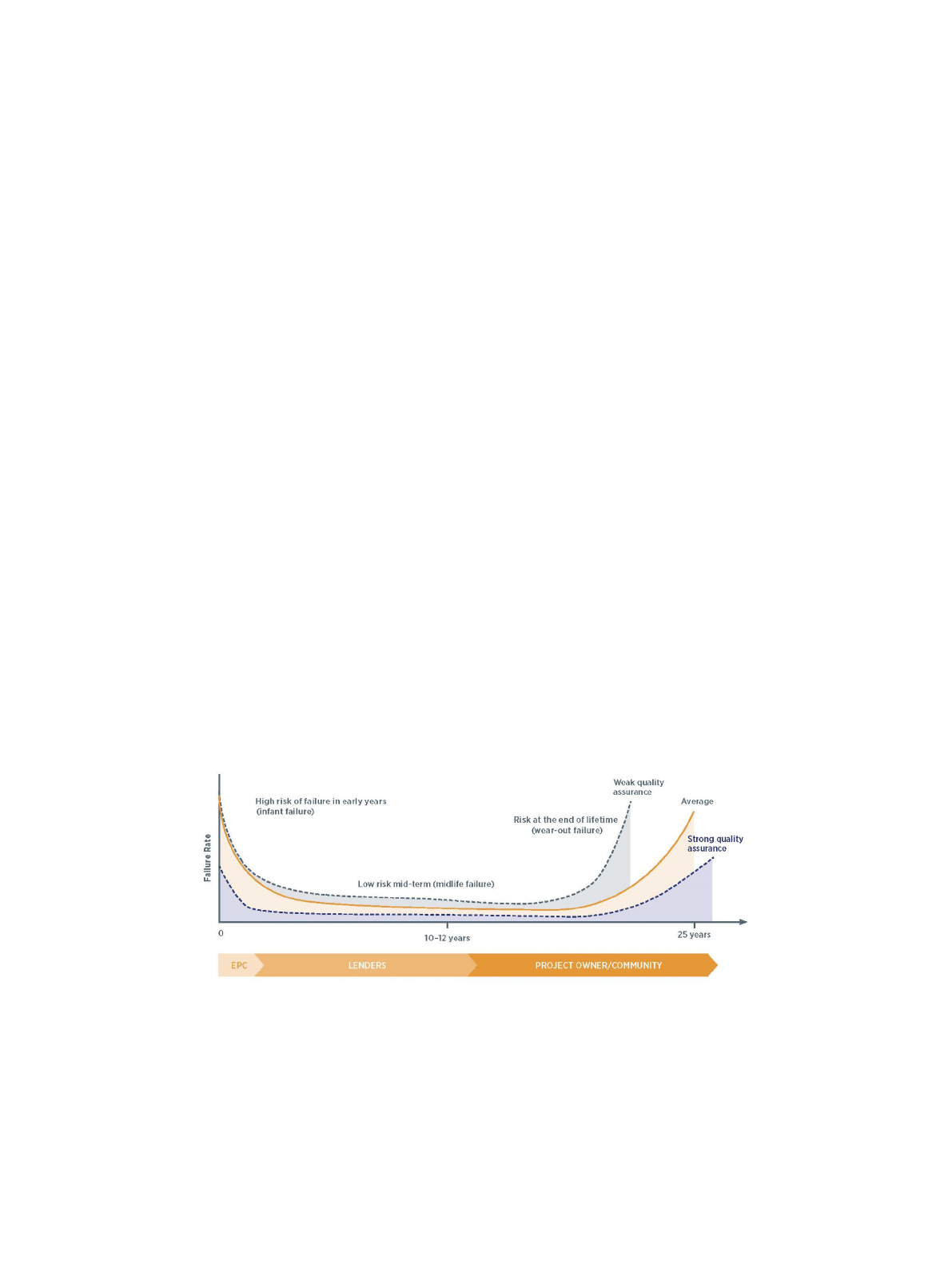
The bathtub curve in Fig. 2 illustrates that technical failures in solar
PV plants occur mainly at the beginning (or even before operation starts,
e.g. malfunctional modules due to microcracks from incorrect trans-
portation) and at the end of their lifetime due to wear and tear [7].
As in a principal-agent model, the Indian government represented by
SECI (principal) delegates the task to build and operate a solar power
plant to the private company (agent) that offers the lowest bid price in a
public auction. The agent enters into an EPC plus O&M or BOO plus PPA
contract with the principal. There is a key difference between these two
types of contracts. Under EPC plus O&M contracts, the project developer
(agent) constructs, operates and maintains the solar PV plants only for a
limited number of years and then transfers ownership to SECI (prin-
cipal). Under BOO contracts, the project developer (agent) is responsible
for everything from construction to operation and assumes ultimate
ownership. The allocation of technical risk over time thus differs
significantly in these two contract arrangements. Fierce price competi-
tion in reverse auctions forces project developers to bid close to their
expected electricity costs per kilowatt hour. Low, winning bids can turn
into a curse if project developers are too optimistic, e.g. about the O&M
costs, particularly if they choose low-quality components to be more
price-competitive, or if interest rates change etc.
Since SECI ultimately assumes the risk of underperformance of the
solar plant over the lifecycle, EPCs have an incentive to ensure the short-
term performance and quality of solar plants. By contrast, EPCs have no
(economic) incentive to focus on quality beyond their O&M period. In a
BOO contract, remuneration is fully performance-based and the owner
has a strong incentive to maximize the output over the lifetime of the
plant, as it may take several years to amortize costs and generate profits.
In line with the principal-agent theory, SECI uses upfront payments,
sanctions, and performance targets to monitor and guarantee that the
power producers do not simply neglect their contractual obligations.
In section 2.1, underbidding and subsequent lower project realiza-
tion rates were highlighted as a problem for policymakers in reverse
auctions for renewable energy projects, including in India [5,23,26,30,
Fig. 2. Failure curve of a solar PV system, reprinted from Ref. [7], p.12.
F.A. Münch and A. Marian
Loading more pages...