
sustainability
Article
Mass Balance of C, Nutrients, and Mineralization of Nitrogen
during Anaerobic Co-Digestion of Rice Straw with
Cow Manure
Furqan Muhayodin 1,2,*, Albrecht Fritze 1and Vera Susanne Rotter 1
Citation: Muhayodin, F.; Fritze, A.;
Rotter, V.S. Mass Balance of C,
Nutrients, and Mineralization of
Nitrogen during Anaerobic
Co-Digestion of Rice Straw with Cow
Manure. Sustainability 2021,13, 11568.
https://doi.org/10.3390/
su132111568
Academic Editors: Zhihui Bai,
Zhanying Zhang, Changsen Zhang
and Zhiguang Yang
Received: 31 August 2021
Accepted: 18 October 2021
Published: 20 October 2021
Publisher’s Note: MDPI stays neutral
with regard to jurisdictional claims in
published maps and institutional affil-
iations.
Copyright: © 2021 by the authors.
Licensee MDPI, Basel, Switzerland.
This article is an open access article
distributed under the terms and
conditions of the Creative Commons
Attribution (CC BY) license (https://
creativecommons.org/licenses/by/
4.0/).
1
Department of Environmental Technology, Chair of Circular Economy and Recycling Technology, Technische
2Department of Farm Machinery and Power, University of Agriculture, Faisalabad 38000, Pakistan
*Correspondence: fur[email protected]
Abstract:
Anaerobic co-digestion technology (AcoD) can be used to process rice straw (RS) and cow
manure (CoM) to produce energy and a digestate rich in nutrients, while the improper disposal of
RS and CoM causes environmental problems. The overall effectiveness of the anaerobic digestion
technology can be improved by utilizing the nutrients available in the digestate. It is also a way
to reduce the usage of mineral fertilizer by recycling the nutrients available in the digestate. The
co-digestion of RS with CoM was performed in a newly developed digester (F1) and in a mesophilic
digester (F2) used as a reference. The mass balance of C, macronutrients (N, P, K, Ca, Mg, and S),
and their distribution into a liquid digestate (LD) and a solid digestate (SD) was investigated in
both digesters. The mass balance was used to evaluate the carbon available in the biogas and in the
digestate. It was also used to investigate the recovery potential of the macronutrients after the AD
process. Moreover, the assessment of the resulting digestate was carried out to suggest its potential
use in agriculture. The amount of C measured in the biogas was the same in both digesters (41.0% and
38.0% of the initial C). Moreover, the conversion efficiency of C from the substrate into methane was
23.4% for F1 and 21.0% for F2. The Ca, Mg, K, and P were conserved in the digestate because their
recovery rates (RR) were close to 100%. However, a relatively low RR was observed for N (84.1% in
F1 and 86.8% in F2) and S (87.1% in F1 and 86.5% in F2) in both the digesters. After separation n of
the SD, from 79.1 to 83.4% (in F1) and 75.0 to 82.4% (in F2) of the final nutrients were available in the
LD. The assessment of the SD suggested its use in agriculture not only for soil amendment but also
as a K-providing organic fertilizer.
Keywords: rice straw; cow manure; anaerobic co-digestion; nutrients; digestate
1. Introduction
Anaerobic digestion (AD) is a biological process in which the specific microorganisms
transform the biomass into biogas in the absence of oxygen [
1
]. It also provides a digestate
that can substitute for fertilizers [
2
] as it is rich in nutrients for crops [
3
]. Many studies
have shown that AD technology can process many types of waste, which also include
crop straw and manure [
1
,
4
,
5
]. Rice straw (RS) is a crop residue left on the cultivated
land after the crop has been harvested [
6
]. It was reported by the Food and Agriculture
Organization of the United Nations that about 830 million tons of RS were generated in
2019 worldwide [
7
]. The common uses of RS are for heating, cooking, animal feeding,
and paper producing, while the rest of the straw is left unused in the fields [
6
]. In situ
incorporation of the RS in the soil and open-field burning are the common practices used
by the farmers for its disposal, especially in the parts of the world where there is a short
time to make the fields ready for the sowing of the next crop [
8
]. These practices are not
environmentally friendly as they contribute to the enhancement of emissions of greenhouse
gas [
8
,
9
]. Moreover, plowing back RS into the soil can potentially increase foliar disease
and reduce crop yields [10].
Sustainability 2021,13, 11568. https://doi.org/10.3390/su132111568 https://www.mdpi.com/journal/sustainability

Sustainability 2021,13, 11568 2 of 18
Various types of manure, such as that of swine, cattle, and chickens, produce another
kind of agricultural waste that also contributes to environmental problems. Excessive
application of nitrogen (N) and phosphorus (P) to the soil causes the contamination of
water bodies. It also contributes to the emission of gases, such as ammonia (NH
3
), nitrous
oxide (N2O), and methane (CH4) [11].
During AD, the organic carbon (C) of the substrate is transformed into biogas, a
mixture of mainly carbon dioxide (CO
2
) and CH
4
[
12
]. The advantages of the estimation of
the C mass balance include the understanding, prediction, and possibly control of the biogas
yield in the AD [
1
]. A biogas plant operator can evaluate the efficiency of the AD process
by the mass balance of C and can also adopt the parameters to increase the degradation of
the substrate, which results in the overall enhancement of the biogas yield [13].
The C/N is very crucial in the AD process, and its optimal value is 20 to 30 [
14
]. The
C/N of the substrate also decreases during AD. This may enhance the fertilizer properties
of the digestate [
12
]. Moreover, the lower C/N of the digestate is important for its potential
use in agriculture as it can be used if its value is less than 25 [
15
]. Moreover, during AD
the organically bound N in the substrate is mineralized predominately in ammonium
(NH
4+
), which is a readily plant-available form of N [
3
]. In establishing a mass balance
of the nutrients, it is important to know their availability in the digestate [
16
]. It can
also help to assess the other advantages of the AD technology, which include agronomic,
environmental, and economic advantages [
17
]. Moreover, the evaluation of both the
primary macronutrients, such as N, P, and potassium (K), and the secondary macronutrients,
such as calcium (Ca), magnesium (Mg), and sulfur (S) is essential for the utilization of
the digestate in agricultural lands by partially or completely replacing the fossil-derived
mineral fertilizer [
17
–
19
]. Therefore, the better usage of the nutrients available in the
digestate is a way to improve the overall effectiveness of the AD technology [1].
Masséet al. [
17
] and Marcato et al. [
18
] investigated the fate of the N, P, and K. They
studied the mass balance and partitioning of these nutrients in two phases, the liquid
digestate (LD) and the solid digestate (SD) in the AD of pig manure.
Similarly, Li et al.
[
1
]
studied the mass balance of the C, N, and P using different crop straw (corn, rice, and
wheat) and various types of livestock manure in a batch-scale experimental setup. All these
studies were conducted at psychrophilic (10–30
◦
C) or mesophilic (30–40
◦
C) temperatures.
Moreover, they were limited to mono-digestion, whereas in the agricultural biogas plants,
the substrates are usually co-digested with two, or even more, suitable co-substrates.
Moreover, all the other studies, except one, were conducted in batch or psychrophilic
anaerobic sequencing batch reactors (PASBR), while the continuously stirred mode is
usually applied in the AD facilities. Moreover, the status of the mineralization of organically
bound N and the assessment of the digestate for its potential use in agriculture have not
been included in these studies.
In the above-mentioned studies, no co-digestion of RS with bovine manure (CoM) was
performed. Therefore, it is necessary to evaluate the mass balance of C and the nutrients
when the RS is co-digested with the CoM to estimate the C availability in the biogas and
the nutrient recovery rate (RR) of the AcoD technology, as well as the distribution of the
nutrients into LD and SD. Moreover, the extent of the mineralization of the organically
bound N into NH
4+
and the recycling of the LD during this co-digestion might affect the
quality of the resulting digestate.
The RS was co-digested with the CoM in an innovative temperature-phased anaerobic
digestion technology (TPAD), called a “loop digester” (F1), and a reference digester (F2)
working in conventional mesophilic conditions [
20
]. The performance, in terms of the
specific methane yield, the anaerobic digestion efficiency, and the volumetric methane
production rate of F1, was compared with that of F2. The performance was also evaluated
as a function of various feedstock C/N ratios (26 to 31), and the results suggested that the
best F1 performance was achieved with a higher C/N ratio. It is beneficial if the digester
can work at a high C/N value as that means it requires a less N-rich co-substrate. Moreover,
the LD was recycled back to the digester in the study. The LD contains nutrients such as N

Sustainability 2021,13, 11568 3 of 18
which help to improve the C/N of the substrate in the AD and reduce the needed amount
of N-rich co-substrates. Less dependence on the co-substrates is beneficial as they are not
easily available in some places. Moreover, the status of the trace elements and their effect
on the methane yield were studied and published [20].
The focus of this study was the fate of the C and the macronutrients in the anaerobic
co-digestion (AcoD) of RS with CoM in both digesters. The following research questions
were formulated and faced: (1) How much C and nutrients were available in the digestate?
(2) What was the partitioning of the output macronutrients into LD and SD? In addition,
the extent of the mineralization of the organically bound N and the assessment of the SD
for its potential use in agriculture were also investigated in this study.
2. Materials and Methods
2.1. Substrates
A mixture of RS and CoM was used in this study as a feedstock for the AcoD process.
The mixture contained 130 g of RS and 350 g of CoM for the experiments used in this
study (Table 1). Their collection, size reduction, sample preparation, and duration of usage
during the experiment were presented in detail in a recently published study [
20
]. The
analyzed parameters of the substrates are reported in Table 2.
Table 1. The details of the experiment with key activities performed for digester F1 and F2.
Period (Days) 50 45 134 84
Experimental Days 1 to 50 51 to 95 96 to 230 231 to 314
Substrates Mixture (g) RS: 100
CoM: 600
RS: 100
CoM: 300
RS: 130
CoM: 350
RS: 130
CoM: 350
OLR (g VS L−1d−1)3.4 3.2 4.3 4.3
HRT (Days) 35 50 40 40
Key Activities
Biogas Measurement presented in Muhayodin et al. [20].
Sampling for mass
balance analysis
reported in this study.
OLR, Organic loading rate; HRT, Hydraulic retention time.
Table 2.
Properties of the feeding substrates. The values represent the arithmetic mean (Average)
with the range (minimum/maximum) of duplicate or triplicate.
Properties
RS
Average (Mini-
mum/Maximum)
CoM2
Average (Mini-
mum/Maximum)
CoM3
Average (Mini-
mum/Maximum)
TS (%) 89.7 (89.6/89.8) 7.8 (7.8/7.9) 8.4 (8.1/8.6)
VS (% of TS) 84.6 (84.6/84.6) 78.0 (78.0/78.0) 75.4 (74.9/76.0)
C (% of TS) 40.9 (40.9/40.9) 40.4 (40.4/40.4) 40.8 (40.6/41.1)
N (% of TS) 0.82 (0.82/0.83) 1.95 (1.93/1.97) 2.24 (2.22/2.27)
C/N 49.6 (49.4/49.8) 20.7 (20.5/20.9) 18.2 (17.9/18.5)
S (% of TS) 0.12 (0.11/0.13) 0.40 (0.39/0.41) 0.64 (0.62/0.66)
P (g/kg TS) 1.30 (1.29/1.32) 5.15 (5.15/5.15) 8.82 (8.57/9.07)
K (g/kg TS) 23.9 (23.5/24.2) 11.12 (10.80/11.44) 16.40 (16.39/16.42)
Ca (g/kg TS) 7.26 (7.14/7.38) 44.0 (43.87/44.12) 44.3 (-/-)
Mg (g/kg TS) 2.05 (2.03/2.08) 23.62 (23.54/23.69) 19.79 (18.64/20.95)
RS, Rice straw; CoM2,3; Cow manure in two different sets; TS, Total solids; VS, Volatile solids.
Sustainability 2021,13, 11568 4 of 18
2.2. Digesters and Their Operation
The first digester, named F1, was newly developed and it consisted of two continu-
ously stirred tank reactors (CSTR). Both of these CSTRs were working in a loop system
to complete the AcoD process. The first CSTR was called F1.1; its working volume was
30 L; and it was operated at mesophilic temperature (about 45
◦
C). The second CSTR
of F1 was F1.2; its working volume was 4 L; and it was operating at hyper-thermophilic
temperature (65 to 70
◦
C). The second digester, F2, was working as a reference at mesophilic
temperature (45
◦
C), and its working volume was 30 L. Regarding the temperatures of
both digesters, different ranges of temperature have been reported in the literature for
mesophilic conditions. The optimal temperature conditions for acidifying bacteria for
mesophilic microorganisms are about 32 to 42 ◦C [21].
For the operational purposes, the digester had various ports for the completion of the
AcoD process, such as for the collection of biogas, the mechanical agitation of the mixture
in the digesters, the temperature control, the feeding of the freshly prepared mixture, and
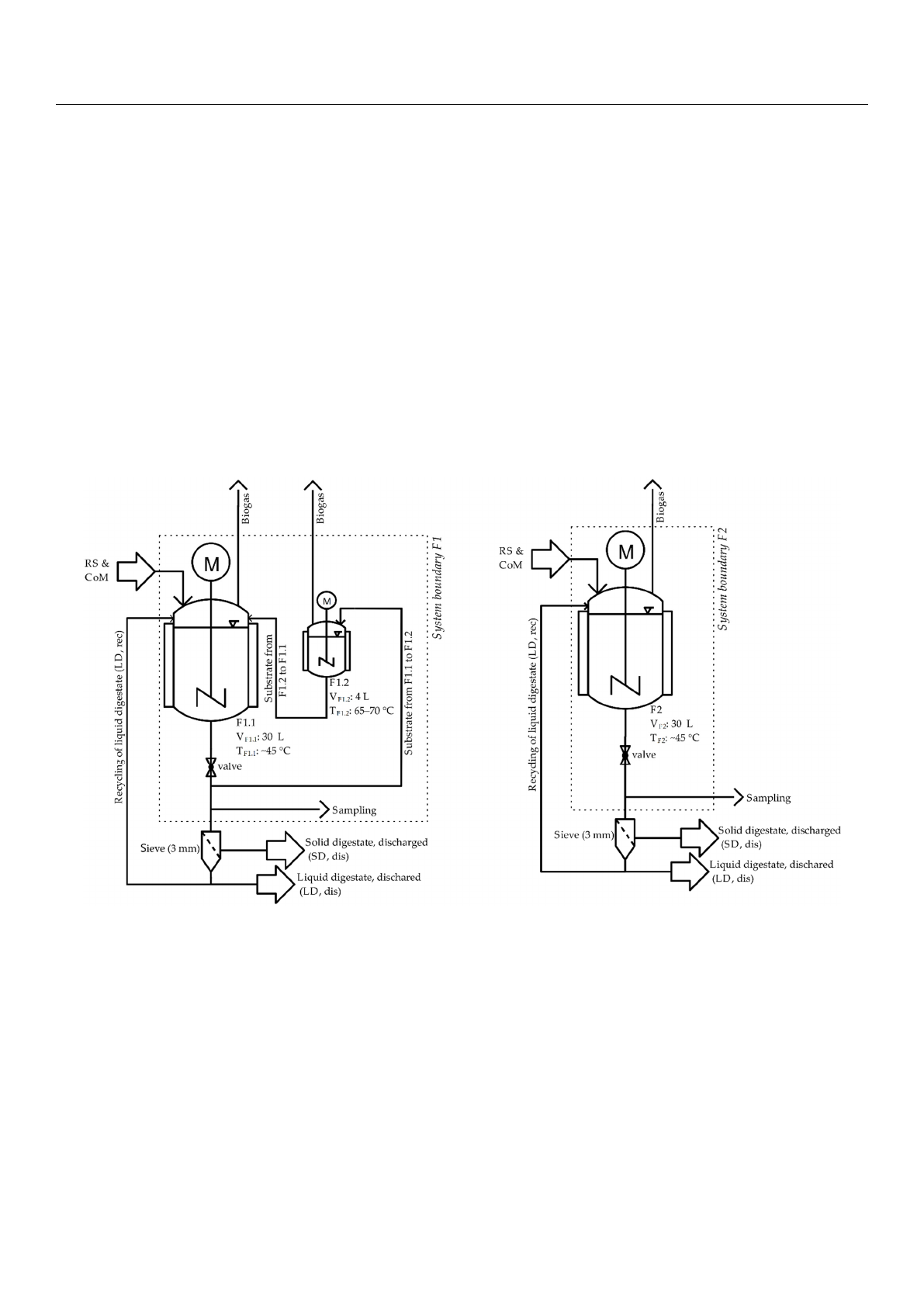
the removal of the substrates after the AcoD. The schematic diagram of the experimental
setup with the system boundary is shown in Figure 1.
Sustainability 2021, 13, 11568 4 of 18
Figure 1. Schematic diagram of both the digesters along with recirculation of obtained liquid digestate and the feeding
substrates. The dotted lines show the system boundary in both digesters.
The digesters were working with the AcoD of the same feeding substrates. These
digesters had sludge, which was used to continue the AcoD of the RS with the CoM for
this study. Therefore, the inoculum was not brought from an external source for starting
the AD process. The digesters were working for more than a year before the experiments
used them in this study. The initial inoculum used in the beginning of the process in these
digesters was the sludge from the biogas plant in which the maize silage and the CoM
were used as substrates.
The AcoD of the RS was performed with the CoM for 314 days in the whole experi-
ment [20]. The first 45 days were considered as being for commissioning and are not re-
ported in Table 1. The feeding of both digesters with the mixture of the input substrates
began with a relatively low organic loading rate (OLR) (2.2 g VS L
−1
d
−1
) in commissioning
and was successfully increased to 4.3 g VS L
−1
d
−1
. The mass balance of the C and the mac-
ronutrients was developed over the period of 134 days. The details of the overall experi-
ment, with the key activities, are presented in Table 1.
Table 1. The details of the experiment with key activities performed for digester F1 and F2.
Period (Days) 50 45 134 84
Experimental Days 1 to 50 51 to 95 96 to 230 231 to 314
Substrates Mixture (g) RS: 100
CoM: 600
RS: 100
CoM: 300
RS: 130
CoM: 350
RS: 130
CoM: 350
OLR (g VS L
- 1
d
-1
) 3.4 3.2 4.3 4.3
HRT (Days) 35 50 40 40
Key Activities
Biogas Measurement presented in Muhayodin et al [20].
Sampling for mass bal-
ance analysis reported
in this study.
OLR, Organic loading rate; HRT, Hydraulic retention time.
Figure 1.
Schematic diagram of both the digesters along with recirculation of obtained liquid digestate and the feeding
substrates. The dotted lines show the system boundary in both digesters.
The digesters were working with the AcoD of the same feeding substrates. These
digesters had sludge, which was used to continue the AcoD of the RS with the CoM for
this study. Therefore, the inoculum was not brought from an external source for starting
the AD process. The digesters were working for more than a year before the experiments
used them in this study. The initial inoculum used in the beginning of the process in these
digesters was the sludge from the biogas plant in which the maize silage and the CoM
were used as substrates.
The AcoD of the RS was performed with the CoM for 314 days in the whole exper-
iment [
20
]. The first 45 days were considered as being for commissioning and are not
reported in Table 1. The feeding of both digesters with the mixture of the input substrates
began with a relatively low organic loading rate (OLR) (2.2 g VS L
−1
d
−1
) in commissioning
and was successfully increased to 4.3 g VS L
−1
d
−1
. The mass balance of the C and the

Sustainability 2021,13, 11568 5 of 18
macronutrients was developed over the period of 134 days. The details of the overall
experiment, with the key activities, are presented in Table 1.
Regarding the operation of the digesters, the feeding was carried out every day for the
whole week, with a freshly prepared mixture of input substrates. The mixture contained
130 g of RS and 350 g of CoM for this study. About 1.0 to 1.1 L of the substrates were
exchanged from F1.1 to F1.2 on a daily basis. The hydraulic retention time (HRT) was
40 days in F1 and F2, while it was 3 to 4 days in F1.2. The digestate was passed through
a sieve with a 3 mm mesh size to obtain the LD. Then, the LD was recirculated to the
digesters. The amounts of LD recycled back to the digester were varied from
500 to 600 g
.
The purpose of recycling of the LD was to keep the constant total solid content in the
digester by diluting the feeding substrates. After the filtration through the sieve, the SD
was either used for analysis or disposed of.
2.3. Sampling Plan
The samples of the digestates, LD, and SD were taken every week for the first 50 days
and bi-weekly for the rest of the experiment (about 80 days) from F1 and F2 for the
analysis of the C and the macronutrients. A homogenous sample of about 400 to 500 g
of digestate was taken every time for the analysis. Moreover, about 300 to 400 g of the
digestate was filtered by the sieve to obtain the LD and SD every time for the analysis of
the required parameters.
2.4. Analytical Methods
The total solids (TS) and volatile solids (VS) of the substrates and all the digestate
were measured according to the standards as DIN EN 15934 [
22
] and DIN EN 15935 [
23
],
respectively.
The measurement of the total C, total N, and total S was conducted by Elemental
Analyzer (Vario EL III, Elementar Analysensysteme GmbH, Langenselbold, Germany).
The contents of the nutrients (Ca, Mg, K, and P) were analyzed by inductively coupled
plasma-optical emission spectroscopy (ICPOES) (iCAP 6000, Thermo Fisher Scientific,
Waltham, MA, USA) according to DIN EN 16170 [
24
]. The samples were prepared using
aqua regia digestion in accordance with DIN EN 16174 [
25
]. All the analyses were carried
out in duplicate. The total C and all the nutrients were analyzed in the substrates, digestate,
and LD. In the SD, the total C, N, and S were also analyzed while Ca, Mg, K, and P
were calculated.
Test kits from Macherey Nagel were used to measure the NH
4+
. The amount of NO
3−
is neglected as it comprises a very small percentage, such as 0 to 1.6%, of the total N after
the AD [1,3,16]. The content of the organic nitrogen was calculated using Equation (1).
Norg =Ntot −NO3
−−NH4+(1)
Elster’s diaphragm gas meter (BK-G4MT) was used to measure the volume of the
biogas. The composition (CH
4
, O
2
, H
2
S, and CO
2
) of the biogas was determined by using
a gas analyzer SEWERIN Multitec
®
545. The composition of the CH
4
, O
2
, and CO
2
was
measured in %, while the H2S was measured in ppm.
2.5. Calculations for Mass Balance
The mass balances for the carbon and the nutrients were calculated according to the
law of mass conservation. Equation (2) shows the general mass flows balance with the
digester input being equal to the digester output plus the mass balance delta (
∆MB
). The
delta mass balance term describes the mismatch of the mass balance, also referred to as
loss. The
.
mi
represents the substance flow, as C or the respective nutrient mass flows. The
mass flow
.
miin
is the sum of all the input flows of the substance
i
over the various input
substrates, i.e., RS and CoM as displayed in Equation (3). The mass flow
.
miout
is the sum of
the output flows of the substance
i
over the output flows of the discharged solid and liquid
Loading more pages...