Hybrid Perovskite at Full Tilt: Structure and Symmetry Relations of
the Incommensurately Modulated Phase of Methylammonium Lead
Bromide, MAPbBr3
Dennis Wiedemann,*Joachim Breternitz,*Daniel W. Paley, and Susan Schorr
Cite This: J. Phys. Chem. Lett. 2021, 12, 2358−2362
Read Online
ACCESS Metrics & More Article Recommendations *
sıSupporting Information
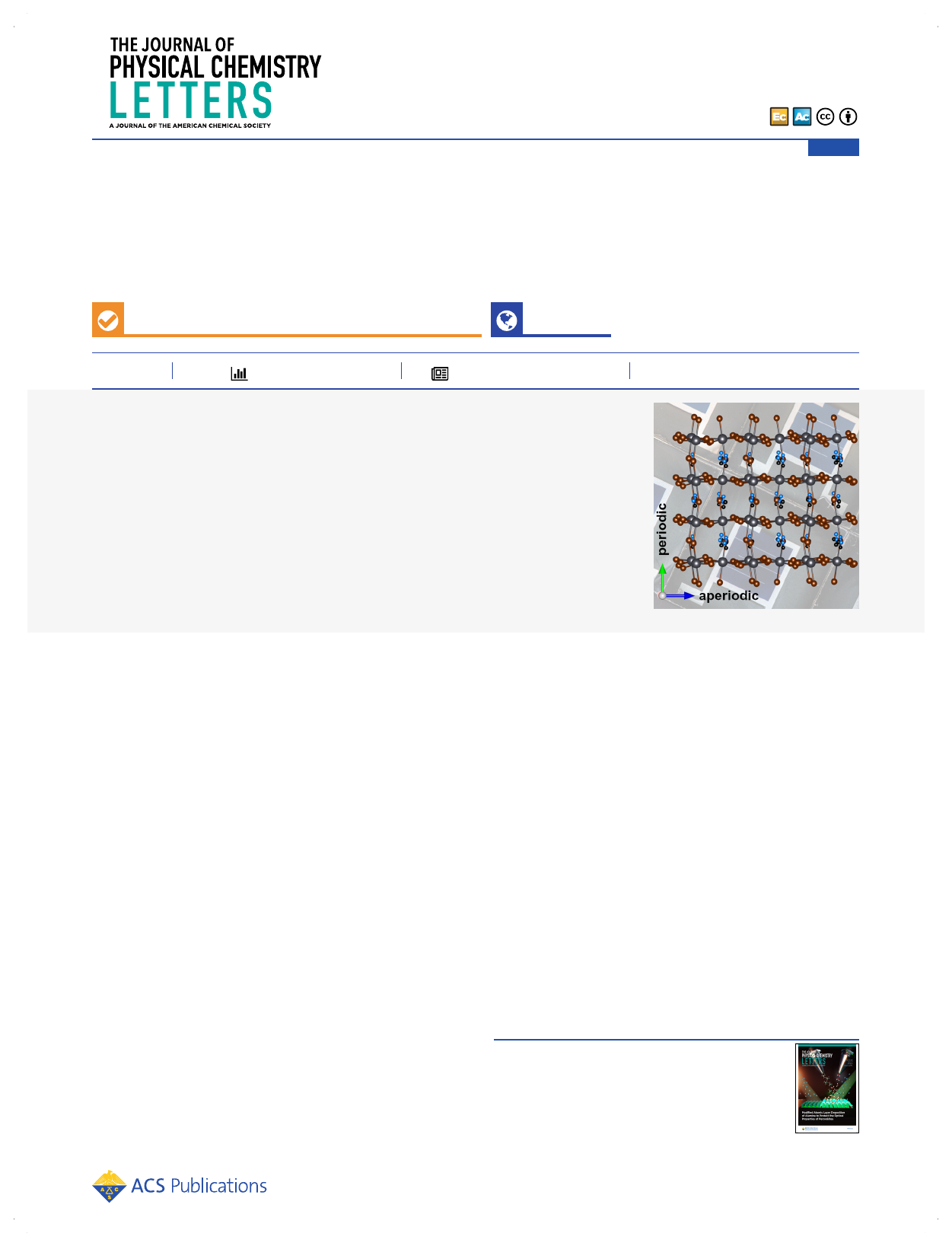
ABSTRACT: As energy-conversion materials, organic−inorganic hybrid perovskites remain a
research- and finance-intensive topic. However, even for the arguably most iconic
representatives, methylammonium and formamidinium lead halides, the crystal structures of
several polymorphs have remained undetermined. Herein, we describe the incommensurately
modulated structure of MAPbBr3in (3+1)D superspace, as deduced from single-crystal X-ray
diffractometry despite systematic twinning. Affirming the published average space group, we
determined the superspace group Imma(00γ)s00 with cell parameters of a= 8.4657(9), b=
11.7303(12), c= 8.2388(8) Å, and q= 0.2022(8)c*. Via group−subgroup and mode analyses
using irreducible representations, we establish symmetry relationships to the well-known cubic
and orthorhombic polymorphs and break down distortions into the average tilt system a−b0a−
and modulated contributions to tilt and deformation of the PbBr6coordination polyhedra. Not
only does our model fill a long-standing gap in structural knowledge, but it may also serve as a
starting point for elucidating other modulated structures within this substance class.
Inthefield of energy-conversion materials, organic−
inorganic hybrid perovskites are a persistent hot topic that
has given rise to extensive research, deduction, prognostication,
speculation, and any mix thereof.
1,2
And while derived
perovskite solar cells (PSCs) are already being prototyped
and announced for commercialization, many questions
concerning underlying crystal-structural principles remain
within this surprisingly complex substance class.
Organic−inorganic hybrid perovskites, in the strict sense of
the word,
3
share the formula ABX3, with Abeing a molecular
organic cation (typically methylammonium, MA, or formamid-
inium, FA), Ba metal cation (often lead or tin), and Xan
anion (mostly halide)although mixed occupation may occur
at any position. Most of these compounds come in three
perovskite-homeotypic modifications: the cubic high-temper-
ature αphase, the tetragonal medium-temperature βphase,
and the orthorhombic low-temperature γphase. The crystal
structures of these have been characterized with respect to the
orientation/position of the organic cation,
4
their actual space-
group type,
5
and their symmetry relationshipsand not all
facts go undisputed. Besides the rather well-known poly-
morphs, two further classes of modifications have been
described: different δphases with non-perovskite structures
(e.g., for FAPbI3)
6
and phases with incommensurately
modulated structures, generally dubbed “the incommensurate
(IC) phase”. The latter occurs at the fringe of the thermally
induced β⇄γtransformation, most prominently of MAPbCl3,
7
but has also been reported for methylammonium lead(II)
tribromide (MAPbBr3) and FA congeners.
8,9
As early as in 1987, an intermediate MAPbBr3phase (then
called “γ”) at 149.5−155.1 K was reported with a structure
conforming to the space group P4/mmm,a= 5.894(2) and c=
5.861(2) Å, with Z= 1, as evidenced by indexed Guinier−
Simon patterns.
10
Later calorimetric measurements suggested a
stability range of 148.8−154.0 K,
11
before a superstructure in
the space-group type I4/mmm with Z= 4 was suggested based
on single-crystal diffractometry.
7
Incommensurability was
postulated in analogy to the chloride congener
12
but was
only thoroughly described by Guo et al. in 2017.
13
Based on
single-crystal X-ray diffraction, they assigned the space-group
type Imma (Z= 4) to the average structure and estimated a
temperature-dependent modulation vector q=γc*(referring
to the standard orthorhombic setting) with 0.2073 ≥γ≥
0.1773 in the range of 148−155 K. Furthermore, the twinning
that accompanies the transformations β⇄IC⇄γwas also
addressed, but it probably kept the authors from solving the
atomic structure of the IC phases. We were able to overcome
this problem and present, for the first time, the incommensur-
ately modulated crystal structure of MAPbBr3at 150 K, where
satellite reflections are most pronounced, in the modern
(3+1)D superspace description.
14
Received: December 18, 2020
Accepted: January 21, 2021
Published: March 5, 2021
Letterpubs.acs.org/JPCL
© 2021 The Authors. Published by
American Chemical Society 2358
https://dx.doi.org/10.1021/acs.jpclett.0c03722
J. Phys. Chem. Lett. 2021, 12, 2358−2362
Downloaded via TU BERLIN on November 22, 2021 at 09:24:48 (UTC).
See https://pubs.acs.org/sharingguidelines for options on how to legitimately share published articles.
Our investigation is based on a data set previously collected
for another study with a different focus.
13
(The respective
crystal had been grown from an aqueous dimethylformamide
solution of dimethylamine, hydrogen bromide, and lead(II)
iodide using the antisolvent method with 2-propanol as
precipitant; see Supplementary Information of ref 13 for
details.) Most software packages for data reduction do not
support simultaneous handling of twinning and modulation.
We were, however, successful in only integrating reflections
caused by the major twin domain and dealing with partial
overlap during refinement with JANA2006/2020.
15
The twin
law is a rotation of almost 180°ca. around [101] (i.e.,
swapping of aand c, inversion of b), which is lost as a
symmetry operation during the tetragonal-to-orthorhombic
phase transition. The structure conforms to the (3+1)D
superspace group Imma(00γ)s00, a= 8.4657(9), b=
11.7303(12), and c= 8.2388(8) Å, q= 0.2022(8)c*, with Z
= 4, leading to an average structure in the space-group type
Imma, as described by Guo et al. before.
13
Although qequals
the rational fraction of 1/5c*within 3σ, the authors have
shown the modulation vector to vary with temperature.
Therefore, we refrain from suggesting a commensurate
model but deem a 1×1×5 cell a suitable approximant (cf.
model with starting phase t0= 0 in the Supporting Information
(SI)). The []
−
∞PbBr3
3framework occupies one unique lead and
two unique bromide positions (for bond lengths, see Table S2
in the SI). The MA ion was found in two unique perpendicular
orientationsone with the C−N bond along b, one with it
almost along ain a ratio of 0.33(3):0.67(3). Each of them is
disordered over a mirror plane perpendicular to the bond, so
that carbon and nitrogen positions are interchangeable.
Because only first-order satellite reflections were discernible,
modulations (as aforementioned plus displacement modula-
tion for lead and bromide ions) were modeled with harmonic
functions of first order. Discontinuous models proved
unwarranted, despite slightly larger absolute residual density
(cf. Figures S1−S6 in the SI). Compared to routine structure
analyses, the quality of the final reduced data (Rσ= 3.52%, Rint
= 12.09%) and the refined model (R1= 8.16%, wR2= 13.13%,
and S= 1.4929 for all data) suffers from the somewhat
approximate treatment of twinning as well as the overall low
intensity and overlap of satellite reflections. Keeping these
systematic problems in mind, the data and model nonetheless
provide a sound basis for the interpretation of the crystal
structure and its symmetry relationships (see section 1 in the
SI for details on structure solution, refinement, and final
model).
The nature of the structural modulation is best understood
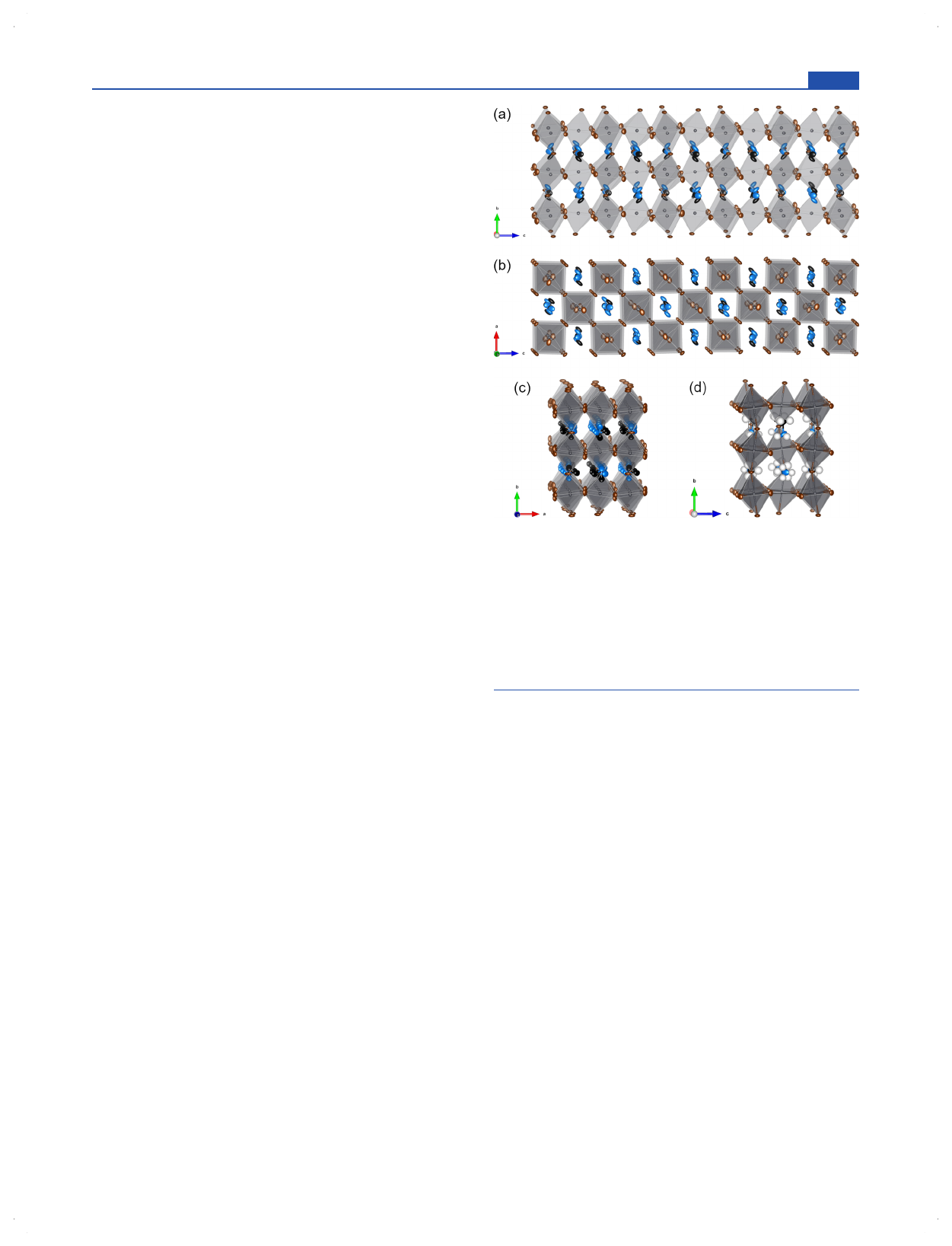
referring to the average structure (see Figure 1d). Besides
minor contributions, the latter is related to the cubic perovskite
aristotype structure by two equally large out-of-phase tilts of
the PbBr6coordination octahedra along two Pb−Br−Pb axes
(tilt system: a−b0a−). This distortion effects a descent from the
space group Pm3m(a,b,c) to the non-maximal subgroup
Imma (a+b,2c,a−b; see Figure 2). Positional modulation is
relatively weak for the lead but strong for the bromide ions.
Treatment of the MA ion as a rigid molecule showed that the
actual position near 0, 1, 1/2is governed by hydrogen-bonding
to the bromide ions (at least two NH···Br bonds per
orientation, criteria: d(N···Br) < 3.8 Å and ∠
(N−H···Br) ≥
140°; see Table S3 in the SI). In this way, the positional
modulation of the bromide ions is linked to the translational/
rotational modulation of the organic cations. Because of the
comparatively low X-ray scattering power and disorder over a
position of higher symmetry, we refrain from discussing the
MA positions/orientation in more depth and will thus focus on
the []
−
∞PbBr3
3framework. The incommensurate modulation of
bromide positions mainly affects the tilts of distorted PbBr6
octahedra: While, on average, they conform to a−in two
directions (see above), they vary harmonically between no tilt
and a maximal out-of-phase tilt, phase-shifted by half a period
with respect to each other (see Figure 3 and tmovie in the SI).
A slight twist of the basal Pb(Br1)4plane, which is tilted with
respect to the ac plane, occurs concomitantly. One modulation
period spans 1/γcells in the cdirection, so that 2γchanges per
cell between zero and maximum tilt ensue. As γincreases with
decreasing temperature,
13
so does the number of changes in a
given crystal segment. For γ→1orγ→0, the a−b+a−structure
of low-temperature MAPbBr3or a hypothetical a−b0c−
structure in C2/m(−a−c,−b,c) would be approached,
respectively.
The bromide displacement parameters at each modulation
phase reflect the bonding, tilt, and twist situation in a
physically sensible manner. While the displacement modu-
lation of Pb1 is very small but significant, Br1 and Br2 exhibit
only one significant and large modulation parameter each: the
ones of U22(Br1) and U13(Br2) (cf. tmovie in the SI). This
means that, for Br1, the magnitude of displacement along b
increases with bending the (ideally linear) Pb−Br−Pb
Figure 1. Section from the crystal structure of IC-MAPbBr3
(approximant with origin at phase t0= 0, aperiodic along c) viewed
roughly along (a) a, (b) −b, and (c) −c; hydrogen atoms omitted for
clarity, MA ions shown in both unique orientations with arbitrary
carbon/nitrogen assignment. (d) Average crystal structure of IC-
MAPbBr3viewed roughly along a; MA ions only shown in one
arbitrary unique orientation for each position with arbitrary carbon/
nitrogen assignment. Atoms are represented as ellipsoids/spheres of
50% probability (gray, lead; brown, bromine; black, carbon; blue,
nitrogen; white, hydrogen) as drawn using VESTA.
16
The Journal of Physical Chemistry Letters pubs.acs.org/JPCL Letter
https://dx.doi.org/10.1021/acs.jpclett.0c03722
J. Phys. Chem. Lett. 2021, 12, 2358−2362
2359
arrangement along b, signifying enlarged anisotropic vibra-
tional motion. For Br2, on the other hand, the modulation of
displacement orientation in the ac plane conveys a dynamic
shift toward the nearest hydrogen-bonding donor at each
phase.
Analysis of the structural distortion modes induced by
irreducible representations of space-group symmetries using
ISODISTORT gives further insight into the phase relation-
ships α→IC→γ, especially with respect to PbBr6tilts and
distortions.
18,19
The main idea of this method is to consider
the structural degrees of freedom not in terms of individual
atomic coordinates but of collective displacements (the so-
called displacive distortion modes) that transform according to
the irreducible representations of the higher-symmetry parent
space group. (We will not consider strain modes, which convey
the rather trivial changes of unit-cell lengths.) For this purpose,
we have separated the hypothetical transformation of the cubic
α-MAPbBr3aristotype into the average IC-MAPbBr3structure
from the incommensurate distortion into the actual IC-
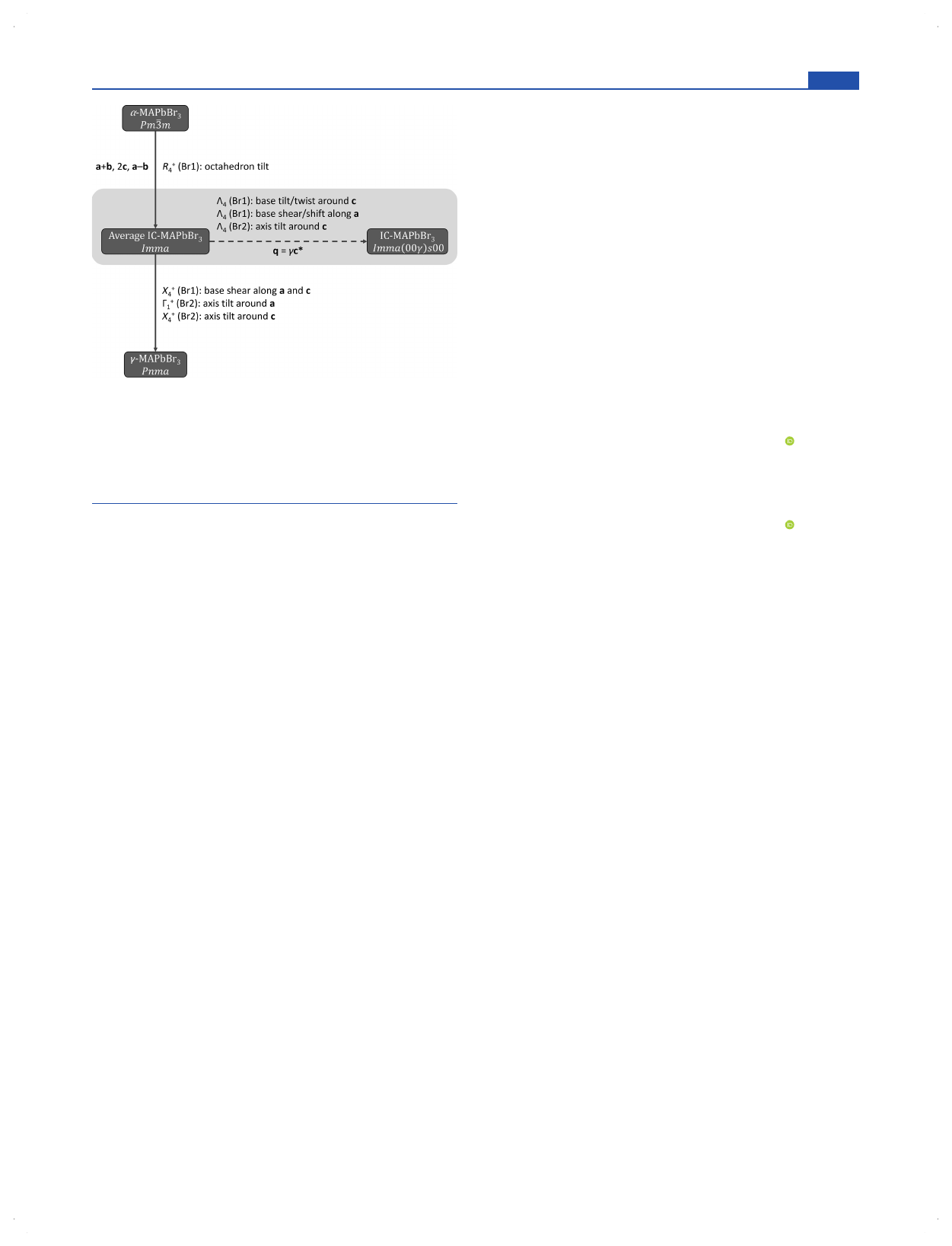
MAPbBr3hettotype (see Figure 4 and the detailed breakdown
in Table S4 in the SI). The positional parameters from the
structural models were then decomposed into distortion
modes and assigned to specificchangesinthePbBr
6
polyhedron after inspection. Because of its disorder, the MA
ion was excluded by placing an invariant pseudoatom in an
idealized position. For each transformation, one single major
distortion mode was found (transforming like R4+,Λ4, and X4+,
respectively) and identified as “primary”, which means it can
effect the symmetry lowering on its own. For α→IC (average),
this conveys the octahedral a−b0a−tilt as described above.
Within the orthorhombic system, the PbBr6environment does
not have a strictly octahedral shape and is subject to distortion
with respect to an equatorial base (ca. in the ac plane) and an
apical axis (ca. along b). A shear of the base and a tilt of the
axis, each in two directions, lead to the well-known γ-MAPbBr3
in the maximal subgroup type Pnma (thus, this transformation
may be of second order according to Landau theory). In the
gedankenexperiment of following IC (average)→IC, the same
incommensurate distortion manifests as tilt or twist / shear or
shift, depending on the position in the crystal. Overall, the
modulation causes an additional tilt of the PbBr6polyhedron
with concomitant deformation of the base. The reason for the
occurrence of incommensurability within a narrow temper-
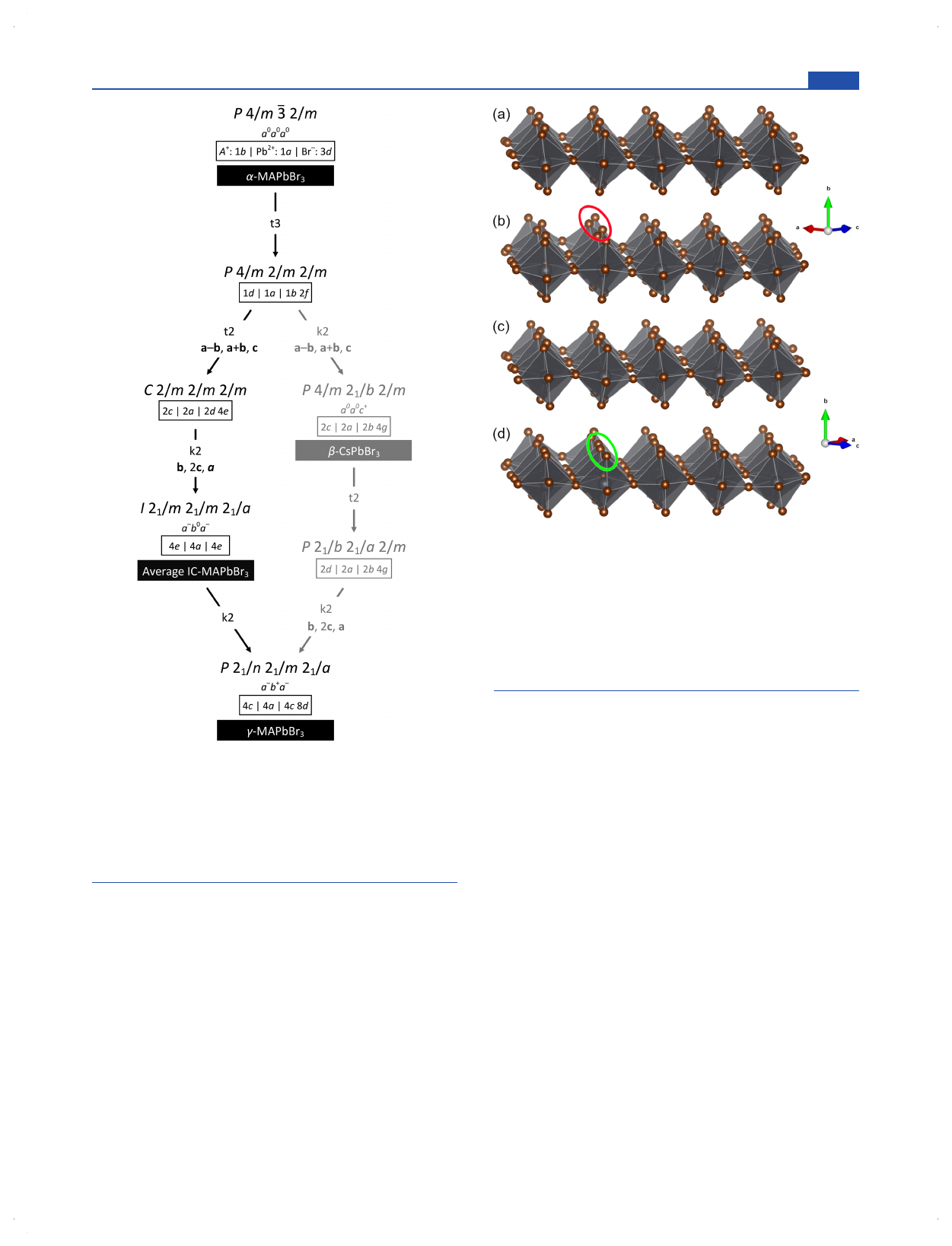
Figure 2. Barnighausen tree showing the group−subgroup relation-
ships between the discussed structures (discussed path in black,
alternative in gray). Nodes consist of full Hermann−Mauguin
symbols for the space-group type, tilt systems in Glazer notation (if
a representative exists),
17
occupied Wyckoffpositions (by A+,Pb
2+,
and Br−ions), and a phase representative (if existent, with dark
background). Links are annotated with kind and index of relationship
as well as transformation of the cell basis (if applicable).
Figure 3. Sections of the average (a, c) and modulated crystal
structure at t0= 0 (b, d) viewed roughly along a+c(a, b) and a−c
(c, d) corresponding to two main axes of the cubic perovskite
aristotype. Atoms are drawn with arbitrary radii (gray, lead; brown,
bromine) using VESTA;
16
MA ions were omitted for clarity. The
average structure exhibits the same a−out-of-phase tilt in both
directions, while the modulated structure varies from almost zero
(green circle) to nearly maximal out-of-phase tilt (red circle). Please
note that the modulation direction is none of the bisectors but c||c*
(cf. Figure 1a−c).
The Journal of Physical Chemistry Letters pubs.acs.org/JPCL Letter
https://dx.doi.org/10.1021/acs.jpclett.0c03722
J. Phys. Chem. Lett. 2021, 12, 2358−2362
2360
ature range seems to be structural frustration during the
reconstructive first-order transition β→IC, which crosses over
from another branch of the Barnighausen tree. This is
evidenced by some locally rather unfavorable deformations
(globally thinned out via modulation) that relax into the
periodic pattern of γ-MAPbBr3upon further cooling.
For our study, we have solved and refined the hitherto
unknown incommensurately modulated structure of MAPbBr3
at 150 K and presented a model of ample quality despite
systematic problems. (Crystals suffer from twinning caused by
the symmetry descent from P4/mmm (a,b,c)toCmmm
(a−b,a+b,c) underlying the reconstructive β→IC trans-
formation.) The average orthorhombic unit cell in the space-
group type Imma gives rise to a known perovskite variant
derived by an a−b0a−tilt from the cubic aristotype.
20
With a≈
8, b≈12, and c≈8 Å, and Z= 4, the parameters are typical for
the system. The actual structure in the (3+1)D superspace
group Imma(00γ)s00, q≈0.2c*, is subject to additional
distortions: Via mode analysis, these were identified to
transform like the irreducible representation Λ4and manifest
in an additional incommensurate tilt of the PbBr6polyhedra
and deformations of their equatorial plane. We tentatively
assign this to structural frustration induced during the first-
order β→IC transformation, which is resolved through
restoration of the periodicity in the IC→γtransformation
upon further cooling. Not only do our model and the in-depth
analysis of its symmetry relationships shed light on one of the
most iconic organic−inorganic hybrid perovskites, but they
may also serve as a starting point for pinning down and
elucidating other (suspected) modulated structures within this
substance class (e.g., of MAPbCl3,
7,21
MAPbI3,
22
FAPbBr3,
8
or
FAPbI3).
■ASSOCIATED CONTENT
*
sıSupporting Information
The Supporting Information is available free of charge at
https://pubs.acs.org/doi/10.1021/acs.jpclett.0c03722.
Movie showing the 3D crystal structure as a function of
the cell modulation phase t, hydrogen atoms with
arbitrary radius, all other atoms as ellipsoids of 50%
probability (gray: Pb, brown: Br, black: C, blue: N;
white: H; Br1 and Br2 in ac plane at y≈0 and 1/2or at y
≈1 and 3/4, respectively), MA ions in both unique
orientations with arbitrary C/N assignment (omitted at
ca. 1/2, 1, 1 and 1/2,3/4, 1 for clarity), cell borders in gray
(MP4)
Experimental and geometrical details, de-Wolffsections,
and details on symmetry relationships (PDF)
Basic crystallographic information file for a 2×1×5
approximant cell with the starting phase t0= 0, caveat:
aperiodic beyond boundaries (CIF)
■AUTHOR INFORMATION
Corresponding Authors
Dennis Wiedemann −Department Structure and Dynamics of
Energy Materials, Helmholtz-Zentrum Berlin fur Materialien
und Energie GmbH, 14109 Berlin, Germany; orcid.org/
0000-0001-6294-3205; Email: dennis.wiedemann@
helmholtz-berlin.de
Joachim Breternitz −Department Structure and Dynamics of
Energy Materials, Helmholtz-Zentrum Berlin fur Materialien
und Energie GmbH, 14109 Berlin, Germany; orcid.org/
0000-0002-0192-6919; Email: joachim.breternitz@
helmholtz-berlin.de
Authors
Daniel W. Paley −Columbia Nano Initiative, Columbia
University, New York 10027, United States
Susan Schorr −Department Structure and Dynamics of
Energy Materials, Helmholtz-Zentrum Berlin fur Materialien
und Energie GmbH, 14109 Berlin, Germany; Institute of
Geological Sciences, Freie Universität Berlin, 12249 Berlin,
Germany
Complete contact information is available at:
https://pubs.acs.org/10.1021/acs.jpclett.0c03722
Notes
The authors declare no competing financial interest.
■ACKNOWLEDGMENTS
We acknowledge Dr. Trevor D. Hull and Professor Jonathan S.
Owen (Department of Chemistry, Columbia University,
United States) for providing single crystals of methyl-
ammonium lead bromide. X-ray diffraction was performed in
the Shared Materials Characterization Laboratory at Columbia
University. We thank Dr. Václav Petrícek (Fyzikální ustav AV
CR, Prague, Czech Republic) for providing us with a
development version of the program JANA2020 and
continuous support.
■REFERENCES
(1) Correa-Baena, J.-P.; Abate, A.; Saliba, M.; Tress, W.; Jesper
Jacobsson, T.; Grätzel, M.; Hagfeldt, A. The Rapid Evolution of
Highly Efficient Perovskite Solar Cells. Energy Environ. Sci. 2017,10,
710−727.
(2) Olaleru, S. A.; Kirui, J. K.; Wamwangi, D.; Roro, K. T.;
Mwakikunga, B. Perovskite Solar Cells: The New Epoch in
Photovoltaics. Sol. Energy 2020,196, 295−309.
(3) Breternitz, J.; Schorr, S. What Defines a Perovskite? Adv. Energy
Mater. 2018,8, 1802366.
Figure 4. Distortion modes describing the (hypothetical) trans-
formations between different polymorphs of MAPbBr3. Nodes name
the polymorph and its (super)space-group type; links are annotated
with coordinate transformations as well as irreducible representations,
affected atoms, and description of the predominant displacive
distortions. “Base”refers to the Pb(Br1)4coordination plane, “axis”
to the Br2−Pb−Br2 arrangement.
The Journal of Physical Chemistry Letters pubs.acs.org/JPCL Letter
https://dx.doi.org/10.1021/acs.jpclett.0c03722
J. Phys. Chem. Lett. 2021, 12, 2358−2362
2361

(4) Franz, A.; Többens, D. M.; Lehmann, F.; Kargell, M.; Schorr, S.
The Influence of Deuteration on the Crystal Structure of Hybrid
Halide Perovskites: A Temperature-Dependent Neutron Diffraction
Study of FAPbBr3.Acta Crystallogr., Sect. B: Struct. Sci., Cryst. Eng.
Mater. 2020,76, 267−274.
(5) Breternitz, J.; Lehmann, F.; Barnett, S. A.; Nowell, H.; Schorr, S.
Role of the Iodide−Methylammonium Interaction in the Ferroelec-
tricity of CH3NH3PbI3.Angew. Chem., Int. Ed. 2020,59, 424−428.
(6)Stoumpos,C.C.;Malliakas,C.D.;Kanatzidis,M.G.
Semiconducting Tin and Lead Iodide Perovskites with Organic
Cations: Phase Transitions, High Mobilities, and Near-Infrared
Photoluminescent Properties. Inorg. Chem. 2013,52, 9019−9038.
(7) Kawamura, Y.; Mashiyama, H. Modulated Structure in Phase II
of CH3NH3PbCl3.J. Korean Phys. Soc. 1999,35, 1437−1440. https://
www.jkps.or.kr/journal/view.html?uid=3952 (accessed 01/22/2021).
(8) Elbaz, G. A. Transport Phenomena in Lead Halide Perovskites and
Layered Materials. Ph.D. Thesis, Columbia University, New York,
2017. DOI: 10.7916/D80Z7FRK.
(9) Kawachi, S.; Atsumi, M.; Saito, N.; Ohashi, N.; Murakami, Y.;
Yamaura, J.-i. Structural and Thermal Properties in Formamidinium
and Cs-Mixed Lead Halides. J. Phys. Chem. Lett. 2019,10, 6967−
6972.
(10) Poglitsch, A.; Weber, D. Dynamic Disorder in Methylammo-
niumtrihalogenoplumbates (II) Observed by Millimeter-Wave Spec-
troscopy. J. Chem. Phys. 1987,87, 6373−6378.
(11) Onoda-Yamamuro, N.; Matsuo, T.; Suga, H. Calorimetric and
IR Spectroscopic Studies of Phase Transitions in Methylammonium
Trihalogenoplumbates (II). J. Phys. Chem. Solids 1990,51, 1383−
1395.
(12) Swainson, I. P.; Stock, C.; Parker, S. F.; Van Eijck, L.; Russina,
M.; Taylor, J. W. From Soft Harmonic Phonons to Fast Relaxational
Dynamics in CH3NH3PbBr3.Phys. Rev. B: Condens. Matter Mater.
Phys. 2015,92, 100303.
(13) Guo, Y.; Yaffe, O.; Paley, D. W.; Beecher, A. N.; Hull, T. D.;
Szpak, G.; Owen, J. S.; Brus, L. E.; Pimenta, M. A. Interplay between
Organic Cations and Inorganic Framework and Incommensurability
in Hybrid Lead-Halide Perovskite CH3NH3PbBr3.Phys. Rev. Mater.
2017,1, 042401.
(14) Janssen, T.; Janner, A.; Looijenga-Vos, A.; de Wolff, P. M.,
Incommensurate and Commensurate Modulated Structures. In
International Tables for Crystallography; Prince, E., Ed.; John Wiley
& Sons: Hoboken, NJ, 2006; Vol. C, pp 907−955. DOI: 10.1107/
97809553602060000624.
(15) Petrícek, V.; Dusek, M.; Palatinus, L. Crystallographic
Computing System JANA2006: General Features. Z. Kristallogr. -
Cryst. Mater. 2014,229, 345−352.
(16) Momma, K.; Izumi, F. VESTA 3 for Three-Dimensional
Visualization of Crystal, Volumetric and Morphology Data. J. Appl.
Crystallogr. 2011,44, 1272−1276.
(17) Glazer, A. M. The Classification of Tilted Octahedra in
Perovskites. Acta Crystallogr., Sect. B: Struct. Crystallogr. Cryst. Chem.
1972,28, 3384−3392.
(18) Stokes, H. T.; Hatch, D. M.; Campbell, B. J. ISODISTORT,
Isotropy Software Suite; Brigham Young University: Provo, UT, 2020;
https://iso.byu.edu.
(19) Campbell, B. J.; Stokes, H. T.; Tanner, D. E.; Hatch, D. M.
ISODISPLACE: A Web-Based Tool for Exploring Structural
Distortions. J. Appl. Crystallogr. 2006,39, 607−614.
(20) Howard, C. J.; Stokes, H. T. Group-Theoretical Analysis of
Octahedral Tilting in Perovskites. Acta Crystallogr., Sect. B: Struct. Sci.
1998,54, 782−789.
(21) Chi, L.; Swainson, I.; Cranswick, L.; Her, J.-H.; Stephens, P.;
Knop, O. The Ordered Phase of Methylammonium Lead Chloride
CH3ND3PbCl3.J. Solid State Chem. 2005,178, 1376−1385.
(22) Jacques, V. L. R.; Gallo-Frantz, A.; Tejeda, A.; Le Bolloc’h, D.;
Lédée, F.; Trippé-Allard, G.; Garrot, D.; Fertey, P.; Deleporte, E.;
Plantevin, O. A New Long-Range Sub-Structure Found in the
Tetragonal Phase of CH3NH3PbI3Single Crystals. J. Phys. D: Appl.
Phys. 2019,52, 314001.
The Journal of Physical Chemistry Letters pubs.acs.org/JPCL Letter
https://dx.doi.org/10.1021/acs.jpclett.0c03722
J. Phys. Chem. Lett. 2021, 12, 2358−2362
2362
Loading more pages...