
3rd PLATE Conference
September 18 – 20, 2019
Berlin, Germany
Nils F. Nissen
Melanie Jaeger-Erben (eds.)
Universitätsverlag der TU Berlin
Franconi, Alessio; Badalucco, Laura; Peck, David; Nasr, Nabil: A multi-hier-
archical “Design for X” framework for accelerating circular economy .
In: Nissen, Nils F.; Jaeger-Erben, Melanie (Eds.): PLATE – Product Lifetimes
And The Environment : Proceedings, 3rd PLATE CONFERENCE, BERLIN,
GERMANY, 18 – 20 September 2019. Berlin: Universitätsverlag der TU
Berlin, 2021. pp. 257 – 265. ISBN 978-3-7983-3125-9 (online). https://doi.
org/10.14279/depositonce-9253.
This article – except for quotes, fi gures and where otherwise noted – is
licensed under a CC BY 4.0 License (Creative Commons Attribution 4.0).
https://creativecommons.org/licenses/by/4.0/.

257
3rd PLATE 2019 Conference
Berlin, Germany, 18-20 September 2019
A Multi-hierarchical “Design for X” Framework for Accelerating
Circular Economy
Franconi, Alessio(a); Badalucco, Laura(a); Peck, David(b); Nasr, Nabil(c)
a) University Iuav of Venice, Venice, Italy
b) Delft University of Technology, Delft, The Netherlands
c) Rochester Institute of Technology, Rochester, United States of America
Keywords: Design for X; Collaborative Design; Interdisciplinary Approach; Circular Framework;
Design Tool.
Abstract: In the past, many frameworks have been conceived in order to support companies and
their designers to develop sustainable products. In the circular economy, however, these frameworks
no longer appear to be sufficient, due to the difficulty in identifying multiple design strategies for the
different product life cycles across time dimensions. By adopting a Design for X (DfX) approach, this
paper develops a multi-hierarchical DfX framework that allows designers to incorporate different
strategies to better address product life cycles. This framework could facilitate the further
development of a more comprehensive and interdisciplinary DfX tool. A key part of the method
deployed is an interview guide approach, where five experts from across academia and industry, were
interviewed. This qualitative research draws on their diverse expertise and generates an intersectoral
link between different fields. Moreover, the DfX tool can be used to highlight relationships between
different circular economy strategies, by providing insights into how interdisciplinary design decisions
influence each other. Such an approach could allow designers to effectively visualize a bigger picture
and positively influence the application and acceleration of the circular economy.
Introduction
Circular product design is a complex and
interdisciplinary process. At the early design
stages, a variety of designers must make
decisions not only about the first lifespan of the
product, but also forecasting where, when, for
whom and how the product will be reintegrated
in the following life cycles, as well as mitigate
concomitant objectives in business,
engineering, product and service design.
Indeed, in contrast to today's linear economy,
circular economy (CE) presupposes a constant
resourcing cycle aimed at preserving natural
assets, maximizing the use of natural capital
and decreasing human impacts on nature
(McDonough, et al., 2010; Stahel, 2010;
Bakker, et al., 2014). This new vision implies a
substantial change not only on the product
design, but in the entire organizational system
of our society. Hence, it is de facto unlikely
that an optimal transition will occur if there is
an imbalance between disciplines and the
system could not be considered as a holistic,
complex structure, to be designed and
managed (Murray, et al., 2017).
The collaboration between so many fields has
always been fundamental to respond to the
exponential complexity of systemic thinking for
sustainability. Some frameworks, such as
Ecodesign Strategy Wheel (Brezet, H., & Van
Hemel, C. 1998), Product-system lifecycle
(Vezzoli, et al., 2008), Whole System Design
(Charnley, 2010) are well known to take in
consideration the bigger picture for sustainable
and interdisciplinary decision-making. However,
these frameworks tend to neglect the different
design approaches for the different life cycles of
the product, which are essential factors to
consider in designing for the CE. For this
reason, it is necessary to review these existing
frameworks on which the design is often based
today and reframe a new and up-to-date
framework that also tackles multiple loops.
The first challenge to develop a
comprehensive framework among so many
variables is to determine a common
terminology (Sauvé et al. 2016). Many
researchers, published works, conferences
and tools make use of the Design for X (DfX)
approach to make designers aware about the
implications of their design decisions on later
life cycle phases of a product. In these

258
3rd PLATE Conference Berlin, Germany, 18-20 September 2019
Franconi A., Badalucco L., Peck D., Nasr N.
A multi-hierarchical “Design for X” framework for accelerating CE
activities, ‘X’ is used as a variable which
represents a specific design strategy. Huang
(1996), defined DfX as an “imperative practice
in product development to achieve
simultaneous improvements in products and
processes”. Many DfX approaches have also
been addressed in the present CE literature
(Bakker et al., 2014; Go, et al., 2015; Van
Weelden, et al., 2016, De los Rios, et al., 2017
and Moreno, et al., 2017). Therefore, the DfX
can arguably be used to map a circular
approach, to a sequence of detailed
interdisciplinary strategies, acting as a flexible
pattern to be applied according to the circular
design requirements.
In this paper, through the theoretical application
of DfXs, the authors present a framework by
which it is possible to hierarchy circular
strategies that cover the life cycle of products
across temporal dimensions. Furthermore, this
paper introduces how the framework could be
used for the future development of an
interactive and open-sourced design tool.
Methodology
To build robust bases capable of supporting
the complexity, information volume,
overlapping concepts and the wide scope of
design disciplines, a methodology has been
structured, in line with Friedman (2003) that
comprises of four steps outlined below.
Friedman states that theoretical construction
cannot be based on practice. Indeed, it is
questionable how critical and systematic
thinking can be established based on case
studies, that meet specific contextual,
productive and temporal requirements. Practice
can, however, provide a validation of the
questions that were created via theory
(Friedman, 2003). Theory can be based on a
general structure that can be revised,
reformulated and reorganized, according to
very precise logic, allowing one to develop a
resilient theoretical framework (Webster, et al.,
2002).
The research shown in this paper therefore
used this theoretical framework consisting of
four steps: (1) Discover - an exploratory review
of the literature, after which a (2) Define -
concept map was defined and developed (3)
Develop - three initial hypothesis and finally
(4) Validate - the hypothesis was validated
through 5 guided interviews (Fig. 1). There are
iteration loops from step 4 back to steps 1, 2
and 3. The structure deployed forms part of a
larger ongoing PhD research activity and
requires further steps in order to develop the
final PhD work.
Figure 1. Methodological steps.
Discover - Exploratory Literature Review
To understand and define the main DfX
strategies and try to create continuity between
them in the various phases of the design
process, it was decided to undertake a first
research on the most common design practices
with respect to the circular economy according
to Webster, et al., (2002). The tool used for this
research was Google Scholar, the keywords
used in multiple combinations were "Design
Theory", "Design Disciplines", "Circular Product
Design", "Circular Economy", "Design Process",
"Systemic Design ","Design for X", and "Design
for Collaboration". All the terms were first
searched individually and then combined using
AND as a conjunction between the different
keywords. Along with the material found
through the review of the literature, some texts
reputed fundamental were added (such as
Brezet, et al., 1998, Vezzoli et al., 2008; Stahel,
2010 and Nasr, et al., 2018). All literature
generated was considered.
Define - Concept Map
To group and view the findings of the
exploratory literature review, the concept map
methodology was used. This methodology
allows the interdependencies of the different
concepts to be connected through logical
reasoning (Novak, et al., 2008). Because the
goal of the research was to define an
interdisciplinary framework, the concept map
developed around the word "Design for
Collaboration". Subsequently, to give
importance to all the design phases, the word
“Design for Collaboration” was connected with
every single phase of the life cycle of the
closed-cycle product readapted based on the
frameworks of Brezet, et al. (1997), and
Vezzoli, et al. (2008).
This step helped to connect the main influences
of different design disciplines with each phase
of the product life cycle. For some of the
phases of the life process of the product a DfX
was assigned in order to establish the possible
disciplines which are able to deal with this
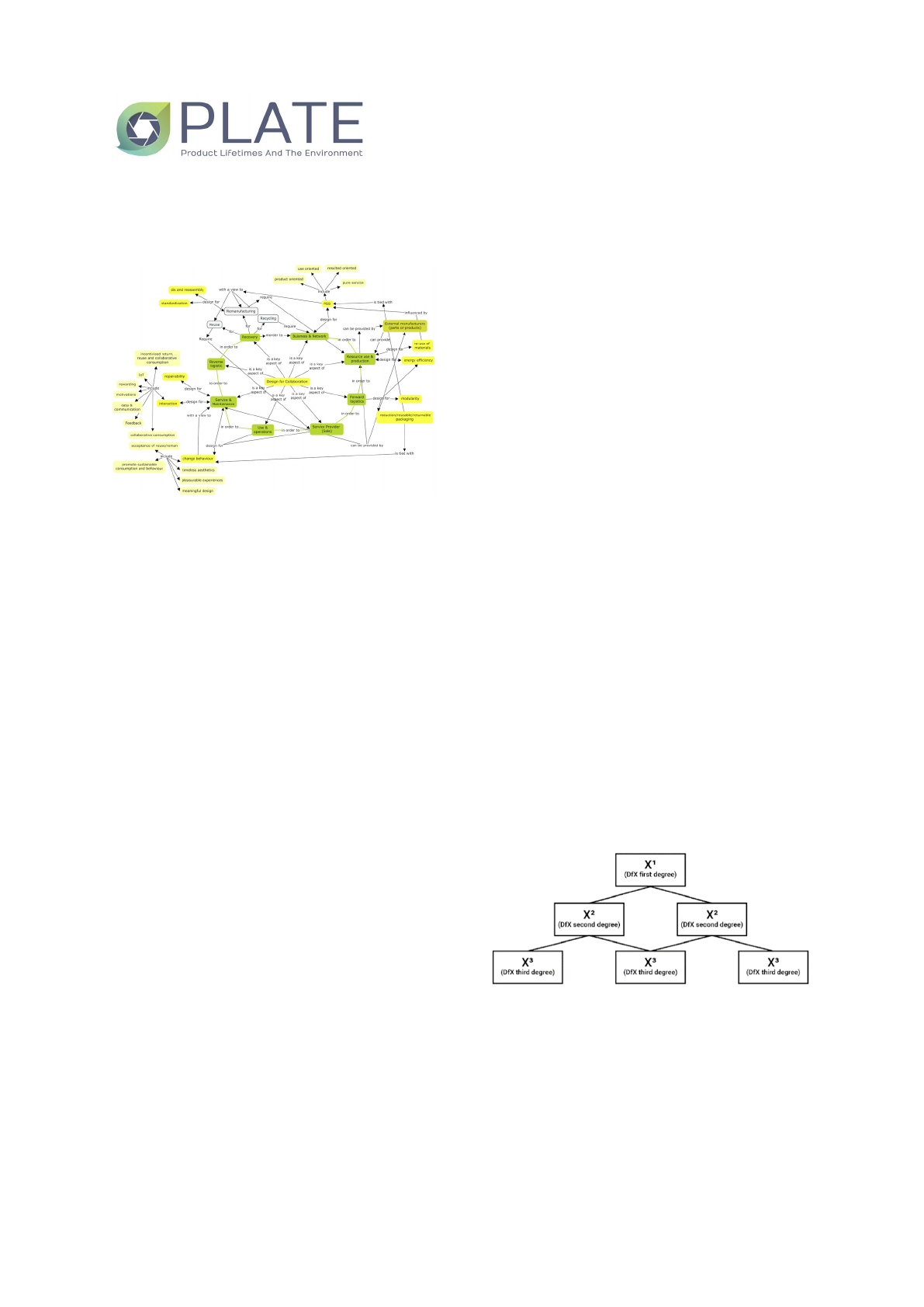
259
3rd PLATE Conference Berlin, Germany, 18-20 September 2019
Franconi A., Badalucco L., Peck D., Nasr N.
A multi-hierarchical “Design for X” framework for accelerating CE
design phase. The map presented in Fig. 2
does not intend to be a map that includes all
the strategies identified, but only an analysis of
key aspects.
Figure 2. Concept map.
From Fig. 2, a series of observations can be
made.
Some DfXs can be applied by different
disciplines / designers simultaneously
(Kuo, et al., 2001)
Some DfXs are applicable exclusively
in specific disciplines / designers
Some DfXs are the consequence of
hierarchical decisions (Huang, 1996)
Some DfXs are mutually non-exclusive
Some DfXs are mutually exclusive
Some DfXs are complementar (Van
Weelden, et al., 2016; De los Rios, et
al., 2017; Moreno, et al., 2017)
Some DfXs are applicable across time
dimensions
Some DfXs follow different processes
in different contexts and times
Some DfXs are applicable in single
and different phases
Some DfXs can be applied
consequently
Some DfXs can be applied in parallel
Some DfXs can take effect after the
first loop of the product
Some DfXs may progressively
increase or decrease in effectiveness
in different loops
Several DfXs have variable
effectiveness on different products
The synthetic DfXs list of observations highlight
the complexity of the hierarchization.
Consequently, it was hypothesized that a
hierarchy of DfXs should follow a multi-
hierarchical approach. While a detailed
verification of the entire conceptualization
presented in Fig. 2 goes beyond the scope of
this study, this has been useful to formulate
three hypotheses which are the interpretation
that resulted from it.
Develop - Hypothesis
Three distinct hierarchies for DfX are
conceivable. The first hypothesis relates to the
hierarchy of the priority orders of the ‘X’
strategies. For example, with a view to
implement a design strategy for refurbishing
(X1) it is essential, in sequential order, work on
design for disassembly (X2) and then more in
detail on design for maintenance (X3), etc. (Van
den Berg, et al., 2015), respectively X1, X2, X3.
‘X’ may vary in detail in the applied design
strategy. The X1 determines the main circular
strategy or in other words Maintenance, Reuse,
Redistribute, Refurbish, Remanufacture, and
Recycle, whereas X2, X3 the possible design
strategies to reach X1. Hence, the first
hypothesis is:
H1
To achieve the first degree DfX (X1) a
hyperbolic tree hierarchy diagram, that
describes each sub DfX strategy, can be used
(Fig. 3).
Figure 3. DfX hierarchization based on degrees of
priority and design specifications.
Companies organize product development
based on the phases of product lifecycle. The
choices made during each phase (P) of the
process can influence the subsequent phases
(Cataldo et al., 2006). In order to achieve X1, a
variety of designers, in different design phases,
should coordinate their own DfXs effectively
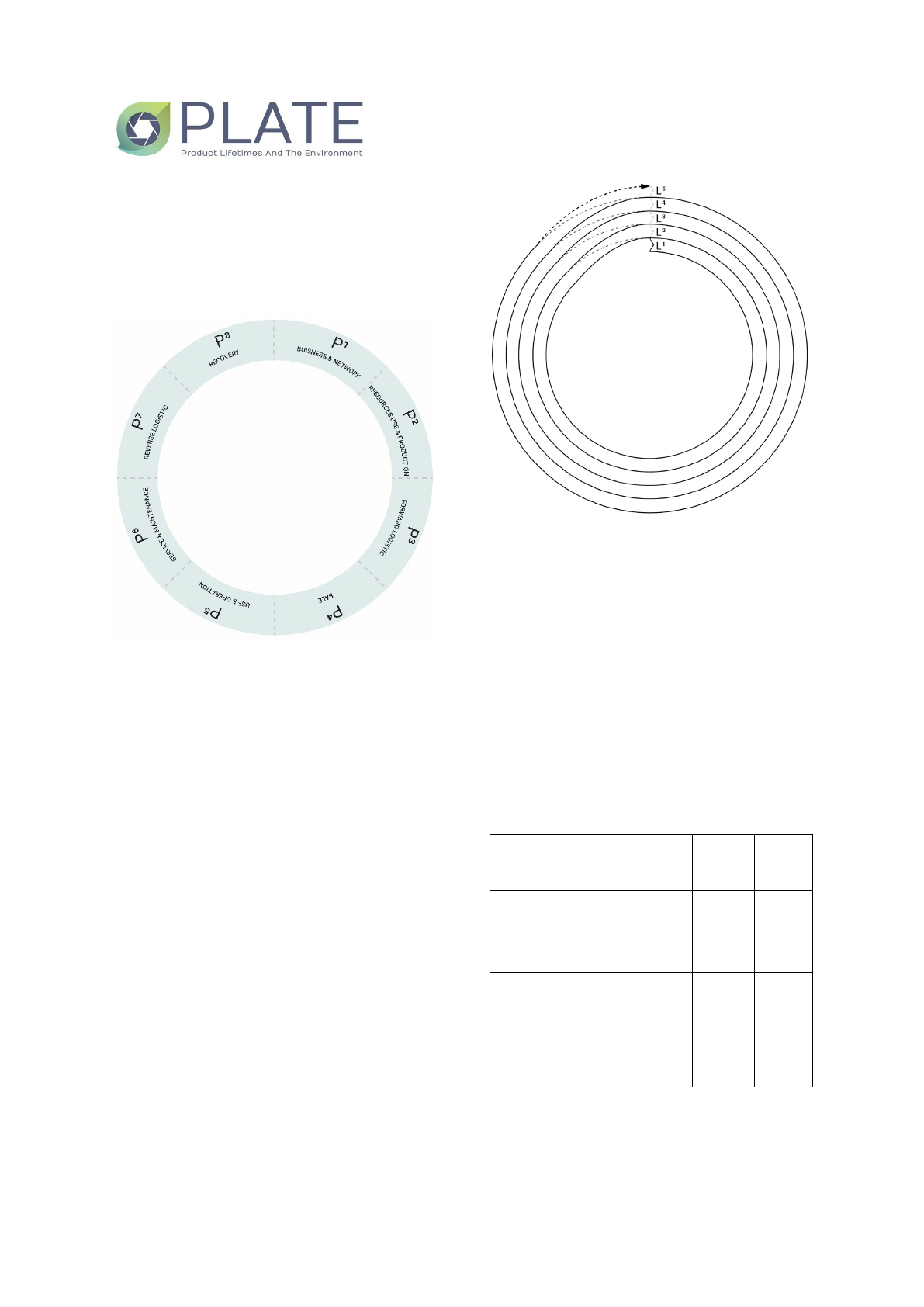
260
3rd PLATE Conference Berlin, Germany, 18-20 September 2019
Franconi A., Badalucco L., Peck D., Nasr N.
A multi-hierarchical “Design for X” framework for accelerating CE
using specific X2 and X3. Hence, the second
hypothesis is:
H2
Through a circular life cycle phase diagram, it
is possible to position any DfX for each phase
(Fig. 4).
Figure 4. DfX hierarchization based on the
phases of the product life cycle.
CE aims at recovering products for many loops
by using as less energy and materials as
possible for each loop (Bakker et al. 2014). In
business terms, the life cycle of the product
should last for many loops (L) by using specific
combinations of strategies in order to make the
business last longer. With that aim, designers
should foresee which X1 should be applied for
each product lifetime (L1, L2, L3, etc.) in order
to then decide in a hierarchical configuration
X2 and X3. Hence, the third hypothesis is:
H3
In a spiral loop diagram, DfXs can be applied
over multiple product life cycles (Fig. 5).
Figure 5. DfX hierarchization based on the
different loops / temporal dimensions.
Validate - Interview guide
In the last step of the methodology, an
interview with experts from the academic and
industrial world through a guided face-to-face
interview was undertaken. This methodology
consists of asking all the interviewees the
same questions, leaving them free to explore
specific issues (Patton, 2002) to validate the
proposal. A brief description of the profiles and
skills of the interviewees has been provided in
Tab. 1.
No. Area of CE expertise Sector From
1 User experience and
product design
Acade. USA
2 Transportation and
mobility systems
Acade. USA
3 Consumer electronics,
nanomaterials, and
lithium-ion batteries
Acade. USA
4 Policies supporting
energy technology,
energy systems and
information technology
Acade. USA
5 Product lifecycle
design and
remanufacturing
Indu. USA
Table 1. Specification on the competences and
origin of the interviewees.
Loading more pages...