
Article
Predicting Water Supply and Evapotranspiration of Street Trees
Using Hydro-Pedo-Transfer Functions (HPTFs)
Gerd Wessolek 1and Björn Kluge 2,*
Citation: Wessolek, G.; Kluge, B.
Predicting Water Supply and
Evapotranspiration of Street Trees
Using Hydro-Pedo-Transfer
Functions (HPTFs). Forests 2021,12,
1010. https://doi.org/10.3390/
f12081010
Academic Editor: Hiroaki Ishii
Received: 19 May 2021
Accepted: 20 July 2021
Published: 29 July 2021
Publisher’s Note: MDPI stays neutral
with regard to jurisdictional claims in
published maps and institutional affil-
iations.
Copyright: © 2021 by the authors.
Licensee MDPI, Basel, Switzerland.
This article is an open access article
distributed under the terms and
conditions of the Creative Commons
Attribution (CC BY) license (https://
creativecommons.org/licenses/by/
4.0/).
1Institute of Ecology, Technische Universität Berlin, 10587 Berlin, Germany; ger[email protected]
2Institute of Ecology, Ecohydrology, Technische Universität Berlin, 10587 Berlin, Germany
*Correspondence: [email protected]; Tel.: +49-30314-73535
Abstract:
The climate, soil properties, groundwater depth, and surrounding settings in cities vary
to a tremendous extent, which all lead to different growing conditions and health for street trees.
Because of climate change, the availability of water in cities will undergo changes in the next decades.
As urban trees have a very positive influence not only on microclimate but also on biodiversity
and life quality in general, they need to be protected. Thus, we need to know how to measure
and calculate the availability of water for street trees to optimize their site conditions and water
supply. This study presents Hydro-Pedo-Transfer Functions (HTPFs) for predicting water supply
and actual evapotranspiration of street trees for varying urban conditions. The HTPFs are easy to
use, and the input parameters can either be mapped easily or taken from local climate agencies
or soil surveys. The first part of the study focuses on the theoretical background and related
assumptions of the HTPFs for predicting water supply, and on obtaining the potential and actual
evapotranspiration of urban street trees using easily available data. The second part gives information
and exemplifies how this input data can be measured, mapped, or predicted. Calibration of the
HTPFs were done using the sap-flow measurements of three Linden trees (Tilia cordata). Exemplarily,
the HTPF scenarios for the varying urban site conditions of Berlin are presented. The water supply
and actual evapotranspiration of the street trees severely depend on the local climate (summer rainfall
and potential evapotranspiration), site conditions (catchment area, soil available water, and degree of
sealing), and on the tree characteristics (species, age, and rooting depth). The presented concept and
the equations build a good and flexible frame that is easy to program using a spreadsheet tool or an
R script. This tool should be tested and validated also for other cities and climate regions.
Keywords:
street trees; evapotranspiration; street-tree catchments; urban trees; water supply; tree
water demand; Blue–Green Infrastructure; street design
1. Introduction
The climate, soil properties, groundwater depth, and surrounding settings in cities
vary to a tremendous extent, which all lead to different growing conditions and health for
street trees. In practice, a major question is how to calculate and manage the water supply
and irrigation of street trees in order keep them alive even under difficult climate and site
conditions. In the past, this has been difficult to calculate, and thus the main motivation
behind this contribution.
This paper investigates so-called Hydro-Pedo-Transfer Functions (HPTFs) as a poten-
tial tool to better inform about water supply and water stress for individual trees in cities,
such as Berlin. The HPTFs make it possible to predict the water supply and potential and
actual evapotranspiration of deciduous street trees using easily available site and climate
information. The relevant data can be taken either by site mapping and/or from local
environmental services, climate agencies, and national soil surveys.
Because of climate change, the availability of water in cities will undergo changes in
the next decades [
1
]. Higher temperatures, unstable transition periods, and an increase
Forests 2021,12, 1010. https://doi.org/10.3390/f12081010 https://www.mdpi.com/journal/forests
Forests 2021,12, 1010 2 of 23
in extreme weather events are being predicted worldwide for many regions [
2
,
3
]. Street
trees improve the aesthetic quality of cities [
4
], provide numerous valuable environmental
benefits and ecosystem functions [
5
], and are very important for the wellbeing of urban
dwellers worldwide [6].
The role of trees for urban climates includes cooling down of temperatures in summer-
time by transpiration and shading of pavements and buildings. Thus, they are ameliorating
the urban heat-island effect [
7
–
9
]. Moreover, they contribute to biodiversity in cities as habi-
tats for wildlife, providing food, habitat, and landscape connectivity for numerous species,
such as birds, squirrels, arachnids, insects, and many others [
10
–
12
]. They can adsorb air
pollutants, produce oxygen, and, at the same time, absorb carbon dioxide [5,12,13].
Not least, unsealed vegetated sites, such as urban greenery and street trees, can reduce
runoff, particularly after stormwater events, which is of high importance in urban areas [
14
].
They contribute to relieve water runoff from heavy precipitation, rivers, and sewer systems
on urban streets [15]. Finally, trees often compensate for architectural blunders.
Providing an adequate water supply contributes to more vitality, better growth condi-
tions, and higher ecosystem benefits [
16
]. In contrast, urban tree growth and ecosystem
services may be negatively impacted by soil compaction and/or by paving in combination
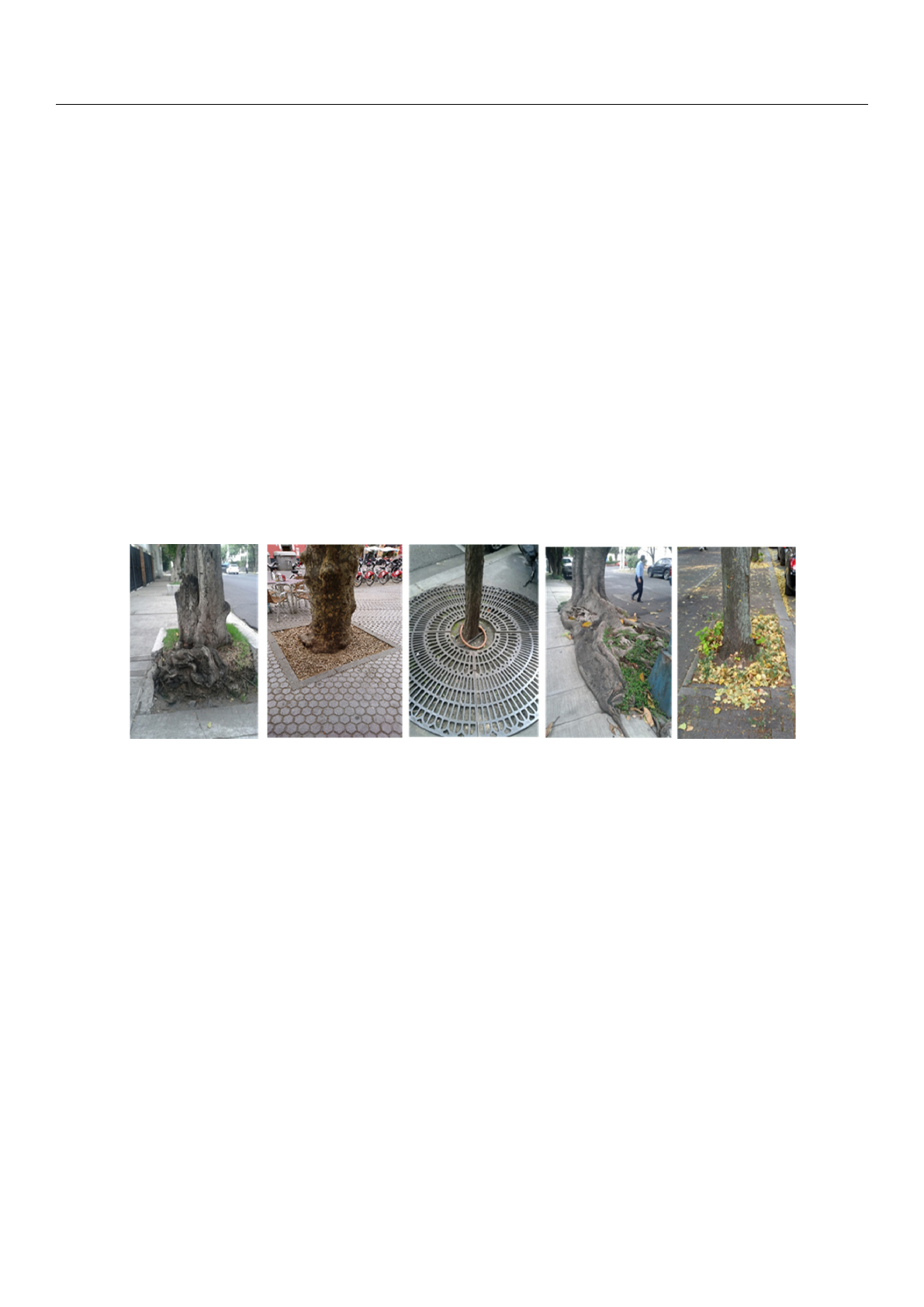
with summer droughts caused by climate change (Figure 1), with the consequence of
limited access to water [1,17,18].
Forests 2021, 12, x FOR PEER REVIEW 2 of 23
Because of climate change, the availability of water in cities will undergo changes in
the next decades [1]. Higher temperatures, unstable transition periods, and an increase in
extreme weather events are being predicted worldwide for many regions [2,3]. Street trees
improve the aesthetic quality of cities [4], provide numerous valuable environmental ben-
efits and ecosystem functions [5], and are very important for the wellbeing of urban dwell-
ers worldwide [6].
The role of trees for urban climates includes cooling down of temperatures in sum-
mertime by transpiration and shading of pavements and buildings. Thus, they are ame-
liorating the urban heat-island effect [7–9]. Moreover, they contribute to biodiversity in
cities as habitats for wildlife, providing food, habitat, and landscape connectivity for nu-
merous species, such as birds, squirrels, arachnids, insects, and many others [10–12]. They
can adsorb air pollutants, produce oxygen, and, at the same time, absorb carbon dioxide
[5,12,13].
Not least, unsealed vegetated sites, such as urban greenery and street trees, can re-
duce runoff, particularly after stormwater events, which is of high importance in urban
areas [14]. They contribute to relieve water runoff from heavy precipitation, rivers, and
sewer systems on urban streets [15]. Finally, trees often compensate for architectural blun-
ders.
Providing an adequate water supply contributes to more vitality, better growth con-
ditions, and higher ecosystem benefits [16]. In contrast, urban tree growth and ecosystem
services may be negatively impacted by soil compaction and/or by paving in combination
with summer droughts caused by climate change (Figure 1), with the consequence of lim-
ited access to water [1,17,18].
Effects of unusually high temperatures and prolonged dry periods occurred in the
last three years (2018, 2019, and 2020), not only in Berlin but also in many other European
regions. As a reaction to these extremely dry years, trees showed yellow/brown foliage
and/or bare branches in the early summer months. This botanic reaction is common in late
autumn. As a result, severe damage to the entire Berlin tree population occurred, indi-
cated by massive deadwood development, fundamental deterioration in vitality, and in-
dividual tree mortality [19]. In both years, 2018 and 2019, the State of Berlin spent an ad-
ditional 2.3 million euros for irrigation measures of city trees [20].
The Department of Economic and Social Affairs Population Dynamics of the United
Nations expects that in the next 30 years, about 70% of the world’s population will live in
cities [21]. Especially in cities of arid and semi-arid regions, street trees are important for
cooling the air temperature by transpiration and shading. They are essential for the qual-
ity of life. Thus, it became an essential issue to develop new strategies for greening inner-
city places and planting new trees.
Figure 1. Examples of urban street-tree catchments, as found in Mexico City, Paris, NYC, Sydney,
and Berlin.
2. Materials and Methods
Chapter 2 explains the basic principles of Hydro-Pedo-Transfer Functions (HPTFs)
and defines the specific site information, such as climate (rainfall and potential evapotran-
spiration), soil (water retention and groundwater depth), and tree (species, age, rooting
Figure 1. Examples of urban street-tree catchments, as found in Mexico City, Paris, NYC, Sydney, and Berlin.
Effects of unusually high temperatures and prolonged dry periods occurred in the
last three years (2018, 2019, and 2020), not only in Berlin but also in many other European
regions. As a reaction to these extremely dry years, trees showed yellow/brown foliage
and/or bare branches in the early summer months. This botanic reaction is common in late
autumn. As a result, severe damage to the entire Berlin tree population occurred, indicated
by massive deadwood development, fundamental deterioration in vitality, and individual
tree mortality [
19
]. In both years, 2018 and 2019, the State of Berlin spent an additional
2.3 million euros for irrigation measures of city trees [20].
The Department of Economic and Social Affairs Population Dynamics of the United
Nations expects that in the next 30 years, about 70% of the world’s population will live in
cities [
21
]. Especially in cities of arid and semi-arid regions, street trees are important for
cooling the air temperature by transpiration and shading. They are essential for the quality
of life. Thus, it became an essential issue to develop new strategies for greening inner-city
places and planting new trees.
2. Materials and Methods
Chapter 2 explains the basic principles of Hydro-Pedo-Transfer Functions (HPTFs)
and defines the specific site information, such as climate (rainfall and potential evapotran-
spiration), soil (water retention and groundwater depth), and tree (species, age, rooting
depth, and catchment area), to solve the equations. Examples of how to gain these data

Forests 2021,12, 1010 3 of 23
either by mapping, measuring, or by using available digital data from various climate
panels and soil information systems are also given.
2.1. Principles of Hydro-Pedo-Transfer Functions (HPTFs)
The principal idea behind HPTFs for predicting potential and actual evapotranspira-
tion and groundwater recharge for cropland, grassland, and forest stands is described in
detail in [
22
]. However, for deriving HPTFs for urban street trees, the inner-city growing
conditions have to be considered. Therefore, firstly explanations are given of how the
HPTFs were derived in principle, followed by modifications for urban site conditions. The
procedure for deriving HPTFs contains two steps: First, a conventional soil–vegetation–
atmosphere–transpiration model (SVAT) was used to calculate the daily rates of evapotran-
spiration and percolation [22], using the following input parameters:
•
Daily climate data—precipitation, wind velocity, mean air temperature, mean air
humidity, and net radiation;
•
Soil hydraulic functions—soil water retention, unsaturated hydraulic conductivity,
and depth to the groundwater table;
•
Plant data—degree of soil cover, rooting depth, plant height, and stomata resistance
for various soil moisture conditions.
Actual evapotranspiration (ETI
a
) was calculated using the Penman–Monteith ap-
proach as modified by Rijtema [
23
]. Soil hydraulic functions were determined in the
laboratory using the instantaneous profile method according to Plagge [
24
]. Model cal-
ibrations use either ETI
a
measurements from field studies, lysimeter measurements, or
balances of total runoff from catchments [
22
]. The SVAT model was used for simulations of
various combinations of site-specific conditions:
•Four soil textures with plant available water from low to high;
•Deciduous trees;
•Six groundwater table depths (from 0.9 m to 2.8 m deep);
•Sixteen climate stations in Germany.
Secondly, annual actual ETI
a
results of >12,000 SVAT simulations for varying water
supply conditions were evaluated by means of nonlinear multiple regression analysis using
the SPSS software package. Each annual actual ETI
a
value was nonlinearly correlated to
the following:
1.
Potential FAO grass reference evapotranspiration (=without any water limitation,
ET0) according to Allen et al. [25];
2. Site-specific annual water supply (Sw).
The annual water supply (S
w
) is defined by the available water resources that plants
can use for transpiring, such as summer precipitation (P
s
), soil available water in the root
zone (W
a
), capillary rise from the groundwater to the root zone (Q
a
), and runoff (R
o
) from
surrounding sealed areas, which can be either a gain or a loss:
Sw= Ps+ Wa+ Qa±Ro(1)
where Swis the available water supply of the tree catchment area (mm), Psis the summer
precipitation from April 1 to September 30 (mm), W
a
is the available soil water in the
effective root zone (mm), Q
a
is the actual capillary rise from the groundwater (mm), and
R
o
is the surface runoff (mm), which is either a gain (+) or a loss (
−
) for the tree depending
on the slope and draining direction in the catchment area.
Next, it became necessary to combine both the water supply and the actual evapotran-
spiration within a logic framework. Figure 2illustrates the principal idea of the HPTFs
describing water stress and water supply: using the ratio of actual evapotranspiration and
potential evapotranspiration (ETIa/ET0) against the actual water supply (S
w
). Up to a
critical threshold (in this case 800 mm), the ratio increases as a function of the water supply
using Function 1; above this threshold the ratio only depends on the height of ET0 and can
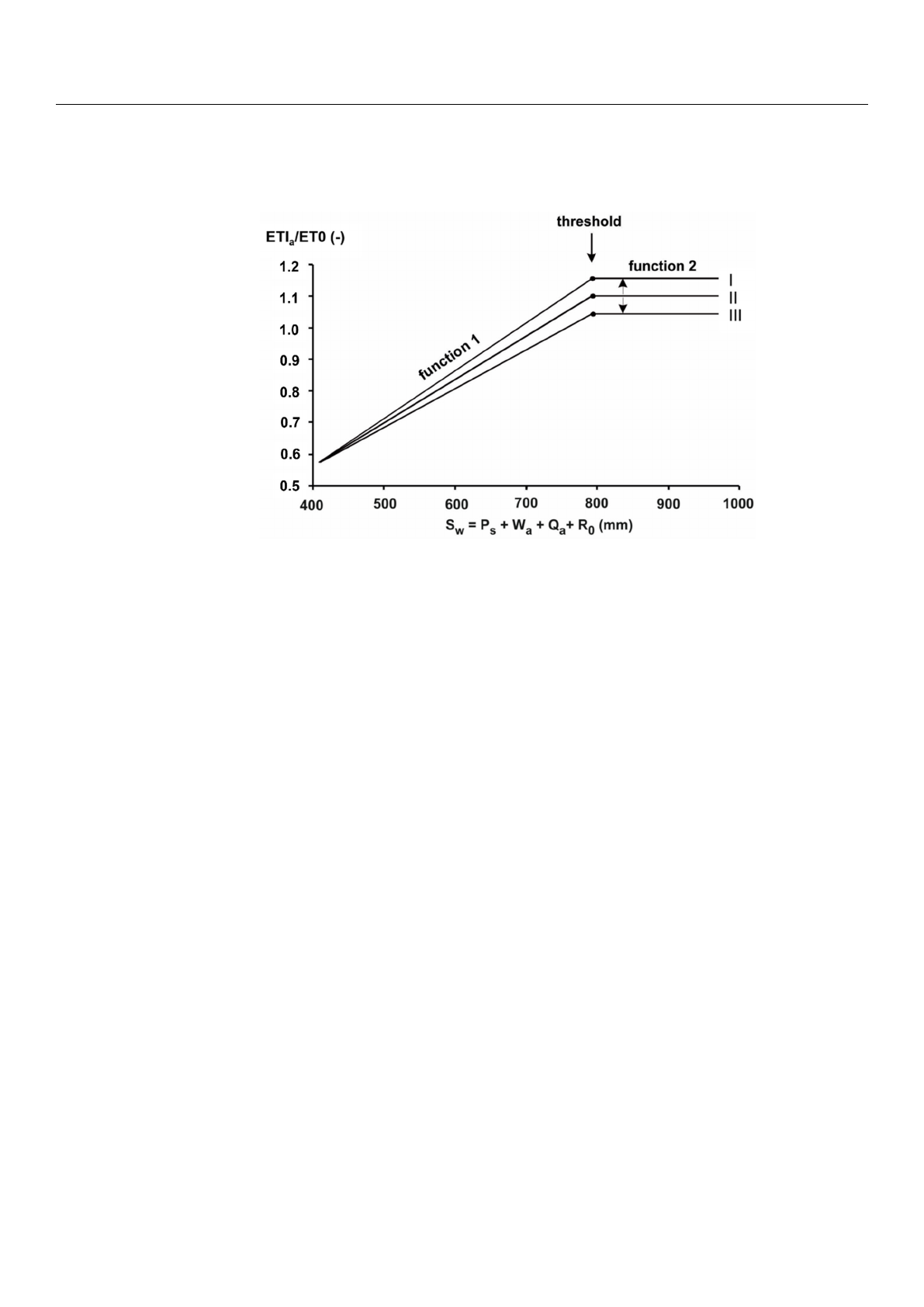
Forests 2021,12, 1010 4 of 23
be described by Function 2, which is independent of the amount of Sw. The three lines (I,
II, and III) of both functions indicate various levels of ET0.
Forests 2021, 12, x FOR PEER REVIEW 4 of 23
using Function 1; above this threshold the ratio only depends on the height of ET0 and
can be described by Function 2, which is independent of the amount of Sw. The three lines
(I, II, and III) of both functions indicate various levels of ET0.
This HTPF concept, which is often called the “TUB-BGR” approach, introduced and
described in detail in Wessolek et al. [22], allows predicting the annual actual evapotran-
spiration, water stress, and percolation rate for different land usage, climate, and side con-
ditions.
Figure 2. Principal HTPF concept: ETI
a
/ET0 (-) is the ratio of actual and potential evapotranspiration
as a function of the total water supply (S
w
). While Function 1 is to be used for sites with water limi-
tation, Function 2 is suitable for sites without any water limitation. The threshold of an unlimited
water supply for trees in the eastern part of Germany is about 800 mm. The three lines (I, II, and III)
of both functions indicate various levels of ET0.
Among others, it has been used to predict the long-term means of the water budget
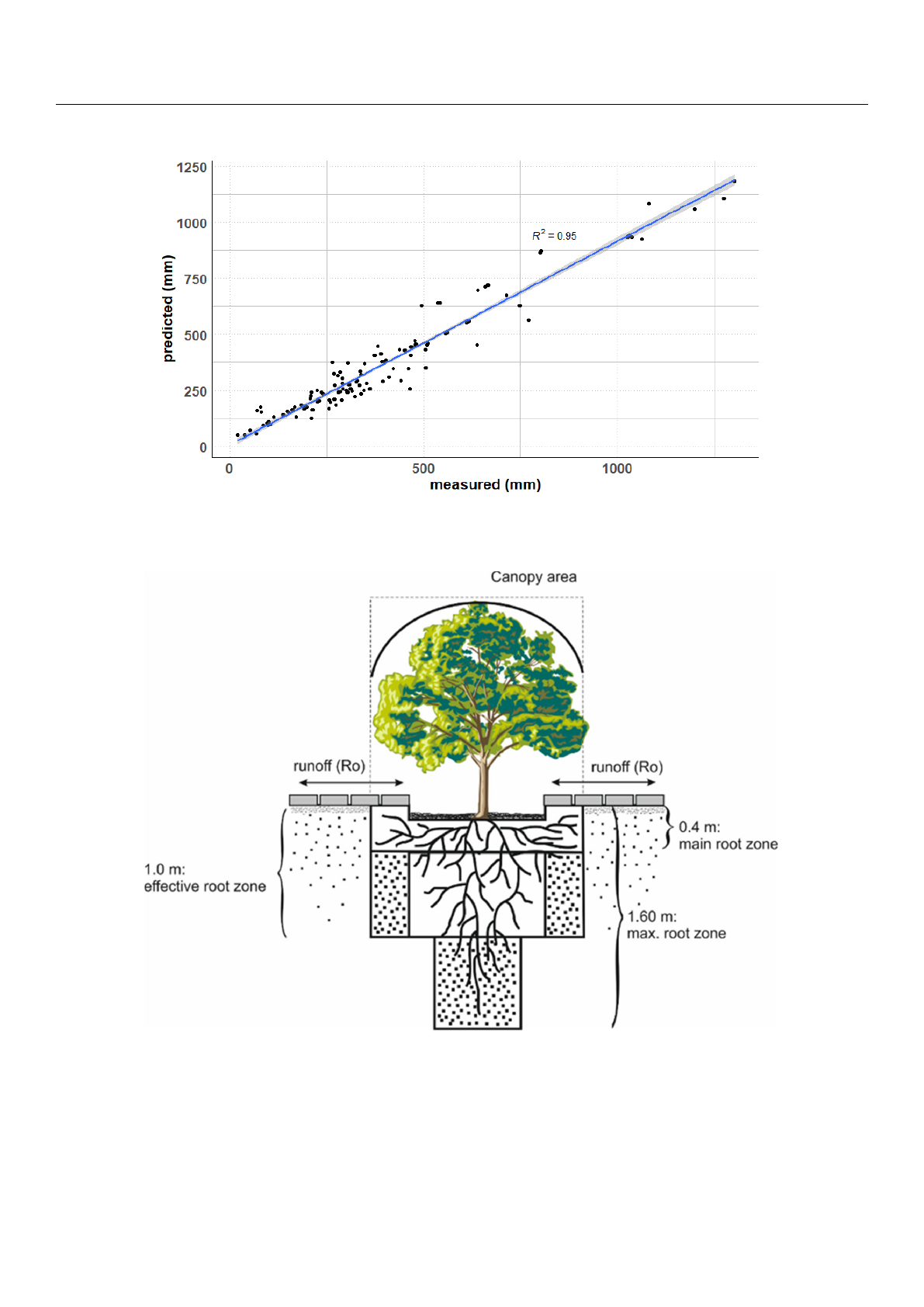
within the framework of the Hydrological Atlas of Germany [26]. The HPTF results have
been successfully validated by comparisons with the gauge-measured values of the mean
percolation rate (R) + runoff (R
o
) taken in 106 different catchment areas in Germany, as
shown in Figure 3.
Figure 3. HPTF validation by comparisons of the gauge-measured values with the predicted perco-
lation rate + runoff, taken in 106 catchments areas in Germany [22].
Figure 2.
Principal HTPF concept: ETI
a
/ET0 (-) is the ratio of actual and potential evapotranspiration
as a function of the total water supply (S
w
). While Function 1 is to be used for sites with water
limitation, Function 2 is suitable for sites without any water limitation. The threshold of an unlimited
water supply for trees in the eastern part of Germany is about 800 mm. The three lines (I, II, and III)
of both functions indicate various levels of ET0.
This HTPF concept, which is often called the “TUB-BGR” approach, introduced and
described in detail in Wessolek et al. [
22
], allows predicting the annual actual evapotran-
spiration, water stress, and percolation rate for different land usage, climate, and side
conditions.
Among others, it has been used to predict the long-term means of the water budget
within the framework of the Hydrological Atlas of Germany [
26
]. The HPTF results have
been successfully validated by comparisons with the gauge-measured values of the mean
percolation rate (R) + runoff (R
o
) taken in 106 different catchment areas in Germany, as
shown in Figure 3.
Recently, the HPTF approach also has been successfully tested for water budget predic-
tions and regionalization of drought stress within a German National Forest Inventory [
27
].
2.2. Conceptual Approach and Deriving Input Parameters
In this chapter, explanations are given of how the HPTF concept has been modified
for urban street-tree conditions, and how evapotranspiration and water supply can be
calculated easily. In detail, it is demonstrated how environmental factors, such as exposition,
location and street type, tree species, soil properties, sealing degree, and climate, are
considered. Moreover, information is given on how the input parameters can be derived
easily by mapping or by using digital information platforms. Figure 4shows principally,
how street-tree sites can be characterized by (i) the tree canopy, which also defines the
catchment area; (ii) soil and surface conditions; and (iii) effective rooting depth.
Forests 2021,12, 1010 5 of 23
Forests 2021, 12, x FOR PEER REVIEW 4 of 23
using Function 1; above this threshold the ratio only depends on the height of ET0 and
can be described by Function 2, which is independent of the amount of Sw. The three lines
(I, II, and III) of both functions indicate various levels of ET0.
This HTPF concept, which is often called the “TUB-BGR” approach, introduced and
described in detail in Wessolek et al. [22], allows predicting the annual actual evapotran-
spiration, water stress, and percolation rate for different land usage, climate, and side con-
ditions.
Figure 2. Principal HTPF concept: ETI
a
/ET0 (-) is the ratio of actual and potential evapotranspiration
as a function of the total water supply (S
w
). While Function 1 is to be used for sites with water limi-
tation, Function 2 is suitable for sites without any water limitation. The threshold of an unlimited
water supply for trees in the eastern part of Germany is about 800 mm. The three lines (I, II, and III)
of both functions indicate various levels of ET0.
Among others, it has been used to predict the long-term means of the water budget
within the framework of the Hydrological Atlas of Germany [26]. The HPTF results have
been successfully validated by comparisons with the gauge-measured values of the mean
percolation rate (R) + runoff (R
o
) taken in 106 different catchment areas in Germany, as
shown in Figure 3.
Figure 3. HPTF validation by comparisons of the gauge-measured values with the predicted perco-
lation rate + runoff, taken in 106 catchments areas in Germany [22].
Figure 3.
HPTF validation by comparisons of the gauge-measured values with the predicted percolation rate + runoff, taken
in 106 catchments areas in Germany [22].
Forests 2021, 12, x FOR PEER REVIEW 5 of 23
Recently, the HPTF approach also has been successfully tested for water budget pre-
dictions and regionalization of drought stress within a German National Forest Inventory
[27].
2.2. Conceptual Approach and Deriving Input Parameters
In this chapter, explanations are given of how the HPTF concept has been modified
for urban street-tree conditions, and how evapotranspiration and water supply can be
calculated easily. In detail, it is demonstrated how environmental factors, such as exposi-
tion, location and street type, tree species, soil properties, sealing degree, and climate, are
considered. Moreover, information is given on how the input parameters can be derived
easily by mapping or by using digital information platforms. Figure 4 shows principally,
how street-tree sites can be characterized by (i) the tree canopy, which also defines the
catchment area; (ii) soil and surface conditions; and (iii) effective rooting depth.
The tree-canopy radius depends on the tree age and species. In our contribution, we
assume that it describes on the ground 1:1 the catchment area beneath the tree crown. If,
for example, the canopy has a radius (r) = 3 m, the catchment area (CA), in which root
water uptake for evapotranspiration takes place, can be calculated as
CA = π × r
2
(2)
where CA is the catchment area (m
2
) and r the radius of the crown area (m); for example,
CA = 3.14 × 9 = 28.26 m
2
.
Figure 4. Scheme for characterizing the site conditions of a street tree.
Rooting depth: In our example, a maximum root depth of 1.6 m, a main root zone of
0.4 m, and a resulting effective root zone of 1.0 m ((1.6 + 0.4)/2) were considered (Figure
4). Runoff from pavement flows either to the tree, thus improving water supply, or leaves
the catchment and discharges into the rainwater canalization. Besides the radius of the
canopy, one also should take the tree species into account, because tree species behave
differently with respect to plant water uptake and transpiration. To describe the relative
water demand of the different street-tree species, we suggest using the relative tree water
demand coefficients (T
r
), as listed in Table 1. They describe the relative differences among
Figure 4. Scheme for characterizing the site conditions of a street tree.
The tree-canopy radius depends on the tree age and species. In our contribution, we
assume that it describes on the ground 1:1 the catchment area beneath the tree crown. If,
for example, the canopy has a radius (r) = 3 m, the catchment area (CA), in which root
water uptake for evapotranspiration takes place, can be calculated as
CA = π×r2(2)
Loading more pages...