
3rd PLATE Conference
September 18 – 20, 2019
Berlin, Germany
Nils F. Nissen
Melanie Jaeger-Erben (eds.)
Universitätsverlag der TU Berlin
Hipp, Tamina N.: “Doing value” – Modelling of useful life based on
social practices. In: Nissen, Nils F.; Jaeger-Erben, Melanie (Eds.):
PLATE – Product Lifetimes And The Environment : Proceedings, 3rd PLATE
CONFERENCE, BERLIN, GERMANY, 18 – 20 September 2019. Berlin: Uni-
versitätsverlag der TU Berlin, 2021. pp. 353 – 359. ISBN 978-3-7983-3125-9
(online). https://doi.org/10.14279/depositonce-9253.
This article – except for quotes, fi gures and where otherwise noted – is
licensed under a CC BY 4.0 License (Creative Commons Attribution 4.0).
https://creativecommons.org/licenses/by/4.0/.

353
3rd PLATE 2019 Conference
Berlin, Germany, 18-20 September 2019
”Doing value“ – Modelling of Useful Life Based on Social Practices
Hipp, Tamina(a,b)
a) Technische Universität Berlin, Zentrum Technik und Gesellschaft, Berlin, Germany
b) Technische Universität Berlin, Fakultät für Elektrotechnik und Informatik, Berlin, Germany
Keywords: Lifetimes of Devices; Replacement; Grounded Theory; Theories of Practice; Sociology of
Valuation.
Abstract: The extension of product lifetimes is discussed as an important aspect of sustainable con-
sumption. So far, models explaining lifetimes of devices are predominantly user-oriented and are
based on a methodological individualism. Systemic interrelationships are underestimated due to an
overemphasis on individual room for manoeuvre. This paper presents a model to explain the useful
life of devices, which – with recourse to practice theory – is taking technological change, the context
of use and the setting of actions into account. The model is based on qualitative interviews that were
analysed using grounded theory. At the core of the model are valuation processes that are located in
the interactions with the devices and carried out against the background of context of use. Based on
sociology of evaluation, it is explained how the value of a devices is produced, reproduced, increased
or decreased until they are replaced. Using mobile phones as an example, two types of forms of prac-
tice are presented and it is it derived how longevity might be promoted.
Introduction
Long lifetimes of consumer goods are dis-
cussed as an important element concerning
sustainability (e.g. van Nes & Cramer, 2006).
This paper presents a model for explaining the
duration in use of devices that takes systemic
interrelations into account instead of overem-
phasis on the freedom of action. The model is
developed based on qualitative interviews
which were analysed using Grounded Theory.
In the following, the current state of research
on the topic of lifetimes is briefly outlined and
practice theory is described as the major con-
ceptual background of this study. This is fol-
lowed by a description of the methodological
design. Then the main construct "doing value"
is explained with reference to sociology of
valuation, before the model is described and
its usability is outlined. In conclusion, the po-
tential of the model and its transferability to
other product groups are discussed.
Literature review
Since the end of the 1970s and the beginning
of the 1980s, research has been carried out
into product lifetimes, replacement and the
handling of garbage in various predominantly
social science disciplines such as economics,
marketing, design, psychology, sociology, an-
thropology and cultural studies (Cooper, 2010).
The studies focus more on decisions and cogni-
tions (purchasing, investment, marketing, de-
sign decisions), sometimes also on emotional
attachment, and less on the practical handling
of consumer goods. With regard to study de-
sign, quantitative methods predominate,
whereby the statistical relationships between
the useful life and the device category, socio-
demographic characteristics, the expected life-
time, as well as intentions and attitude such as
environmental awareness are often investigat-
ed (Echegaray, 2015; Gnanapragasam, Cole,
Singh, & Cooper, 2018; Jaeger-Erben & Hipp,
2018; Knight, King, Herren, & Cox, 2013; LE
Europe et al., 2018; Siddharth, Dehoust, Gsell,
Schleicher, & Stamminger, 2016; Wieser,
Tröger, & Hübner, 2015). In these studies, the
user is predominantly conceived - whether im-
plicitly or explicitly - as a benefit-maximizing
subject according to methodological individual-
ism and rational choice, who would act inde-
pendently and self-controlling. However, the
fact that only a small part of behaviour can be
explained by attitudes and intentions is much
discussed in attitude-behavioural research
(Hassan, Shiu, & Shaw, 2016; Sheeran, 2002;
Sheeran & Webb, 2016; Shove, 2010). The
inconsistency between user attitudes and be-
haviour was also found in relation to lifetimes of
devices (Evans & Cooper, 2010). Praxeological
354
3rd PLATE Conference Berlin, Germany, 18-20 September 2019
Hipp T.
”Doing value“ – Modelling of useful life based on social practices
approaches, on the other hand, take structure
of society into account and may provide im-
pulses for research on (non-)sustainable use of
electronic products (Jaeger-Erben, Winzer,
Marwede, & Proske, 2016).
Practice theories
By drawing on practice theories, the separation
between actor and structure often found in the
social sciences is overcome conceptually and
methodically (Schatzki, Knorr-Cetina, & Savi-
gny, 2000). Social practices are set as the place
of the social and the smallest unit of analysis,
and routines are thus embedded in social con-
texts and settings that determine the meaning-
fulness of action supraindividually (Shove &
Spurling, 2013). Practice theory emphasizes the
materiality and physicality of social activity, arte-
facts are understood as important elements of
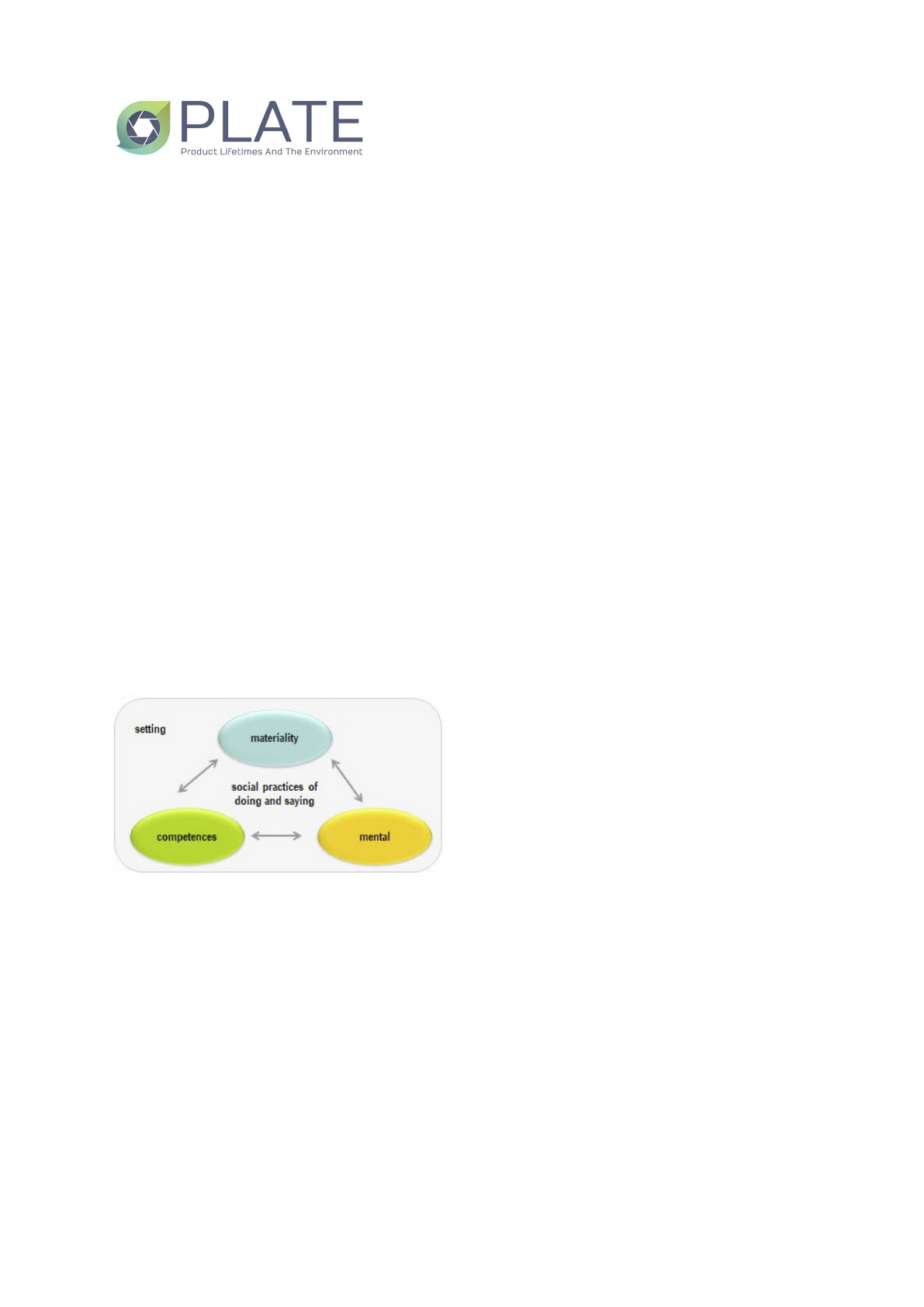
the formation of practice. Individuals are con-
ceived as carriers of practices that make mean-
ingful (mental) use of artefacts (materiality)
(Reckwitz, 2002), for which they need specific
competences. Social practices are performed
within a setting (see Figure 1). Interrelated con-
catenations of social practices are referred to as
forms of practice in the following, taking Hille-
brandt (2014) as a reference.
Figure 1. Elements of social practices © Own
illustration based on Jaeger-Erben 2016.
A practice-based approach enables the per-
spective that people do not consume in order
to meet needs, but that social practices require
consumption in order to be carried out (Warde
2005; Røpke, 2009; Shove, 2007). Thus the
questions arise for what the devices are used
for and how and why they are replaced and no
longer used for performing these practices.
Methodological approach
A qualitative approach was chosen for the in-
vestigation of the handling of devices. Both the
sampling and the analyse were carried out by
using (reflexive) grounded theory (Breuer,
Muckel, & Dieris, 2018; Bryant & Charmaz,
2011; Strauss & Corbin, 1996), since this
methodology is suitable for generating theories.
To date, 15 guideline-based in-home inter-
views, each lasting approximately 2 hours,
have been conducted, and more are planned.
The interviewees from different social segments
are between 14 and 79 years old and live all
over Germany. The data material was analysed
using the tool ATLAS.ti.
The focus of the interviews was on mobile
phones and washing machines. For both de-
vices, it was recorded how many of these de-
vices were used in life and how the devices
were replaced. During the analysis it became
apparent that reference was often made to a
"value" of the device and that this value seems
to be constitutive for many practices in dealing
with devices.
Conceptualization of valuation
processes
The empirical material suggests that a dynamic,
relative value of the devices is produced in and
through social practices. A recourse to the so-
ciology of valuations provides the theoretical
foundation for the reconstruction of these pre-
dominantly just implicit valuations. Although so
far only a few attempts have been made to
combine practice theories and sociology of
valuation (Arnould, 2014), this might be fruitful,
since part of the heterogeneous field of the
valuation sociology also deals with how valua-
tions are carried out operationally and which
practices are connected with it (Lamont 2012;
Kjellberg & Mallard 2013). If practices are seen
as an ontological basis, the combination with
practice theories is possible (Schatzki, 2016).
Thus the importance of materiality is also em-
phasized in the sociology of valuation (Meier,
Peetz, & Waibel, 2016).
Value is decoded as something that is pro-
duced in interaction – in contrast to economics,
which locate it in the object, or psychology,
which locate it in the subject (Ramírez, 1999;
Simmel & Frisby, 2004). In short: "(...) value
emerges from what people do" (Arnould, 2014,
p. 130). The value of a device is thus produced,
reproduced, upgraded or devalued in and by
the social practices in which the device is in-
volved or related to the device. The valuations
do not have to be conscious of the acting sub-
ject or be intended by him; instead, they are
produced and varied in their use of the device –
against the background of context of use and
setting. In order to emphasize the performative

355
3rd PLATE Conference Berlin, Germany, 18-20 September 2019
Hipp T.
”Doing value“ – Modelling of useful life based on social practices
character of this valuation process, in the fol-
lowing this process is referred to as "doing val-
ue". "Doing value" is thus conceptualized as a
main construct, as implicit order schemata,
which encompasses both the processes of
emotionally founded value attribution (Krüger &
Reinhart, 2016, 2017) differentiated in the lit-
erature and the comparison-based weighing of
values (Bowker & Star, 2000).
In the sociology of valuation, often only single
moments of valuation (methodological situa-
tionalism, Knorr-Cetina & Cicourel, 1981) are
in focus. In order to analyse how the replace-
ment of a device occurs, however, concatena-
tions of valuations must be considered. The
model of the evaluation constellation (German
Bewertungskonstellation) of Meiers allows us
to analyse the transsituative character of valu-
ations. Therefore, elements1 of this concept
are adopted to elaborate the characteristics of
"doing value" (Meier et al., 2016):
1) Valuations are interlocked with positions
and relations that have specific structural
characteristics. The valuation of a device takes
place against the background of the context of
use, i.e. the suitability to do certain things with
it or to be able to represent the symbolic val-
ues required. Furthermore, the valuation takes
place in relation to the technological change
and the concrete setting. A device is valuated
relationally in comparison to another device.
2) Valuations have rules with transsituative
validity. Valuation rules indicate what the situa-
tion is about, which indications are used and
which logic is followed in the valuation. With
regard to the model, this can mean, for exam-
ple, "practicability" or "less effort".
3) Valuation processes require materiality. In
relation to the useful life, this is on the one
hand the material composition of the device
used (quality, functions, operability, etc.) and
on the other hand the wear and tear and de-
fects.
This characterization of the valuation process-
es forms the basis for the developed model.
Practice based model to explain
useful life of devices
In the literature, the lifetime of a device is di-
vided into the phases of acquisition, use, and
1 The model of the valuation constellation is based on a
methodical subject-object division. Therefore, only those
aspects of its model are used that are also based on a
practice-based approach.
give away2 (Murakami, Oguchi, Tasaki, Daigo,
& Hashimoto, 2010). My interviews suggest
that this order does not correspond to the logic
of social practice. Which device is purchased
does not arise from "nothingness", but is relat-
ed to handling experience with a previous
device in the specific context of use. Also, the
passing on of a device is often not to be ex-
plained exclusively with reference to the de-
vice itself (e.g. not repairable defect), but takes
place in relation to a potentially new device or
its positive valuation and accessibility. The
potentially new device thus serves as a refer-
ence standard, which forms the basis for the
valuation of the current device. According to
my interviews, even the first personal pur-
chase of a device is shaped by experiences of
using other devices (e.g. using washing ma-
chine at parents' house), the use of devices
with similar functions (e.g. experiences with
the computer are transferred to the
smartphone) or stories told by friends and
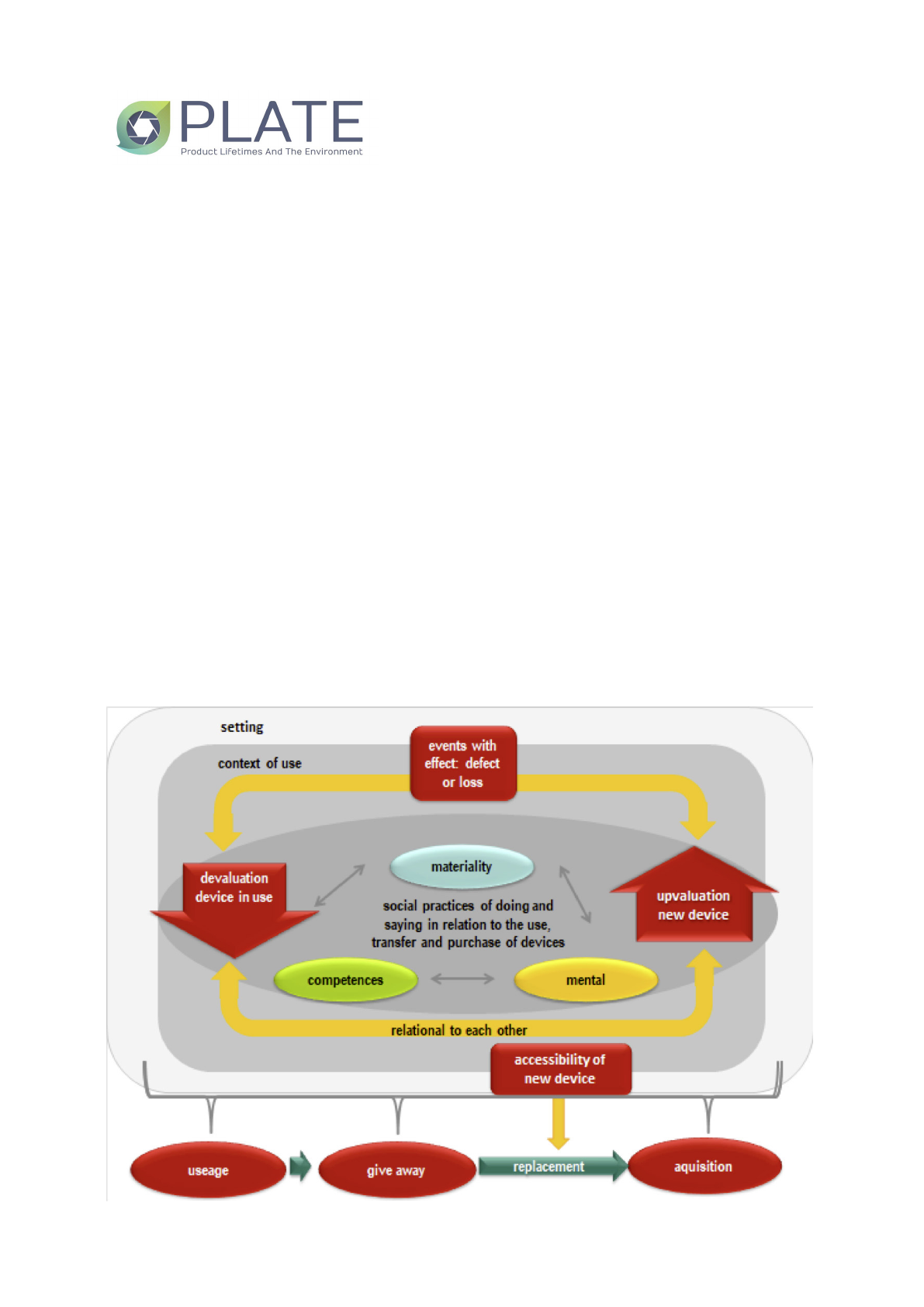
relatives. Accordingly, I model the usage
phase as the beginning, which explains the
product give away associated with the pur-
chase of a new device. The model is illustrated
in Figure 2.
The value of a device is permanently re-
produced, increased or decreased by so-
cial practices
A device is integrated by the user into the de-
sign of everyday life, for example a
smartphone for communication, entertainment
and information retrieval. Social practices are
also carried out in which the device is not a
substantial part of it, but which are related to
the device, for example by talking about the
device or looking for information about the
product. All these social practices of doing and
saying in the context of use, give away and
purchase are linked to valuations of the de-
vice. With each of these social practices, as
well as with the omission (e.g. no care practic-
es), the value of the device is produced, re-
produced, increased or decreased. The per-
formatively produced value of the device is
rarely reflected, but it has a meaningful char-
acter.
2 There are various definitions of product lifetime and
duration in use. With regard to duration in use, an addi-
tional distinction is often made between storage and repair
phases. For reasons of limited space, this article does not
go into this further, although storage and repair were also
part of the interviews.
356
3rd PLATE Conference Berlin, Germany, 18-20 September 2019
Hipp T.
”Doing value“ – Modelling of useful life based on social practices
The valuation processes takes place with re-
gard to various characteristics such as func-
tionality, quality, usability, modernity, design
and emotional attachment. Due to these differ-
ent dimensions, the revaluation or devaluation
can also be contradictory. For example, the
usability can improve due to the habituation
during the usage phase, while the valuation of
functionality and aesthetics can decrease due
to wear and tear. Overall, the gradual devalua-
tion of the current device is predominantly
carried out during use in parallel with the grad-
ual upgrading of a desirable new one.
The valuations manifest themselves in the
elements of social practices
Production, reproduction and changes in value
are evident in the three elements of social
practices: Materiality, meanings and compe-
tencies and are intertwined.
With regard to materiality, the devaluation of
the current device may be related to technical
(partial) defects, optical wear or the lack of
innovative applications, for example. These
can occur successively (e.g. battery slows
down, scratches) or spontaneously caused by
events (e.g. device falls down).
The meanings associated with the valuation
processes can be related both to the device
itself (e.g. emotional attachment, careful han-
dling to maintain functionality, enjoyment of
design) and to the everyday life (e.g. time
management). Regarding the upgrading of the
replacement device, the attractiveness of nov-
elty respectively the enthusiasm for new de-
vices plays a major role (see Frick, Jaeger-
Erben & Hipp, this volume).
The competences refer to the ability to handle
the device (e.g. know-how regarding care
practices, repair). They are either to be as-
signed to the wearer of the practice or they are
conveyed via media or friends and relatives.
"Doing value” takes place within a specific
setting and is related to the context of use.
The evaluation processes takes place within a
specific setting. The setting describes the envi-
ronment in which the social practices take
place and thus reflects not only milieu-specific
circumstances (e.g. household size, mobility,
financial resources) but also social (e.g. con-
ventions, values, role attributions) and techno-
logical change (e.g. product innovations). The
setting thus influences social practices and
their elements.
The setting also shapes the context of use, i.e.
for what purpose (e.g. communication, enter-
tainment, information) and how intensively a
Figure 2. Model of "doing value".
Loading more pages...