
energies
Review
Modeling Energy Demand—A Systematic Literature Review
Paul Anton Verwiebe 1,* , Stephan Seim 1, Simon Burges 2, Lennart Schulz 1and Joachim Müller-Kirchenbauer 1
Citation: Verwiebe, P.A.; Seim, S.;
Burges, S.; Schulz, L.; Müller-
Kirchenbauer, J. Modeling Energy
Demand—A Systematic Literature
Review. Energies 2021,14, 7859.
https://doi.org/10.3390/
en14237859
Academic Editor: Abdul-Ghani Olabi
Received: 5 October 2021
Accepted: 15 November 2021
Published: 23 November 2021
Publisher’s Note: MDPI stays neutral
with regard to jurisdictional claims in
published maps and institutional affil-
iations.
Copyright: © 2021 by the authors.
Licensee MDPI, Basel, Switzerland.
This article is an open access article
distributed under the terms and
conditions of the Creative Commons
Attribution (CC BY) license (https://
creativecommons.org/licenses/by/
4.0/).
1Chair of Energy and Resource Management, Technische Universität Berlin, H69, Straße des 17. Juni 135,
mueller-kir[email protected] (J.M.-K.)
2Institute of Energy and Climate Research, Systems Analysis and Technology Evaluation (IEK-STE),
*Correspondence: [email protected]
Abstract:
In this article, a systematic literature review of 419 articles on energy demand modeling,
published between 2015 and 2020, is presented. This provides researchers with an exhaustive
overview of the examined literature and classification of techniques for energy demand modeling.
Unlike in existing literature reviews, in this comprehensive study all of the following aspects of
energy demand models are analyzed: techniques, prediction accuracy, inputs, energy carrier, sector,
temporal horizon, and spatial granularity. Readers benefit from easy access to a broad literature
base and find decision support when choosing suitable data-model combinations for their projects.
Results have been compiled in comprehensive figures and tables, providing a structured summary of
the literature, and containing direct references to the analyzed articles. Drawbacks of techniques are
discussed as well as countermeasures. The results show that among the articles, machine learning
(ML) techniques are used the most, are mainly applied to short-term electricity forecasting on a
regional level and rely on historic load as their main data source. Engineering-based models are
less dependent on historic load data and cover appliance consumption on long temporal horizons.
Metaheuristic and uncertainty techniques are often used in hybrid models. Statistical techniques
are frequently used for energy demand modeling as well and often serve as benchmarks for other
techniques. Among the articles, the accuracy measured by mean average percentage error (MAPE)
proved to be on similar levels for all techniques. This review eases the reader into the subject matter
by presenting the emphases that have been made in the current literature, suggesting future research
directions, and providing the basis for quantitative testing of hypotheses regarding applicability and
dominance of specific methods for sub-categories of demand modeling.
Keywords:
energy demand modeling; energy forecasting techniques; systematic literature review;
energy demand drivers; level of detail; electricity load forecasting; natural gas consumption; heating
demand; energy demand sectors; prediction
1. Introduction
The transformation of our energy system towards a more reliable, eco-friendly, and
cost-effective one is a central goal of today’s energy policy. An integral part of the plan-
ning processes across different infrastructures are energy system models. As the scope
of such models is expanding across multiple infrastructures and energy carriers [
1
] they
become increasingly detailed and complex [
2
]. Hence, well-founded information on fu-
ture energy demand with the high temporal and spatial resolution is one of the most
crucial inputs for such models, having a direct impact on associated decision-making
processes [
3
] affecting real-time grid operation as well as long-term infrastructure extension
planning. Accordingly, there is a strong need for reliable models predicting and simulating
energy demand (in this article, all methods for the mathematical representation of energy
demand or consumption are summarized under the term “energy demand modeling”.
Therefore, the terms energy consumption and energy demand are to be understood syn-
Energies 2021,14, 7859. https://doi.org/10.3390/en14237859 https://www.mdpi.com/journal/energies

Energies 2021,14, 7859 2 of 58
onymously). Finally, energy demand modeling is the essential basis for all quantifications
of demand flexibility.
There is an entire field of research revolving around the question of how energy
demand can be modeled using a variety of approaches on different scales ranging from
a global level down to a single appliance [
4
,
5
]. In the year 2009, there were 60 English
articles indexed on “Web of Science”, which had “energy demand” (the query also included
“energy consumption” as a synonym for “energy demand”) and “model” in their title.
In 2020 this number had increased to 641. Energy demand models have a wide range of
applications. As shown by Bhattacharyya and Timilsina [
6
], they can range from short-
term energy consumption forecasting in energy grids and markets over a simulation of
heat and electricity loads in buildings and industrial processes to econometric long-term
projections of national energy demand. In this article both, future-oriented forecasting, as
well as operational simulation of energy demand in technical systems, is addressed by the
term modeling.
Several reviews have been published capturing the variety of approaches and describ-
ing the developments in energy demand modeling literature. 28 recent reviews have been
analyzed for this article. An overview of their characteristics can be found in Table A1 in
the Appendix A. Seven out of these 28 stood out in terms of their systematic procedure
ensuring transparency, replicability, and reduced bias following the conduct of a systematic
literature review as described in [
5
,
7
,
8
]. These seven studies will be briefly presented in
the following.
Kuster et al. [
9
] present a review on electric load forecasting techniques. 41 papers are
reviewed regarding applied techniques, input data, pre-processing routines, geographic
extend, temporal resolution, and horizon. While this review covers a variety of criteria, the
number of reviewed articles could be extended across other energy carriers and sectors.
In [
10
], 63 articles are reviewed which focus on energy consumption in buildings mainly
applying ML techniques. The authors analyze the reviewed articles regarding techniques,
types of feature, pre-processing, temporal granularity, data size, type of building, type of
energy end-use, and performance measures. In [
11
], an analysis of the viability of various
model inputs for residential energy consumption is given, focusing on socio-demographic,
psychological, and contextual factors. In [
4
], Debnath and Mourshed present a review on
forecasting techniques for supply and demand in energy planning models across all energy
carriers. The authors present 483 models from articles published between 1985 and 2017.
They discuss geographical extend, time frames, and performance measures, as well as
specific criteria for techniques, such as the number of neurons in layers for artificial neural
networks (ANN). While this review provides a wide-ranging analysis, data-related aspects
are not included and a distinction between sectors is missing. Riva et al. [
12
] provide
an analysis of 130 peer-reviewed studies on long-term rural energy planning, covering
the electricity, oil, and heating sector on the demand and supply side. The reviewed
studies are classified according to spatial coverage, planning horizon, energy carrier,
mathematical models, and energy use. Šebalj et al. [
13
] review 39 articles on predicting
natural gas consumption in the residential and commercial sector, published between 2003
and 2017. Articles are categorized regarding technique, input variables, spatial scope,
and temporal horizon. Wei et al. [
14
] compiled a literature study on conventional and
artificial intelligence-based models in energy consumption forecasting. 116 publications
have been described with respect to purpose, temporal horizons, data properties, applied
areas, pre-processing, and forecasting techniques. Additionally, forecasting accuracy is
evaluated considering the MAPE.
Table 1shows which aspects have been covered by recent systematic reviews. It
reveals that none of the existing reviews provides comprehensive coverage regarding all of
the aspects analyzed in the article at hand.
Energies 2021,14, 7859 3 of 58
Table 1.
Overview of recent systematic literature by content. In each line, black squares (
) indicate topics covered in the
given review. Most reviews cover several sectors or energy carriers and analyze model inputs and spatio-temporal features.
Few reviews analyze model accuracies and only the present article covers all the aspects.
Techniques Energy Carriers Sectors
Spatio-
Temporal
Features
Input
Data Accuracy Articles Reference
Electricity
Thermal
Natural gas
Primary energy
Residential
Commercial
Industries
All sectors together
Temp. horizon
Temp. resolution
Spatial resolution
41 [9]
n/a [11]
63 [10]
483 [4]
130 [12]
39 [13]
116 [14]
419 This
article
2. Methodology
The literature review follows a systematic procedure as recommended in [
4
,
7
,
9
]. The
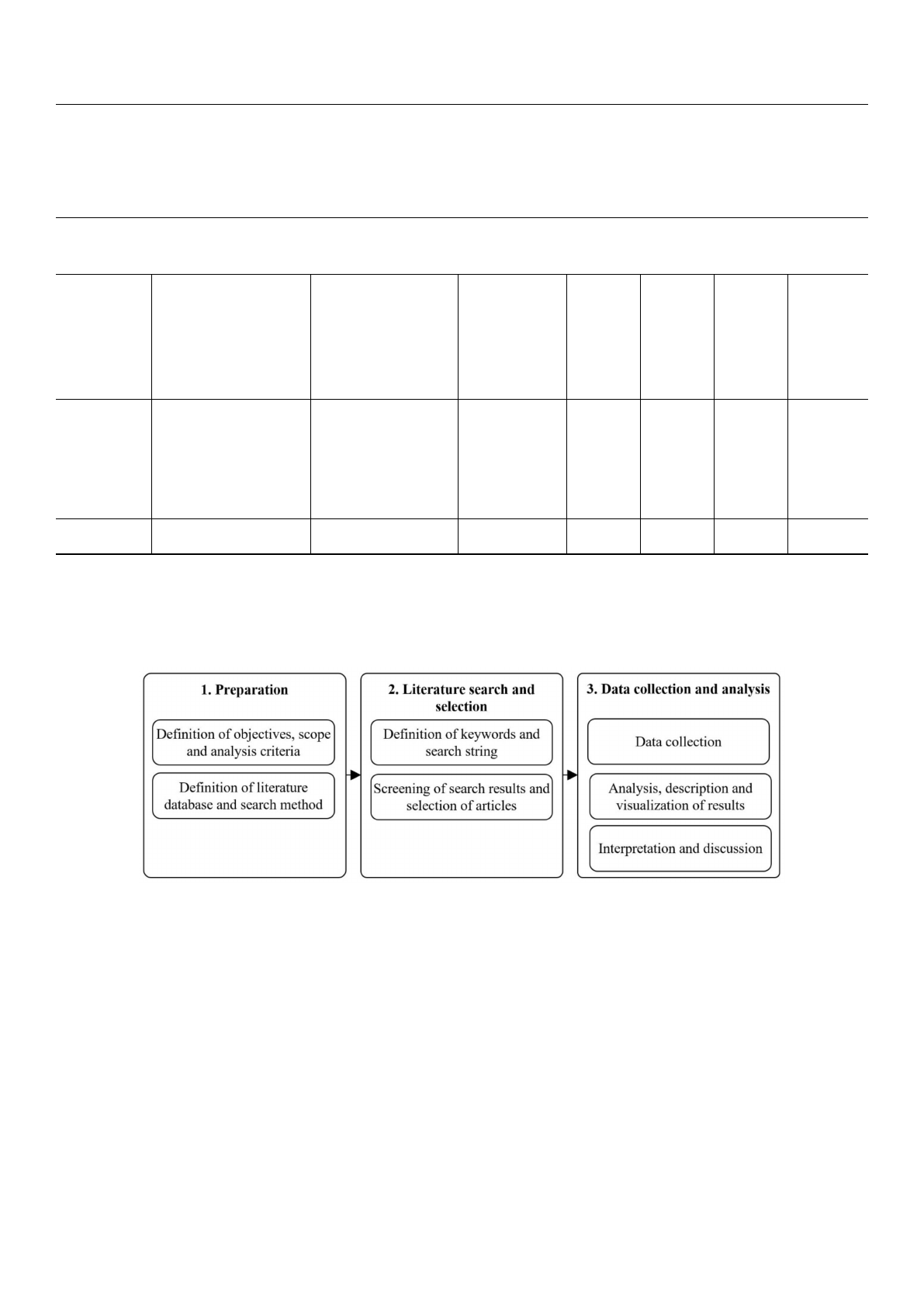
step-by-step procedure is shown in Figure 1.
Figure 1. Review procedure. The literature review process is divided into three main steps.
This review provides a comprehensive description and well-structured presentation
of the content of recent international literature on energy demand modeling. Therefore, a
systematic and replicable analysis of a high number of articles was conducted regarding
the utilized techniques as well as associated input data, accuracy, and spatio-temporal
resolution across different energy carriers and sectors. This comprehensive and concise
literature classification serves as a decision-base for fellow researchers for the selection
of appropriate data-model combinations for their projects. Direct and easy access to
articles corresponding to a particular set of criteria is provided through structured tables
in the Appendix A. Moreover, the advantages and drawbacks of common techniques as
well as countermeasures against disadvantages are presented. This review constitutes
an exploratory study examining and categorizing a broad and up-to-date literature base
regarding an unprecedented number of properties using descriptive statistical methods.
Challenges and future research directions are suggested and the compiled material provides
a basis for future hypothesis-based quantitative testing.

Energies 2021,14, 7859 4 of 58
The article is organized as follows: In
Section 2
, the systematic review process is
described. In
Section 3
, a description and classification of techniques are given. In
Section 4
the results of the literature analysis are presented, starting with sectors and energy carriers
and followed by results on modeling techniques, input data, temporal and spatial char-
acteristics as well as accuracy. In Section 5most significant results are discussed and in
Section 6future research directions are suggested. The paper concludes with Section 7.
To aim for recent and relevant literature, the search was limited to articles published
between 2015 and 2020 in journals related to energy, engineering, modeling, and simulation
or computer science in English. The literature base for this review is the result of a replicable
query to Web of Science Core Collection, a database for international journal publications
and conference proceedings [
15
], on 1 May 2021. A search string was derived from a
keyword matrix containing keywords from the thematic groups “energy”, “demand” and
“modeling”. The search string and keyword matrix can be found in the Appendix Aof this
review (see Table A2). The search yielded 695 articles, which were then further scrutinized
based on their title and abstract resulting in an exclusion of 276 articles due to non-matching
topics or closed access despite institutional logins at the publishers’ websites. The final
literature collection contains 419 articles.
Articles are analyzed according to the properties listed in Table 2. Given the variety
of entries for all the criteria, they have been grouped in the column “possible values” in
Table 2. The spatial resolution is defined by the smallest energy-consuming entity, which is
modeled in the respective articles. For the temporal horizon, various categorizations exist
in the literature [
4
,
16
]. The chosen definition is inspired by Wei et al. [
14
]. The MAPE is
defined as the average absolute discrepancy between the predicted value and the actual
value, expressed as a percentage of the actual value [
17
]. It is a unitless performance
measure and not dependent on the magnitude of the system, which makes it appropriate
for comparing the performance of techniques applied in different contexts [
18
]. Therefore,
it is a widely used accuracy measure in energy demand modeling [
5
]. For the techniques, a
variety of classifications can be found in the literature. The following section provides a
clear definition of categories of techniques used for energy demand modeling.
Table 2.
Assessment criteria. Overview of analysis criteria defining the collected data during step three of the review
procedure. Each item represents a property characterizing the techniques applied in the respective articles. A short
description and possible values are given. For mutually exclusive criteria only one value is possible, while for non-exclusive
properties multiple values can be given and counted multiple times.
Analysis Criteria Description Possible Values Mutually
Exclusive
Technique Modeling technique applied Artificial neural network, support vector
machine,
regression, autoregressive methods, etc. No
Category of techniques General category of applied
technique
Statistical, machine learning, metaheuristic,
stochastic/fuzzy/grey, and engineering-based
techniques No
Technique combination A single technique or a
combination of techniques was
applied Stand-alone or hybrid approach Yes
Model inputs
Inputs for energy demand models
serving as explanatory variables
and predictors
Data describing historic load, calendar
information, weather, economy, demographics,
environment, prices, behavior, and information
about the technical system
No
Energy carrier Forecasted/modeled type of
energy Electricity, natural gas, energy for heating and
cooling No
Sector Economic sector or consumer
group which is modeled Industrial, commercial, residential, all sectors No
Technical system
Applications or technical systems,
which are modeled Power grid, gas grid, district heating, building,
production No

Energies 2021,14, 7859 5 of 58
Table 2. Cont.
Analysis Criteria Description Possible Values Mutually
Exclusive
Spatial resolution Spatial level of detail of models Country, regions (e.g., district),
households/buildings, appliances Yes
Temporal resolution Scale of time steps that are
described by the models Sub-hourly, hourly, daily, above daily Yes
Temporal horizon Timespan that is covered by the
models
Short-term (up to one day), medium-term
(several weeks or months), long-term (one year
and above) Yes
Accuracy Performance evaluation of
presented models Numeric values for MAPE No
The 419 articles represent the total population of units whose properties are analyzed
and described. Hence, descriptive statistical techniques are used in order to illustrate the
frequency and contingency of the properties of the articles, using bar plots and box plots.
The data collected from the articles are categorical in all cases except for the MAPE value,
which is of numerical continuous type. For the MAPE value, a histogram was plotted in
order to illustrate its (non-symmetric) distribution.
After classification and analysis, the results are presented using plots and structured ta-
bles for the direct accessibility of articles. Subsequently, highlights are discussed regarding
particular advantages and drawbacks of techniques.
3. Classification of Techniques
A variety of classifications for techniques for energy demand modeling exists in the
literature. Debnath and Mourshed [
4
] distinguish between statistical, computational intelli-
gence (CI), and mathematical programming as well as stand-alone and hybrid techniques.
Within the category of statistical techniques, they define regression, time series analysis
(TSA), and autoregressive conditional heteroscedasticity (ARCH) techniques. Within the
category of CI, they mention ML, uncertainty, and metaheuristic techniques as well as
expert-based methods. Hong and Fang [
5
] suggest the two general categories of statistical
and artificial intelligence techniques, with the former comprising multiple linear regres-
sion and TSA techniques and the latter including ANN, fuzzy regression, support vector
machines (SVMs), and gradient boosting machines. Wei et al. [
14
] distinguish between
conventional techniques, including TSA, regression, and grey models, and artificial intelli-
gence techniques, such as ANN and SVM. Kuster et al. [
9
] discuss the categories of TSA,
regression models, ANN, SVM, and bottom-up techniques.
This article is based on the classification by Debnath and Mourshed [
4
], however,
extended by engineering-based techniques, which have been mentioned by other authors
and referred to as bottom-up techniques [
6
,
9
,
19
–
22
]. Expert-based systems and mathemati-
cal programming mentioned in [
4
] are not considered since none of the analyzed articles
followed either approach. Furthermore, the category of uncertainty techniques, which
consists of fuzzy logic and grey models according to [
4
], is complemented by stochastic
models, which have been encountered several times during data collection. The cate-
gory name “uncertainty technique” might evoke some ambiguity amongst readers, since
uncertainty is a natural property of any forecasting attempt. Therefore, the category is
renamed “stochastic/fuzzy/grey systems theory”. Based on the classifications of [
4
,
9
] the
following five categories are defined: statistical, ML, metaheuristic, stochastic/fuzzy/grey,
and engineering-based techniques.
3.1. Statistical Techniques
According to [
4
,
5
], this category consists of regression and TSA techniques. As shown
in [
6
], techniques from this category have been used in econometrics to explore the interre-
lationship between energy demand and economic development.
Loading more pages...