
Blaming Kehl: Muslim Turkish Men and their Moral Journey
in the Franco- German Borderland
OĞUZ ALYANAK
Georg-August-Universität Göttingen,
Postdoctoral Researcher,Fairwork Project/Technical University of Berlin
Abstract
Geographical space is more than a Cartesian plane where actors move across coordi-
nates. It has a moral weight that renders each move subject to moral discourse. Yet,
rarely does this premise prevent people from exploring spaces that are associated with
anything wrong or bad. In fact, we continue to find people in places where they should
not be, and doing things that are not just communally shunned but also personally
acknowledged to be wrong or bad. Why is that the case? This paper draws on my eth-
nography on Turkish men who live in Strasbourg and socialize in its German neighbor,
Kehl, to examine the role of space in the production of moral and masculine disposi-
tions and practices. Approaching the Strasbourg- Kehl border as a moral boundary, I
examine how crossing the border to Kehl constitutes an integral part of the journey that
my interlocutors take in constructing their moral and masculine selves. In this journey,
spatial transgressions are not diverted but embraced, and confronted. These trans-
gressions also produce anxieties— mistakes which in moments of self- reflection lead to
regrets. In such moments, two logics come into play: consequentialism and blame. The
first builds on Islamic notions of fallibility and nefs, while the latter brings Kehl into the
picture as a moral alibi— a space that takes blame for sins. The latter also helps others
in the community who fail to prevent men from going to Kehl and transgressing moral
boundaries to transpose culpability. In conclusion, I emphasize the need to consider the
making and maintenance of masculinities and moralities in conjunction with the lived
environments where such identities are formed and performed.
[Morality; Masculinity; Borderlands; Turks in France, Germany; Migration]
Geographical space is more than a Cartesian plane where actors
move across coordinates. It has a moral weight that renders each
move subject to moral discourse. “The ‘where’ of the people,
how they are situated in relation to others in geographical space and
place,” argues David M. Smith, one of the pioneers of the moral turn in
scholarship on space and place, “has fundamental implications for what
might be the right or wrong things to do” (1998, 9). Many, including
Turkish men in France and Germany, seem to take Smith’s premise to
heart. Most of them would agree that home is the right place to be, or
the mosque a good space to socialize, while considering coffeehouses
and other leisurely venues as being bad and inviting sin. Yet, in prac-
tice, I would encounter these men in places where they should not be,
City & Society, Vol. 34, Issue 1, pp. 111–134, ISSN 0893-0465, eISSN 1548-744X. © 2021 The Authors. City & Society published
by Wiley Periodicals LLC on behalf of American Anthropological Association.
This is an open access article under the terms of the Creat ive Commo ns Attri bution License, which permits use, distribution and
reproduction in any medium, provided the original work is properly cited. DOI:10.1111/ciso.12419

City & Society
112
doing things that are not just communally shunned but also personally
acknowledged to be wrong or bad. Why is that the case?1
There is a rebellious element in spatially transgressive practices,
which is often associated with manhood (Broude 1990; McDowell 2002;
Morrell 1998), motivating me to explore the ways that masculinity
implicates transgressions of a moral and spatial kind. My ethnography
on Turkish men in Strasbourg and Kehl has left me with numerous sto-
ries that show how the production of Muslim male subjectivities in the
Franco- German borderland involve transgressive practices that gener-
ate moral anxieties, both for the community as well as the individuals
engaging in these practices. Yet, trespassing physical and moral borders
is a given— an expected practice even, from young men just starting
their journey toward becoming moral Muslims. Transgressions are not
something my interlocutors try to divert. Rather, they embrace and con-
front them. For them, being a moral Muslim means not just following
the commands stated in the Qur’an or preached by Islamic preachers, or
imams, which would lead to living highly restrictive lives (such as that
of Cebrail, whom I recount in the following pages) but also engaging in
spatial and moral transgressions in their youth, and later thinking about
the consequences of said actions and tackling the outcomes.
In recent years, excellent research has been done on the role of
space in the making of moral subjectivities, and in particular Muslim/
devout/pious masculinities (Gerami 2005; Ouzgane 2006; Samuel 2011;
Kandiyoti 2016; Gökarıksel and Secor 2017; Khan 2018). This research
complements what has long been analyzed within the context of Islamic
female subjectivities (Ardener 1981; Bauer 1985; Göle 1996; Secor 2002;
Mahmood 2004; Falah and Nagel 2005). I intend to build on extant
research and intersect it with insights from my ethnography of two neigh-
boring border towns. The data I present comes from interviews held with
members of the Turkish community who adhere to the Hanefi school of
Sunni Islam, which constitutes the majority denomination in Turkey.
This is an important point to keep in mind as the theological teachings
of Hanefi Sunnism differ from other schools and denominations, such as
the Şafiî, another Sunni school of thought, or Caferi, Alevi, and Bektaşi,
which are Shi’a branches of Islam. My analysis on Islamic morals there-
fore applies to the Hanefi Sunnis alone.
Border towns are spaces that produce “mobile” or “borderland” sub-
jectivities (Saldivar 1997). Here, mobile denotes not only increased
possibilities for physical mobility, which may be enjoyed by some and
restricted to others, but also the kind of mobility where moral bound-
aries are transgressed (Vila 2003). Thus, this paper urges us to think of
the practice of crossing the border from Strasbourg to Kehl as not only a
geographical practice but also a moral one.
Strasbourg has plenty of its own vices. But its German neighbor, Kehl,
is often considered the hub for evils that attract young and middle- aged
Muslim men. Many of my interlocutors who live in Strasbourg frequent
Kehl on a daily basis to buy cigarettes or to fill up their gas tank, both

Blaming Kehl
113
of which are cheaper in Germany. But there is also fear that their trips
may include a stop in other venues that Kehl is known for, such as shi-
sha lounges, nightclubs, betting alleys, and gambling venues. With the
exception of gambling venues, the rest can also be found in Strasbourg.
Yet, it is Kehl that gets the blame.
That it is men who engage in these cross- border trips after work adds
further nuance to my analysis and helps me to contribute to a larger
discussion about how men form themselves in relation to and through
Kehl, and how these trips lend themselves to a broader conversation
on Islamic manners and morals, which my interlocutors are expected to
abide by. In this conversation, Kehl, which is only a few minutes’ drive
east of Strasbourg, is brought up as a threat to the community’s moral
fabric. The many monikers Kehl has attained over the years reaffirm
the understanding that Kehl is no mere neighbor. It is the swamp, the
Sin City— a place where the Devil, the Şeytan, is ever- present.
I do not disregard the mobility of women in Strasbourg, but my focus is
on men’s mobility and leisure as they constitute the primary group of people
to whom— as a male researcher— I had greater access. Moreover, much of
my participant observation in Kehl took place in homosocial spaces— that
is, venues frequented by men. Often times, while these men were outside,
the women— their wives, sisters, daughters, and mothers— would be at
home, socializing in each other’s homes or going for walks around the neigh-
borhood. It was brought to my attention that younger women did gather in
outside spaces such as cafes and restaurants in Strasbourg and Kehl, but
my data on such leisurely activities is limited. It would, however, be very
interesting to read similar research conducted by a female researcher, to see
whether such moral queries take shape among women as well, becoming
part of the construction of pious or Islamic femininities in this borderland.
The production of Kehl as a leisurely space circumscribes moral
and masculine dispositions, and underlines the complex ways in which
Islamic masculinities are produced in this borderland. In their reflec-
tions on the moral composition of Muslims, my interlocutors would
commonly agree that they should be spending time at home with fam-
ily members, or in mosques with other Muslims, rather than visiting
shisha lounges, nightclubs, betting alleys, casinos, or “bistro- casinos”
in Kehl.2This acknowledgment, however, is rarely put into practice.
On paper, the discrepancy between discourse and practice may seem to
reveal a contradictory logic, where these men act in ways that confront
their conviction. Yet, for my interlocutors, the path to morality is laid
with contradictions, making it not a linear but a digressive journey.
Most men engage in such digressions rather than follow a rigid moral
path as described in the Qur’an or preached by the imams. “Mistakes
are to be made,” Süleyman Bey will remind us in one of the stories
that follow. “They are necessary to grow up, and have something for
which a man could later repent.” Certainly, not everyone embraces
their mistakes with the same openness. The story of Cebrail, for exam-
ple, provides an example of a young man who refrains from sin (Alyanak
City & Society
114
et. al 2018). So, why do other men not follow the examples set by
Muslims like Cebrail, by limiting their spatial and moral transgressions
by way of avoiding spaces that are inviting of immoral or sinful behav-
ior? And how do they confront the anxieties that these transgressions
generate? I find part of the answer in a what Robbins (2004) describes
as a consequentialist logic. The other part has to do with Kehl, which,
as a moral alibi, helps to transpose sins from the individual to a space. I
will explain what I mean by these terms later in this paper.
Transgressions, however, are not individual acts alone. They are also
perceived to be committed communally. Mistakes affect not only those
who partake in them; they also encompass actors close to those who engage
with said mistakes in the first place. My interlocutors’ trips to Kehl, and
their “sinking” in the “swamp,” bring in other actors such as wives, fathers,
close friends, or community leaders like imams into the picture. These
actors are expected to dissuade their peers from committing sins by check-
ing on each other and helping them avoid “losing their path.” When such
checks do not produce favorable outcomes, and men continue to visit Kehl,
those close to them also have to share the burden. To evade this burden,
they transpose responsibility onto a space they deem guilty of moral trans-
gressions. Like the men who frequent Kehl, they, too, blame Kehl.
Locating Kehl
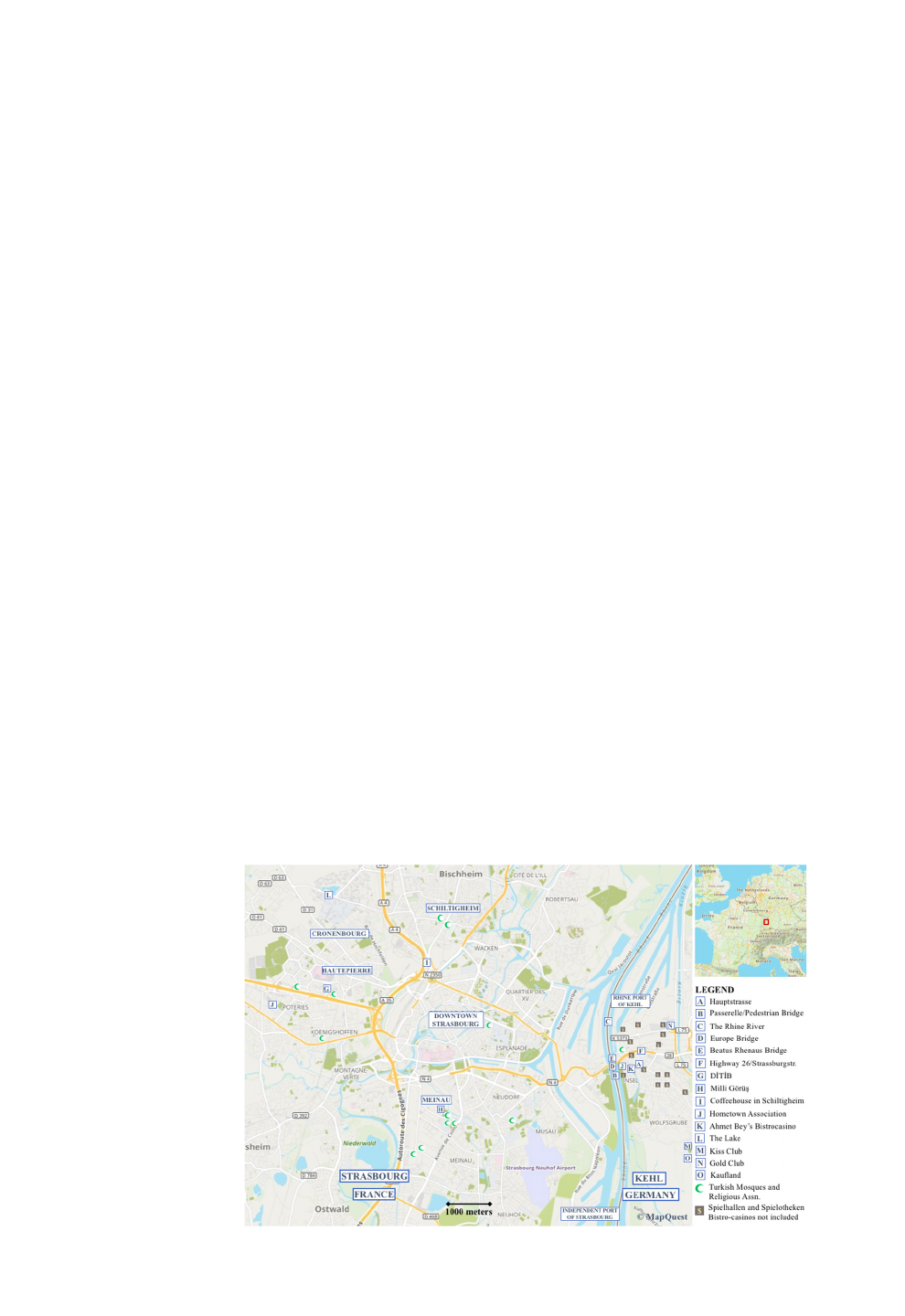
For most Turks in Strasbourg, Kehl constitutes a key part of daily life.
Aside from taking weekend strolls on its main street, the Hauptstrasse
[A]3, or the river walk by its recently built bridge, Passerelle des Deux
Rives/Brücke der zwei Ufer [B], many attend the beautifully decorated
Kehl mosque to perform religious rituals, stop by its tobacco shops and gas
stations to buy cigarettes and gas at a discount, visit ice cream shops and
restaurants for snacks and Turkish delicacies, and shop at its supermarkets.
Kehl circum-
scribes moral
and masculine
dispositions,
and underlines
the complex
ways in which
Islamic mas-
culinities are
produced

Blaming Kehl
115
Yet, key texts on Turkish migration to Strasbourg, which discuss the
binational character of this European capital (Western 2007) and draw
attention to the transnational ties that shape daily life and politics in
the city (Brabant 1992; Brabant and Sahli 1992; Selimanovski 1992;
Tapia 1994; Tapia 1996), omit a critical engagement with Kehl. At
best, Kehl is spoken of as a convenient stop for cheaper cigarettes and
higher quality auto- repair services (Western 2012, 90), or as a cross
over en route to the Frankfurt airport (Ibid, 154). I see at least two rea-
sons behind this omission. The first has to do with a lack of compar-
ative local perspective in migrant incorporation (Schiller and Çağlar
2009), where movement across different European cities is rarely prob-
lematized. Instead, research retains its focus on migrant incorporation
in specific locations, and neglects the ties that migrants maintain to
the various cities they travel to. This leads scholarship to reproduce
the very approach it critiqued in the first place— methodological
nationalism— and analyze migrant movement only across sending
and receiving contexts. However, my interlocutors do more than en-
gage in trips between Turkey and France. Many of them travel around
Europe— to various German cities across the border such as Kehl,
Offenburg, Saarbrücken, Karlsruhe, and Mannheim— in search of eco-
nomic and leisurely opportunities.
The second reason is temporal and has to do with Kehl’s recent rise
to prominence as a leisure town. Initially founded as a fishing village by
the banks of the Rhine [C] in 1038, Kehl has retained its importance
for successive French and German emperors for both its defensive and
commercial value. It obtained city status in 1774 (Kehl Marketing).
Although Kehl was repeatedly annexed by French and German Empires,
and lost much of its population to outmigration during the Second
World War, in 1953, it became part of the Federal Republic of Germany,
and since then has served an important role as a port city. In 1960, the
Pont de l’Europe/Europabrücke/Europe Bridge [D] was built, replacing a
temporary bridge built in 1951, with a border post on the German side
used for border control, which, though unoccupied, is preserved to this
day. Prior to the Schengen Agreement, inhabitants of Strasbourg were
required to obtain a visitor’s pass and present it at this checkpoint. Today,
border police are still present on the Europe Bridge, but passport controls
are rarely conducted.
Kehl has long been a gateway between France and Germany, but more
recent developments have helped foment the transnational ties that bind
it to Strasbourg. Since the Schengen Agreement came into effect in 1995,
a number of trans- border agglomerations known as Eurodistricts have been
established in the European Union (van Houtum 2000). One of the first
was the Strasbourg- Ortenau Eurodistrict, which encompasses over 950,000
inhabitants in eight cities located at both sides of the Rhine, including
Strasbourg and Kehl (Reitel and Mouillé 2015). In official French and
German accounts, the Eurodistrict is celebrated for encouraging trans-
border exchange, cooperation and integration, and attracting investment
Loading more pages...