
water
Article
Closing Water Cycles in the Built Environment through
Nature-Based Solutions: The Contribution of Vertical Greening
Systems and Green Roofs
David Pearlmutter 1,†, Bernhard Pucher 2,† , Cristina S. C. Calheiros 3,* , Karin A. Hoffmann 4, Andreas Aicher 5,
Pedro Pinho 6, Alessandro Stracqualursi 7, Alisa Korolova 8, Alma Pobric 9, Ana Galvão10 , Ayça Tokuç 11,
Bilge Bas 12, Dimitra Theochari 13, Dragan Milosevic 14 , Emanuela Giancola 15 , Gaetano Bertino 16 ,
Joana A. C. Castellar 17,18 , Julia Flaszynska 19 , Makbulenur Onur 20 , Mari Carmen Garcia Mateo 21,
Maria Beatrice Andreucci 7, Maria Milousi 22, Mariana Fonseca 23 , Sara Di Lonardo 24 , Veronika Gezik 25 ,
Ulrike Pitha 26 and Thomas Nehls 4
Citation: Pearlmutter, D.; Pucher, B.;
Calheiros, C.S.C.; Hoffmann, K.A.;
Aicher, A.; Pinho, P.; Stracqualursi, A.;
Korolova, A.; Pobric, A.; Galvão, A.;
et al. Closing Water Cycles in the
Built Environment through
Nature-Based Solutions: The
Contribution of Vertical Greening
Systems and Green Roofs. Water 2021,
13, 2165. https://doi.org/10.3390/
w13162165
Academic Editor: Jiangyong Hu
Received: 10 July 2021
Accepted: 28 July 2021
Published: 6 August 2021
Publisher’s Note: MDPI stays neutral
with regard to jurisdictional claims in
published maps and institutional affil-
iations.
Copyright: © 2021 by the authors.
Licensee MDPI, Basel, Switzerland.
This article is an open access article
distributed under the terms and
conditions of the Creative Commons
Attribution (CC BY) license (https://
creativecommons.org/licenses/by/
4.0/).
1Department of Geography and Environmental Development, Ben-Gurion University of the Negev,
2Institute of Sanitary Engineering and Water Pollution Control, University of Natural Resources and Life
3Interdisciplinary Centre of Marine and Environmental Research (CIIMAR/CIMAR), University of Porto,
Novo Edifício do Terminal de Cruzeiros do Porto de Leixões, Avenida General Norton de Matos, S/N,
4450-208 Matosinhos, Portugal
4Chair of Ecohydrology and Landscape Evaluation, Institute of Ecology, Technische Universität Berlin,
[email protected] (T.N.)
5
Bauhaus Institute for Infrastructure Solutions, Bauhaus-Universität Weimar, Goethe Platz 7/8, 99423 Weimar,
Germany; andreas.aicher@uni-weimar.de
6cE3c-Centre for Ecology, Evolution and Environmental Changes FCUL, Edifício C2, Campo Grande,
7
Department of Planning, Design, Technology of Architecture, Sapienza University of Rome, Via Flaminia, 72,
00196 Rome, Italy; alessandro.stracqualursi@uniroma1.it (A.S.); mbeatrice.andreucci@uniroma1.it (M.B.A.)
8Faculty of Architecture, Riga Technical University Kipsalas, Str. 6, LV-1048 Riga, Latvia;
9Department of Geography, Faculty of Science, University of Sarajevo, Add. Zmaja od Bosne 33-35,
10
11 Department of Architecture, Dokuz Eylul University, Campus of Tinaztepe, Buca ˙
Izmir 35160, Turkey;
12 Department of Civil Engineering, Istanbul Bilgi University, Santralistanbul, Kazim Karabekir Cd. No: 13,
13 MERA Landschaftsarchitekten mbB, Griegstraße 75, Haus 24b, 22763 Hamburg, Germany;
14 Climatology and Hydrology Research Centre, Faculty of Sciences, University of Novi Sad, Trg Dositeja
15 Department of Energy, Energy Efficiency in Buildings Unit, CIEMAT, 28040 Madrid, Spain;
16 Alchemia-Nova GmbH, Institute for Innovative Phytochemistry & Closed Loop Processes, A-1140 Vienna,
Austria; [email protected]
17
Catalan Institute for Water Research (ICRA), Carrer Emili Grahit 101, 17003 Girona, Spain; [email protected]
18 University of Girona, Plaça de Sant Domènec 3, 17004 Girona, Spain
19 Faculty for Architecture and Planning, Technical University of Vienna, Karlsplatz 13, 1040 Vienna, Austria;
20 Department of Landscape Architecture, Karadeniz Technical University, Trabzon 61080, Turkey;
21 MCG Research & Innovation Sustainability Architecture/Urban Planning, Zarandona, 30004 Murcia, Spain;
maricarmengarcia.ar[email protected]
22 Department of Chemical Engineering, University of Western Macedonia, Koila, 50100 Kozani, Greece;
23
Associação CECOLAB, Collaborative Laboratory towards Circular Economy, R. Nossa Senhora da Conceição,
Water 2021,13, 2165. https://doi.org/10.3390/w13162165 https://www.mdpi.com/journal/water

Water 2021,13, 2165 2 of 33
24
Research Institute on Terrestrial Ecosystems-National Research Council (IRET-CNR), Via Madonna del Piano
10, 50019 Sesto Fiorentino, Italy; sara.dilonardo@cnr.it
25 Faculty of Management, Comenius University in Bratislava, Odbojárov 10, P.O. Box 95, 82005 Bratislava 25,
Slovakia; [email protected]
26 Department of Civil Engineering and Natural Hazards, Institute of Soil Bioengineering and Landscape
Construction, University of Natural Resources and Life Sciences, Peter-Jordan-Strasse 82, A-1190 Vienna,
Austria; [email protected]
*Correspondence: cristina@calheiros.org
† These authors contributed equally to this work.
Abstract:
Water in the city is typically exploited in a linear process, in which most of it is polluted,
treated, and discharged; during this process, valuable nutrients are lost in the treatment process
instead of being cycled back and used in urban agriculture or green space. The purpose of this
paper is to advance a new paradigm to close water cycles in cities via the implementation of nature-
based solutions units (NBS_u), with a particular focus on building greening elements, such as green
roofs (GRs) and vertical greening systems (VGS). The hypothesis is that such “circular systems”
can provide substantial ecosystem services and minimize environmental degradation. Our method
is twofold: we first examine these systems from a life-cycle point of view, assessing not only the
inputs of conventional and alternative materials, but the ongoing input of water that is required
for irrigation. Secondly, the evapotranspiration performance of VGS in Copenhagen, Berlin, Lisbon,
Rome, Istanbul, and Tel Aviv, cities with different climatic, architectural, and sociocultural contexts
have been simulated using a verticalized ET
0
approach, assessing rainwater runoff and greywater
as irrigation resources. The water cycling performance of VGS in the mentioned cities would be
sufficient at recycling 44% (Lisbon) to 100% (Berlin, Istanbul) of all accruing rainwater roof–runoff, if
water shortages in dry months are bridged by greywater. Then, 27–53% of the greywater accruing
in a building could be managed on its greened surface. In conclusion, we address the gaps in the
current knowledge and policies identified in the different stages of analyses, such as the lack of
comprehensive life cycle assessment studies that quantify the complete “water footprint” of building
greening systems.
Keywords:
water reuse; water management; water cycle; nature-based solutions; green roofs; vertical
greening systems; life-cycle assessment; circular cities; built environment; building greening
1. Introduction
Natural water cycles are under increasing pressure from urban expansion, which is
driven by incessant population growth. It is expected that the world’s urban population
will grow from 3.4 billion people in 2009 to 6.3 billion in 2050. The demand for water
will increase by 55%, which will lead to a rise in water pollution, aggravating problems
associated with water scarcity [
1
], since water availability is compromised by its quality [
2
].
In fact, of all the fresh water entering the city, only a fraction is actually used for con-
sumption; the remaining becomes polluted, treated, and discharged [
3
]. Within this linear
process, valuable nutrients, such as nitrogen and phosphorus, are lost in the treatment pro-
cess instead of being captured and cycled back (e.g., for agricultural usage or maintenance
of green areas) [
4
]. Stormwater management is another example of this non-sustainable
linear water process, as typically, its main goal is the fast discharge of stormwater to avoid
flooding. With changes in climate, however, rainfall patterns can exceed the capacity of
the sewer system and cause widespread flooding [
5
]. Under dry conditions, however, in
which water would be needed to irrigate and sustain vegetation to maintain its necessary
cooling function, water is once again used linearly, with fresh drinking water exploited, as
no other source is stored or provided [6].
In this sense, Nature-Based Solutions units (NBS_u) as green technologies that can
be implemented in combination with existing infrastructure or as stand-alone systems [
7
]

Water 2021,13, 2165 3 of 33
can support the transition towards a new water reuse paradigm, by integrating circular
economy (CE) principles into urban water management.
When implementing urban NBS_u to create “circular cities”, the following urban
circularity challenges (UCC) [
8
,
9
] can be addressed: (i) restoring and maintaining the water
cycle (by rainwater management); (ii) water and waste treatment, recovery, and reuse;
(iii) nutrient recovery and reuse; (iv) material recovery and reuse; (v) food and biomass
production; (vi) energy efficiency and recovery; and (vii) building system recovery. The
built environment can be identified as a key facilitator to address, promote, and benefit
from a change in the water use paradigm by using the UCC to shift towards a circular
management of resources [
8
]. At the building systems level [
10
], water streams, including
separated wastewater, precipitation, and runoff, can be reused on site using NBS_u and
supporting units (e.g., non NBS based on the COST Action CA17133 definition [
11
]). The
same concept can be applied towards green building sites, and further support “reuse”
practices in green building materials.
At the building scale, NBS_u, such as vertical greening systems (VGS) (ground-based
green facade, wall-based green facades, pot-based green facades, and vegetated pergola)
and green roofs (GRs) (intensive, extensive and semi-intensive) can be integrated in the
building envelope of new and existing buildings in order to address the listed UCC. The
reuse of water and nutrients through source separation at the building level is supported by
those NBS_u. Greywater (household wastewater without the toilet stream) has proven to
be a viable resource for irrigation, and the necessary treatment can be done by judiciously
employing on-site systems, such as pot-based green facades and GRs [
12
,
13
]. In addition,
water via rainwater harvesting can be reused for irrigation [14].
Plant water consumption must be met throughout the year to allow for the full
spectrum of multifunctionality, e.g., increasing biodiversity, contributing toward public
health, decreasing air pollution, and cooling the surrounding area [
6
]. This “demand” is
mainly met with fresh water or drinking water, further contributing to water depletion [
14
].
However, operational water demand is not the only important factor in water reuse
practices. NBS_u require resources for their initial production, and the processes used
to manufacture their constituent materials are often highly water dependent as well [
15
].
Moreover, the production chains of components for VGS and GRs not only consume
water, but the “production” of this water requires energy for pumping and often for
treatment—meaning that carbon emissions are associated with constructed systems such
as these, which are conceived as NBS_u, and where the expressed intent is often to reduce
a building’s environmental footprint.
Transformation of the water use and reuse paradigm is needed in order to reduce
fresh water depletion. Therefore, the hypothesis of this work is: “The illustration of the
needed water demand for the production of building materials for NBS_u, as well as their
operational water needs, will help to foster rethinking towards the implementation of
water reuse practices.”
In this paper we consider two categories of NBS_u as vehicles for applying CE prin-
ciples (especially fostering water reuse), surveying the existing knowledge, barriers, and
gaps that are crucial for their wider implementation, and for fostering a transition from the
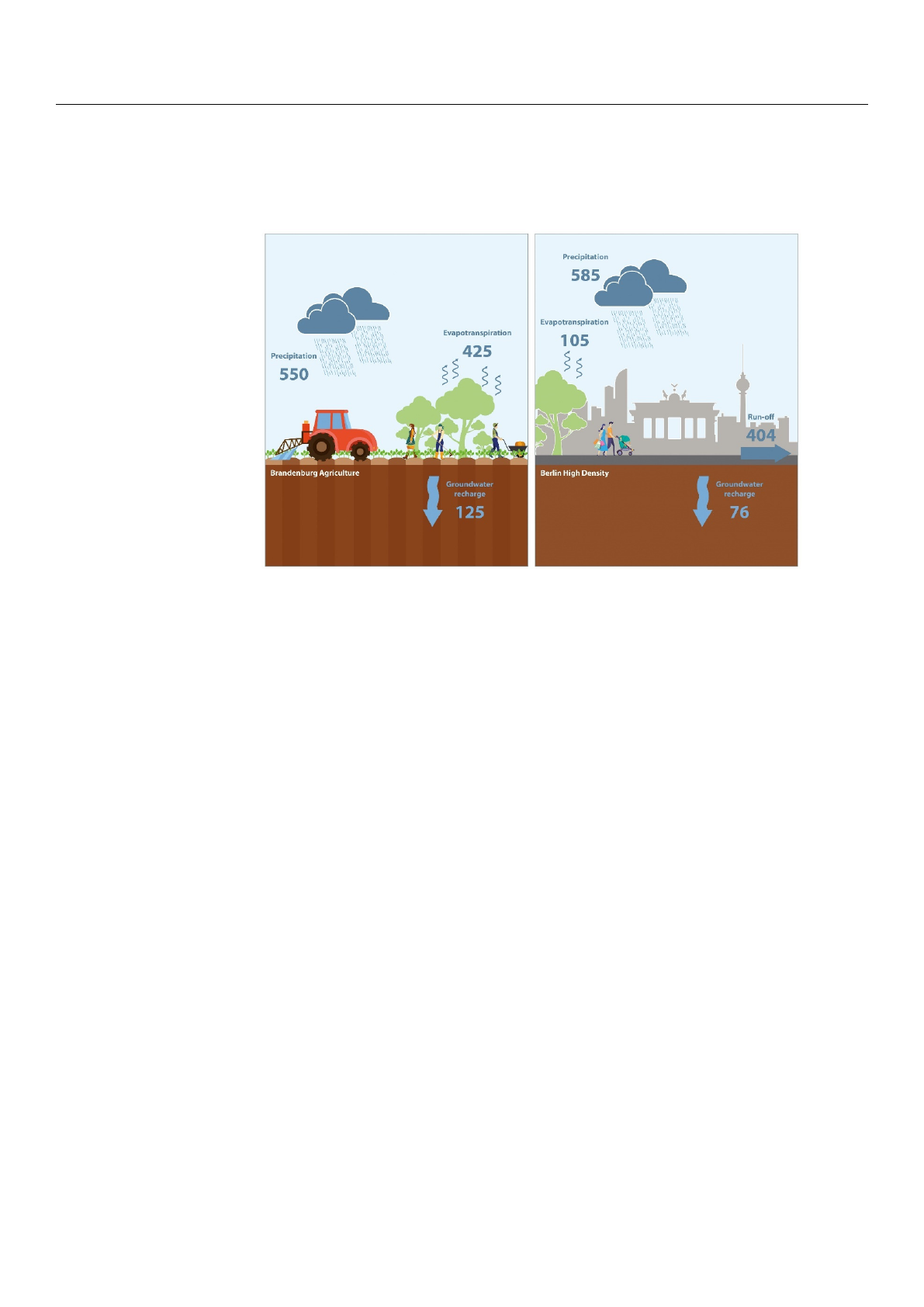
existing linear water use paradigm within the built environment. A schematic depiction of
this existing linear paradigm is presented in Figure 1.
To support CE principles in the water sector, we first examine the “wicked problem”
of urban water management. We then review the relevant literature on selected NBS_u
functions, performance, and impact. To provide more detail on their actual water needs,
we scrutinized the published studies, which quantified both the materials and irrigation
requirements in the context of a life-cycle assessment (LCA).
As the actual water demand of plants is highly dependent on various geographical,
climatic, and physiological factors, a case study was used as a methodological approach to
simulate the potential for meeting water demand with rainwater and greywater availability
in model buildings located in a cross-section of European cities. Finally, we discuss
Water 2021,13, 2165 4 of 33
the knowledge gaps and policy barriers that must be overcome to achieve widespread
implementation of building greening systems, and offer recommendations to accelerate the
use of NBS_u in the built environment, ultimately creating more circular cities.
Water2021,13,xFORPEERREVIEW4of34
Figure1.Schematicrepresentationofthemeanannualwaterbalanceinanagriculturallandscape
westofBerlin(left)andadenselyoverbuiltquarterwith>85%soilsealinginthecityofBerlin,
Germany(right).DrawingbasedondataavailablefromthestateofBrandenburg(www.lfu.bran‐
denburg.de,accessedon7October2021)fortheyears1991–2015(giveninmm/a).Illustration:Di‐
mitraTheochariandThomasNehls(unauthorizeduseisnotpermitted).
TosupportCEprinciplesinthewatersector,wefirstexaminethe“wickedproblem”
ofurbanwatermanagement.WethenreviewtherelevantliteratureonselectedNBS_u
functions,performance,andimpact.Toprovidemoredetailontheiractualwaterneeds,
wescrutinizedthepublishedstudies,whichquantifiedboththematerialsandirrigation
requirementsinthecontextofalife‐cycleassessment(LCA).
Astheactualwaterdemandofplantsishighlydependentonvariousgeographical,
climatic,andphysiologicalfactors,acasestudywasusedasamethodologicalapproach
tosimulatethepotentialformeetingwaterdemandwithrainwaterandgreywateravail‐
abilityinmodelbuildingslocatedinacross‐sectionofEuropeancities.Finally,wediscuss
theknowledgegapsandpolicybarriersthatmustbeovercometoachievewidespread
implementationofbuildinggreeningsystems,andofferrecommendationstoaccelerate
theuseofNBS_uinthebuiltenvironment,ultimatelycreatingmorecircularcities.
ThisisthefirstlargecollaborativeEuropeanstudythat(a)conductedacomprehen‐
sive,in‐depthreviewofLCAstudiesthatfocusedparticularlyonGRsandVGS,withan
emphasisonwaterasaninputtothematerialinventory;and(b)quantitativelycompared
thewaterbalanceofthesesystemsinarangeofEuropeancities,withdifferentclimatic
andculturalattributes.
2.MaterialsandMethods
2.1.WickedProblemofWater
Wateruse,particularlyreuseatthecityscale,isacomplexprocedure.Therefore,the
term“wickedproblemofwater”isintroducedanddescribed,usingseveralimportant
fieldsinurbanwatermanagement.Theneededinformationwasgatheredbasedonavail‐
ableliteratureofthefollowingtopics:
Closingthewatercycleatthebuildingscale;
Embodiedenergyintheprovisionofwater;
Technicalfacilitiesforgreywatertreatmentatthebuildingscale;
NBS_uforgreywatertreatmentatthebuildingscale;
Figure 1.
Schematic representation of the mean annual water balance in an agricultural land-
scape west of Berlin (
left
) and a densely overbuilt quarter with >85% soil sealing in the city
of Berlin, Germany (
right
). Drawing based on data available from the state of Brandenburg
(www.lfu.brandenburg.de, accessed on 7 October 2021) for the years 1991–2015 (given in mm/a).
Illustration: Dimitra Theochari and Thomas Nehls (unauthorized use is not permitted).
This is the first large collaborative European study that (a) conducted a comprehen-
sive, in-depth review of LCA studies that focused particularly on GRs and VGS, with an
emphasis on water as an input to the material inventory; and (b) quantitatively compared
the water balance of these systems in a range of European cities, with different climatic
and cultural attributes.
2. Materials and Methods
2.1. Wicked Problem of Water
Water use, particularly reuse at the city scale, is a complex procedure. Therefore, the
term “wicked problem of water” is introduced and described, using several important fields
in urban water management. The needed information was gathered based on available
literature of the following topics:
•Closing the water cycle at the building scale;
•Embodied energy in the provision of water;
•Technical facilities for greywater treatment at the building scale;
•NBS_u for greywater treatment at the building scale;
•Policies and regulation to support water reuse.
2.2. Green Roofs and Vertical Greenery System Water Use Based on LCA Studies
The impacts embodied by GRs and VGS could be considered in a LCA, which provides
a quantitative evaluation of a product or system’s environmental impact based on the
inventory of materials required to build it. In contrast to typical building components, VGS
and GRs are living systems, which rely not only on the materials originally employed in
their construction, but on “materials” that must be continuously supplied throughout the
building’s life, such as water. Hence, a more detailed investigation on the actual water use

Water 2021,13, 2165 5 of 33
over the lifespan of a NBS_u can support change toward a more circular water loop. Water
usages by GRs and VGS are addressed, based on literature reviews related to LCA studies.
2.3. Simulation Case Study
The aim of this simulation case study was to assess the potential contribution of
VGS to the management and recirculation of water—preferably rainwater run-off, but
also greywater at the building scale (in an urban context). Therefore, (i) the amount of
otherwise drained or wasted water accruing in densely populated city center quarters, with
different urban morphologies, was estimated; and (ii) this water “supply” was compared
to the water “demand” or water loss, due to evapotranspiration of VGS located in different
climatic zones. It is assumed that no storage capacity is provided to use as surplus run-off,
or greywater, in subsequent months of a water deficit.
The potential water demand of a generic VGS model system was estimated. Driven
by pragmatic curiosity—we calculated the balances between the available water and water
demand for typical buildings, in six home cities of the authors, (Table 1).
Table 1.
Parameters describing the climatic, architectural, and hydrological characteristics of the case studies. The presented
data included precipitation (P), temperature (T), evapotranspiration (ET), greywater (GW) production per inhabitant,
occupancy (O) and run-off (RO) generation.
City Climate (2) Typical Building Water Availability
Class (1) P T P-ET
Oct-Mar Apr-Sep Ground Facade Window v/h OGW
Capita
GW
Facade
RO
Facade
mm/a ◦C mm —————m2————- (-) inh/m2L/inh d —L/m2d—
Copenhagen Dfb 614 9.4 151 −206 980 3206 1408 3.27 0.044 51 0.69 0.37
Berlin Dfb 585 10.3 118 −238 166 440 132 2.65 0.065 63 1.54 0.43
Rome Csa 605 17.8 135 −644 1302 3996 813 3.07 0.029 90 0.85 0.41
Lisbon Csa 571 17.4 126 −791 237 407 142 1.72 0.021 81 0.99 0.71
Istanbul Csa 546 16.0 −18 −840 231 310 132 1.34 0.170 58 7.35 0.82
Tel-Aviv Csa 506 21.5 −171 −1090 165 330 66 2.00 0.040 58 1.16 0.57
(1) acc. to Köppen-Geiger, (2) acc. to Meteonorm 8, Meteotest Bern, Switzerland 2000–2019.
2.3.1. Calculating Rainwater Run-Off Availability
The building-related rainwater run-off (RO) discussed here was harvested from the
roofs. The harvested water was a high proportion of precipitation (P) and the collected water
was clean compared to street RO. There are several types of contaminants typical to roofs,
such as depositions from the urban atmosphere and substances released from roofing and
gutter materials [16]. Most of these contaminants can be discarded using a first flush diverter.
Several technical guides for rainwater harvesting suggest a first flush diversion of 0.1 to
1 mm [
17
,
18
]. Following these guidelines, a first-flush diversion of 1 mm was considered here
in RO calculations on a daily base. RO was calculated by applying the static run-off coefficient
(RC) of 0.9 and the ground area of the chosen buildings, assuming that it approximated the
roof area well. For P, long-term averages (2000–2019) were taken from the database Meteonorm
8 (Meteotest, Bern, Switzerland) using interpolated data sets for all cities (Table 1).
2.3.2. Estimating Greywater Availability
The greywater availability was calculated based on published greywater production
rates for the corresponding countries or cities (Table 1) and the occupancy of the buildings
(inh/m
2
) related to the ground area of the building. Occupancy (O) was calculated using
the average population density per district divided by the fraction of buildings to total area
analyzed, using figure ground diagrams for the different cities (source: schwarzplan.eu).
Thus, a typical average occupancy (not the actual) was applied. The ground area reference
allows one to directly compare rainwater RO and greywater production.
2.3.3. Simulating Evapotranspiration of VGS
The potential evapotranspiration demand of VGS, denoted ET
0vert
(L/m
2
), was calcu-
lated based on verticalization of the well-established, adapted, Penman–Monteith approach,
Loading more pages...