Citation: Ayaragarnchanakul, E.;
Creutzig, F.; Javaid, A.;
Puttanapong, N. Choosing a Mode in
Bangkok: Room for Shared Mobility?
Sustainability 2022,14, 9127.
https://doi.org/10.3390/su14159127
Academic Editors: Junfeng Jiao,
Amin Azimian and Haizhong Wang
Received: 28 June 2022
Accepted: 22 July 2022
Published: 25 July 2022
Publisher’s Note: MDPI stays neutral
with regard to jurisdictional claims in
published maps and institutional affil-
iations.
Copyright: © 2022 by the authors.
Licensee MDPI, Basel, Switzerland.
This article is an open access article
distributed under the terms and
conditions of the Creative Commons
Attribution (CC BY) license (https://
creativecommons.org/licenses/by/
4.0/).
sustainability
Article
Choosing a Mode in Bangkok: Room for Shared Mobility?
Eva Ayaragarnchanakul 1,2,* , Felix Creutzig 1,3 , Aneeque Javaid 3and Nattapong Puttanapong 4
1Technische Universität Berlin, Chair of Sustainability Economics of Human Settlements, Straße des 17,
2Prince of Songkla University, Faculty of Economics, 15 Kanjanavanich, Songkhla 90110, Thailand
3Mercator Research Institute on Global Commons and Climate Change, Torgauer Str. 19,
4Thammasat University, Faculty of Economics, 2 Prachan Road, Bangkok 10200, Thailand;
*Correspondence: [email protected]
Abstract:
Individual motorized vehicles in urban environments are inefficiently oversupplied both
from the perspective of transport system efficiency and from the perspective of local and global
environmental externalities. Shared mobility offers the promise of more efficient use of four-wheeler
vehicles, while maintaining flexible routing. Here, we aim to understand the travel mode choices of
commuters in Bangkok and explore the potential demand for shared mobility through examining
both revealed and stated choices, based on our survey (n = 1239) and a systematic comparison of
mode choice situations. Our multinomial logistic regression analysis indicates that commuters value
time in their vehicles and accept fuel costs, but that they dislike wasting time walking, waiting, and
searching for parking or pay for road use and parking. Our model results imply that shared taxi has
a higher chance of being used as a door-to-door mode rather than as a competitor to motorcycle taxis
as a feeder to the metro stations. Ride sharing gains substantial potential when private motorized
cars are charged with the social external costs they cause via congestion charges and parking fees.
Replacing cars with shared taxis as the daily choice for those living in detached houses will result in
a 24–36% reduction of car trips on Bangkok roads.
Keywords:
shared mobility; sustainable transportation; revealed preference; stated choice experiment;
discrete choice model; Bangkok
1. Introduction
Private vehicles are a source of major social inefficiency and damage in cities. The use
of cars is highly inefficiently, with only 1.1–1.4 passengers, on average, driving in vehicles
that weigh 2–3 tons (UN Habitat III, 2016). Globally, urban motorized transport emits almost
3 Gt CO
2
in 2010, accounting for 40% of the transport sector’s total emissions [
1
]. Climate
change is not the only negative externality resulting from transportation, but air pollution,
noise, road damage, accidents, and congestion are also generating social costs [
2
–
6
]. While
the effect of climate change is global and mainly independent of the originating location,
the other externalities are strongly dependent on location. In addition, these location-
specific external costs in urban cities are much higher than in rural areas, mostly because
of higher congestion costs and higher pollution costs from higher population receptor
density [
7
]. In 2017, the external cost of mobility in Bangkok, one of the world’s megacities,
was approximately USD 15—22.9 billion or 7—10.8% of the Bangkok Metropolitan Region’s
GDP. Congestion cost is the major externality (42.4%), followed by traffic accidents (25.1%),
air pollution (18.8%), climate change (7.9%), and noise pollution (5.9%) [8].
Buses were Bangkok’s main transportation mode in the 1990s, but due to its old fleet
and low service quality, private vehicle demands have been skyrocketing since 2000. In
2010, the number of cars exceeded motorcycles and dominated the roads [
9
], caused by
Sustainability 2022,14, 9127. https://doi.org/10.3390/su14159127 https://www.mdpi.com/journal/sustainability

Sustainability 2022,14, 9127 2 of 19
both the increase in Bangkokian’s purchasing power and by increasingly affordable ecocars.
Traffic jams are dominating city life.
To remedy the gridlock, the Mass Rapid Transit Master Plan in the Bangkok Metropoli-
tan Region (M-Map) aims to expand the urban metrosystem by 2029 from the first opening
in 1999, which is a crucial and necessary measure. However, although public transportation
is an effective way to move large number of people along the route and save cost, it does
not provide the door-to-door service that people desire from private vehicles.
Shared mobility provides a service in combination between mass transit and private
cars. It is used to decrease the overcrowded modes of public transportation in larger
cities and improve accessibility and connectivity to public transportation in smaller ones.
Shared mobility fits the characteristics of a sharing economy, as stated by Botsman and
Rogers (2010) [
10
] because it is possible to (1) share underutilized vehicles (idle capacity);
(2) support socially sustainable transport (belief in public or common goods); (3) be applied
in the urban city with high demand not only from population density, but also from
limited parking space and traffic jam (critical mass); and (4) be used with strangers when
safety is ensured under the ICT tracking system and customer reviews (trust strangers).
Shared mobility has become increasingly popular since there are important positive effects:
(1) People become less dependent on their cars that can be substituted by healthier modes of
transport such as on-foot or cycling that pollute less and become more interactive with each
other along the way [
11
]. (2) People can save money by sharing rides from their underused
cars that are sitting idle in the parking space [
12
] and simultaneously save time stuck in
traffic that will lead to less congestion [
13
] and less frustration. (3) Finally, higher vehicle
occupancy is one of the key measures to increase efficiency of vehicle use and decrease
GHG emissions [14].
New transportation modes that emerge with innovative technology, for example, ride
sourcing and automated vehicles (AVs), will become increasingly important in cities [
15
].
Apart from technological feasibility, AVs will be challenged by various issues such as safety,
acceptability, ethics, and maintenance. AVs may reduce labor cost but simultaneously
increase ownership costs. Shared AVs may seem like a good solution. However, this
option may backfire because shared AVs will be driven all the time, increasing travel and
energy demand from the low cost of sharing rides [
16
]. In addition, if in-vehicle time
cost falls sharply, road pricing will be an important tool to alleviate congestion [
17
]. A
series of simulations in European cities conducted by the ITF-OECD found that there are
CO
2
emission reduction benefits and decreased total vehicle travel by motivating shared
mobility usage, namely taxi buses, shared taxis, and carpooling services [18–22].
Earlier studies on determinants of shared mobility and mode choice show that the
adoption of shared mobility options is based on individual monetary and time costs, social
context, as well as infrastructure factors [
23
–
25
]. Additionally, travel attitudes and travel
characteristics (such as travel distance), and the value placed on characteristics lead to
differential mode choices, as relevant for shared-pooled mobility [
26
,
27
]. For example,
shared mobility is more acceptable for young, well-educated, higher-income, working
individuals residing in higher-density areas [
28
]. In effect, the economics of shared mobility,
in the current price regime of subsidized private automobility, depend on high user density
only found in metropolitan areas. However, while there is a growing number of studies
using discrete choice models to understand the motivation for adoption of shared mobility
options, they are relatively underdeveloped as compared with other travel modes.
Studies on shared mobility in Southeast Asia are scarce. A study in Ho Chi Minh
City investigated the intention to use Uber/Grab and found that age, gender, distance,
living cost, usefulness of Uber/Grab, subjective norms, environmental awareness, and
privacy influence the use of Uber/Grab [
29
] (similarly [
30
] for Kuala Lumpur). Neither
study, however, provided mode shifting potential of existing modes against shared mobility.
Another paper demonstrated that motorcycle sharing in Jakarta increased mobility options
for mostly young commuters, but failed to reduce GHG emissions [31].

Sustainability 2022,14, 9127 3 of 19
Travel mode choice models performed in Thailand have mainly involved either urban
school trips [
32
,
33
] or international travel destinations [
34
–
36
] that lacked focus on rep-
resenting daily commuting pattern within a city, and hence were insufficient to identify
suitable transport demand strategies for urban sustainability. In addition, the Bangkok
mode choice studies are outdated [
37
,
38
] as the GDP has been growing, metro stations
have been expanded, water transport modal share has been decreasing, and ride-hailing
services have recently been legitimized. [
37
] explored household travel behavior and atti-
tude towards existing modes and the proposed metrosystem. Their analysis showed that
factors influencing vehicle ownership, mode choice, and trip sharing included age, gender,
job status, household income, presence of children, trips in the CBD, and long-distance
trips. [
38
] suggested that water transport was more reliable but less accessible in relative to
road transport. Decreasing the total travel time, total travel cost, and maximum delay of
boats would result in increasing demand elasticity of boat commute.
Here, we aim (1) to explain the influential factors determining the mode choice be-
havior of Bangkok commuters, (2) to identify potential commuters that are ready to make
the shift to shared mobility, and (3) to estimate the sensitivity of trip attributes on mode
choice probability. Our survey covers various districts of Bangkok that represent different
income classes and areas of public transit coverage, including a unique private paratransit
service in Thailand which is called the “motorcycle taxi” that is popularly used in narrow
streets (called “soi”). Similar modes are available in most Southeast Asian cities. The
survey consists of revealed preference (RP) and stated choice (SC) questions. In the stated
choice experiment, we present respondents with nine choice situations. In each choice
situation, respondents are asked to choose one mode from four modes: private vehicle (car
or motorcycle), public transit (bus or metro), shared mobility (shared taxi or ride hailing),
or multimodal (connections from motorcycle taxi or shared taxi to the metro). We use our
analysis to provide a congestion alleviation policy to influence the shift away from private
vehicles and into shared mobility.
The rest of this paper is organized as follows: in Section 2, we explain the survey
design of the revealed preference and stated choice data; in Section 3, we clarify the discrete
choice model methodology; in Section 4, we report the analysis results and discuss related
strategies; and in Section 5, we conclude our findings.
2. Data Collection and Questionnaire Design
We use the socioeconomic characteristics and travel-related questions from the re-
vealed preference (RP) survey and transport mode choice attributes from the stated choice
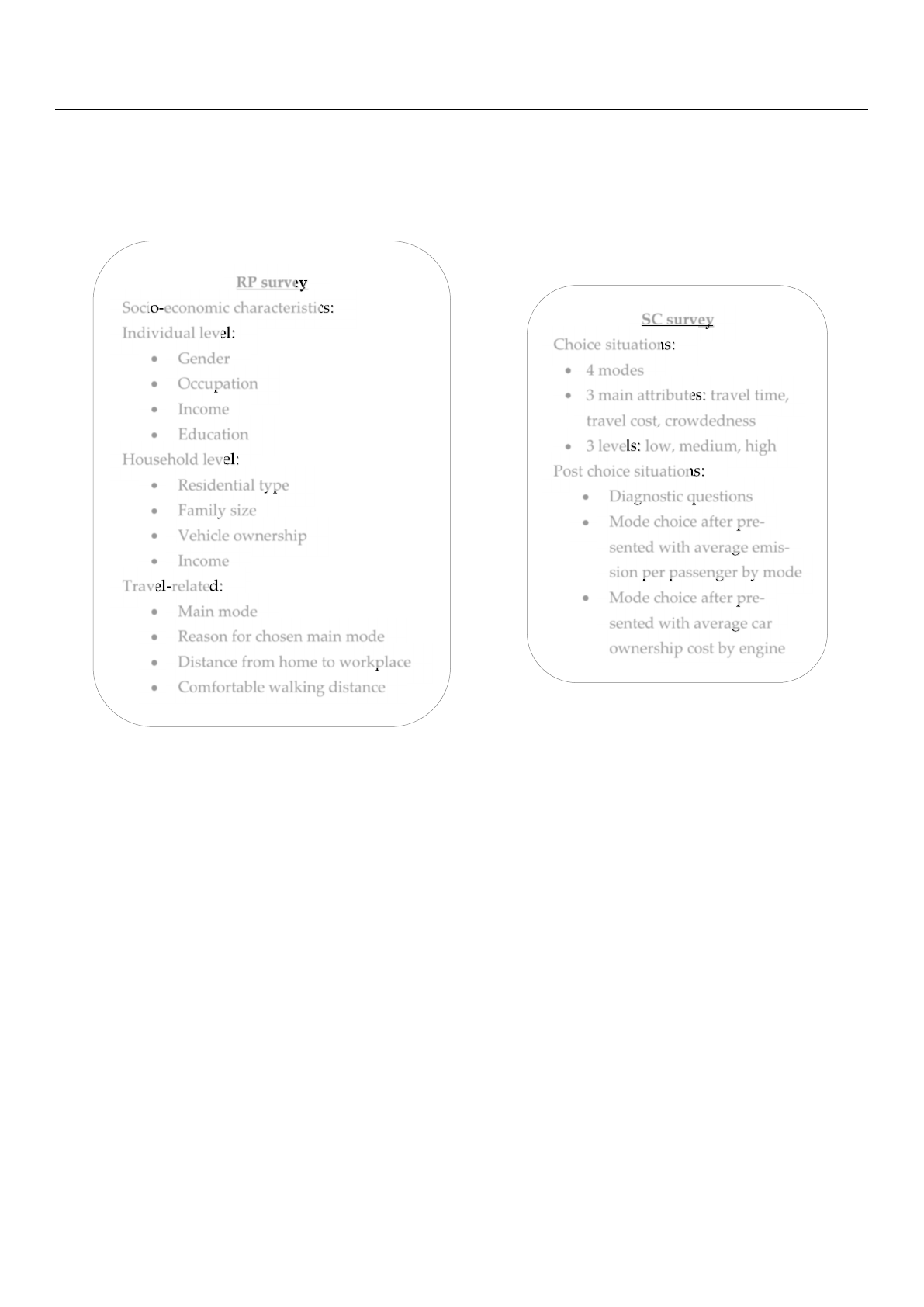
(SC) survey, according to Figure 1. The calculation of 477 sample families for our survey is
shown in Appendix A. Our selection comprises household members of at least 18 years old
and above. A total of 1239 respondents participated.
2.1. Revealed Preference
The questionnaire is built on the initial input from the Household Travel Survey (HTS)
conducted in 2017 provided by OTP, Thailand. The HTS asked Bangkok Metropolitan
Region commuters to answer questions on the household and individual level. Household
information included their current address, residential type, family size, vehicle ownership,
and income. Then, household members were asked about their gender, occupation, income,
main transport mode (all currently available transport modes were included in the question-
naire including car, motorcycle, walk, cycle, metro (MRT, BTS, and ARL), bus (conventional
and with a/c), passenger van, Songthaew (converted pick-ups), boat (Saen Saeb canal,
Padung Krung Kasem canal, and Chao Praya river express), ferry, taxi, ride-hailing (e.g.,
Grab), motorcycle taxi, Tuktuk (3-wheeler), and other), travel diary, and the reasons for
choosing their main mode (respondents were asked to provide five main reasons by prefer-
ence from the following options: travel time, waiting time, cost, convenience/accessibility,
comfort, ability to multitask, privacy, reduce global warming, safety, reliability/punctuality,
physical health, no sidewalk/bike lane, weather condition/pollution, indicate social status,
Sustainability 2022,14, 9127 4 of 19
meet new people/travel companion, and other.). In addition, we asked the respondents to
provide information on their education and comfortable walking distance. All respondents’
residential and employment locations were geocoded and used to calculate the Euclidean
distances between the locations.
Sustainability2022,14,xFORPEERREVIEW4of20
Figure1.Surveydata.Socioeconomicandtravel‐relatedvariablesthatarelikelytoinfluencemode
choicesareincludedintherevealedpreferencesurvey.Questionsaboutfuturemodechoicesthat
aretraded‐offbydifferentlevelsoftraveltime,travelcost,andcrowdednessaregiveninthestated
choicesurvey.
2.1.RevealedPreference
ThequestionnaireisbuiltontheinitialinputfromtheHouseholdTravelSurvey
(HTS)conductedin2017providedbyOTP,Thailand.TheHTSaskedBangkokMetropol‐
itanRegioncommuterstoanswerquestionsonthehouseholdandindividuallevel.
Householdinformationincludedtheircurrentaddress,residentialtype,familysize,vehi‐
cleownership,andincome.Then,householdmemberswereaskedabouttheirgender,
occupation,income,maintransportmode(allcurrentlyavailabletransportmodeswere
includedinthequestionnaireincludingcar,motorcycle,walk,cycle,metro(MRT,BTS,
andARL),bus(conventionalandwitha/c),passengervan,Songthaew(convertedpick‐
ups),boat(SaenSaebcanal,PadungKrungKasemcanal,andChaoPrayariverexpress),
ferry,taxi,ride‐hailing(e.g.,Grab),motorcycletaxi,Tuktuk(3‐wheeler),andother),travel
diary,andthereasonsforchoosingtheirmainmode(respondentswereaskedtoprovide
fivemainreasonsbypreferencefromthefollowingoptions:traveltime,waitingtime,cost,
convenience/accessibility,comfort,abilitytomultitask,privacy,reduceglobalwarming,
safety,reliability/punctuality,physicalhealth,nosidewalk/bikelane,weathercondi‐
tion/pollution,indicatesocialstatus,meetnewpeople/travelcompanion,andother.).In
addition,weaskedtherespondentstoprovideinformationontheireducationandcom‐
fortablewalkingdistance.Allrespondents’residentialandemploymentlocationswere
geocodedandusedtocalculatetheEuclideandistancesbetweenthelocations.
2.2.StatedChoice
WegathertravelinformationontheexistingtransportmodesinBangkokthatare
significanttocommutersandtheirassociatedattributelevelsaccordingtotheHTS(2017)
andintroducesharedmobility(SM)thatcouldimprovethecontinuityofcommutingand
RPsurvey
Socio-economiccharacteristics:
Individuallevel:
Gender
Occupation
Income
Education
Householdlevel:
Residentialtype
Familysize
Vehicleownership
Income
Travel-related:
Mainmode
Reasonforchosenmainmode
Distancefromhometoworkplace
Comfortablewalkingdistance
SCsurvey
Choicesituations:
4modes
3mainattributes: traveltime,
travelcost,crowdedness
3levels: low,medium,high
Postchoicesituations:
Diagnosticquestions
Modechoiceafterpre‐
sentedwithaverageemis‐
sionperpassengerbymode
Modechoiceafterpre‐
sentedwithaveragecar
ownershipcostbyengine
Figure 1.
Survey data. Socioeconomic and travel-related variables that are likely to influence mode
choices are included in the revealed preference survey. Questions about future mode choices that
are traded-off by different levels of travel time, travel cost, and crowdedness are given in the stated
choice survey.
2.2. Stated Choice
We gather travel information on the existing transport modes in Bangkok that are
significant to commuters and their associated attribute levels according to the HTS (2017)
and introduce shared mobility (SM) that could improve the continuity of commuting and
are eco-friendlier. The SM modes that we choose to present are “ride hailing” and “shared
taxi”. Ride hailing is well recognized in Bangkok, but just became legalized in Thailand in
May 2021. “Grab” has the largest market share among all ride hailing service providers
in Thailand. Ride hailing is mainly used to replace the inefficiency of private cars, by
specifically increasing the usage instead of parking for the majority of the time, but may
not be able to decrease low-occupancy usage. Shared taxi is basically a ride hailing service
in which the driver can pickup other passengers along the way within a proper detour
time (up to 10 min). Passengers can split their cost with up to three other passengers
that share the ride. The quality of shared taxi service falls in between public and private
transportation. Commuters can save their travel cost and travel time (involves less transfer,
waiting time, and time searching for parking), and also acquire a certain level of privacy.
Shared taxi is not yet available in Bangkok, but can be seen in big cities worldwide such as
Chicago, Berlin, and Beijing.
According to Walker et al. (2017) [
39
], a random design was more robust in a broader
range of the value of time (VOT) which has been often estimated in transport studies. Hence,

Sustainability 2022,14, 9127 5 of 19
there is no benefit from using more complex models such as “efficient designs” that are
conditional on the correctness of prior assumptions. In addition, the common full fractional
“orthogonal designs” are efficient when employed in the original conjoint analysis, but have
been called into question about their appropriateness for nonlinear models (The design
usually begins with a full fractional design of
ΠjLMjNj
j
choice situations, where jrepresents
alternative j,Nis the number of alternatives or choices, Mis the number of factors affecting
the choices (attributes), and Lis the number of levels of each attribute. The choice sets
exponentially increase with the variables which make the design impracticable.). Therefore,
we use the random fractional factorial design by using travel time as the factor linkage,
eliminating the dominant choices, and ensuring utility balance while keeping the attributes
level balanced to avoid biased effects [
40
]. Detailed literature on the experimental designs
can be found from, among others, [23,41–46].
The SC questionnaire covers eight modes shown in Table 1. Commuters are required
to perform a first preference choice task from nine choice situations (Table A1), each with
four alternatives from each transport mode group (i.e., PV, PT, SM, and multimodal). In
addition to the choice situations, we present car ownership costs by car type (Table A2)
and emissions from vehicles (Figure A2). Then, we ask respondents to choose whether they
will shift from their current modes or not. If so, to which mode. In case the respondents
own a private vehicle, shifting means that they are willing to sell their vehicle(s).
Table 1.
The alternatives, attributes, and attribute levels used in the stated choice experiments. All
attributes have three levels, i.e., low, medium, and high. The levels are separated with commas for
attributes: total travel time (min), fuel cost or fare (Baht), and parking fee (Baht), for example, total car
travel time for low, medium, high choice situations are 13, 32, and 51 min from origin to destination.
Tolls have three levels, i.r., 30, 45, and 60 Baht. Only the modes with check marks require commuters
to pay for tolls and are assigned with crowdedness levels. The level of crowdedness is applied to the
PT and SM modes, including multimodal. While shared taxis can accompany one to three people,
buses and the metro may have plenty of seats left on board, few empty seats, or only standing room.
Attributes/
Alternatives
Attribute Levels
PV PT SM Multimodal
(Transfer to Metro)
Car Mtc Metro Bus, Van Shared Taxi Ride-Hailing Mtc-Taxi Shared Taxi
Total travel time
1 (min)
13, 32, 51
6, 21, 36
11, 26, 42
15, 35, 57 12, 32, 45 9, 27, 42 7, 19, 37 12, 29, 46
Fuel cost, fare (Baht)
13, 33, 52
2, 8, 13
15, 44, 70
8, 19, 35 25, 66, 82 37, 99, 123 25, 60, 75 28, 63, 88
Toll (Baht) √- - - √ √ -√
Parking fee (Baht)
10, 30, 55
5, 10, 20 - - - - - -
Crowdedness - - √ √ √ -√ √
1
Total travel time includes in-vehicle time, walking, waiting, detour, and search for parking. PV, private vehicle;
PT, public transit; SM, shared mobility; mtc, motorcycle. Source: Researcher’s calculation from data provided by
the HTS (2017), Bangkok Mass Transit System (BTS), Metropolitan Rapid Transit (MRT), Airport Rail Link (ARL),
Bus Rapid Transit (BRT), and Bangkok Mass Transit Authority (BMTA).
3. Methodology
The discrete choice model (DCM) in the choice theory is an established method that is
used to study and predict consumer satisfaction, willingness to pay, consumer behavior,
including travel mode choice behavior. Since the dependent variable in this study is the
travel mode choice from alternative options which is not a continuous variable, using DCM
is suitable. Commuters’ decisions on travel mode follow the random utility maximization
(RUM) model because human behaviors cannot be forecasted under certainty [
47
]. We
assume that the probability that an individual will choose a transport mode follows the
multinomial logit (MNL) model. Methodological details are provided in Appendix C.
Loading more pages...