Citation: Rana, A.G.; Schwarze, M.;
Tasbihi, M.; Sala, X.; García-Antón, J.;
Minceva, M. Influence of Cocatalysts
(Ni, Co, and Cu) and Synthesis
Method on the Photocatalytic
Activity of Exfoliated Graphitic
Carbon Nitride for Hydrogen
Production. Nanomaterials 2022,12,
4006. https://doi.org/10.3390/
nano12224006
Academic Editor: Joon Ching Juan
Received: 13 July 2022
Accepted: 11 November 2022
Published: 14 November 2022
Publisher’s Note: MDPI stays neutral
with regard to jurisdictional claims in
published maps and institutional affil-
iations.
Copyright: © 2022 by the authors.
Licensee MDPI, Basel, Switzerland.
This article is an open access article
distributed under the terms and
conditions of the Creative Commons
Attribution (CC BY) license (https://
creativecommons.org/licenses/by/
4.0/).
nanomaterials
Article
Influence of Cocatalysts (Ni, Co, and Cu) and Synthesis Method
on the Photocatalytic Activity of Exfoliated Graphitic Carbon
Nitride for Hydrogen Production
Adeem Ghaffar Rana 1,2 , Michael Schwarze 3,*, Minoo Tasbihi 3, Xavier Sala 4, Jordi García-Antón4and
Mirjana Minceva 1,*
1Biothermodynamics, TUM School of Life Sciences, Technical University of Munich,
Maximus-Von-Imhof-Forum 2, 85354 Freising, Germany
2Department of Chemical, Polymer and Composite Materials Engineering, University of Engineering and
Technology (UET), Lahore 39161, Pakistan
3Department of Chemistry, Technische Universität Berlin, Straße des 17. Juni 124, 10623 Berlin, Germany
4Departament de Química, Unitat de Química Inorgànica, Universitat Autònoma de Barcelona,
08193 Bellaterra, Barcelona, Spain
*Correspondence: [email protected] (M.S.); [email protected] (M.M.);
Tel.: +49-8161716170 (M.M.)
Abstract:
Exfoliated graphitic carbon nitride (ex-g-CN) was synthesized and loaded with non-noble
metals (Ni, Cu, and Co). The synthesized catalysts were tested for hydrogen production using a
300-W Xe lamp equipped with a 395 nm cutoff filter. A noncommercial double-walled quartz-glass
reactor irradiated from the side was used with a 1 g/L catalyst in 20 mL of a 10 vol% triethanolamine
aqueous solution. For preliminary screening, the metal-loaded ex-g-CN was synthesized using the
incipient wetness impregnation method. The highest hydrogen production was observed on the
Ni-loaded ex-g-CN, which was selected to assess the impact of the synthesis method on hydrogen
production. Ni-loaded ex-g-CN was synthesized using different synthesis methods: incipient wetness
impregnation, colloidal deposition, and precipitation deposition. The catalysts were characterized by
X-ray powder diffraction, X-ray photoelectron spectroscopy, nitrogen adsorption using the Brunauer–
Emmett–Teller method, and transmission electron microscopy. The Ni-loaded ex-g-CN synthesized
using the colloidal method performed best with a hydrogen production rate of 43.6
µ
mol h
−1
g
−1
.
By contrast, the catalysts synthesized using the impregnation and precipitation methods were less
active, with 28.2 and 10.1
µ
mol h
−1
g
−1
, respectively. The hydrogen production performance of
the suspended catalyst (440
µ
mol m
−2
g
−1
) showed to be superior to that of the corresponding
immobilized catalyst (236 µmol m−2g−1).
Keywords:
graphitic carbon nitride; water splitting; hydrogen production; nickel; cocatalyst deposition
1. Introduction
Energy and environmental challenges are emerging with industrial and economic
development [
1
–
3
]. Industrialization and increasing population are the main reasons
behind the energy and environmental crises. Most of the world’s energy demand is fulfilled
by nonrenewable sources (petrol, diesel, and coal), which are becoming depleted [
4
,
5
].
Additionally, during the past few decades, the increased consumption of fossil fuels has led
to severe environmental issues, such as global warming and climate change. As a result,
researchers are putting more effort into developing renewable energy sources, the only
alternative to ensure sustainable development. Solar light, wind, biomass, hydro, and
geothermal energy sources are eco-friendly sources of renewable energy [
6
–
9
]. Among
them, sunlight energy can be stored in the chemical bonds of a fuel (e.g., hydrogen, H
2
)
through artificial photosynthesis [
4
,
10
–
12
]. Hydrogen, an alternative renewable energy
source, can release considerable energy without emitting greenhouse gases; water is the
Nanomaterials 2022,12, 4006. https://doi.org/10.3390/nano12224006 https://www.mdpi.com/journal/nanomaterials

Nanomaterials 2022,12, 4006 2 of 13
only by-product of hydrogen combustion. Hence, photocatalytic H
2
generation through
solar light-driven water splitting using semiconductor materials that convert solar energy
to chemical energy has become a promising approach [
13
]. Consequently, the development
of a stable, effective, and inexpensive catalyst for the hydrogen evolution reaction (HER)
has become a challenging and important research topic [14].
A wide variety of semiconductor-based photocatalysts, such as TiO
2
[
15
], ZnO [
16
,
17
],
Bi [
18
], CdS [
19
], and g-CN [
20
], have been investigated in the last few decades. The more
conventional (i.e., TiO
2
and ZnO) have advantages and disadvantages regarding stability
and nontoxicity [
21
,
22
]. Conversely, they typically have large bandgaps and a high rate
of electron–hole recombination, which results in low solar-to-fuel efficiency [
23
]. Among
semiconductor materials, graphitic carbon nitride (g-CN) has attracted considerable atten-
tion since Wang et al. first reported its use for water splitting [14,24]. g-CN, a visible-light
photocatalyst composed of N, C, and H, has attracted interest because of its extensive ap-
plication in CO
2
reduction [
25
], pollutant degradation [
23
], organic synthesis reactions [
26
],
and water splitting [
27
]. These nitrogen-rich materials are inexpensive, abundant, and
easy to synthesize [
22
,
28
]. The thermal decomposition of nitrogen-rich precursors, such
as melamine, urea, thiourea, cyanamide, or dicyanamide, is used to synthesize g-CN in
the form of tri-s-triazine sheets. Moreover, the nontoxic g-CN, which can be activated by
visible light because of the low bandgap energy (2.7 eV), possesses chemical, electronic, and
thermodynamic stability [
22
,
23
,
29
]. However, the photocatalytic performance of bulk g-CN
is low because of the low specific surface area (10 m
2
/g), low availability of active sites, low
adsorption and absorption, and rapid recombination of photogenerated electron-hole pairs.
Several strategies can be adopted during the photocatalyst design to improve the surface
and optical properties of g-CN to overcome these problems. These include metal and
nonmetal doping, morphology control, compositing with other semiconductor materials,
and exfoliation [
22
,
30
]. From these strategies, exfoliation is a fast, efficient, and easy method
to improve a given material and its optical properties by increasing its surface area [
23
].
Moreover, doping can help improve the electronic properties of materials by introducing
more electron-hole pairs and minimizing charge recombination [8,22,24,30].
Modifying the catalyst with a cocatalyst enhances the performance of materials sig-
nificantly. Immobilization of a cocatalyst on the surface of the semiconductor material is
one of the efficient and essential methods to accelerate the separation efficiency of electron–
hole pairs generated in the process, consequently enhancing the overall photocatalytic
performance of the semiconductor material. Therefore, adding cocatalysts enhances hy-
drogen production in a water-splitting reaction. Noble and non-noble metals can play this
role [1,6,13,21,31].
Noble metal cocatalysts typically enhance the kinetics of the reaction at low overpoten-
tials and help induce charge separation from the semiconductor to the cocatalyst [
13
]. Noble
metals, such as platinum (Pt) [
32
], gold (Au) [
33
], ruthenium (Ru) [
34
], silver (Ag) [
35
],
and palladium (Pd) [
36
], are usually the most common cocatalysts for improving the
photocatalytic performance [
1
]. However, noble metals are scarce, which prevents their
practical implementation on a large scale. Hence, researchers are trying to find a cocatalyst
that can replace these noble metals, such as non-noble metals, metal oxides, and metal
sulfides [
21
,
31
]. From all the non-noble metals available for HER, nickel-based cocatalysts
have attracted attention because of their low price, stability, and high activity [1].
Recently, Ni metal and Ni-based compounds (Ni
2
P, Ni(OH)
2
, NiN
3
, NiB, NiS, and
Ni
3
C) have shown significant HER performance when used as cocatalysts in g-CN-based
photocatalytic systems. Ni can play a similar role to noble metals, improving the separation
efficiency of electron–hole pairs [
1
,
13
]. The cocatalyst loading on the support material
can be achieved using diverse synthetic methods. The synthesis methods determine the
structure, dispersion, and size distribution of the cocatalyst, which affects the activity of the
final hybrid material. In recent years, various methods have been proposed to synthesize
supported nanoparticles. However, few studies have compared different synthesis methods

Nanomaterials 2022,12, 4006 3 of 13
for a given support and a given photocatalytic processes. Therefore, rationally choosing
the most suitable method remains a challenge [37].
This study evaluated the effect of non-noble metal (Ni, Cu, and Co) cocatalyst loading
on exfoliated g-CN (ex-g-CN) for hydrogen production. The hybrid photocatalyst was
initially prepared using the incipient wet impregnation (IWI) method and the superior
photocatalytic activity of Ni (over Cu and Co) was observed. After this preliminary
screening, the best-performing Ni-based hybrid photocatalyst was prepared using one
of the following methodologies: (i) precipitation deposition method (PRDM), (ii) IWI
method, and (iii) colloidal deposition method (CM). The effects of the synthesis method
on the HER photocatalytic performance were studied with triethanolamine (TEOA) as the
sacrificial agent under simulated solar light irradiation using a 300-W xenon lamp with a
395-nm cutoff filter. Moreover, the effects of the catalyst exposure to the reaction medium
(immobilization or suspension) were studied for practical applications.
2. Materials and Methods
2.1. Chemicals
Melamine (C
3
H
6
N
6
, 99%) and dihydrogen hexachloroplatinate(IV) hydrate, 99.9% (metal
basis) (H
2
PtCl
6·
H
2
O) were purchased from Alfa Aesar (Haverhill, MA, USA). Nickel
sulfate hexahydrate (NiSO
4·
6H
2
O), copper sulfate pentahydrate (CuSO
4·
5H
2
O), and cobalt
sulfate monohydrate (CoSO
4·
H
2
O) (Merck, Darmstadt, Germany), sodium hydroxide
(NaOH), ethanol (C
2
H
5
OH), methanol (CH
3
OH), cyclohexane (C
6
H
12
), 1-butanol (C
4
H
10
O),
and ascorbic acid (C
6
H
8
O
6
) were obtained from VWR (Radnor, PA, USA). Triton X-100
(C
14
H
22
O(C
2
H
4
O)
n
(n = 9–10)) was supplied by Sigma-Aldrich (Darmstadt, Germany).
TEOA (C
6
H
15
NO
3
) was acquired from Sigma-Aldrich (Darmstadt, Germany). All chemicals
were used as received.
2.2. Synthesis of ex-g-CN
Bulk carbon nitride (g-CN) was synthesized with prethermal decomposition of melamine
using the procedure established in a previous study [
23
]. Briefly, a closed crucible with
melamine was placed into a muffle furnace (Carbolite Gero, GPC 1200, Derbyshire, UK)
for thermal decomposition. The heating program consisted of two steps: heating to
450 ◦C
with a gradient of 2
◦
C min
−1
, and this temperature was kept for 2 h. The sample was then
heated to 550
◦
C at a rate of 2
◦
C min
−1
, maintaining this temperature for 4 h. Bulk g-CN
was crushed in a mortar and pestle, rinsed with ultrapure water, and dried overnight at
80
◦
C. Carbon nitride (ex-g-CN) was exfoliated from g-CN by placing g-CN in an open
crucible inside a muffle furnace for 2 h at 500
◦
C using a heating ramp of 2
◦
C min
−1
. The
ex-g-CN was obtained after thermal treatment.
2.3. Cocatalyst Loading onto ex-g-CN
Incipient Wet Impregnation
The IWI method was used to synthesize Ni, Cu, Co, and Pt-loaded ex-g-CN catalyst
(
2 wt.%
theoretical loadings) for the preliminary screening of hydrogen production. The Ni-
based catalyst synthesized using this method was called Ni
IWI
/ex-g-CN [
38
]. According
to stoichiometric calculations, the required amount of a respective salt precursor was
added dropwise to the ex-g-CN. The beaker containing the catalyst powder was placed
in a sonicator for better dispersion. The material was dried overnight at 80
◦
C before
further use.
2.4. Precipitation Deposition Method
Ni
PRDM
/ex-g-CN (2 wt.% theoretical Ni loading) was synthesized using the PRDM [
39
].
The respective amount of the nickel salt precursor was added to 300 mL of milli-Q water.
The solution was maintained at pH 9 using 0.1M NaOH. At a stable pH, ex-g-CN was
added with continuous stirring. The deposition–precipitation procedure was conducted at

Nanomaterials 2022,12, 4006 4 of 13
70
◦
C at a constant pH for 2 h, and the slurry was stirred and dried overnight at the same
temperature. The catalyst was washed and dried at 80 ◦C under vacuum.
2.5. Colloidal Deposition Method
Ni
CM
/ex-g-CN (2 wt.% theoretical Ni loading) was synthesized using the CM. The
microemulsion system for synthesizing Ni nanoparticles consists of two phases, e.g., the
water and oil phases. The nickel salt precursor, surfactant (Triton X-100), and co-surfactant
(1-butanol) were present in the water phase. The oil phase was cyclohexane. Two mi-
croemulsions were prepared for the synthesis: (1) with Ni salt and (2) with a reducing
agent (ascorbic acid). The synthesis process was conducted in a glass reactor with stirring.
Emulsion 2 contained ascorbic acid, cyclohexane, butanol-1, triton X-100, and water. Emul-
sion 1 contained the nickel salt precursor, cyclohexane, butanol-1, triton X-100, and water.
Emulsion 2 was added slowly to the reactor containing emulsion 1. The mixture was stirred
at 700 rpm for 30 min at room temperature to form the colloidal stabilized Ni nanoparticles
and then stirred for 2 h at room temperature. The ex-g-CN support was then added to the
mixture with vigorous stirring to deposit the Ni nanoparticles onto the surface of ex-g-CN.
The suspension was stirred further for 2 h at 55
◦
C. After the process, the reactor was cooled
to room temperature. The solid was centrifuged and washed several times with acetone.
Finally, the catalyst was dried at 80 ◦C under vacuum.
2.6. Characterization
The Brunauer–Emmett–Teller (BET) surface area was determined from a nitrogen
adsorption–desorption experiment at 77 K (quadrasorp, Quantachrome, Boynton Beach,
FL, USA). The crystalline phases were examined using X-ray diffraction (XRD, Mini Flex
600C, Rigaku, Tokyo, Japan) was conducted using CuK
α
radiation at a voltage, current,
and spin speed of 40 kV, 15 mA, and 80 rpm, respectively, in the range between 3
◦
and 60
◦
2
θ
with a step size of 0.0075
◦
. Transmission electron microscopy (TEM, JEM-ARM300F2)
images were obtained using a probe corrected with a cold FEG emitter (JEOL Ltd., Tokyo,
Japan) operated at 300 kV with a camera length of 10 cm. The acquired and evaluated high-
angle annular dark-field images represent a detection angle of 54–220 mrad. The image
contrasts were formed mainly by Rutherford scattering and were correlated to the atomic
number. X-ray photoelectron spectroscopy (XPS, Phoibos 150 analyzer, SPECS GmbH,
Berlin, Germany) was conducted under ultra-high vacuum conditions (base pressure
5×10⁻¹⁰ mbar
) using a monochromatic Al K
α
X-ray source (1486.74 eV). The energy
resolution measured from the FWHM of the Ag 3d
5/2
peak for a sputtered silver foil
was 0.62 eV at the Catalan Institute of Nanoscience and Nanotechnology in Barcelona.
Ni loading in Ni-loaded ex-g-CN samples was determined using inductively coupled
plasma optical emission spectrometry (Perkin-Elmer Optima 4300DV model system) in the
Chemical Analyses Service of the Universitat Autònoma de Barcelona.
2.7. Photocatalytic Experiments
The photocatalytic experiments were performed in a noncommercial side-irradiated
double-walled quartz-glass reactor (shown in a previous work [
40
]) with a maximum
volume of 35 mL. In general, 20 mg of the prepared photocatalyst was placed into the
reactor, and 20 mL of an aqueous TEOA solution (10 vol% TEOA) was added. The solution
was flushed with Ar for 15 min to remove oxygen, and the reactor was closed with a
rubber septum. The reactor was connected to a thermostat (ministat 125, Huber, Germany,
Tset = 19 ◦C
) and placed onto a magnetic stirrer in front of a 300-W Xe lamp equipped with
a 395-nm cutoff filter. The distance between the lamp and reactor was 10 cm. The lamp was
switched on, and after irradiating the intensively stirred photocatalyst suspension for the
desired time, a gas phase sample was taken with a gas-tight syringe. The gas sample was
analyzed by gas chromatography (Agilent Technologies 7890 A) equipped with a thermal
conductivity detector.
Nanomaterials 2022,12, 4006 5 of 13
The hydrogen production photocatalytic activity was calculated as follows:
H2µmol g−1h−1=(V0−VL)·H2(GC)
mcat ·tR·Vm(1)
where V
0
is the total volume of the reactor, V
L
is the volume of the solution, H
2
is the
amount of H
2
detected using GC, m
cat
is the amount (g) of catalyst, t
R
is the irradiation
time, and Vmis the molar volume of hydrogen.
3. Results
3.1. Catalyst Characterization
Before assessing the as-prepared photocatalysts for the HER, they were characterized
using the different techniques. Optical properties were characterized using UV-Vis and
photoluminescence (PL) spectroscopy (Figures S1 and S2). The bandgap energy for bulk
and exfoliated g-CN were 2.42 and 2.62 eV showing light absorption in the visible range.
After loading with Co, Ni, and Cu, the bandgap energy was 2.6, 2.5, and 2.4 eV, respectively.
The optical properties remained after cocatalyst loading. In the case of different methods
to load Ni onto ex-g-CN, bandgap energy was constant at about 2.5 eV. PL spectroscopy
showed that g-CN materials absorbed the maximum in the range of 430–460 nm. The
chemical composition was studied using FTIR (Figure S3) and spectra are typical for g-CN
materials. Peaks at 806 cm
−1
can be attributed to triazine units, whereas the strong bands
between 1636 and 1242 cm
−1
belong to the C=N and C–N bonds of heterocyclic rings.
There were no peak alterations and new peaks after the addition of the cocatalyst.
3.2. X-ray Diffraction
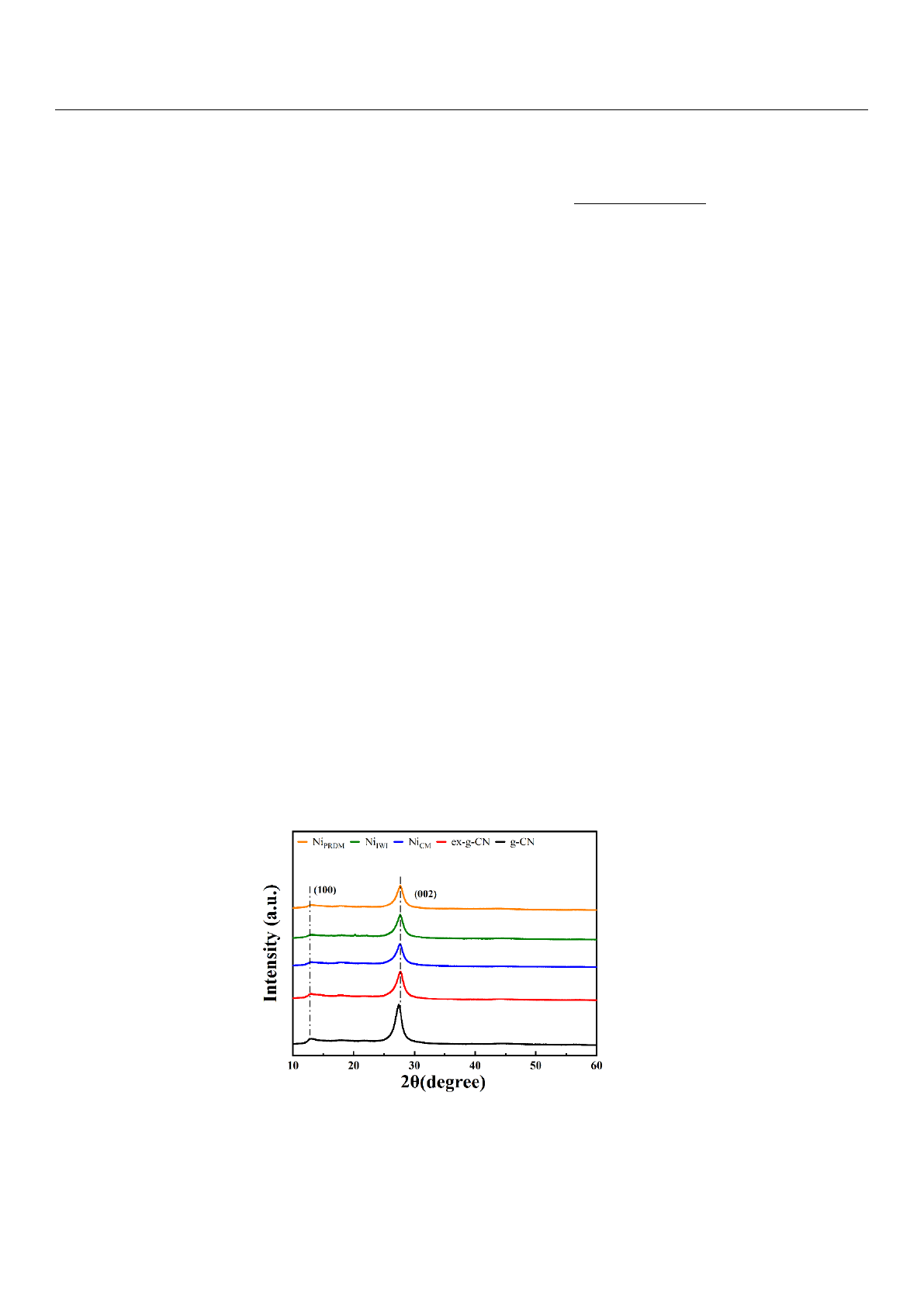
The phase structures of g-CN, ex-g-CN, and Ni-loaded ex-g-CN were examined using
XRD and the diffractograms are shown in Figure 1. All samples showed the characteristic
peak at 27.2
◦
2
θ
and a weaker peak at 13
◦
2
θ
. The strong peak was indexed to the (002)
plane, a characteristic interlayer stacking peak of aromatic g-C
3
N
4
systems. Moreover, the
weak peak was assigned to the (100) crystal plane, which was attributed to the repeated
tri-s-triazine units. The decrease in intensity and the slight shift in the peaks were attributed
to exfoliation and Ni loading. There were no peaks of Ni due to the low Ni content. The
XRD patterns of cobalt and copper loaded ex-g-CN showed similar peaks with no visible
peak of respective metal (Figure S4).
Nanomaterials 2022, 12, x FOR PEER REVIEW 5 of 13
395-nm cutoff filter. The distance between the lamp and reactor was 10 cm. The lamp was
switched on, and after irradiating the intensively stirred photocatalyst suspension for the
desired time, a gas phase sample was taken with a gas-tight syringe. The gas sample was
analyzed by gas chromatography (Agilent Technologies 7890 A) equipped with a thermal
conductivity detector.
The hydrogen production photocatalytic activity was calculated as follows:
𝐻 (μmol gh)= (𝑉−𝑉
)⋅𝐻
(𝐺𝐶)
𝑚 ⋅𝑡
⋅𝑉
(1)
where V0 is the total volume of the reactor, VL is the volume of the solution, H2 is the
amount of H2 detected using GC, mcat is the amount (g) of catalyst, tR is the irradiation
time, and Vm is the molar volume of hydrogen.
3. Results
3.1. Catalyst Characterization
Before assessing the as-prepared photocatalysts for the HER, they were characterized
using the different techniques. Optical properties were characterized using UV-Vis and
photoluminescence (PL) spectroscopy (Figures S1 and S2). The bandgap energy for bulk
and exfoliated g-CN were 2.42 and 2.62 eV showing light absorption in the visible range.
After loading with Co, Ni, and Cu, the bandgap energy was 2.6, 2.5, and 2.4 eV, respec-
tively. The optical properties remained after cocatalyst loading. In the case of different
methods to load Ni onto ex-g-CN, bandgap energy was constant at about 2.5 eV. PL spec-
troscopy showed that g-CN materials absorbed the maximum in the range of 430–460 nm.
The chemical composition was studied using FTIR (Figure S3) and spectra are typical for
g-CN materials. Peaks at 806 cm−1 can be attributed to triazine units, whereas the strong
bands between 1636 and 1242 cm−1 belong to the C=N and C–N bonds of heterocyclic rings.
There were no peak alterations and new peaks after the addition of the cocatalyst.
3.2. x-Ray Diffraction
The phase structures of g-CN, ex-g-CN, and Ni-loaded ex-g-CN were examined us-
ing XRD and the diffractograms are shown in Figure 1. All samples showed the charac-
teristic peak at 27.2° 2θ and a weaker peak at 13° 2θ. The strong peak was indexed to the
(002) plane, a characteristic interlayer stacking peak of aromatic g-C3N4 systems. Moreo-
ver, the weak peak was assigned to the (100) crystal plane, which was attributed to the
repeated tri-s-triazine units. The decrease in intensity and the slight shift in the peaks were
attributed to exfoliation and Ni loading. There were no peaks of Ni due to the low Ni
content. The XRD patterns of cobalt and copper loaded ex-g-CN showed similar peaks
with no visible peak of respective metal (Figure S4).
Figure 1.
XRD patterns of g-CN, ex-g-CN, and Ni-loaded ex-g-CN synthesized using the incipient wet
impregnation (IWI) method, colloidal method (CM), and precipitation deposition method (PRDM).
3.3. Brunauer–Emmett–Teller
The specific surface areas were measured to reveal any change in the structural features
of carbon nitride before and after exfoliation. The surface area of ex-g-CN, obtained from
Loading more pages...