
Frontiers in Microbiology 01 frontiersin.org
Beer fermentation performance
and sugar uptake of
Saccharomycopsis fibuligera–A
novel option for low-alcohol
beer
YvonneMethner
1, FredericoMagalhães
2,3, LuisRaihofer
1,
MartinZarnkow
1, FritzJacob
1 and MathiasHutzler
1
*
1 Research Center Weihenstephan for Brewing and Food Quality, Technical University of Munich,
Freising, Germany, 2 Chair of Brewing and Beverage Technology, Technical University of Berlin,
Berlin, Germany, 3 VTT Technical Research Centre of Finland Ltd., Espoo, Finland
There is a growing trend for beers with novel flavor profiles, as consumers
demand a more diversified product range. Such beers can beproduced by
using non-Saccharomyces yeasts. The yeast species Saccharomycopsis
fibuligera is known to produce exceptionally pleasant plum and berry flavors
during brewer’s wort fermentation while its mycelia growth is most likely a
technological challenge in industrial-scale brewing. To better understand and
optimize the physiological properties of this yeast species during the brewing
process, maltose and maltotriose uptake activity trials were performed. These
revealed the existence of active transmembrane transporters for maltose in
addition to the known extracellular amylase system. Furthermore, a single cell
isolate of S. fibuligera was cultured, which showed significantly less mycelial
growth during propagation and fermentation compared to the mother culture
and would therefore bemuch more suitable for application on an industrial
scale due to its better flocculation and clarification properties. Genetic
differences between the two cultures could not be detected in a (GTG)5
rep-PCR fingerprint and there was hardly any difference in the fermentation
process, sugar utilization and flavor profiles of the beers. Accordingly, the
characteristic plum and berry flavor could also be perceived by using the
culture from the single cell isolate, which was complemented by a dried
fruit flavor. A fermentation temperature of 20°C at an original gravity of 10 °P
proved to beoptimal for producing a low-alcohol beer at around 0.8% (v/v) by
applying the S. fibuligera yeast culture from the single cell isolate.
KEYWORDS
Saccharomycopsis fibuligera, non-Saccharomyces yeasts, fermentation, brewing,
low-alcohol beer, sugar uptake, micromanipulation, flavor
TYPE Original Research
PUBLISHED 05 October 2022
DOI 10.3389/fmicb.2022.1011155
OPEN ACCESS
EDITED BY
Haifeng Zhao,
South China University of Technology,
China
REVIEWED BY
Diego Bonatto,
UFRGS, Brazil
Olimpio Montero,
Spanish National Research Council (CSIC),
Spain
André Alcarde,
University of São Paulo, Brazil
*CORRESPONDENCE
Mathias Hutzler
SPECIALTY SECTION
This article was submitted to
Food Microbiology,
a section of the journal
Frontiers in Microbiology
RECEIVED 03 August 2022
ACCEPTED 06 September 2022
PUBLISHED 0 October 20225
CITATION
Methner Y, Magalhães F, Raihofer L,
Zarnkow M, Jacob F and Hutzler M (2022)
Beer fermentation performance and sugar
uptake of Saccharomycopsis fibuligera–A
novel option for low-alcohol beer.
Front. Microbiol. 13:1011155.
doi: 10.3389/fmicb.2022.1011155
COPYRIGHT
© 2022 Methner, Magalhães, Raihofer,
Zarnkow, Jacob and Hutzler. This is an
open-access article distributed under the
terms of the Creative Commons Attribution
License (CC BY). The use, distribution or
reproduction in other forums is permitted,
provided the original author(s) and the
copyright owner(s) are credited and that
the original publication in this journal is
cited, in accordance with accepted
academic practice. No use, distribution or
reproduction is permitted which does not
comply with these terms.

Methner et al. 10.3389/fmicb.2022.1011155
Frontiers in Microbiology 02 frontiersin.org
Introduction
The yeast species Saccharomycopsis fibuligera (synonym:
Endomyces fibuliger) is known from food fermentations,
especially from liqueur production (Aidoo etal., 2006; Xie
etal., 2021). It was isolated from traditional fermented foods,
such as Indonesian tapé made from glutinous rice or cassava
tuber (Djien, 1972). In Southeast Asia in particular, the yeast
species is used in rice wine fermentation and is known to
produce desirable floral, fruity, and honey-like flavors during
fermentation as a result of high production of esters and
higher alcohols (Xie et al., 2021; Yang et al., 2021).
Characteristic fruity, flowery, and honey flavors were also
noted when S. fibuligera was cultured in selective media
containing different carbohydrate sources (Lee etal., 2018).
Due to its positive flavor properties, it was also tested for its
suitability to ferment brewer’s wort, where there is a demand
for diversification of the product range. As a result,
S. fibuligera produced exceptionally promising plum-like, and
also berry-like flavors in the beers (Srithamma, 2009;
Methner etal., 2019, 2022). It was noticeable that, depending
on the yeast strain, different sugar utilization patterns took
place in brewer’s wort, so it was possible to produce both
non-alcoholic and alcoholic beers. Lindner, who isolated the
yeast species in the context of bread spoilage in 1907,
described it as strongly utilizing sucrose during fermentation,
weakly utilizing glucose, and unable to utilize maltose
(Lindner, 1907). In contrast, Kreger-van-Rij stated in 1984
that the yeast species is capable of fermenting glucose as well
as sucrose and maltose (Kreger-Van Rij, 1984). Nevertheless,
existing literature explains that maltose utilization is slow
(Kurtzman and Smith, 2011). Generally, S. fibuligera is known
to possess amylolytic activity and therefore has the ability to
degrade starch. In 1944, Wickerham observed the presence of
an extracellular amylase system for S. fibuligera (Wickerham
et al., 1944). Through several studies, the two enzymes
α-amylase and glucoamylase from S. fibuligera were isolated
and characterized (Futatsugi etal., 1993; Chen etal., 2010).
The endoamylase α-amylase is capable of randomly cleaving
α-1,4 glycosidic bonds and thus reducing amylose to
oligosaccharides such as maltotriose and maltose.
Glucoamylase (synonym: amyloglucosidase) yields individual
glucose units from the hydrolysis of non-reducing ends of
amylose and amylopectin and additionally cleaves maltose
and maltotriose (Janeček and Baláž, 1992; Pandey, 1995;
Tiwari etal., 2015). Hostinová observed that S. fibuligera can
synthesize either both enzymes or only one type of amylase
in a strain-specific manner (Hostinová, 2002). In a study by
Methner etal. the glucoamylase activity gave an indication of
why maltose from selective media could befully metabolized
by the yeast strain S. fibuligera S. fib Lu27 although hardly any
maltose and maltotriose could beutilized by this strain from
brewer’s wort (Methner et al., 2022). In contrast, the
S. fibuligera yeast strain S. fib SF4 was able to partially
metabolize maltose and maltotriose from brewer’s wort in
another study (Methner etal., 2019). To date, it has not yet
been investigated whether this yeast species utilized maltose
due to extracellular amylase activity and subsequent passive
glucose transport into the cell or due to transmembrane
transporters (permeases) which actively transport maltose
and/or maltotriose into the cell. Since the fermentation trials
with S. fib Lu27 and S. fib SF4 were performed at different
temperatures in the two aforementioned studies by Methner
et al., a possible temperature dependence on the sugar
utilization needs to betaken into consideration.
A distinctive characteristic of the yeast species S. fibuligera is
its morphology, as it is dimorphic and forms individual round or
oval budding cells as well as mycelia (Nga etal., 1995; Xie etal.,
2021). The mycelium represents a challenge in terms of its
suitability for brewing, since it does not flocculate, triggering a
restriction of clarification of the beer. For this reason, single cells
were isolated and recultivated in this study to establish in a direct
comparison with the mother culture, whether the single cell
isolation would influence the morphology during propagation and
fermentation. To ensure that the culture of the isolated single cell
had no genetic differences from the mother culture, additional
(GTG)5 rep-PCR fingerprints were applied. Furthermore, since
the yeast should retain the ability to produce exceptionally fruity
flavors during the fermentation of brewer’s wort as a consequence
of the single cell isolation, the sensory properties of the final beers
were studied.
The objective of this study was to elucidate whether the yeast
species S. fibuligera possesses an active transport system for
maltose and maltotriose, which was examined by maltose and
maltotriose transport assays. Furthermore, it was investigated –
exemplified by the yeast strain S. fib SF4 – whether it was possible
to reduce the characteristic mycelial formation by means of
micromanipulation and recultivation in order to increase the
suitability for brewing on an industrial scale. Possible influences
of micromanipulation on brewing potential including sugar
utilization and beer flavor profiles were studied and compared
with the mother culture and the domesticated reference lager yeast
strain Saccharomyces pastorianus TUM 34/70 at fermentation
temperatures of 20 and 28°C.
Materials and methods
Yeast strains
Table 1 lists the yeast strains with the corresponding
abbreviations that were investigated or used as reference yeast
strains in this study. While the two S. fibuligera yeast strains
represented the yeasts under investigation, S. pastorianus S. pas
34/70 served as the reference yeast strain for all conducted
experiments. S. eubayanus S. eub 12357 and S. ludwigii S. lud SL17
were used as additional reference yeasts for the maltose and
maltotriose transport assays.

Methner et al. 10.3389/fmicb.2022.1011155
Frontiers in Microbiology 03 frontiersin.org
Maltose and maltotriose uptake activity
S. lud SL17 was used as a negative control as the yeast strain is
unable to take up maltose or maltotriose during fermentation
(Boundy-Mills etal., 2011) whereas S. eub 12357 is known to
bemaltose-positive but maltotriose-negative during fermentation
and thus represented the maltotriose-negative control (Gibson
etal., 2013). S. pas 34/70, which represents a traditional group II
lager yeast can utilize both maltose and maltotriose and was
therefore used as the positive control. The maltose and maltotriose
uptake activity of the two yeast strains S. fib Lu27 and S. fib SF4
were to be determined. For maltose and maltotriose uptake
measurement, S. lud SL17 was grown in YP medium prepared
from 1.0% yeast extract (Sigma-Aldrich, St. Louis, MO, U.S.A.),
2.0% peptone from casein, pancreatic digest (Sigma-Aldrich, St.
Louis, MO, U.S.A.) and 1.0% glucose. S. eub 12357 was grown in
YP containing 1.0% maltose and the remaining three strains
(S. pas 34/70 and the two S. fibuligera S. fib Lu27 and S. fib SF4)
were grown in YP medium containing maltose (1% w/v) or
maltotriose (1% w/v). All strains were propagated at 20°C in liquid
medium to an OD600nm between 4 and 8. The cells were harvested
by centrifugation (10 min, 2,968 g, 0°C), washed twice with
ice-cold water and once with 0.1 M tartrate-Tris (pH 4.2) before
being re-suspended in the same buffer to a concentration of
200 mg/ml fresh yeast. Zero-trans rates of [U-14C]-maltotriose
uptake were measured at 20°C essentially as described by Lucero
etal. (1997). Briefly, aliquots of 40 μl of yeast suspension were
added to 20 μl of 15 mM labeled maltotriose (for a final
concentration of 5 mM [U-14C]-maltotriose) and incubated for
60 s at 20°C. The reaction was stopped by adding 5 ml ice-cold
water. The suspension was immediately filtered and washed with
an additional 5 ml ice-cold water. The filter was submerged in
3.5 ml of Optiphase HiSafe 3 scintillation cocktail (Perkin Elmer,
MA, UnitedStates) and the radioactivity measured in a Perkin
Elmer Tri-carb 2,810 TR scintillation counter. [U-
14
C]-maltotriose
(ARC 627) was obtained from American Radiolabeled Chemicals
(St. Louis, MO, United States) and re-purified before use as
described by Dietvorst etal. (2005). Maltose (minimum purity,
99%) and maltotriose (minimum purity, 95%) were from Sigma-
Aldrich (St. Louis, MO). The cell washing was expected to remove
any potential extracellular carbohydrate-hydrolase that could
interfere with the results. In addition, keeping cells on ice until the
uptake assay, the short incubation time in maltotriose, and subpar
temperature and pH conditions for known extracellular
glucoamylases of the Saccharomyces genus (pHOpt = 4.5–6,
T
Opt
= 40–60°C; (Hostinová and Gašperík, 2010)) were expected
to limit the activity of any residual carbohydrate hydrolase that
might bepresent.
Micromanipulation and yeast
propagation
For micromanipulation, a TransferMan® 4r micromanipulator
with DualSpeed™ Joystic and CellTram® 4r Air, a pneumatic
manual microinjector, were used (Eppendorf SE, Hamburg,
Germany). The capillary with an inner diameter of 10 μm
(BioMedical Instruments, Zöllnitz, Germany) was connected to a
Nikon eclipse Ti-e inverse microscope (Nikon, Tokyo, Japan)
using an adapter. For micromanipulation, 3 ml of sterilized wort
(100°C, 45 min) with an original gravity of 10 °P was pipetted into
three sterile cell culture dishes (35 × 10 mm; Greiner Bio-One
GmbH, Frickenhausen, Germany). Wort was prepared from
unhopped malt extract (Weyermann®, Bamberg, Germany) by
re-dilution with distilled water. The yeast strain S. fib SF4 was
transferred from a wort slant agar (mother culture) into the wort
of one cell culture dish and was distributed using a sterile
inoculation loop. Using the micromanipulator, two single cells of
the yeast strain S. fib SF4 were isolated and one cell per cell culture
dish was transferred into the wort. Due to the filamentous growth
of S. fibuligera, care was taken not to isolate filaments from the
mother culture along with the single cells. One cell culture dish
was incubated at 20°C for 72 h, the other sample was incubated at
28°C for 72 h. Temperatures at 20 and 28°C were selected, since
there are already existing studies with S. fibuligera yeast strains in
brewer’s wort on these two approximate temperatures (Methner
etal., 2019, 2022). The yeast cultures grown in the cell culture
dishes were each transferred to 50 ml sterile wort in 100 ml flasks
sealed with cotton plugs and propagated for another 72 h at
the respective temperatures on a WiseShake orbital shaker
(Witeg Labortechnik GmbH, Wertheim, Germany) at 80 rpm.
Simultaneously, S. fib SF4 mother culture from wort slant agar was
incubated under sterile conditions into 2 × 50 ml of the identical
wort in 100 ml flasks. Here as well, one sample was propagated at
20°C, while the second sample was propagated at 28°C. At the end
of the 72 h propagation, 1 ml material of the four different samples
was removed in each case into sterile 1.5 ml SafeSeal micro tubes
(Sarstedt AG & Co. KG, Nümbrecht, Germany) for (GTG)5
rep-PCR fingerprint analysis. The remaining propagation yeasts
were transferred to 250 ml fresh, sterile 10 °P wort in 500 ml flasks
and propagated for an additional 72 h at the respective parameters
selected at the outset. In a final propagation step, the four samples
were transferred to 1800 ml sterile wort in 2500 ml flasks and
propagated for another 72 h before the yeasts were further
processed for fermentation. Since a reference beer was to
be produced for the fermentations in addition to the four
experimental beers, the yeast strain S. pas 34/70 was also
TABLE1 Yeast species and strain numbers with corresponding
abbreviations used in this study.
Yeast strain number Yeast strain
abbreviation Yeast species
TUM SL17 S. lud SL17 Saccharomycodes ludwigii
VTT C-12902/CBS12357 S. eub 12357 Saccharomyces eubayanus
VTT A-13220/TUM 34/70 S. pas 34/70 Saccharomyces pastorianus
PI S 6; Lu27 S. fib Lu27 Saccharomycopsis fibuligera
PI S 7; Lu 26/SF4 S. fib SF4 Saccharomycopsis fibuligera

Methner et al. 10.3389/fmicb.2022.1011155
Frontiers in Microbiology 04 frontiersin.org
propagated as described as a commercial domesticated lager yeast
strain for brewing. Additionally, comparative microscopic images
were taken of the mother culture S. fib SF4 from the wort slant
agar and the two yeasts propagated at 28°C (mother culture and
micromanipulated culture) to compare the morphologies using
the aforementioned brightfield Nikon inverse microscope at a
magnification of × 40 (objective) plus digital zoom (scale is visible
in microscopic pictures).
(GTG)5 rep-PCR fingerprint
(GTG)
5
rep-PCR fingerprint system was applied to determine
if the four differently propagated S. fibuligera S. fib SF4 yeast
cultures had identical or different genetic fingerprints. According
to Versalovic etal. (1994), the primer (GTG)
5
(5′-GTG GTG GTG
GTG GTG-3′) was originally developed for bacteria and was
successfully transferred to differentiate various non-Saccharomyces
yeasts (Meyer et al., 1993; Erdem et al., 2016). After sample
preparation, DNA fingerprint amplification was performed,
followed by capillary gel electrophoresis and the data processing
of the generated fingerprints. Table 2 lists the four different
propagation approaches of the S. fibuligera yeast strain S. fib SF4
with their corresponding varying parameters and abbreviations,
which were subsequently investigated.
For sample preparation, DNA was first isolated from the
liquid samples. For this purpose, the yeast-wort suspensions were
centrifuged (Mikro 200, Andreas Hettich GmbH & Co. KG,
Tuttlingen, Germany) in sterile 1.5 ml SafeSeal microtubes
(Sarstedt AG & Co. KG, Nümbrecht, Germany) at 16,000 g for
2 min and the supernatant was discarded. 200 μl Insta-Gene
Matrix was added to the samples before they were incubated in the
thermomixer preheated to 56°C for 30 min. Samples were then
vortexed in the tubes and placed in the 95°C preheated
thermomixer for an additional 8 min. After a further
centrifugation step at 16,000 g for 2 min, 100 μl of the supernatant
was transferred to fresh sterile tubes. In the next step, DNA
concentrations were measured using NanoDrop1000
spectrophotometer (Peqlab Biotechnologie GmbH, Erlangen,
Germany) and adjusted to 25 ng/μL, containing 12.5 μl RedTaq
Mastermix (2×) 2-fold (Genaxxon bioscience, Ulm, Germany),
10 μl Primer Solution (50 pmol/l), 5 μl PCR-clean double distilled
water (ddH2O) and 2.5 μl sample DNA. The PCR temperature
protocol of the DNA fingerprint amplification and subsequent
capillary gel electrophoresis including data processing were
described according to Riedl etal. (2019).
Fermentation and beer analysis
Before starting the small-scale fermentation trials in triplicate,
the yeast cell counts for the reference strain S. pas 34/70 and the
four individually propagated S. fib SF4 cultures were determined.
The Cellometer® Vision (Nexcelom Bioscience LLC, Lawrence,
MA, UnitedStates) was used to determine cell counts. The pitching
rate for the fermentation experiments was set at 10 × 106 cells/mL
(± = 1 × 10⁶ cells/mL). After cell counting, the corresponding
calculated propagation yeast volumes were centrifuged (Roto
Super 40, Andreas Hettich GmbH & Co. KG, Tuttlingen, Germany)
at 750 g for 5 min in sterilized 500 ml PPCO centrifuge bottles
(Nalgene, Thermo Fisher Scientific, Waltham, MA, USA).
Subsequently, the wort supernatant was discarded and the yeast
samples were pitched into 1800 ml unhopped sterilized wort
(10.2 °P, pH 5.3) prepared from malt extract (Weyermann®,
Bamberg, Germany) in 2000 ml sterile Duran glass bottles (Schott
AG, Mainz, Germany). The fermentation bottles were closed with
glass fermentation airlocks on top. While yeast cultures already
propagated at 28°C were also fermented at 28°C, yeast cultures
propagated at 20°C were fermented at 20°C accordingly. By
weighing the samples every 24 h, the fermentation progress was
monitored by weight loss, which was mainly due to escaping
carbon dioxide and based on Balling’s assumption that during
fermentation, an average of 2.0665 g of extract is converted into 1 g
alcohol, 0.9565 g carbon dioxide and 0.11 g yeast (Esslinger, 2009).
Following the main fermentation, which lasted for 480 h (20 days),
the samples were sealed with sterile screw caps and cooled to 2°C
for an additional 168 h (7 days) before the analyses shown in
Table 3 were performed. For the sugar utilization results,
one-sample t-tests were performed using OriginPro 2020 as
statistical software to evaluate if the mean values of carbohydrate
utilizations of the different fermentations varied significantly.
Sensory evaluation
The beer samples were tempered to 12°C and were profiled
at 20°C room temperature by a sensory panel of eight
DLG (Deutsche Landwirtschafts-Gesellschaft e.V., Frankfurt,
Germany)-certified assessors. The accredited sensory evaluations
were conducted according to DIN EN 17025. To exclude external
interferences during the tastings, they were held in an
appropriately neutral, white-colored room with individual tasting
chambers. A sensory test was carried out according to the DLG
evaluation scheme, which comprises a rating scale from zero to
five. While zero is considered the lowest score and represents
insufficient product quality, a score of five points fully meets the
quality expectations of the product and matches the quality
TABLE2 Four different propagation approaches with the
corresponding varying parameters of the yeast strain
Saccharomycopsis fibuligera SF4.
Abbreviation Yeast culture Propagation and
fermentation temperature
SF4-MI-20 Micromanipulated 20°C
SF4-MK-20 Mother culture 20°C
SF4-MI-28 Micromanipulated 28°C
SF4-MK-28 Mother culture 28°C
Methner et al. 10.3389/fmicb.2022.1011155
Frontiers in Microbiology 05 frontiersin.org
description very well (Hildebrandt and Schneider-Haeder, 2009).
The odor, purity of taste and body of the beers were evaluated,
while the quality of bitterness as well as carbonation were
neglected as the beers were produced from unhopped malt extract
and the fermentations were conducted without pressure. For the
tasting, the samples were assigned randomized three-digit
numbers and 50 ml of each sample was served in brown 200 ml
tasting glasses. There was also an additional sensory test method
– a descriptive tasting. The method was based on the descriptive
sensory evaluation of Meier-Dörnberg etal. (2017) with the seven
main categories of tropical fruity, fruity (other fruits), citrus, spicy,
floral, malty, and other flavors. The sensory assessors were asked
separately about beer odor and taste, which they scored from 0
(not noticeable) to 5 (extremely noticeable). The results were
statistically analyzed by first determining the interquartile ranges
and removing extreme outliers (3 × IQR) to obtain only statistically
significant values. For significant results, the mean values of odor
and taste were calculated before the beer samples fermented with
the S. fibuligera yeast strain S. fib SF4 were compared with the
reference beers fermented with S. pastorianus S. pas 34/70.
Results
Maltose and maltotriose uptake activity
Prior to the uptake activity assessment, the strains were
propagated when possible in both maltose and maltotriose as sole
carbon sources. Due to the inability of S. eub 12357 to grow on
maltotriose, it was propagated only on maltose. S. lud SL17 cannot
grow on maltose nor maltotriose and was therefore only
propagated in glucose. The results of the maltose and maltotriose
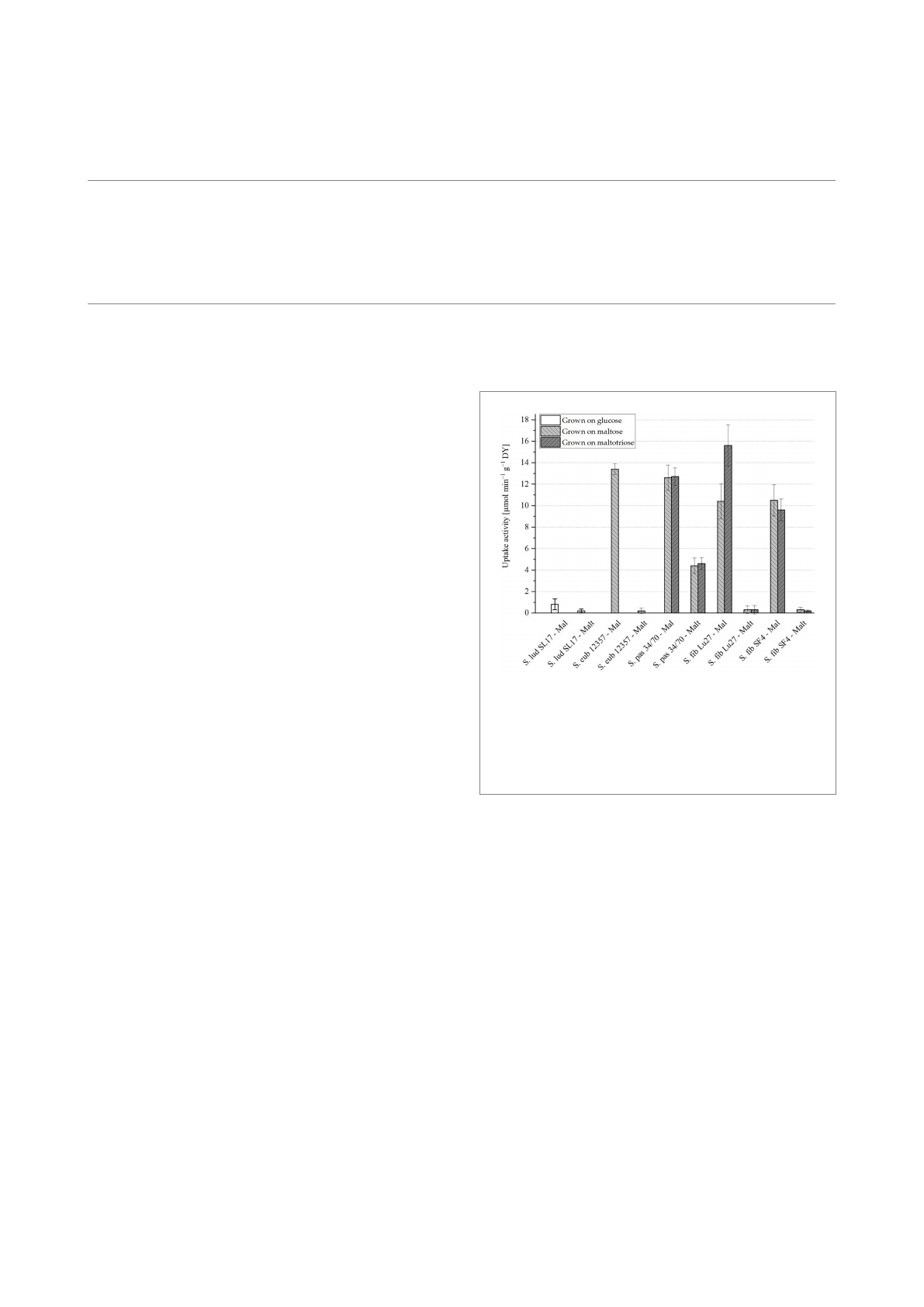
uptake activity are presented in Figure1, respectively. Raw data
can befound in the Supplementary material Table1.
S. ludwigii S. lud SL17 maltose uptake activity was just above
the limit at 0.8 μmol min−1g−1 DY but not significantly (standard
deviation of ±0.51; cf. Figure1). This strain is known to bemaltose
negative and the higher measured value is likely a result of
experimental variability. Maltotriose activity was, however, clearly
below the minimum activity required (cf. Figure1). S. eubayanus
S. eub 12357, as expected, showed high maltose uptake activity
and no maltotriose uptake activity. The strain S. pas 34/70 had
maltose uptake activity comparable to that of S. eub 12357 and it
was the only strain with maltotriose uptake activity significantly
above 0.5 μmol min−1g−1 DY. Growth on maltose or maltotriose
generally did not seem to affect the uptake activity of either sugar.
The only exception was S. fib Lu27, which had 50% higher maltose
uptake activity when grown on maltotriose. Otherwise, the
S. fibuligera strains S. fib Lu27 and S. fib SF4 showed very similar
behavior. Maltose uptake activity was lower but still comparable
to that of S. eub 12357 and S. pas 34/70. Maltotriose activity was
below 0.5 μmol min−1g−1 DY for both strains irrespective of the
sugar used. However, the error is quite high, particularly for S. fib
Lu27. This can partly be explained by the difficulty of
homogenizing cells with filamentous growth. This created
challenges for the uptake experiments and the measurement of
cell mass. Regardless, the results strongly suggest that S. fibuligera
does not have any significantly active transporters able to take up
maltotriose into the cells. Maltotriose utilization is therefore
TABLE3 Analytical methods of the wort and the beers according to MEBAKa and Donhauser etal.b.
Analysis Method Device
Original gravity, apparent attenuation, ethanol content MEBAKa WBBM 2.9.6.3 Bending vibration and NIR spectroscopy, Alcolyzer Plus with DMA 5000 X
sample 122 (Anton-Paar GmbH, Ostfildern, Germany)
pH value MEBAKa WBBM 2.13 pH meter with pH electrode, ProfiLine pH3210 pH meter (Xylem Inc.,
NewYork, NY, UnitedStates)
Sugar composition (glucose, fructose, sucrose, maltose,
maltotriose)
Donhauser etal.b LS-HPLC 002_2 HPLC UltiMate 3000 (Thermo Fisher Scientific, Waltham, MA, United
States)
aMEBAK® (2012), Editor: Dr. F. Jacob: The MEBAK collection of brewing analysis methods: Wort, beer and beer-based beverages. Collection of methods of the Mitteleuropäischen
Brautechnischen Analysenkommission. Self-published by MEBAK.
bDonhauser, S.; Wagner, D. (1990): Zucker- und Endvergärungsgradbestimmung mittels der HPLC, 9:306–309. Monatsschrift für Brauwissenschaft.
FIGURE1
Zero-trans rates of maltose (Mal) and maltotriose (Malt) uptake
activity (μmol min−1g−1 dry yeast (DY)) measured at 20°C for cells
propagated on glucose (white), maltose (light grey) or maltotriose
(dark grey) with n = 4. An uptake activity equal or below 0.5 μmol
min−1g−1 DY is considered negligible. Yeast strain abbreviations
according to Table1.
Loading more pages...