
Citation: Baumgarten, R.; Ingale, P.;
Knemeyer, K.; Naumann
d’Alnoncourt, R.; Driess, M.;
Rosowski, F. Synthesis of High
Surface Area—Group 13—Metal
Oxides via Atomic Layer Deposition
on Mesoporous Silica. Nanomaterials
2022,12, 1458. https://doi.org/
10.3390/nano12091458
Received: 29 March 2022
Accepted: 21 April 2022
Published: 25 April 2022
Publisher’s Note: MDPI stays neutral
with regard to jurisdictional claims in
published maps and institutional affil-
iations.
Copyright: © 2022 by the authors.
Licensee MDPI, Basel, Switzerland.
This article is an open access article
distributed under the terms and
conditions of the Creative Commons
Attribution (CC BY) license (https://
creativecommons.org/licenses/by/
4.0/).
nanomaterials
Article
Synthesis of High Surface Area—Group 13—Metal Oxides via
Atomic Layer Deposition on Mesoporous Silica
Robert Baumgarten 1, Piyush Ingale 1, Kristian Knemeyer 1, Raoul Naumann d’Alnoncourt 1,* ,
Matthias Driess 1,2 and Frank Rosowski 1,3
1BasCat—UniCat BASF JointLab, Technische Universität Berlin, Hardenberstraße 36, 10623 Berlin, Germany;
2Institut für Chemie: Metallorganik und Anorganische Materialien, Technische Universität Berlin, Straße des
17. Juni 135, 10623 Berlin, Germany
3
Process Research and Chemical Engineering, BASF SE, Carl-Bosch-Straße 38, 67056 Ludwigshafen, Germany
*Correspondence: r[email protected]; Tel.: +49-30-314-73683
Abstract:
The atomic layer deposition of gallium and indium oxide was investigated on mesoporous
silica powder and compared to the related aluminum oxide process. The respective oxide (GaO
x
,
InO
x
) was deposited using sequential dosing of trimethylgallium or trimethylindium and water
at 150
◦
C. In-situ thermogravimetry provided direct insight into the growth rates and deposition
behavior. The highly amorphous and well-dispersed nature of the oxides was shown by XRD and
STEM EDX-mappings. N
2
sorption analysis revealed that both ALD processes resulted in high
specific surface areas while maintaining the pore structure. The stoichiometry of GaO
x
and InO
x
was
suggested by thermogravimetry and confirmed by XPS. FTIR and solid-state NMR were conducted
to investigate the ligand deposition behavior and thermogravimetric data helped estimate the layer
thicknesses. Finally, this study provides a deeper understanding of ALD on powder substrates and
enables the precise synthesis of high surface area metal oxides for catalytic applications.
Keywords:
atomic layer deposition; thermogravimetry; metal oxides; Ga
2
O
3
; In
2
O
3
; trimethylgal-
lium; trimethylindium; high surface area; mesoporous silica
1. Introduction
Group 13 metal oxides (e.g., Al
2
O
3
, Ga
2
O
3
, and In
2
O
3
) possess key properties for a
broad range of applications such as semiconductors, optoelectronics, and catalysts. Alu-
minum oxide is used as an insulator in gate transistors [
1
], as inert fillers [
2
], and as
ceramics due to its firmness [
3
]. Gallium oxide can be applied as oxygen-gas sensors [
4
],
as surface passivation of solar cells [
5
], and in electroluminescent devices [
6
]. Because of
its high optical transparency and electric properties, indium oxide is used in numerous
optoelectronic applications such as photovoltaics [
7
], light-emitting diodes [
8
], and modern
displays [9].
In addition to electronic applications, group 13 metal oxides are crucial components
of heterogeneous catalysts. Al
2
O
3
acts as a typical catalyst support, for example in Pt-
Sn/Al
2
O
3
which is employed industrially for the dehydrogenation of propane [
10
]. Ga
2
O
3
has been studied for the dehydrogenation of light alkanes such as propane. Moreover,
In
2
O
3
-based catalysts have received tremendous attention due to their ability to convert
CO
2
-rich syngas into methanol [
11
,
12
]. Especially in heterogeneous catalysis, most of the
reactions take place at active sites on the material’s surface. Therefore, a high surface
area and homogeneous dispersion of deposited interfaces (e.g., metal oxides) are vital for
enhanced activity [13].
The native bulk oxides of gallium and indium exhibit specific surface areas below
120 m
2
/g [
12
,
14
,
15
]. In order to increase the surface areas for catalytic applications, the
Nanomaterials 2022,12, 1458. https://doi.org/10.3390/nano12091458 https://www.mdpi.com/journal/nanomaterials

Nanomaterials 2022,12, 1458 2 of 19
oxides can be deposited on a carrier material such as porous silica, alumina, and carbon with
up to 600 m
2
/g [
16
,
17
]. One well-established tool for the deposition of uniform, nanoscale
films is atomic layer deposition (ALD). This technique follows sequential reactions of a
gaseous precursor and a reactant with the terminal groups of a material’s surface, growing
one sub-monolayer per cycle (ca. 1 Å) [
18
]. One of the most commonly studied materials
grown by ALD is Al
2
O
3
, using trimethylaluminum (TMA) and water as a precursor-reactant
combination [
19
]. Alumina can be deposited on substrates with various topographies such
as flat silicon wafers for passivation [
20
], electrodes for enhanced cyclability [
21
], and even
polymers [22].
Since ALD is applicable to materials with different topographies, it progressively
gained recognition in heterogeneous catalysis [
23
,
24
]. It was also investigated as a synthesis
tool for the precise deposition of active metals [
25
,
26
] or metal oxides [
27
–
29
]. For instance,
alumina overcoating on a Pt/Al
2
O
3
catalyst was shown to prevent the sintering of Pt
during propane dehydrogenation (PDH) [
30
]. Additionally, an alucone layer on Ni/SiO
2
prevented unwanted carbon formation under dry reforming conditions [
31
]. Further, ZnO
ALD was applied to synthesize PDH-active Pt
1
Zn
1
nano-alloys [
32
]. Thereby, SiO
2
was
used as a carrier material for the ZnO ALD layer to increase the specific surface area up to
400 m
2
/g. Although AlO
x
ALD is widely applied in catalyst research, synthesis strategies
employing ALD of the other group 13 oxides (e.g., GaO
x
and InO
x
) are seldom investigated.
Yet, there are some examples such as the usage of GaO
x
ALD to introduce acid sites on
zeolites [
28
] or the application of InO
x
ALD to grow an In
2
O
3
layer over Pt/Al
2
O
3
as an
efficient PDH catalyst [29].
To date, published studies on the deposition behavior of GaO
x
or InO
x
ALD on
powder substrates are limited, especially with regard to higher surface area and porous
structure [
33
]. On flat substrates, however, different precursor-reactant combinations
were studied for the deposition of GaO
x
such as GaMe
3
/O
2
-plasma [
34
–
37
], GaEt
3
/O
2
-
plasma [
38
,
39
], Ga(
i
OPr)
3
/H
2
O [
40
], Ga(CpMe
5
)/ O
2
+ H
2
O [
41
], and [Ga(NMe
2
)
3
]
2
/O
2
-
plasma [
42
]. Yet, all of them aimed for coatings of Si-wafer, fused silica, or SiO
2
terminated
Si, focusing for example on electronic applications such as thin-film transistors [
43
]. The
same accounts for InO
x
ALD investigations on flat substrates which comprise the usage
of numerous combinations such as InCl
3
/H
2
O [
44
], InMe
3
/(H
2
O or O
2
-plasma) [
45
–
48
],
InEt3/O2-plasma [39], InCp/O2+ H2O [49,50], and others [46,51–58].
The consensus of the studies collected above is that water as an oxygen source, espe-
cially in combination with GaMe
3
, leads to low growth rates due to the insufficient removal
of methyl ligands [
35
]. Similar conclusions were made for the combination of InMe
3
and
water [
47
]. Nevertheless, Kim et al. [
45
] found that a longer Langmuir exposure of H
2
O
(ca. 2 Torr·s) enabled the complete exchange of methyl groups, yielding In2O3with linear
growth per cycle (gpc). These findings can be rationalized by high activation barriers to
remove the methyl group through water (E
a
(Ga-CH
3
) = 151.0 and (In-CH
3
) = 169.8 kJ/mol),
calculated by Shong et al. [
59
]. Insufficient ligand removal can be overcome by the usage of
reactants with higher oxidation potential such as O
2
-plasma [
47
]. However, plasma has the
drawback of swift recombination on larger steel set-ups [
60
,
61
] and might lead to unwanted
changes in the surface morphology of the substrate [
62
]. In addition to ALD, metal organic
chemical vapor deposition (MOCVD) was used to synthesize defined layers of indium
oxides. For example, Kakanakova-Georgieva et al. managed to stabilize two-dimensional
(2D) layers of InO between graphene and Si/C via MOCVD of InMe
3
[
63
]. Hereby, DFT
calculations were applied to investigate bonding and structure particularities, revealing
a sequence of O-In-In-O for the 2D InO quadruple layer [
64
]. However, on amorphous
silica, the formation of highly ordered oxides is unlikely as the surface structure is far more
complex than ordered Si/C.
In order to use the full potential of ALD for the modification of porous substrates,
deeper knowledge about the deposition mechanisms on powders is essential. Additionally,
ALD on powders demands different process parameters which are less relevant for the
coating of flat substrates [
65
,
66
]. For instance, diffusion limitations in the pores and

Nanomaterials 2022,12, 1458 3 of 19
high surface areas (100–500 m
2
/g) require different reactor geometries and longer dosing
times [
66
,
67
]. Fixed- or fluidized-bed reactors were shown to be convenient, however, they
cannot accommodate spectroscopic ellipsometry or a quartz crystal microbalance (QCM)
for in-situ monitoring. Therefore, ALD processes on powders such as AlO
x
/SiO
2
[
68
],
ZnO/SiO
2
[
67
], and PO
x
/V
2
O
5
[
69
] were studied using a magnetic suspension balance for
in-situ thermogravimetric analysis [
70
]. In the current study, we progressed with detailed
investigations of the ALD growth behavior of gallium and indium oxides on mesoporous
silica powder as a model system. The respective oxide was deposited with up to three
cycles by the sequential dosing of trimethylgallium (TMG)/H
2
O and trimethylindium
(TMI)/H2O at 150 ◦C.
2. Materials and Methods
2.1. Materials
Silica powder (SiO
2
amorphous,
≥
99%, high-purity grade (Davisil Grade 636), average
pore size 60 Å, particle size 250–500
µ
m, specific surface area 505 m
2
/g, Sigma-Aldrich,
St. Louis, MO, UAS) was used as a substrate for atomic layer deposition. Trimethyla-
luminium (Al(CH
3
)
3
, TMA, elec. grade (99.999%—Al)), Trimethylgallium (Ga(CH
3
)
3
,
TMG, elec. grade (99.999%—Ga)), and Trimethylindium (In(CH
3
)
3
, TMI, elec. grade
(99.999%—In)) (Strem Chemicals Europe, Bischheim, France) were employed as atomic
layer deposition precursors. Water (H
2
O, CHROMASOLV
®
, for HPLC, Riedel-de Haën/
Honeywell Specialty Chemicals Seelze GmbH, Seelze, Germany) served as a reactant and
was used without further purification. High purity argon (Ar, 99.999%) was used as a
carrier and purging gas.
2.2. Atomic Layer Deposition of GaOxand InOxon SiO2
Initially, the deposition behavior was examined in a magnetic suspension balance
(MSB) for in-situ monitoring of mass changes (marked with MSB or in-situ). Afterward,
the developed processes were scaled up in a quartz tube fixed bed reactor, producing up
to 20 mL of ALD-modified material for ex-situ analysis. Both self-build setups possess
fixed bed geometry operating at atmospheric pressure with top-to-bottom flow, as further
described elsewhere [
70
]. In the MSB, GaO
x
, and InO
x
ALD was carried out under a
constant flow of 50 mL/min containing precursor or reactant diluted in argon. For each
cycle, reactants were dosed until no further mass change was detected to ensure saturation.
The same procedure accounted for intermediate purging steps to ensure the removal of
gaseous precursors. For the larger fixed bed reactor (FB), a continuous flow of 100 mL/min
was applied and saturation of the precursor was determined by an online quadrupole
mass spectrometer (Pfeiffer Vacuum, Asslar, Germany). The point of saturation is reached
once a constant ion current of unreacted precursor ions is measured in the MS shortly
after the signal breakthrough (TMG: 69 m/zfor Ga* and TMI: 115 m/zfor In*), similar
to previously described [
67
]. The precursor chamber of TMG was kept at RT and TMI at
80
◦
C while the reactors were maintained at 150
◦
C. For both oxides, three cycles were
performed employing an ALD-sequence (cycle) of TMX/Ar-purge/H
2
O/Ar-purge on
dried silica powder.
2.3. Characterization of the Materials
Nitrogen physisorption measurements were performed at liquid N
2
temperature
(77 K) using a Quadrasorb SI (Quantachrome GmbH & Co. KG, Odelzhausen, Germany).
Prior to measurements, the samples were degassed at 150
◦
C for 2 h. The specific surface
areas were determined applying the B.E.T. method (Brunauer–Emmett–Teller) and the
corresponding pore size distribution was calculated from the desorption branches using
the B.J.H. method (Barrett–Joyner–Halenda). Powder X-ray diffraction (XRD) patterns were
acquired with an X‘PERT Pro (PANalytical, Malvern, UK) equipped with a scintillation
detector, using Cu K
α
1 radiation (
λ
= 0.154 nm). Inductively coupled plasma optical
emission spectrometry (ICP-OES) was employed to determine In and Ga contents and

Nanomaterials 2022,12, 1458 4 of 19
measured on a Varian 720-ES (Varian Inc., Palo Alto, CA, USA). Solutions from the powder
were prepared via acidic leaching. Respective metals were detached from silica in a
sealed container using saturated hydrochloric acid (35%) at 120
◦
C. The spectroscope
was three-point calibrated with a commercially available, diluted standard for In and Ga.
Mass fractions of carbon, hydrogen, nitrogen, and sulfur were determined by combustion
analysis (CHN), executed on a EuroEA Elemental Analyzer (HEKAtech GmbH, Wegberg,
Germany). FT-IR spectroscopy was measured in transmission (4000–400 cm
−1
) on a Bruker
ALPHA FT-IR spectrometer inside a glove box. Samples were diluted with KBr, ground in
a mortar, and pressed into pellets. Prior to preparation, samples were dried at 130
◦
C for
3 h and transferred into the glovebox. Spectra were collected as data point tables by the
usage of OPUS (Bruker, Billerica, MA, USA). Solid-state (SS) nuclear magnetic resonance
(NMR) spectra were recorded with a Bruker Avance 400 MHz spectrometer operating at
100.56 MHz for
13
C and 79.44 MHz for
29
Si. High-power decoupled (HPDEC)
13
C and
29
Si
cross-polarization magic angle spinning (CP/MAS) NMR experiments were carried out at
a MAS rate of 10 kHz, contact time of 2.0 ms, and a recycle delay of 2 s, using a 4 mm MAS
HX double-resonance probe. Spectra are referenced to those of external tetramethylsilane
(TMS) at 0 ppm for
13
C and
29
Si, using adamantane and tetrakis(trimethylsilyl)silane (TKS)
as secondary references, respectively. X-ray photoelectron spectroscopy (XPS) was carried
out on a K-Alpha
™
+ X-ray Photoelectron Spectrometer System (Thermo Fisher Scientific,
Waltham, MA, USA), equipped with a Hemispheric 180
◦
dual-focus analyzer connected to
a 128-channel detector. The X-ray monochromator applies micro-focused Al
−
K
α
radiation.
The as-prepared samples were loaded directly on the sample holder for measurement. Data
were collected with an X-ray spot size of 200
µ
m, 20 scans for the survey, and 50 scans
for regions. Binding energy surveys were calibrated according to the C1s orbital fixed at
284.8 eV. Scanning transmission electron microscopy (STEM) was performed on an FEI
Talos F200X (Thermo Fisher Scientific, Waltham, MA, USA) with an XFEG field emission
gun and acceleration voltage of 200 kV. Energy-dispersive X-ray (EDX) mappings were
recorded with a SuperX system of four SDD EDX detectors (Analysis software: Velox
2.9.0 by Thermo Fisher Scientific, Waltham MA, USA). The surface density of OH groups
was determined via a Grignard titration method described in detail elsewhere [
71
]. A
j-young NMR tube was loaded with ca. 20 mg of SiO
2
(dried at 150
◦
C), ferrocene, and
self-synthesized Mg(CH
2
Ph)
2·
2(THF) as Grignard reagent (mass-ratio ca. 3:1:5) inside a
glovebox. The solid mixture was suspended in benzen-d6 and the NMR tube was sealed
and shaken to let the reagents react with the OH-groups of SiO
2
.
1
H NMR spectra were
measured on a Bruker Avance II 200 MHz spectrometer (Bruker BioSpin MRI GmbH,
Ettlingen, Germany). The total number of OH-sites was determined by calculating the
number of moles of toluene produced (based on its methyl group peak integral at 2.1 ppm)
using ferrocene as an internal standard.
3. Results
3.1. In-Situ Thermogravimetric Analysis
Deposition of GaO
x
and InO
x
was carried out on mesoporous SiO
2
using the ALD
processes of TMG/H
2
O and TMI/H
2
O at 150
◦
C. The mass change during ALD was
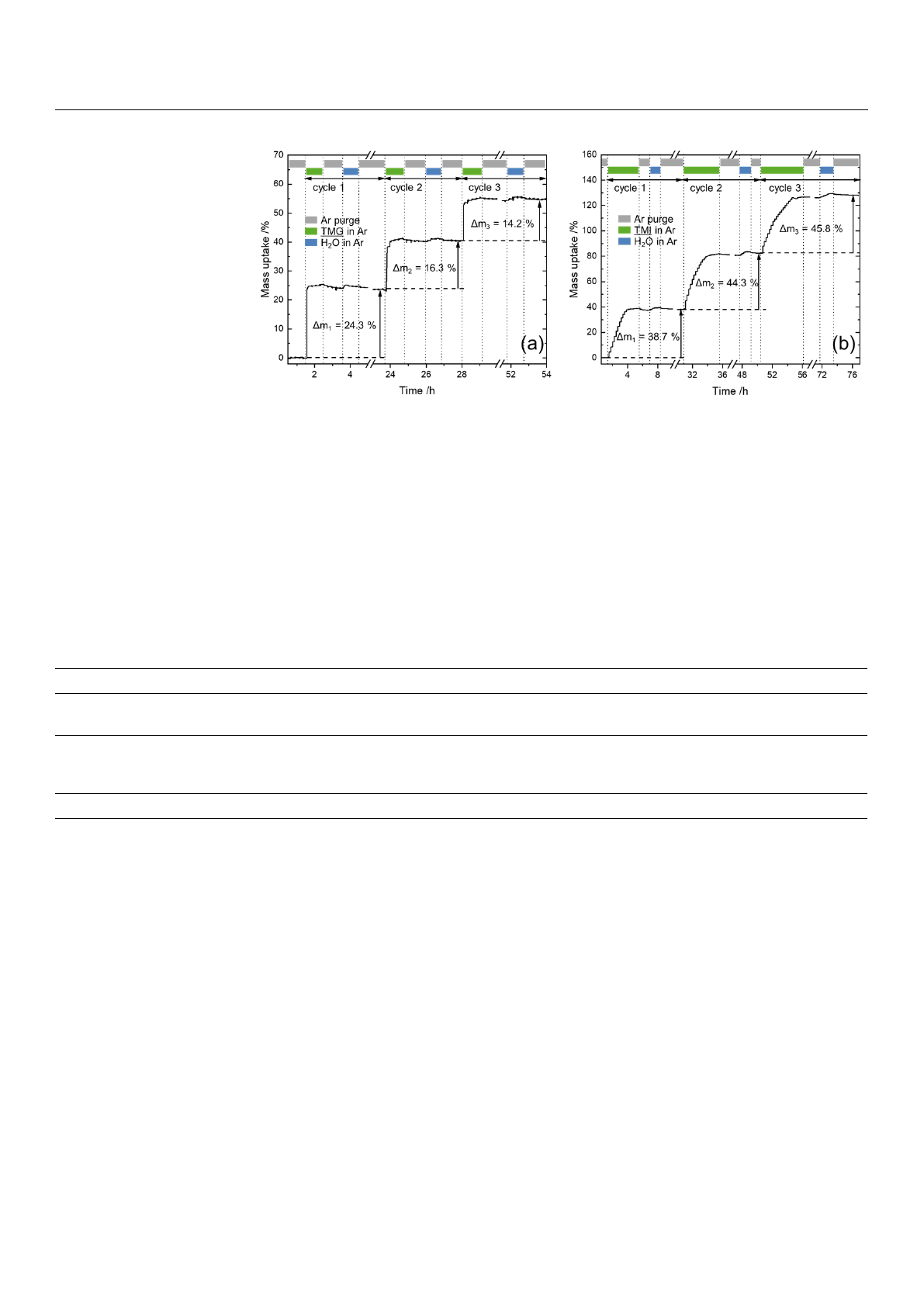
monitored using an in-situ magnetic suspension balance (MSB, Figure 1). Both ALD
processes showed self-limitation for all first half-cycles when the precursor is dosed as well
as during the ligand removal steps in the second half-cycles, representing ALD growth
behavior. In the case of GaO
x
ALD, self-limitation of precursor chemisorption was reached
within minutes, as for InO
x
, the first half-cycles extended over two hours. This can be
rationalized by the three times higher vapor pressure of the gallium precursor under our
conditions (TMG
300K
= 327 mbar [
72
] and TMI
353K
= 107 mbar [
73
]). Subsequently, the
slight increase in mass during the second half-cycles relates to the exchange of the methyl
group (15 g/mol) by the heavier OH-groups (17 g/mol) introduced by water.
Nanomaterials 2022,12, 1458 5 of 19
Nanomaterials 2022, 11, x FOR PEER REVIEW 5 of 19
in mass during the second half-cycles relates to the exchange of the methyl group (15
g/mol) by the heavier OH-groups (17 g/mol) introduced by water.
Figure 1. In-situ gravimetric monitoring of (a) GaOx ALD and (b) InOx ALD on SiO2 powder at 150°C
using the ALD processes of TMG/H2O and TMI/H2O, respectively. Mass-uptake = ∆m/m0.
In the following, the trend of growth is discussed based on the in-situ mass-uptake,
defined as the mass deposited by ALD divided by the initial mass of the support (Table
1). In the first full cycle, the GaOx ALD led to a mass-uptake of 24.3 wt% while the uptake
declined within the second and third cycles to 16.3 and 14.2 wt%. This indicates either a
substrate enhanced growth or incomplete ligand removal in the second half-cycles, as fur-
ther discussed in the following section.
Table 1. Mass uptakes, molar uptakes, and total mass fractions of AlOx, GaOx, and InOx on SiO2
during three cycles of ALD using TMX (X = A, G, I) and H2O at 150 °C (GaOx, InOx) or 200 °C (AlOx).
Mass-uptake = ∆m/m0; molar-uptake = est.-Mol(M2O3)/m0; mass-fraction (frac.) = ∆m/(m0 + ∆m).
AlOx/SiO2 [68]
GaOx/SiO2
InOx/SiO2
ALD
Cycles
Mass
Up./%
Molar
Up./mmol·g−1
Mass
Frac./%
Mass
Up./%
Molar Up.
/mmol·g−1
Mass
Frac./%
Mass
Up./%
Molar Up.
/mmol·g−1
Mass
Frac./%
1
+11.9
+1.0
10.6
+24.3
+1.0
19.6
+38.7
+1.0
27.9
2
+11.4
+1.0
18.9
+16.3
+0.8
28.9
+44.3
+1.1
45.4
3
+13.4
+1.2
26.9
+14.2
+0.7
35.4
+45.8
+1.1
56.3
Sum
+36.7
+3.2
26.9
+54.8
+2.5
35.4
+128.8
+3.2
56.3
Interestingly, Elam et al. observed a declining ALD growth of GaOx due to insuffi-
cient removal of methyl ligands using TMG/water above 200 °C [35]. Our in-situ gravi-
metric studies also indicated lower GaOx uptakes (−33%) after the first ALD cycles. How-
ever, the use of H2O as a reactant did not hinder distinct growth during subsequent cycles.
Moreover, a fourth cycle was conducted (Figure S1), resulting in uptakes of 13.4 wt% GaOx
being of the same order of magnitude as the third cycle (14.2 wt%). Therefore, incomplete
ligand removal does not necessarily translate to full inhibition of further growth.
In contrast, the InOx ALD led to a mass-uptake of 38.7 wt% in the first cycle and
increased to 44.3 and 45.8 wt% in the following cycles. Increased uptake at higher cycle
numbers hints at higher reactivity between the precursor and deposited oxides or a higher
abundance of OH-groups compared to SiO2. Elam et al. demonstrated poor nucleation
employing TMI/H2O in a quartz crystal microbalance and therefore proposed using O2-
plasma [47]. Nevertheless, our study clearly demonstrates the constant growth of InOx on
SiO2, indicating the suitability of H2O as a reactant. A similar observation was made by
Kim et al. for the deposition of InOx on a SiO2 terminated silicon flat substrate [45].
Figure 1.
In-situ gravimetric monitoring of (
a
) GaO
x
ALD and (
b
) InO
x
ALD on SiO
2
powder at
150
◦
C using the ALD processes of TMG/H
2
O and TMI/H
2
O, respectively. Mass-uptake =
∆
m/m
0
.
In the following, the trend of growth is discussed based on the in-situ mass-uptake,
defined as the mass deposited by ALD divided by the initial mass of the support (Table 1).
In the first full cycle, the GaO
x
ALD led to a mass-uptake of 24.3 wt% while the uptake
declined within the second and third cycles to 16.3 and 14.2 wt%. This indicates either
a substrate enhanced growth or incomplete ligand removal in the second half-cycles, as
further discussed in the following section.
Table 1.
Mass uptakes, molar uptakes, and total mass fractions of AlO
x
, GaO
x
, and InO
x
on SiO
2
during three cycles of ALD using TMX (X = A, G, I) and H
2
O at 150
◦
C (GaO
x
, InO
x
) or 200
◦
C (AlO
x
).
Mass-uptake =
∆
m/m
0
; molar-uptake = est.-Mol(M
2
O
3
)/m
0
; mass-fraction (frac.) =
∆
m/(m
0
+
∆
m).
AlOx/SiO2[68] GaOx/SiO2InOx/SiO2
ALD
Cycles
Mass
Up./%
Molar
Up./mmol·g−1Mass
Frac./%
Mass
Up./%
Molar Up.
/mmol·g−1Mass
Frac./%
Mass
Up./%
Molar Up.
/mmol·g−1Mass
Frac./%
1 +11.9 +1.0 10.6 +24.3 +1.0 19.6 +38.7 +1.0 27.9
2 +11.4 +1.0 18.9 +16.3 +0.8 28.9 +44.3 +1.1 45.4
3 +13.4 +1.2 26.9 +14.2 +0.7 35.4 +45.8 +1.1 56.3
Sum +36.7 +3.2 26.9 +54.8 +2.5 35.4 +128.8 +3.2 56.3
Interestingly, Elam et al. observed a declining ALD growth of GaO
x
due to insufficient
removal of methyl ligands using TMG/water above 200
◦
C [
35
]. Our in-situ gravimetric
studies also indicated lower GaO
x
uptakes (
−
33%) after the first ALD cycles. However,
the use of H
2
O as a reactant did not hinder distinct growth during subsequent cycles.
Moreover, a fourth cycle was conducted (Figure S1), resulting in uptakes of 13.4 wt% GaO
x
being of the same order of magnitude as the third cycle (14.2 wt%). Therefore, incomplete
ligand removal does not necessarily translate to full inhibition of further growth.
In contrast, the InO
x
ALD led to a mass-uptake of 38.7 wt% in the first cycle and
increased to 44.3 and 45.8 wt% in the following cycles. Increased uptake at higher cycle
numbers hints at higher reactivity between the precursor and deposited oxides or a higher
abundance of OH-groups compared to SiO
2
. Elam et al. demonstrated poor nucleation
employing TMI/H
2
O in a quartz crystal microbalance and therefore proposed using O
2
-
plasma [
47
]. Nevertheless, our study clearly demonstrates the constant growth of InO
x
on
SiO
2
, indicating the suitability of H
2
O as a reactant. A similar observation was made by
Kim et al. for the deposition of InOxon a SiO2terminated silicon flat substrate [45].
Under the rough assumption, that the deposited oxides have a stoichiometry of M
2
O
3
(M = Al, Ga or In), the molar uptakes per cycle were calculated based on the thermogravi-
metric data (Table 1). For each oxide and ALD cycle, the deposited moles of M
2
O
3
per gram
Loading more pages...