
Vol.:(0123456789)
https://doi.org/10.1007/s43615-022-00157-x
1 3
ORIGINAL PAPER
Assessment ofCritical Resource Use inAircraft
Manufacturing
IuliaDolganova1 · VanessaBach1 · AnneRödl2 · MartinKaltschmitt2 ·
MatthiasFinkbeiner1
Received: 8 September 2021 / Accepted: 13 January 2022 /
© The Author(s) 2022
Abstract
The global aircraft fleet has been expanding worldwide, leading to a high demand for
primary resources. Simultaneously, recycling initiatives for decommissioned aircraft are
still incipient. Following circular economy principles, the aims of this paper are to iden-
tify potentially critical resources used and related environmental impacts, to derive recom-
mendations regarding recycling, and to analyze the influence of increasing utilization of
lightweight composite materials in aircraft manufacturing. It was identified that the engine
is the structure containing resources with the highest scarcity, with tantalum dominating
seven of the eleven analyzed impact categories. Aluminum, titanium, and nickel were
shown to lead to the highest environmental impacts. Hotspots in the criticality and envi-
ronmental assessment often occur due to alloying resources with a low mass share. It was
shown that aluminum and steel alloy recycling should be prioritized. A higher lightweight
composite material share in the aircraft increases impacts in the categories climate change
and fossil resource depletion by 12% and 20%, respectively, whereas the impact of the cate-
gory acidification, political stability, and demand growth decreases by 16%, 35%, and 60%,
respectively.
Keywords Aircraft· Resources· ESSENZ· Criticality· Life cycle assessment
Introduction
The relevance of the air transportation sector has been increasing in the last decade, mainly
driven by factors such as low air fares and better living standards [1]. According to the
most recent forecasts, between 2017 and 2036, the number of airline passengers worldwide
is expected to grow by an average of 4.7% yearly [2]. By 2037, the annual number of pas-
sengers is predicted to reach up to 8.2 billion [3]. To satisfy this increasing demand, the
aircraft fleet will almost double in the next 20 years [4, 5].
* Vanessa Bach
vanessa.bac[email protected]
1 Technische Universität Berlin, Strasse des 17. Juni 135, 10623Berlin, Germany
2 Technische Universität Hamburg, Eissendorfer Strasse 40, 21073Hamburg, Germany
Circular Economy and Sustainability (2022) 2:1193
-
1212
Published online: 1 March 2022

Circular Economy and Sustainability (2022) 2:1193
-
1212
1 3
In the last 30 years, the primary resource demand rose worldwide by overall 50%
[6, 7] and is projected to more than double from 79 Gt/a in 2011 to 167 Gt in 2060,
whereas metals are expected to grow the fastest [8]. The global aerospace industry alone
consumes 770 kilo tons of resource per year [9]. Simultaneously, the topic of resources’
criticality has become more relevant in recent years due to limited availability of certain
resources. Criticality is defined as supply risk (probability of supply disruption) and the
vulnerability to this supply risk [10–12]. Several studies on country level (e.g., [13–16])
as well as product level (e.g., [12, 17–20]) including the mobility sector (e.g., [21–25])
have been carried out in recent years to assess resources’ criticality.
In this context, a circular economy approach is a precondition for achieving climate
neutral production processes. The concept of circular economy emerged in the last dec-
ade considering the scarcity of natural resources counterposed to the growing demand
for them due to, e.g., increasing population. While most of the studies apply this con-
cept for increasing the recycling or the reuse rate of products, a social dimension seems
to be missing [26]. The ESSENZ method, applied in this paper, addresses the criticality
of resources also incorporating societal aspects [27].
Usually, an aircraft is in operation for about 30 to 40 years. Considering the age of
the current aircraft fleet, about 18,000 passenger aircraft will be decommissioned in the
next 20 years [28]. Some aircrafts are used for spare parts, sold to developing countries
or eventually brought back to service in the case of an increased demand. Notably, the
most common practice for decommissioned aircraft is their disposal in deserts of former
airports—the so-called aircraft graveyards [29, 30], where they are simply parked for
an undefined time period. Even though some initiatives for aircraft recycling have been
already developed and partly implemented (e.g., PAMELA project) [31–33]), they are
still very incipient, also because there is no international regulation for the end-of-life
handling of aircraft.
As aircraft are composed of a number of different resources, including aluminum, tita-
nium, nickel, and steel alloys, which are easily recyclable [34], these aircraft graveyards
can be seen as a great source for secondary resources, especially considering that some
of these resources might become scarce in the next decades. Also, it was already dem-
onstrated that 80–85% of an aircraft’s weight could be recycled [32]. Thus, it should be
identified which resources to focus on for recycling to reduce overall criticality and envi-
ronmental impacts of the aircraft manufacturing.
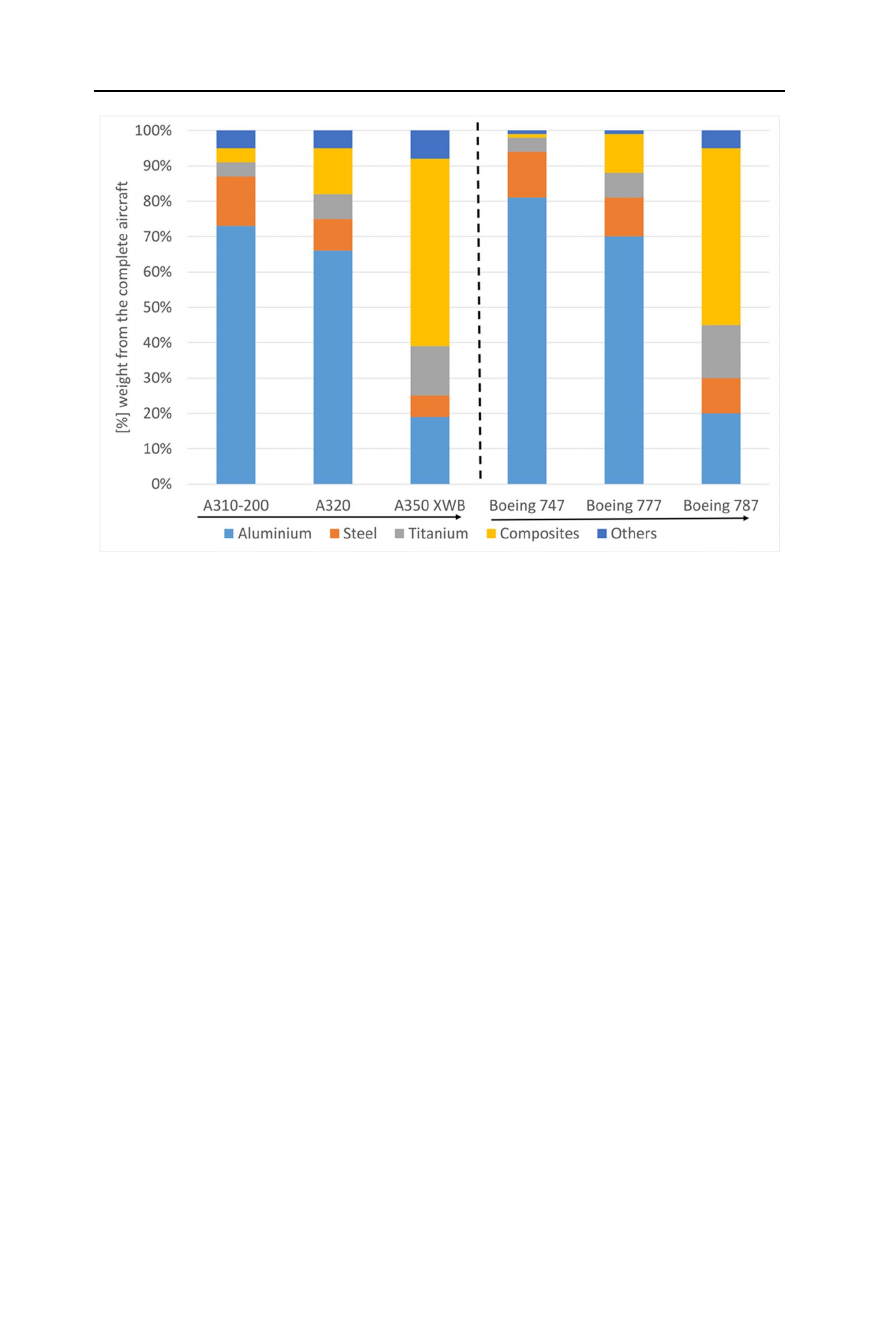
As shown in Fig.1, a new trend in the aircraft industry is the increased utilization of
lightweight composite materials, such as carbon fiber reinforced plastic (CFRP) or glass
fiber reinforced plastic (GFRP) [35, 36]. It is reported that the fuel use of aircraft with a
higher proportion of composites materials is around 25% lower than a reference aircraft
based mainly on aluminum parts [37]. Thus, the integration of composites materials in the
aircraft manufacturing may significantly reduce emissions throughout the operation phase
[38–40].
However, the resource use of aircraft during the production and recycling phases is not
fully addressed in these publications. As carbon fibers are mainly produced from fossil fuels,
their dependency on these resources is high. Methods for CFRP recycling are still under
development [39, 42, 43]. Currently, lightweight composite resources are more likely to be
landfilled or burnt than properly recycled [44–46]. Thus, a comprehensive assessment of envi-
ronmental impacts and criticality of composite materials considering current and future use
is also included in this paper. Overall, the aims of this paper are (i) to identify the most criti-
cal resources used in aircraft manufacturing applying the ESSENZ method [47, 48] —further
explained in background "ESSENZ Method" section—(ii) to determine the environmental
1194
Circular Economy and Sustainability (2022) 2:1193
-
1212
1 3
impacts of the manufacturing phase; (iii) to derive recommendations regarding recycling of
resources, and (iv) to analyze the influence of the increasing use of lightweight composite
materials and their impacts on resource criticality and the environment.
The Airbus A330-200 was selected as a reference aircraft, exemplary for the entire aircraft
which is a commercial passenger aircraft designed for medium to long-haul flights. Currently,
there are approximately 416 active A330-200 airplanes, and 199 are being stored [49]. The use
phase is not considered in this paper, although it has the largest environmental impact when
considering the entire life cycle of aircraft [44], and the use of fossil-based jet fuels is a hot-
spot in terms of resource use in general as well as critical resources. However, as the use phase
has these high impacts, the impacts of the manufacturing stage are comparably low. Thus, the
manufacturing phase is being disregarded by most of the authors. The focus of this paper is
deliberately on the manufacturing phase to identify hotspots only in this life cycle stage.
To achieve the aims of the paper, first the analyzed product system and the methodology
("Method") including the life cycle inventory are described. The results are presented for the
criticality assessment including long-term availability ("Criticality Assessment Including
Long-Term Availability"), environmental assessment ("Environmental Assessment"), recom-
mendations regarding recycling of resources ("Recommendations Regarding Recycling of
Resources"), and scenario analysis for increased use of lightweight composite information
("Scenario Analysis for Increased Use of Lightweight Composite Materials"). The underly-
ing assumptions of the case study are discussed ("Discussion"), and conclusions are drawn
("Conclusions").
Fig. 1 Material trends for Airbus and Boeing aircraft based on a comparison designed by Ilg (2015) [41],
showing the increasing share of composites materials in the most modern aircraft
1195

Circular Economy and Sustainability (2022) 2:1193
-
1212
1 3
Environmental andSocial Impact Evaluation ofAircraft Production inExisting
Literature
There are only few publications depicting the LCA of an aircraft in detail. This is
mainly due to the lack of public available data from aircraft manufacturers. In fact, only
one peer-reviewed paper performing a complete LCA of an aircraft was found [44] and
one from an aircraft’s wing [50], while the remaining works originate from theses and
reports [40, 45, 51, 52]. There are also a few available publications focusing on the
comparison between metallic alloys and lightweight materials from an environmental
point of view [38, 39, 53]. The social dimension of aircraft manufacturing has not been
discussed so far, affirming the assumption of Nikolaou etal. (2021) [26] that most of
engineering works tend to disregard it even in a context of sustainability assessment.
Howe et al. (2013) [54] conducted an LCA of A320 applying the Eco-Indicator
method, where manufacturing phase was found to contribute with 0.089% to the life
cycle. The main impact occurred mainly due to use of CFRP (responsible for 45% of
the total manufacturing impact). While evaluating an Airbus A320-200 with ReCiPe
Endpoint method, Johanning etal. (2013) [51] concluded that material production and
other manufacturing-related processes bore less than 1% of the total aggregated impact.
Both authors assumed that the aircraft was solely composed by aluminum, steel, tita-
nium composites, and miscellaneous (without specification of what “miscellaneous”
could mean). Jordão (2013) [52] have estimated only the embodied CO2-eq emissions,
concluding that aircraft manufacturing was responsible for 0.05% of the total life cycle
impact of an Airbus A330-200.
Lopes (2010) [45] conducted a comprehensive life cycle assessment with detailed data
for the manufacturing, operation, and recycling of an A330-200. Three methods were
applied: ReCiPe Midpoint, Cumulative Energy Demand [55], and Ecological Footprint
[56]. Also here, the impact from manufacturing in most of the categories was very small
(ca. 1·10-6%). Nevertheless, manufacturing was assessed in detail with ReCiPe midpoint
method, concluding that the structure engine emerges as having the largest contribution in
most of the categories. Wojcieh (2015) [40] used data obtained by Lopes (2010) [45], and
by applying selected categories from ReCiPe Midpoint (climate change, terrestrial acidifi-
cation, photochemical oxidant formation, particular matter formation) also obtained mar-
ginal contribution of the manufacturing phase.
Asmatulu etal. (2013) [42] and Ribeiro and Gomes (2014) [29] raised concerns about
end-of-life and recycling of aircraft and made recommendations on recycling options.
While Asmatulu etal. (2013) [42] focused on estimating energy savings from the use of
recycled materials, Ribeiro and Gomes (2014) [29] developed a conceptual framework for
integrating end-of-life (EoL) already in the preliminary design of the aircraft. Energy and
cost savings were the most important aspects of the framework.
ESSENZ Method
The integrated method to assess resource efficiency (herein referred to as ESSENZ) [47,
48] allows for a comprehensive assessment of resources use by addressing environmen-
tal impacts, criticality, and long-term availability of resources as well as societal aspects
of resource utilization. Further details are presented in the Supplementary Information
– Sect.1.
1196

Circular Economy and Sustainability (2022) 2:1193
-
1212
1 3
For measuring the long-term availability of resources, the abiotic depletion potential
(ADP) indicator based on ultimate reserves [57, 58] is applied. Criticality is assessed using
an approach developed for ESSENZ, which was identified as one of the best approaches to
address criticality aspects of products assessments [10, 59]. The following potential sup-
ply disruptions are considered in the method: concentration of production, reserves and
company concentration, feasibility of exploration projects, political stability, occurrence as
co-product, mining capacity, primary material use, demand growth, price fluctuations, and
trade barriers.
Societal impacts within the category societal acceptance are determined by two catego-
ries: compliance with social and environmental standards. As consumers and local commu-
nities become more interested in compliance with social and environmental standards, this
can become an additional constraint for companies when purchasing resources. For meas-
uring the category “Compliance with Social Standards”, child labor, high conflict zones,
and forced labor based on indicators of the Social Hotspot Database [60] are applied. The
indicator to measure the category “Compliance with Environmental Standards” is the
Environmental Performance Index (EPI) [61].
For the determination of environmental impacts, the life cycle impact assessment
method CML-IA [62] is applied for the impact categories acidification, eutrophication, cli-
mate change, and photochemical ozone creation.
Method
In the following, the product system, the corresponding system boundaries, and the
assumptions for the scenario with an increased share of lightweight composite materials
are presented.
The functional unit was defined as 1 (one) aircraft A330-200. The aircraft A330-200 has
been separated into six major structural components: wings, fuselage, vertical stabilizer,
horizontal stabilizer, landing gear, and engine. The aircraft A330-200 can operate with dif-
ferent engine types. As only data for the General Electric model CF6-80E1 are available
[45], this engine type is considered.
The weight of the aircraft is the manufacturer’s empty weight (MEW) as defined by
IVAO [63]. This includes the airframe structure and the engine, excluding the closed sys-
tem fluids as well as internal components of the aircraft such as textiles due do lacking
data. Electronic parts were examined only for the structure engine.
For determining the environmental impacts, the GaBi software with datasets of sphera
[64] and ecoinvent [65] was used. For the resource criticality assessment, only the bill of
materials (BoM) of which the aircraft is composed of has been taken into account.
The identification of the BoM of the product system is based on the work of Lopes [45],
as shown on Table1. As far as the authors are aware, no other data sources for aircraft are
available. However, to ensure that the applied data is adequate, the authors discussed the
BoM as well as some of the results with the major aircraft manufacturers that confirmed
that the overall data quality is fair to good. More information on the detailed alloys con-
sidered are presented in the Supplementary Information - Sect.2. Energy and water use for
the complete airplane production was retrieved from Spielmann etal. [66], where a similar
aircraft was analyzed.
As already shown in Fig.1, there is a trend to produce aircraft with an increasingly
higher share of composites. For the scenario presented in this paper, based on the example
1197
Loading more pages...