
brill.com/vjep
Transferring Ethnopharmacological Results
Back to Traditional Healers in Rural Indigenous
Communities – The Ugandan Greater Mpigi Region
Example
Research Translation
Fabien Schultz (corresponding author) | ORCID: 0000-0003-1904-2430
Institute of Biotechnology, Faculty III – Process Sciences, Technical
University of Berlin, Berlin, Germany
Department of Agriculture and Food Sciences, Neubrandenburg University
of Applied Sciences, Neubrandenburg, Germany
fabien.schultz@mailbox.tu-berlin.de
Inken Dworak-Schultz
ARUDEVO, Lwengo, Uganda
Alex Olengo
Department of Plant Sciences, Microbiology and Biotechnology,
Makerere University, Kampala,
Godwin Anywar | ORCID: 0000-0003-0926-1832
Department of Plant Sciences, Microbiology and Biotechnology,
Makerere University, Kampala, Uganda
Leif-Alexander Garbe
Department of Agriculture and Food Sciences, Neubrandenburg University
of Applied Sciences, Neubrandenburg, Germany
ZELT – Neubrandenburg Center for Nutrition and Food Technology gGmbH,
Neubrandenburg, Germany
Video Journal of Education and Pedagogy
(2021) 1-15
© Fabien Schultz et al., 2021 | doi:10.1163/23644583-bja10018
This is an open access article distributed under the terms of the CC BY 4.0 license.
Heruntergeladen von Brill.com11/02/2021 08:10:55AM
via free access
2
Abstract
In ethnopharmacology, scientists often survey indigenous communities to identify
and collect natural remedies such as medicinal plants that are yet to be investigated
pharmacologically in a laboratory setting. The Nagoya Protocol provided international
agreements on financial benefit sharing. However, what has yet only been poorly
defined in these agreements are the non-financial benefits for local intellectual
property right owners, such as traditional healers who originally provided the
respective ethnomedicinal information. Unfortunately, ethnopharmacologists still
rarely return to local communities. In this video article, the authors present a method
for transferring results back to traditional healers in rural indigenous communities,
taking the authors’ previous studies among 39 traditional healers in Uganda as an
example. The authors’ approach is based on a two-day workshop, and the results are
presented as original footage in the video article. The authors’ work demonstrated
a successful method for ensuring bidirectional benefit and communication while
fostering future scientific and community-work collaborations. The authors believe it
is the moral duty of ethnopharmacologists to contribute to knowledge transfer and
feedback once a study is completed. The workshop method, as an example for science
outreach, might also be regarded as a valuable contribution to research on education
theory and science communication.
Keywords
research translation – ethnopharmacology – traditional medicine – traditional healers
– workshop – Mpigi – transfer of results – Uganda – medicinal plants
Feature This article comprises a video, which can be viewed here.
10.1163/23644583-bja10018 | schultz et al.
Video Journal of Education and Pedagogy (2021) 1-15
Heruntergeladen von Brill.com11/02/2021 08:10:55AM
via free access

3
1 Introduction
Across the globe and throughout history, plants have been used by humans
as a source of medicine and natural remedies (Bussmann et al., 2018; Kigen
et al., 2019). The World Health Organization defines traditional medicine as
“the knowledge, skills and practices based on the theories, beliefs and experi-
ences indigenous to different cultures, used in the maintenance of health and
in the prevention, diagnosis, improvement or treatment of physical and men-
tal illness.” (who, 2019) Traditional medicine continues to be of great impor-
tance to all human beings (Yuan et al., 2016). In the developing world, over
80% of the population still relies on medicinal plants as their primary source
of healthcare (Bussmann et al., 2018; Kigen et al., 2019; F. Schultz et al., 2020;
who, 2010). Even in the modern Western pharmaceutical industry, traditional
medicine still plays a key role in drug discovery (Atanasov et al., 2015; Balunas
& Kinghorn, 2005; Heinrich et al., 2015; Porras et al., 2020; Fabien Schultz,
Godwin Anywar, Huaqiao Tang, et al., 2020). For instance, nearly 50% of all
drugs that are currently fda-approved in the US have been derived directly or
indirectly from natural sources (Li et al., 2019; Veeresham, 2012).
Here, the science of ethnopharmacology seeks to investigate the medic-
inal use of plants, animals, macrofungi, microorganisms, and minerals
through pharmacological, socio-cultural, and anthropological methods.
Ethnopharmacology is a highly interdisciplinary field of research (Heinrich,
2014; Heinrich & Jäger, 2015), encompassing a) field studies (such as ethno-
botanical studies in local communities, interviews, surveys, and the first
time documentation of medicinal use, ritual use, or religious aspects), b) the
pharmacological assessment of recorded and collected medicinal species in
a laboratory setting (so-called “bioactivity studies”), and c) drug discovery of
pharmacologically active natural products via pharmacognostic approaches.
These activities may be expanded to include community work, as we believe
ethnopharmacologists should also act as advocates for the respective indige-
nous communities with whom they collaborate.
Throughout history, the intellectual property rights of indigenous peoples
have not been recognized, and questions concerning the ownership of bio-
diversity following the development and commercialization of pharmaceu-
ticals have arisen. The Nagoya Protocol and the Convention on Biological
Diversity provided international agreements on financial benefit sharing and
recognized each nation’s sovereignty over the biodiversity resources within
its borders (Alexiades & Sheldon, 1996; Balick & Cox, 2020; Heinrich & Jäger,
2015; Heinrich et al., 2018). But what about non-monetary benefits? What
about the transfer of knowledge in both directions? Unfortunately, even today,
TRANSFERRING RESULTS BACK | 10.1163/23644583-bja10018
Video Journal of Education and Pedagogy (2021) 1-15
Heruntergeladen von Brill.com11/02/2021 08:10:55AM
via free access
4
ethnopharmacologists rarely return to the local communities after a study has
been completed and published (Maregesi et al., 2007; Fabien Schultz, Godwin
Anywar, Barbara Wack, et al., 2020). Thus, the successful collection of plant
samples and ethnopharmacological information from traditional healers and
other community members often marks the end point of this one-sided col-
laboration, despite the fact that this data will still be analyzed, interpreted, and
published (see Figure 1). This problem was previously addressed in a book by
Herman et al. (Herman et al., 2018).
Laboratory studies may follow, leading to unique significant discoveries that
would certainly be of interest to the local study participants and could even
empower them locally while fostering an equal partnership (Cordell, 1995;
Unander et al., 1995; Vandebroek et al., 2011). If the scientists ever return, then
in many cases it is only because of an entirely new study, aimed at extract-
ing new information for their research. We believe that ethnopharmacologists
therefore have the great responsibility of keeping this collaboration and the
communication with their local informants bidirectional. Information and
knowledge should be shared, creating a benefit for both the scientists and the
local study participants.
1.1 Previous Ethnopharmacological Studies
In this video article, we would like to introduce a method for transferring the
results of laboratory analyses and ethnobotanical surveys back to traditional
healers. Our approach is based on a two-day workshop, using our previous
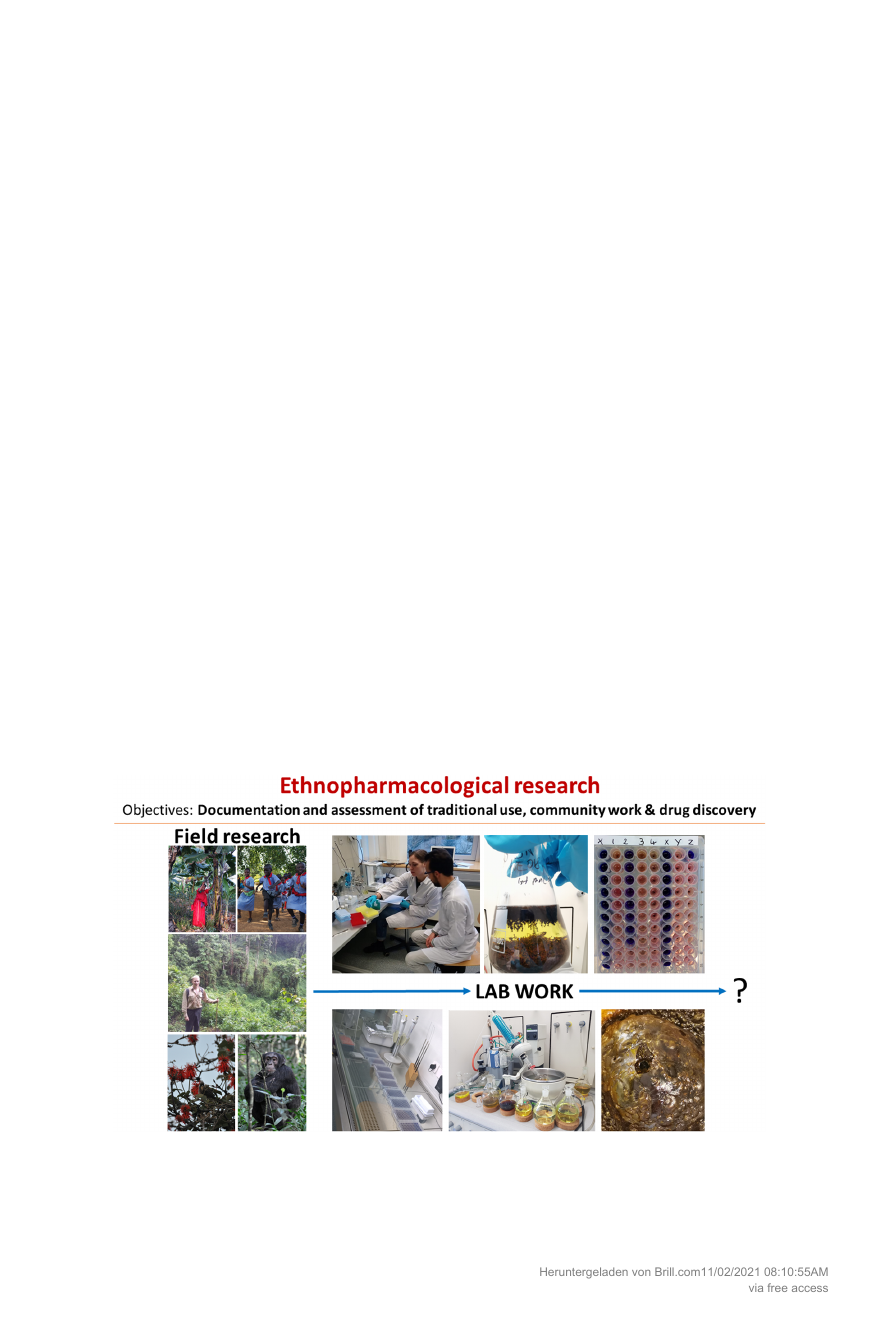
figure 1 Objectives of ethnopharmacological research, showing the fieldwork and
laboratory steps. But what comes next?
10.1163/23644583-bja10018 | schultz et al.
Video Journal of Education and Pedagogy (2021) 1-15
Heruntergeladen von Brill.com11/02/2021 08:10:55AM
via free access
5
studies from the Greater Mpigi region in Uganda as an example. A total of 16
medicinal plant species were investigated as part of an ethnobotanical survey
among 39 traditional healers from the Greater Mpigi region. This past study
has recently been published in the Journal of Ethnopharmacology (Fabien
Schultz, Godwin Anywar, Barbara Wack, et al., 2020). Traditional healers from
29 different villages, including one from a small island in Lake Victoria, were
interviewed. The study involved the first-time documentation of preparation
and administration methods and the identification of a total of 75 medical dis-
orders that are treated with these medicinal plants. In this study, information
was obtained using questionnaires that were specifically designed to collect
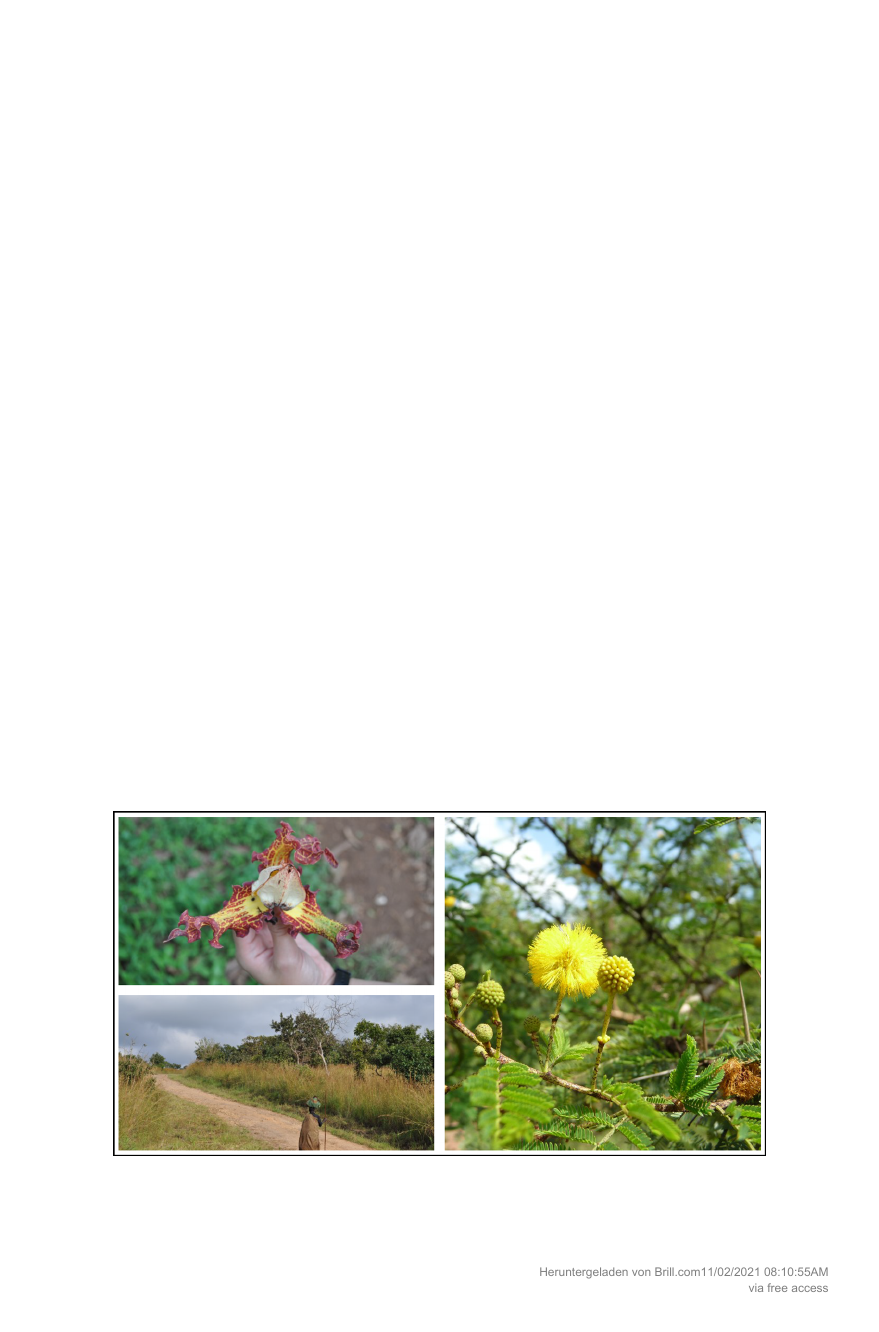
in-depth data on each species. Figure 2 shows three photographs from this
field study, giving examples of local plant diversity.
In another follow-up study that was published, we applied the Degrees of
Publication (DoP) method as a novel tool for literature assessment in ethno-
pharmacological research (F. Schultz et al., 2020). There are numerous field
assessment tools in use today. However, none of these tools are able to help
researchers determine which species merit the costly laboratory studies that
would be required for their further investigation, e.g., pharmacological assays
and the isolation of bioactive natural product compounds. The introduction
of the DoP method has filled this gap. In the context of the aforementioned
ethnobotanical survey, the DoP method made it possible to classify six of the
16 medicinal plant species as “highly understudied” and three as “understud-
ied.”(F. Schultz et al., 2020)
figure 2 Illustrations of Ugandan plant diversity and traditional African community life
TRANSFERRING RESULTS BACK | 10.1163/23644583-bja10018
Video Journal of Education and Pedagogy (2021) 1-15
Heruntergeladen von Brill.com11/02/2021 08:10:55AM
via free access
Loading more pages...