
Vol.:(0123456789)
Biodiversity and Conservation (2021) 30:2255–2266
https://doi.org/10.1007/s10531-021-02182-y
1 3
COMMENTARY
Reframing urban “wildlife” topromote inclusive conservation
science andpractice
MonikaEgerer1,2 · SaschaBuchholz2,3
Received: 17 October 2020 / Revised: 2 February 2021 / Accepted: 12 April 2021 / Published online: 19 April 2021
© The Author(s) 2021
Abstract
Cities are home to both a majority of the world’s human population, and to a diversity of
wildlife. Urban wildlife conservation research and policy has importantly furthered eco-
logical understanding and species protection in cities, while also leveraging wildlife con-
servation to connect people to urban nature. Thus, urban wildlife conservation intersects
conservation research, conservation policy, and the general public in cities worldwide. Yet,
species that are often framed as “urban wildlife” are often of higher trophic levels, includ-
ing birds and mammals that serve as “flagship” species for public support. Other forms of
urban life including plants and invertebrates are often largely ignored, producing a norma-
tive urban wildlife concept that may bias urban wildlife conservation research and policy,
and sentiment in the general public. To develop new strategies in urban wildlife conser-
vation for the urban era, we need to move towards a more inclusive and holistic framing
ofurban wildlife for bothresearch and the public. In this article, we discuss the normative
framing ofurban wildlife and how this framingmay bias urban conservation efforts, and
argue for a holistic approach to urban wildlifeinclusive of all life forms for future research,
publicity and policy interventions.
Keywords Conservation· Ecology· Human-wildlife interactions· Urban· Wildlife
Communicated by Dirk Sven Schmeller.
* Monika Egerer
Sascha Buchholz
sascha.buc[email protected]
1 School ofLife Sciences, Technical University ofMunich, Hans Carl-von-Carlowitz-Platz 2,
85354Freising, Germany
2 Department ofEcology, Technical University ofBerlin, 12165Berlin, Germany
3 Berlin-Brandenburg Institute ofAdvanced Biodiversity Research (BBIB), 14195Berlin, Germany

2256
Biodiversity and Conservation (2021) 30:2255–2266
1 3
Introduction
Many of the world’s growing cities are located in biodiversity rich areas, or “biodiver-
sity hotspots” (Ives etal. 2016). Rapid urbanization often drives declines of biodiversity
in many regions and has catalyzed wildlife conservation strategies and efforts designed
for cities. Most urban wildlife conservation efforts by researchers and policymakers focus
on charismatic species, specifically vertebrates. For example, urban conservation actions
include: protection of urban forest fragments, provision of green bridges and wildlife corri-
dors for birds and large carnivore populations (Riley etal. 2014); wildlife-friendly gardens
for hedgehogs and bats to ‘re-wild’ urban areas (Van Helden etal. 2020); and citizen sci-
ence urban wildlife conservation research programs monitor urban bird (e.g., ‘Celebrate
Urban Birds’ program) and wild fox populations (Scott etal. 2014). As such, these familiar
and charismatic fauna species of birds and mammals are often what people associate with
urban ‘wildlife’ conservation or management particularly among the general public. Why
are such vertebrate species framed as ‘urban wildlife’, while others including plants, fishes
and arthropod invertebrate species are rather framed and labeled as ‘urban biodiversity’?
What may this imply for invertebrate conservation if ‘urban wildlife’ serves as a synonym
for higher trophic level flagship species popular with the public?
Here, we question the normative framing of ’urban wildlife’ particularly in the con-
text of invertebrate conservation practice in cities. We focus specifically on urban wild-
life conservation because, as an emerging interdisciplinary field, conservation efforts and
programs are designed and implemented differently in cities to integrate people, the envi-
ronment, and their interactions (Shwartz et al. 2014). Urban wildlife conservation faces
unique challenges arising from the spatial heterogeneity of urban ecosystems (e.g., extreme
habitat fragmentation and degradation) and environmental stressors (e.g., light pollution,
soil quality, transport infrastructure) combined with the social context around nature and
conservation in cities (e.g., loss of nature experience, people’s perceptions of and connec-
tion to nature, to wildlife; (Miller 2005)). Moreover, urban residents may be biased towards
certain facets of urban wildlife and their common perception of ecosystem service provi-
sion (Home etal. 2009). This can stifle comprehensive biodiversity conservation if people
are unwilling to support conservation efforts towards what they may not perceive as wild-
life (Soanes etal. 2019). It is within this context that we consider the potential impact of
a normative ‘urban wildlife’ framing for citizens, researchers or practitioners if—though
aims are shared (e.g., protecting biodiversity in urban environments; promoting ecosys-
tem function and services; fostering human-wildlife experiences in cities)—this may bias
urban conservation efforts (especially for invertebrates) with unforeseen consequences on
ecosystem-level conservation and ecosystem service provision.
What associates withurban “wildlife”?
Urban wildlife has its associations in scientific research and among the general pub-
lic. Academic and applied perspectives tend to focus predominantly on urban ‘wildlife’
as higher trophic level vertebrate populations including mammals and birds, while plants
and invertebrates are both largely ignored as urban ‘wildlife’ (Magle etal. 2012), or are
distinguished from urban wildlife (Adams 2005). In Magle and colleague’s search of the
literature using the word urban “wildlife”, less than 10% of recent papers included a study

2257
Biodiversity and Conservation (2021) 30:2255–2266
1 3
about plants or arthropods (Magle etal. 2012). This discrepancy is further highlighted in
our review of the recent literature of three high impact conservation journals (Conservation
Letters, Conservation Biology, and Conservation Science and Practice). A review of the
years 2019 and 2020 using ‘wildlife’ as a search term in any field identified 348 studies,
of which only six included arthropods. In an analysis of ten urban wildlife conservation
programs, only one included insects to a minimal extent (Bern, Switzerland: two species
out of 71 species in total). This is not to say that, for example, urban arthropod research
does not exist, as there are many arthropod studies in cities (Beninde etal. 2015; Fenoglio
etal. 2020). However, this framing in scientific research can shift the focus of conserva-
tion efforts or programs because arthropod research is in most cases not framed as wildlife
research. Moreover, in the 2019 Urban Wildlife Conference, most work continues to focus
on mammals and birds as focal species, with very few on invertebrates, including bees. The
oversight can create a gap or bias in scientific knowledge if literature searches and scien-
tific exchange focus on wildlife largely excluding invertebrates. Science mimics paradigms
in society and the general public of what is synonymous with ‘wildlife’: searching ‘urban
wildlife’ in Google Images similarly reveals only two of 300 photos with invertebrates.
A mammalian and bird focus in urban ‘wildlife’ research and practice follows academic
disciplinary traditions in wildlife conservation research where wild game management
laid the foundation for the discipline of urban wildlife ecology, conservation, and manage-
ment in the late 1960s and 1970s (Adams 2014). This set course for using the term wildlife
for animals that can be hunted, and while hunting game is uncommon in cities, the term
wildlife still seems to be used with traditional meaning. Yet, as defined by Cambridge,
“wildlife” should holistically consider “animals and plants that grow independently of peo-
ple, usually in natural conditions” (Cambridge Dictionary 2020). This English definition
translates similarly to “wildlife” definitions and concepts in many other languages, from
Portugese (vida selvage; “all plants, fungi and other organisms that grow or live wild in an
area without being introduced by humans”) to Chinese (野生动植物; “all kinds of undo-
mesticated animals that live in their natural state and have not been subjected to artificial
selection”) (Appendix 1). The urban environment inherently complicates these definitions
(i.e., what is ‘natural’ in cities). Yet in principle, urban wildlife should consider sponta-
neous unmaintained vegetation populating urban forest fragments harboring silvicolous
insects; unmanaged long-naturalized neophyte plants providing habitat for invertebrates in
urban dry grasslands; and wild pollinating insects roaming urban gardens and streetscapes.
All of these wild species are central agents to urban ecosystem function including nutrient
cycling, decomposition, and pollination. Moreover, city dwellers come into contact with
these lifeforms just as often, if not more, in their daily lives than with those lifeforms that
are currently emphasized as urban wildlife: most people likely encounter insects more fre-
quently than bats in cities. The emphasis of particular taxa within urban environments as
urban ‘wildlife’ opens a debate on how this framing may bias urban conservation research
and practice, especially against the background of an alarming worldwide insect crisis
(Hochkirch 2016) and the understanding that cities can be hotspots for threatened inverte-
brate species (Soanes and Lentini 2019).
We confront the focus on higher trophic levels and “mega-fauna” in the conceptualiza-
tion and application of the urban wildlife frame in scientific research but also in the general
public. This as a technically incorrect framing of what is actually ’wild’ life in cities. Stud-
ies on plants and invertebrates in urban areas have long contributed to our understanding
of the ecology of urban environments, the flora and fauna therein, and the important role
of such species for urban ecosystem function and services (Wu 2014). Why are such spe-
cies not necessarily framed as urban wildlife in the scientific community, but rather framed

2258
Biodiversity and Conservation (2021) 30:2255–2266
1 3
and labeled as ‘urban biodiversity’—which can be difficult to understand for some urban
residents, and not necessarily synonymous with ‘wildlife’ (Levé etal. 2019). What sense in
conservation research and practice does it make to label, for example, urban bats as ‘urban
wildlife’ but urban bumblebees as ‘urban biodiversity’? Both labels may evoke different
meanings to researchers and city residents, and how the public perceives a species can
largely affect what is considered acceptable in species management and conservation (van
Eeden etal. 2020). It is concerning that ’urban wildlife’ may not necessarily involve wild
plants or invertebrates in urban environments, with wildlife ecology historically separating
wildlife into “wildlife and plants” (Adams 2005). What are the conservationimplications
in policy and practice if ‘urban wildlife’, rather than biologically correct, serves as a syno-
nym for iconic flagship species popular with the general public? How will this influence
the acceptance of conservation programs in the general public?
Overlooking plants, invertebrates, amphibians, and lower trophic levels as urban wild-
life can influence public perception and public willingness to contribute to the conservation
of these taxa, with city dwellers more willing to protect charismatic megafauna flagship
species above all (Mesquita etal. 2014; Colléony etal. 2017; Curtin and Papworth 2020).
Although invertebrates are essential to urban ecosystem functioning (McIntyre 2000),
arthropods are often dismissed as harmful pests or a nuisance in cities—associated with
filth and sickness by residents—and not prioritized in urban wildlife conservation (Hunter
and Hunter 2008). Yet, because such trophic levels or dimensions of urban wildlife are
often what people experience daily, people may be more likely to value invertebrates and
plants in urban conservation efforts if such life forms are framed as urban wildlife. A shift
in perceptions, values, and norms around urban wildlife especially in publicity is critical for
urban invertebrate conservation to ultimately influence habitat management and urban con-
servation financial support (Schultz and Kaiser 2012). For example, insects that are “bug-
like” and less “human-like” are often perceived as less attractive, less worthy of rescue
than other animals among the general public (Cardoso etal. 2011; Mesquita etal. 2014),
and thereby receive less conservation funding (Curtin and Papworth 2020). How can we
shift negative perceptions of invertebrates among the general public to equally value such
creatures as ecosystem service providers, as they may for larger mammals or birds? What
is the conservation potential if spaces such as urban gardens can facilitate more positive,
and less negative interactions with less charismatic species?
This presents a new opportunity to rethink the urban wildlife framing in conservation
science, practice, and science-society interfaces. It is time for an inclusive framing of
urban wildlife, a holistic urban wildlife concept, to deepen the ecological understanding
of urban ecosystems, and to heighten society’s appreciation of all urban wildlife across
all life forms. An inclusive framing could best promote more diverse and holistic spe-
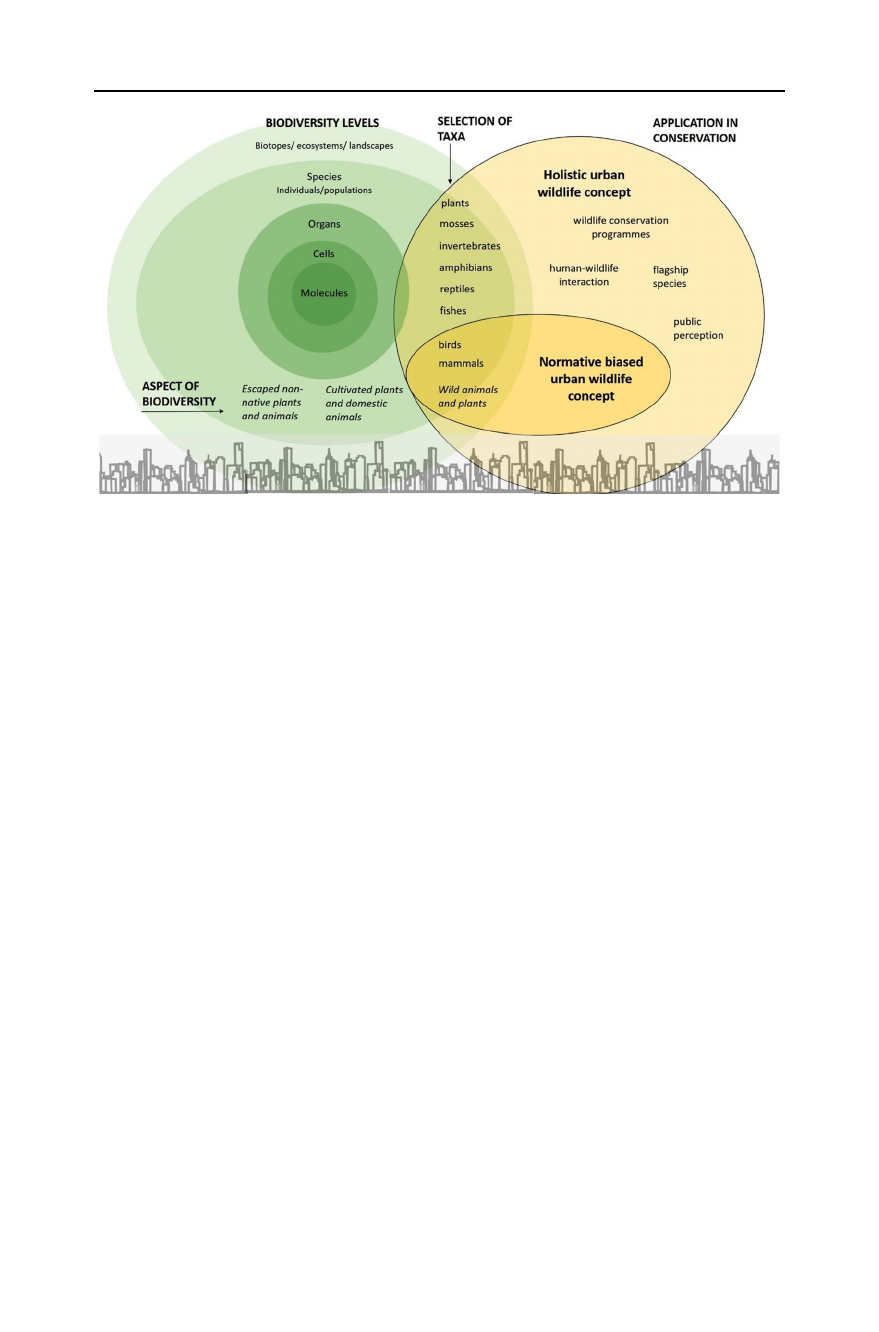
cies conservation and protection in cities. We frame urban wildlife to include all trophic
levels and life forms within urban ecosystems, from soil-dwelling organisms, inverte-
brates, small mammals, and large carnivores (Fig.1). Within this inclusive frame, urban
wildlife should, in principle, also encompass un-managed non-native neophyte species
long naturalized. What species we then deem of conservation concern and action can
then be in question for practitioners and policymakers (e.g., debates about conserving
non-natives). But painting a false image or perpetuating a normative narrative about
what comprises urban wildlife in research but more importantly also in the general pub-
lic can have adverse conservation outcomes if, for example, we neglect other trophic
levels and less charismatic species that are necessary for ecosystem functioning because
public support for targeted conservation is absent. An inclusive urban wildlife fram-
ing in public awareness campaigns is especially important in times of rapid invertebrate
2259
Biodiversity and Conservation (2021) 30:2255–2266
1 3
biodiversity loss, growing cities, and the heightening interest in and importance of
urban arthropod conservation This can be achieved, for example, through popular sci-
ence books and brochures that inspire the public about invertebrates and their ecological
importance, according to Heinz Sielmann’s motto "Only those who know nature will
protect it".
Some national-level wildlife organizations are beginning to explicitly recognize, for
example, native insect pollinators in their framing and programs, such as in the US (e.g.
the National Wildlife Foundation; https:// www. nwf. org/ Our- Work/ Wildl ife- Conse rvati on)
and in Europe (e.g. the German Wildlife Foundation; https:// www. deuts chewi ldtie rstif tung.
de/ wildt iere). Moreover, recent successful urban wildlife programs are using other trophic
level species as a “mascot” for their wildlife programs, with great potential to deconstruct
the image of wildlife as only birds and mammals within the general public. For exam-
ple, the German Wildlife Foundation is using bumblebees as flagship species. We need to
expand such inclusivity in urban conservation practice and policy across trophic levels and
life forms to appreciate and conserve wildlife within urban environments worldwide. This
includes going beyond including charismatic native bee and butterfly pollinators to elevate
plants, fishes, and even “creepy crawlies” like spiders both in conservation research and
science communication to the general public. Urban biodiversity conservation requires a
particular publicity approach because most urban dwellers have unique perspectives and
connections with nature (Berenguer etal. 2005). We provide three lines of evidence to sup-
port this argument.
Fig. 1 Although the basic unit of biodiversity is often the species, biologically speaking it consists of sev-
eral levels, from molecules to biotopes. In urban areas, species are therefore only one aspect of biodiversity,
but the essential benchmark for the wildlife concept. However, in both urban conservation research and
conservation policy the selection of relevant taxa is then determined by the underlying wildlife concept, and
whether we apply a biased wildlife framing or a holistic wildlife framing. This framing determines whether
we consider only a part of all wild living plants and animals or all of them. The framing in turn may affect
which taxa of biodiversity come into the focus of urban “wildlife” conservation programs, are selected as
flagship species, or are the subject of public perception
Loading more pages...