
Citation: Hörnschemeyer, B.;
Söfker-Rieniets, A.; Niesten, J.;
Arendt, R.; Kleckers, J.; Klemm, C.;
Stretz, C.J.; Reicher, C.;
Grimsehl-Schmitz, W.; Wirbals, D.;
et al. The ResourcePlan—An
Instrument for Resource-Efficient
Development of Urban
Neighborhoods. Sustainability 2022,
14, 1522. https://doi.org/10.3390/
su14031522
Academic Editors:
Thomas Luetzkendorf and
Rebekka Volk
Received: 17 December 2021
Accepted: 24 January 2022
Published: 28 January 2022
Publisher’s Note: MDPI stays neutral
with regard to jurisdictional claims in
published maps and institutional affil-
iations.
Copyright: © 2022 by the authors.
Licensee MDPI, Basel, Switzerland.
This article is an open access article
distributed under the terms and
conditions of the Creative Commons
Attribution (CC BY) license (https://
creativecommons.org/licenses/by/
4.0/).
sustainability
Article
The ResourcePlan—An Instrument for Resource-Efficient
Development of Urban Neighborhoods
Birgitta Hörnschemeyer 1,*, Anne Söfker-Rieniets 2, Jan Niesten 3, Rosalie Arendt 4, Jonas Kleckers 1,
Christian Klemm 5,6 , Celestin Julian Stretz 1, Christa Reicher 2, Winona Grimsehl-Schmitz 7, Daniel Wirbals 3,
Vanessa Bach 4, Matthias Finkbeiner 4, Jens Haberkamp 1, Janik Budde 5, Peter Vennemann 5,
Gotthard Walter 1, Sabine Flamme 1and Mathias Uhl 1
1Institute for Infrastructure Water Resources Environment, Muenster University of Applied Sciences,
48149 Muenster, Germany; kleckers@fh-muenster.de (J.K.); c.stretz@fh-muenster.de (C.J.S.);
haberkamp@fh-muenster.de (J.H.); gwalter@fh-muenster.de (G.W.); flamme@fh-muenster.de (S.F.);
uhl@fh-muenster.de (M.U.)
2Institute for Urban Design and European Urbanism, RWTH Aachen University, 52062 Aachen, Germany;
3Department of Environment and Urban Planning, City of Herne, 44652 Herne, Germany;
4
Department of Sustainable Engineering, Institute of Environmental Technology, Technische Universität Berlin,
[email protected] (M.F.)
5Department of Energy, Building Services and Environmental Engineering, Muenster University of Applied
Sciences, 48565 Steinfurt, Germany; christian.klemm@fh-muenster.de (C.K.);
janik.budde@fh-muenster.de (J.B.); vennemann@fh-muenster.de (P.V.)
6Department of Energy and Environmental Management, Europa-Universität Flensburg,
24943 Flensburg, Germany
7Department of Civil Engineering and Traffic, City of Herne, 44652 Herne, Germany;
*Correspondence: b.hoernschemeyer@fh-muenster.de
Abstract:
In Germany, the current sectoral urban planning often leads to inefficient use of resources,
partly because municipalities lack integrated planning instruments and argumentation strength
toward politics, investors, or citizens. The paper develops the ResourcePlan as (i) legal and (ii) a
planning instrument to support the efficient use of resources in urban neighborhoods. The integrative,
multi-methodological approach addresses the use of natural resources in the building and infrastruc-
tural sectors of (i) water (storm- and wastewater) management, (ii) construction and maintenance of
buildings and infrastructure, (iii) urban energy system planning, and (iv) land-use planning. First,
the development as legal instrument is carried out, providing (i) premises for integrating resource
protection at all legal levels and (ii) options for implementing the ResourcePlan within German
municipal structures. Second, the evaluation framework for resource efficiency of the urban neigh-
borhoods is set up for usage as a planning instrument. The framework provides a two-stage process
that runs through the phases of setting up and implementing the ResourcePlan. (Eco)system services
are evaluated as well as life cycle assessment and economic aspects. As a legal instrument, the
ResourcePlan integrates resource protection into municipal planning and decision-making processes.
The multi-methodological evaluation framework helps to assess inter-disciplinary resource efficiency,
supports the spatial identification of synergies and conflicting goals, and contributes to transparent,
resource-optimized planning decisions.
Keywords:
resource efficiency; resource management; urban neighborhood; urban planning; urban
development; Germany; water; building materials; energy; land
Sustainability 2022,14, 1522. https://doi.org/10.3390/su14031522 https://www.mdpi.com/journal/sustainability

Sustainability 2022,14, 1522 2 of 30
1. Introduction
Urbanization is the future mega-trend. The German Advisory Council on Global
Change identifies urbanization as one of the most outstanding challenges for social and
infrastructural development of present and future [
1
]. Although urbanization can increase
the inhabitant’s quality of live by, e.g., raising availability of health services or social and
infrastructural facilities [2,3], it can also bring environmental and social problems.
In 2005, the Millennium Ecosystem Assessment stated that “human activity is putting
such strain on the natural functions of earth that the ability of the planet’s ecosystems to
sustain future generations can no longer be taken for granted” [
4
]. The use and overuse
of natural resources such as water, raw materials, and land threaten the Earth system’s
resilient state [
5
,
6
]. Seto et al. [
7
] declare, “the conversion of earth’s land surface to urban
uses is one of the most irreversible human impacts on the global biosphere”. Covering
less than 3% of the global terrestrial surface [
8
], cities consume about 75% of the world’s
energy [
9
] and 60% of residential water resources [
8
]. The excessive use of resources goes
hand in hand with advancing climate change. If global warming proceeds in the current
trend, the loss and damage to ecosystem services will lead to a lack of human well-being,
livelihoods, and health [10,11].
A clear need for change in resource use for urban development can be seen (e.g.,
[12,13])
.
In 2005, the World Conservation Union introduced the three pillars of sustainable devel-
opment (Ecological–Social–Economic) [
14
,
15
] and therefore seeks to bring attention to the
role of holistic decision making. With the declaration of the 17 Sustainable Development
Goals [
16
], the United Nations Sustainable Development Summit marked a turning point
for urban development in 2015, addressing questions of water, infrastructure, biodiversity,
and climate change. Similar alignments are promoted by the Leipzig Charter [
17
,
18
], the
New Urban Agenda [
19
], the Paris Agreement [
20
], and the European Commission’s Green
Deal [21].
Urban development influences the use of natural resources water, raw materials, and
land. When discussing an efficient resource use, “resource efficiency” can be defined as
“ratio of a certain benefit or result to the resource input required to achieve it” [
22
]. Different
sectors—in the sense of fields of building and infrastructural resource management—can
be identified as relevant for urban development, such as water (storm- and wastewater)
management, construction and maintenance of buildings and infrastructure (building
material cycles), urban energy system planning, and land-use planning. For all of them,
resource management concepts already exist that pursue sectoral resource efficiency: Firstly,
stormwater management impacts the urban water and energy cycle [
23
]. The principles
for water wise cities [
24
] lead to recursive planning and stepwise realization (“no-regret
approach”). Water Sensitive Urban Design [
25
,
26
] combines “retention, detention and use”
in “blue–green infrastructure” with high design quality for water and land. Secondly, the
separation of different domestic wastewater streams such as black and gray water at the
source prevents dilution of more concentrated wastewater by less concentrated wastewater
and therefore facilitates efficient treatment and enables efficient recycling of water and
nutrients [
27
]. Thirdly, sustainable management of building material cycles is possible
through knowledge of material quantities, qualities, and flows [
28
,
29
]. Valuation indices
and procedures for resources at the regional scale are transforming from mass-based to
integrated approaches that consider resource availability as well as environmental im-
pacts [
30
–
32
]. Fourth, in urban energy system planning, there are a variety of technologies
and measures that can lead to an improvement in sustainability. These technologies and
measures can be summarized under the three sub-strategies of energy efficiency [
33
,
34
],
energy sufficiency [
34
,
35
], and energy consistency [
36
]. Fifth, the use of land is mainly
managed through the urban land-use planning (in Germany in accordance to the Federal
Building Code BauGB [
37
]). Environmental land-use assessments are examined in accor-
dance to the Federal Nature Conservation Act of Germany [
38
] using methods such as the
biotope value procedure [39].

Sustainability 2022,14, 1522 3 of 30
However, sectoral resource management strategies do not consider inter-disciplinary
interactions and conflicting interests. Besides, political discourse about sustainable solu-
tions and conflicting goals of different stakeholders [
40
,
41
] inhibit the implementation of
transformation strategies. Therefore, municipalities need integrated concepts (i) to evaluate
resource efficiency inter-disciplinary [
42
] and (ii) to support sustainable decision making
under discourse and conflicting interests [43].
One existing option to evaluate the city’s environmental impacts in terms of its resource
use on global level is life cycle assessment (LCA) [
44
,
45
]. A number of studies are available
for resource recovery in building construction [
46
–
48
], urban water supply and wastewater
disposal [
49
–
52
], and urban land management [
53
]. Concepts for integrated evaluations
exist on neighborhood [
54
,
55
] and city scales [
56
,
57
]. However, LCA in an urban context is
complex and challenging because inter-disciplinary, dynamic aspects have to be considered,
and system boundaries cannot always be clearly defined [
58
]. Approaches to integrate local
effects, such as urban heat islands [59], are still under development.
As another option, various decision support instruments for urban contexts lead to
sustainable solutions. They exist for inter-disciplinary assessments [
60
–
62
] or sectoral
decision making [
63
–
67
]. However, in terms of the mentioned political discourse and
conflicting goals, they lack of legal liability, weighting systems, and need-based evaluation
approaches to consider all perspectives [68].
In contrast, governing frameworks such as environmental impact assessment [
69
],
strategic environmental assessment [
70
], or urban climate maps [
71
] identify the local
consequences of a proposed action on a sectoral scale. However, due to their environmental
focus, they do not fully incorporate inter-disciplinary interactions. Methods to assess
multi-functionality at relevant scale are lacking [
72
]. Moreover, their low transparency and
accountability are highly obstructive to holistic implementation in community policy and
decision making [73–75].
Analyzing the demands and limitations of current urban resource management prac-
tices, the main lacks can be summarized as (i) missing integrated municipal concepts or
instruments that (ii) support holistic, inter-disciplinary evaluation and decision making and
(iii) promote assertiveness of those decisions. Therefore, the aim of this study is to research
integrated planning approaches for efficient use of urban resources and to develop an
instrument for (i) evaluating inter-disciplinary resource efficiency as well as (ii) supporting
legal enforcement of developed resource management strategies. The instrument to be
developed are subject to binding constraints such as:
(i)
The resource efficiency evaluation should consider the three pillars of sustainable
development (Ecological–Social–Economic) as well as the relevant urban building
and infrastructural resource management sectors (water, building materials, energy,
and land), which can be supplemented modularly on demand.
(ii)
Resource efficiency evaluation should be possible inter- as well as intra-disciplinarily,
including all necessary internal and external drivers.
(iii)
For multi-functional use in the development of comprehensive strategies on the one
hand, and specific decision making on the other hand, the instrument should be
scalable from the neighborhood to the parcel level.
(iv)
In addition, the results should be the basis for a legal realization within the existing
municipal structures. The development is completed based on German law.
The instrument is going to be called “ResourcePlan”. It will be developed as a package
of modular instruments. The aim of this paper is to present its theoretical conceptualization
and to test applicability with an exemplary case study.
2. Materials and Methods
2.1. Conceptual Approach
A “ResourcePlan” that supports the successive development of a sustainable, efficient
use of resources in different neighborhood typologies is defined. The approach addresses
the increase of efficient resource use at relevant urban building and infrastructural resource
Sustainability 2022,14, 1522 4 of 30
management sectors: (i) water (storm- and wastewater) management, (ii) construction and
maintenance of buildings and infrastructure, (iii) urban energy system planning, and (iv)
land-use planning (Section 2.2.2). This exemplary selection of urban resource management
sectors can be expanded in a modular form.
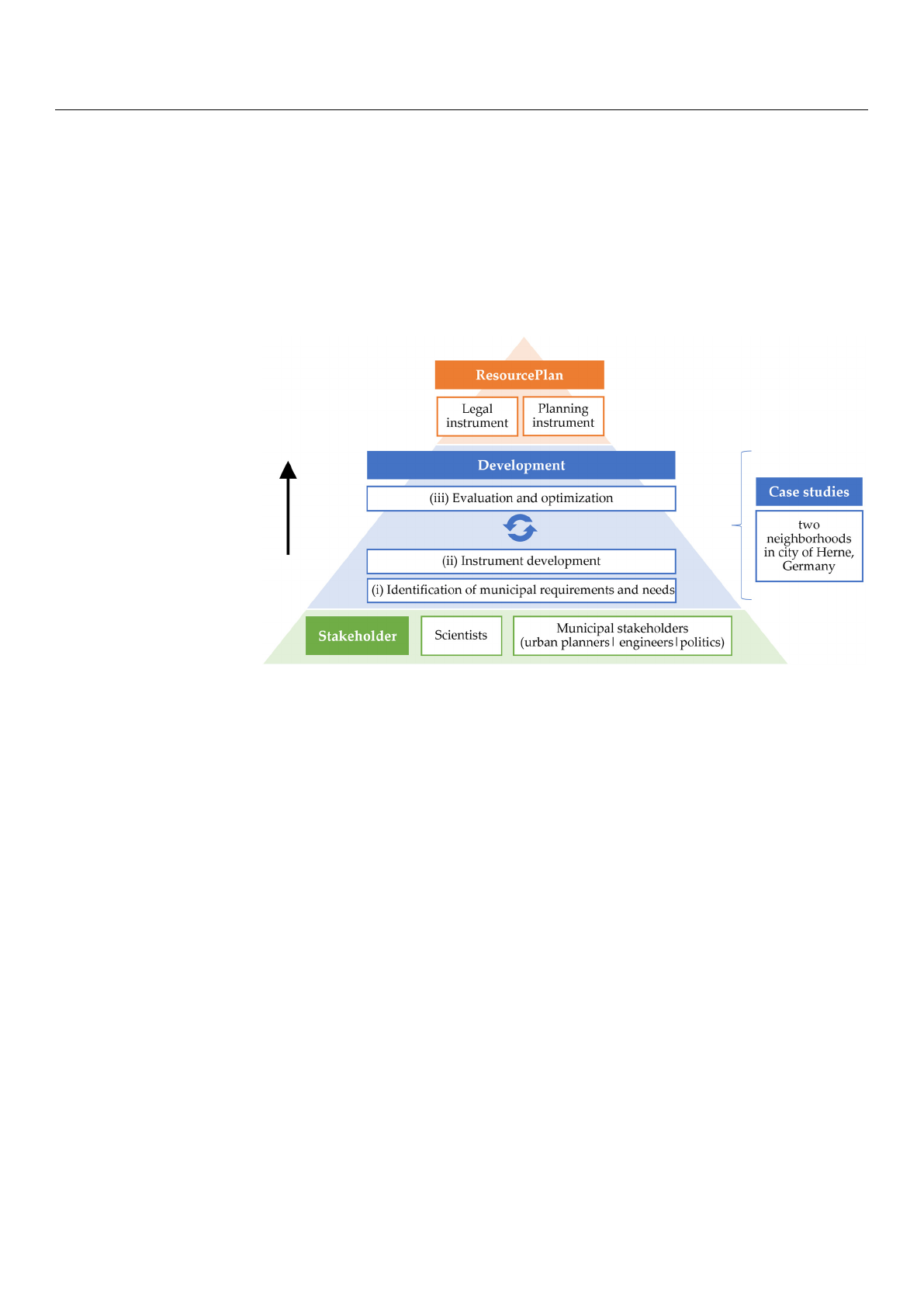
The structure for development is summarized in Figure 1. The ResourcePlan is
designed as a two-component instrument (Figure 1, orange). For legalizing resource
management strategies within the existing municipal structures, first, the ResourcePlan
is conceptualized as a legal instrument. Second, an inter-disciplinary decision support
framework is designed for usage as a planning instrument.
Sustainability 2022, 14, x FOR PEER REVIEW 4 of 31
2. Materials and Methods
2.1. Conceptual Approach
A “ResourcePlan” that supports the successive development of a sustainable, effi-
cient use of resources in different neighborhood typologies is defined. The approach ad-
dresses the increase of efficient resource use at relevant urban building and infrastructural
resource management sectors: (i) water (storm- and wastewater) management, (ii) con-
struction and maintenance of buildings and infrastructure, (iii) urban energy system plan-
ning, and (iv) land-use planning (Section 2.2.2). This exemplary selection of urban re-
source management sectors can be expanded in a modular form.
The structure for development is summarized in Figure 1. The ResourcePlan is de-
signed as a two-component instrument (Figure 1, orange). For legalizing resource man-
agement strategies within the existing municipal structures, first, the ResourcePlan is con-
ceptualized as a legal instrument. Second, an inter-disciplinary decision support frame-
work is designed for usage as a planning instrument.
The development follows an explorative approach and is based on close, trans-disci-
plinary exchange between scientists and stakeholders of the municipalities (Figure 1,
green). On the scientific side, experts for all resources under consideration are involved.
On the municipal side, urban planners, engineers, and politicians from the city of Herne,
as the main partner, and from eight other associated municipalities participate.
All topics are discussed within a recursive three-step process of (i) identification of
municipal requirements and needs, (ii) instrument development, and (iii) evaluation and
optimization (Figure 1, blue). The municipal requirements and needs were established by
the stakeholders at the beginning of the project. The defined aspects go back to experi-
ences from past projects, identified barriers to current structures, and requirements aris-
ing from future challenges. The prioritization was conducted in collaborative discussion
of all stakeholders. Afterward, the aspects were formulated as “framing principles” for
both instrument components for use as evaluation und optimization criteria. They are de-
scribed within the next sections (Sections 2.1.1 and 2.1.2).
The instrument development is mainly performed by the scientists in communication
with the municipal stakeholders. The municipal stakeholders evaluate the proposed solu-
tions in terms of the framing principles. At all times, the development is conducted based
on two case studies in the city of Herne (Section 2.3), which are stepwise and used to
validate the conceptual methods under development.
Figure 1. Conceptual approach for development of the ResourcePlan.
Figure 1. Conceptual approach for development of the ResourcePlan.
The development follows an explorative approach and is based on close, trans-
disciplinary exchange between scientists and stakeholders of the municipalities (Figure 1,
green). On the scientific side, experts for all resources under consideration are involved.
On the municipal side, urban planners, engineers, and politicians from the city of Herne, as
the main partner, and from eight other associated municipalities participate.
All topics are discussed within a recursive three-step process of (i) identification of
municipal requirements and needs, (ii) instrument development, and (iii) evaluation and
optimization (Figure 1, blue). The municipal requirements and needs were established by
the stakeholders at the beginning of the project. The defined aspects go back to experiences
from past projects, identified barriers to current structures, and requirements arising from
future challenges. The prioritization was conducted in collaborative discussion of all
stakeholders. Afterward, the aspects were formulated as “framing principles” for both
instrument components for use as evaluation und optimization criteria. They are described
within the next sections (Sections 2.1.1 and 2.1.2).
The instrument development is mainly performed by the scientists in communication
with the municipal stakeholders. The municipal stakeholders evaluate the proposed
solutions in terms of the framing principles. At all times, the development is conducted
based on two case studies in the city of Herne (Section 2.3), which are stepwise and used to
validate the conceptual methods under development.
2.1.1. Analysis of Legal Implementation (Legal Instrument)
The development of the ResourcePlan as a legal instrument is completed inductively
based on existing legal structures. The study is performed in two steps:
First, premises for integrating resource protection at all legal levels—from EU- to
municipal level—are derived (Section 3.2.1). To obtain an object of comparison, the current

Sustainability 2022,14, 1522 5 of 30
legal structures for climate protection and their effects on the processes of local government
are examined. For this purpose, an analysis of the development of legal structures for
climate protection on the EU, federal, regional, and municipal levels is completed. From
this, premises for resource protection are derived.
Second, options for legalizing the ResourcePlan within municipal structures are speci-
fied (Section 3.2.2). For this purpose, existing formal and informal instruments are evaluated
regarding (i) the depth of impact, (ii) the sectoral influence, (iii) the relevance of ownership,
(iv) the suitability of different life cycle status (new/existing), and (v) the legal bindingness.
The framing principles for the development of the legal instrument and its recursive
evaluation and optimization are:
1.
Permanent task: Resource efficiency and resource protection are to become a permanent
municipal task within medium- and long-term planning;
2. Inter-/trans-disciplinarity: Early and integrative cooperation of all disciplines;
3. Future ability: Ensure updatability and transferability;
4.
Communication: Transparent communication to addressees: internal administration,
citizens, investors;
5. Practical orientation: Comprehensible and user-oriented structure;
6.
Integration: Integrating resource planning as a major concern in municipal manage-
ment structures.
2.1.2. Inter-Disciplinary Evaluation Framework (Planning Instrument)
An evaluation system is developed to analyze, measure, and evaluate resource ef-
ficiency in the urban neighborhood. The system is designed as a multi-methodological
evaluation process, going back to (i) the three pillars of sustainable development (Ecological–
Social–Economic) as well as (ii) the relevant urban building and infrastructural resource
management sectors (water, building materials, energy, and land). On the one hand, LCA
is chosen as one evaluation method to cover aspects of environmental impacts through the
whole life cycle of the neighborhood. On the other hand, local system functionality and
low environmental impact must be ensured, as well. To cover the sectoral system states as
well as their interactions, sectoral resource efficiency evaluations are performed as well as
their summary within a common framework. Therefore, the development of the planning
instrument is completed modularly.
The main concept starts from a common definition of resource efficiency (Section 2.2.3).
Based on this, the approach is transferred and specified sectoral. Existing sectoral evaluation
principles are taken as a basis and adapted to the specific needs of the ResourcePlan
framework. To ensure linkability of the sectoral evaluation results and practicability at
the municipal level, the system is based on geodata. Key aspects—such as the overall
approach of the evaluation system, the relevance of the selected evaluation indicators and
the complexity of the data management—are discussed with the municipal stakeholders.
The framing principles for the development of the planning instrument and its recur-
sive evaluation and optimization are:
1.
Transferability: The evaluation framework must be transferable to other neighborhoods
and municipalities;
2.
Practical relevance: Results must be application-oriented and easy to understand.
Planning targets and solution strategies that can be used for orientation and success
control in future projects are helpful;
3.
Relative assessment: Due to the different conditions of different neighborhoods, a
relative assessment is preferable to an absolute assessment;
4.
Adaptability: Due to the different parameters (qualitative, quantitative) of the various
sectors, an open and flexible approach is sought;
5. National guidance: Criteria must be aligned to nationwide objectives;
6.
Updateability: The approach must be adaptable to new scientific knowledge or chang-
ing objectives;
Loading more pages...