
Bioinorganic Chemistry Hot Paper
A Pseudotetrahedral Terminal Oxoiron(IV) Complex: Mechanistic
Promiscuity in CH Bond Oxidation Reactions
Katrin Warm, Alice Paskin, Uwe Kuhlmann, Eckhard Bill, Marcel Swart, Michael Haumann,
Holger Dau, Peter Hildebrandt, and Kallol Ray*
Dedicated to Professor Wolfgang Kaim on the occasion of his 70th birthday
Abstract: S=2 oxoiron(IV) species act as reactive intermedi-
ates in the catalytic cycle of nonheme iron oxygenases. The few
available synthetic S=2Fe
IV=O complexes known to date are
often limited to trigonal bipyramidal and very rarely to
octahedral geometries. Herein we describe the generation and
characterization of an S=2 pseudotetrahedral FeIV=O com-
plex 2supported by the sterically demanding 1,4,7-tri-tert-
butyl-1,4,7-triazacyclononane ligand. Complex 2is a very
potent oxidant in hydrogen atom abstraction (HAA) reactions
with large non-classical deuterium kinetic isotope effects,
suggesting hydrogen tunneling contributions. For sterically
encumbered substrates, direct HAA is impeded and an
alternative oxidative asynchronous proton-coupled electron
transfer mechanism prevails, which is unique within the
nonheme oxoiron community. The high reactivity and the
similar spectroscopic parameters make 2one of the best
electronic and functional models for a biological oxoiron(IV)
intermediate of taurine dioxygenase (TauD-J).
Introduction
High-valent oxoiron(IV) intermediates act as the active
oxidants in the catalytic cycles of a variety of mononuclear
non-heme iron oxygenases.[1] These high-valent species have
been characterized by rapid freeze quench methods in few
cases[1] and were unambiguously shown by UV/Vis, Mçssba-
uer, and X-ray absorption spectroscopic methods to contain
high-spin (S=2) iron(IV) centres. However, the available
experimental data could not reveal other important structural
features, such as the number, identity, and disposition of
ligands in the FeIV coordination sphere. Density functional
theoretical (DFT) studies[2] on the taurine:aKG dioxygenase
(TauD) system have shown that the spectroscopic properties
of the hydrogen-abstracting oxoiron(IV) key intermediate
(TauD-J) are consistent with both suggested structural
models (Scheme 1), that is, with trigonal bipyramidal (TBP)
as well as distorted octahedral (Oh) coordinations. Significant
synthetic efforts in the past decade have led to the generation
of oxoiron(IV) cores in both TBP and Ohgeometries
(Scheme 1). Although the majority of the synthetic complexes
exhibit S=1 ground states in Ohgeometry,[3] DFT-studies
predicted stabilization of the more reactive[4] S=2 oxoiron-
(IV) units[5] either by enforcing a TBP geometry at the
iron(IV) centre[5a–d] or by weakening the equatorial donation
in Ohgeometry.[5e]
Results and Discussion
In the context of the existing ambiguity related to the
coordination number of iron in biological oxoiron(IV)
intermediates,[2] and the limitation of the synthetic S=2
oxoiron(IV) cores to mainly TBP and in rare cases to Oh
geometries, we have now sought to identify a tripodal ligand
that allows for trapping an FeIV=O core in a geometry
different from the known TBP or Ohgeometries. Herein we
report the synthesis and characterization of the S=2 pseu-
dotetrahedral [FeIV(O)(tBu3tacn)]2+(2,tBu3tacn[6] =1,4,7-tri-
tert-butyl-1,4,7-triazacyclononane) complex, which exhibits
spectroscopic and reactivity properties distinct from the
oxoiron(IV) cores in TBP or Ohgeometries. In particular, in
direct contrast to the vast majority of previous oxoiron(IV)
cores,[3a–g,5a–e] where the reactivity with substrates containing
CH bonds is controlled by the CH bond dissociation
[*] M. Sc. K. Warm, M. Sc. A. Paskin, Prof. Dr. K. Ray
Institut fr Chemie, Humboldt-Universitt zu Berlin
Brook-Taylor-Str. 2, 12489 Berlin (Germany)
E-mail: [email protected]
Dr. U. Kuhlmann, Prof. Dr. P. Hildebrandt
Institut fr Chemie, Technische Universitt Berlin, Fakultt II
Straße des 17. Juni 135, 10623 Berlin (Germany)
Dr. E. Bill
Max-Planck-Institut fr Chemische Energiekonversion (CEC)
Stiftstraße 34–36, 45470 Mlheim (Germany)
Prof. Dr. M. Swart
Institut de Qumica Computacional i Catlisi, Universitat de Girona,
Campus Montilivi (Cincies)
Maria Aurlia Capmany i Farns, 69, 17003 Girona (Spain)
and
ICREA
Pg. Llus Companys 23, 08010 Barcelona (Spain)
Dr. M. Haumann, Prof. Dr. H. Dau
Institut fr Physik, Freie Universitt Berlin
Arnimallee 14, 14195 Berlin (Germany)
Supporting information and the ORCID identification number(s) for
the author(s) of this article can be found under:
https://doi.org/10.1002/anie.202015896.
2020 The Authors. Angewandte Chemie International Edition
published by Wiley-VCH GmbH. This is an open access article under
the terms of the Creative Commons Attribution Non-Commercial
NoDerivs License, which permits use and distribution in any
medium, provided the original work is properly cited, the use is non-
commercial and no modifications or adaptations are made.
A
ngewandte
Chemi
e
Research Articles
How to cite: Angew. Chem. Int. Ed. 2021,60, 6752–6756
International Edition: doi.org/10.1002/anie.202015896
German Edition: doi.org/10.1002/ange.202015896
6752 2020 The Authors. Angewandte Chemie International Edition published by Wiley-VCH GmbH Angew. Chem. Int. Ed. 2021,60, 6752 – 6756
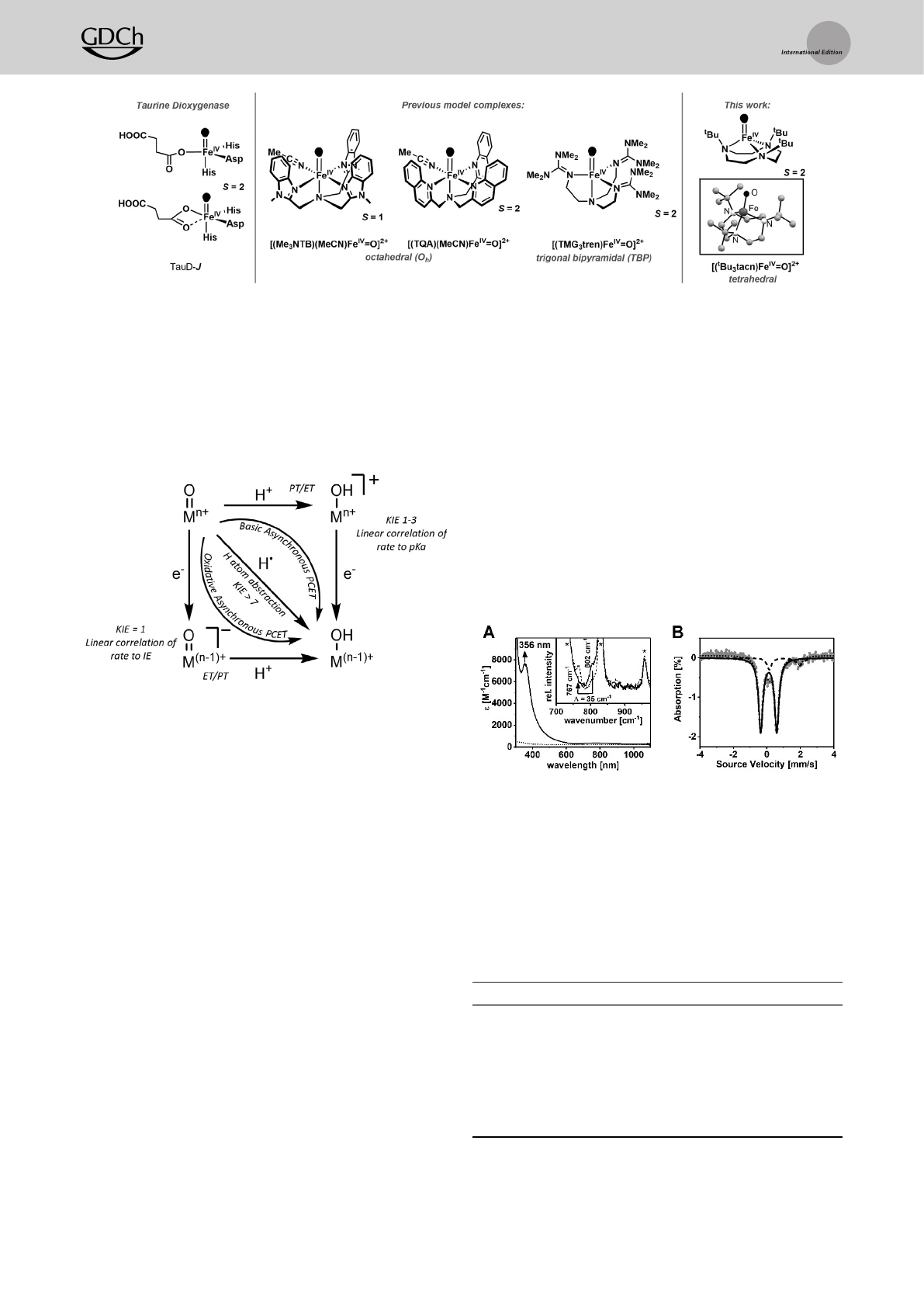
energies (BDEC-H), complex 2demonstrates a mechanistic
promiscuity in its CH oxidation reactions. Sterically less
hindered CH bonds are oxidized via a conventional direct
hydrogen atom abstraction (HAA; Scheme 2) mechanism
that is characterized by large deuterium kinetic isotope effects
(KIEs), which are greater than the semi-classical limit of 7,
implying a significant contribution of hydrogen tunnelling.[7]
In contrast, for sterically encumbered substrates, where the
direct access to the FeIV=O core is blocked, the CH
oxidation reaction proceeds with a significantly lower KIE
and presumably involves a proton-coupled electron transfer
(PCET) mechanism along a spectrum of “asynchronicity”[8] in
which the transition state for the net H-atom transfer contains
more electron transfer character (Scheme 2; Oxidative asyn-
chronous PCET).
Combination of equimolar amounts of the previously
reported tBu3tacn ligand[6,9] and FeII(OTf)2(CH3CN)2in
CH2Cl2afforded [FeII(tBu3tacn)(OTf)](OTf) (1), whose crys-
tal structure (Figure S1; Tables S1,S2) exhibited a distorted
tetrahedral geometry (N-Fe-N angles of 86.5–88.3
8
) with an
Fe-O distance of 1.935(2) and three Fe-N distances of
2.105(2)–2.124(2) . The zero-field Mçssbauer spectrum of
1(Figure S2) revealed a single doublet with an isomer shift
(d) of 0.97 mms1and a large quadrupole splitting (DEQ=
1.98 mms1), consistent with an S=2 spin state, which is also
supported by DFT[11] (Table S3). Reaction of 1in pure CH2Cl2
or butyronitrile (PrCN) at 90
8
C with 2-(tert-butylsulfonyl)-
iodosobenzene (sPhIO)[12] yielded a transient species 2(Fig-
ure 1A; half-life at 70
8
C=20 min) with electronic absorp-
tion features centered at lmax =356 nm (e=7500 M1cm1)
and 780 nm (e=150 M1cm1). Notably, the presence of
a well-defined strong absorption band in the near-UV region
is typical of S=2 oxoiron(IV) cores (Table S4);[5a–d] in 2this
band at lmax =356 nm is slightly red-shifted (Table 1) relative
to that of TauD-J(lmax =318 nm).[1a] The S=2 spin state of 2
was additionally corroborated by the Evans[13] NMR method
(Figure S3) at 90
8
C which yielded the magnetic moment
meff =4.50 mB(theoretical value for S=2: 4.90 mB). An elec-
tron spray ionization mass spectrum (Figure S4) of 2exhib-
Scheme 1. Left: Proposed structures of S=2TauD-Jbased on DFT studies;[2] middle: selected examples of S=1 and S=2 oxoiron(IV) cores in
TBP and Ohgeometries; right: A pseudotetrahedral S=2oxoiron(IV) complex 2reported in this work; in the inset is shown the DFT calculated
structure of 2in the S=2 state.
Scheme 2. Mechanisms of net hydrogen atom transfer.
Figure 1. A) UV/Vis spectra of 1(dashed line) and 2(solid line) in
CH2Cl2at 90
8
C; inset shows the rRaman spectra of 16O- (solid line)
and 18O-labelled (dashed line) 2(4 mM solution) in CH2Cl2upon
406 nm irradiation at 90
8
C; solvent signals are indicated by an
asterisk; B) Zero-field Mçssbauer spectrum (grey) of a frozen sample
of 2in PrCN/CH2Cl2(10:1) and simulation with d=0.11 mms1and
DEQ=0.96 mms1for the main species (solid line, 87%). The minor
species (dashed line) with d=0.97 mms1and DEQ=1.98 mms1
corresponds to unreacted 1.
Table 1: Comparison of the spectroscopic properties of TauD-Jand 2.
TauD-J[1a,b,2,10] 2
lmax [nm] 318 356
R(Fe-O) [] 1.62 1.66
nFe=O[cm1] 821 802
d[mm1s1] 0.31 0.11
DEQ[mm1s1] 0.88 0.96
Axx,Ayy,Azz [T] S=2:
18.4, 17.6, 31
S=2:
10.1, 3.3, 36.1
Eo[eV] 7123.8 7123.2
A
ngewandte
Chemi
e
Research Articles
6753Angew. Chem. Int. Ed. 2021,60, 6752 – 6756 2020 The Authors. Angewandte Chemie International Edition published by Wiley-VCH GmbH www.angewandte.org

ited a signal at m/z=518.7, consistent with its formulation as
[FeIV(O)(tBu3tacn)(OTf)]+(m/zcalc=518.2). However, the
19F-NMR spectrum (Figure S5) of 2displayed a single reso-
nance at 77.0 ppm, which confirmed that the triflate (OTf)
anion is not bound to the Fe-centre in 2. This observation
together with the same UV-vis spectrum (Figure S6) of 2in
both coordinating (PrCN) and non-coordinating (CH2Cl2)
solvents corroborates the absence of any exogeneous ligands
binding to the iron centre. Thus, the 4-coordinate geometry
found in 1is retained in 2, leading us to formulate the latter as
[FeIV(O)(tBu3tacn)]2+.
The 4-coordinate geometry of 2was also supported by
Extended X-ray Absorption Fine Structure (EXAFS) anal-
ysis (Figure S7A, Table S5), which yielded a good fit with an
oxygen ligand at 1.66 , assigned to the Fe=O bond, and
a further shell of three nitrogen ligands at 2.06 , corre-
sponding to the N donors of tBu3tacn. The Fe K-edge X-ray
absorption spectrum (Figure S7B) of 2reveals an edge energy
of 7123.2 eV (vs. 7119.7 eV for 1), which is within the range of
values found for synthetic FeIV=O complexes.[3b,5a–c] Further-
more, in contrast to the pre-edge features of existing S=1
complexes that can be modelled with a single Gaussian,[13] in
the pre-edge region of 2two spectral features at 7115 and
7117 eV are tentatively discernible (Figure S7A,C), which
may be rationalized in terms of a splitting of the aand bdz2
orbitals by spin polarization in the S=2 oxoiron(IV) cor-
es.[5a,b]
Resonance Raman spectroscopy revealed a n(Fe=O)
stretching mode at 802 cm1in 2(Figure 1A, inset) that
shifted to 767 cm1upon 18O-labelling. The observed n(Fe=O)
mode has one of the lowest energies reported to date for
oxoiron(IV) cores. This may be attributed to the high spin
(S=2) ground state of 2as this would (in a simplified
pseudotetrahedral ligand field) require a d(x2y2)1d(xy)1d-
(xz,yz)2d(z2)0electronic configuration with an FeO bond
order (BO) of 2.0.[15] Notably, the high-spin ground state of 2
is unique for a pseudotetrahedral geometry; previously
reported pseudotetrahedral M-X (X=O2,NR
2,orN
3)
complexes,[16] including the recent CoIIIO complex,[8,17] all
possess a low-spin ground state with a M-X BO of 3. The zero
field Mçssbauer spectrum of 2exhibits a doublet (87% yield)
with a quadrupole splitting, DEQ=0.96 mms1, and an isomer
shift, d=0.11 mms1(Figure 1B). Although, the DEQvalue is
very close to the value reported for TauD-J(Table 1),[1b] the
d-value is significantly lower, which may reflect the nitrogen-
rich character in 2in contrast to the harder oxygen-containing
ligand sphere in TauD-J.In applied magnetic fields, the
spectra of 2exhibit paramagnetic hyperfine structures, which
were analysed by assuming an S=2 center yielding a non-
axial A-tensor with Axx/gnbn=10.1 T, Ayy/gnbn=3.3 T and
Azz/gnbn=36.1 T (Figure S8). The structure of 2as obtained
by DFT calculations (Scheme 1, inset) reveals an off-axis tilt
of the oxo ligand resulting in a deviation from the C3
symmetry, which may account for the non-axial A-tensor
determined from magnetic Mçssbauer studies. The quintet
state was calculated to be more stable than the triplet and the
singlet states by 0.8 and 6.6 kcalmol1, respectively (Ta-
ble S3). Furthermore, among all spin states, the calculated
spectroscopic properties of the S=2 state provide the best
description of the experimental data. The calculated Fe=O
and FeN bond distances (1.63 and 2.06 , respectively), Fe=
O stretching mode frequency (893 cm1,18O isotope shift
36 cm1), and Mçssbauer d-value (0.06 mms1), on the
ground S=2 state are in satisfactory agreement with experi-
ments (Table S3). Notably, the calculated data for the S=1
and S=0 states deviate significantly from the experiments,
such that we take the calculations as a further support for the
S=2 ground state in 2.
The oxidative reactivity of 2(Figures S9–S18; Table S6)
has been investigated with several substrates in oxygen atom
transfer (OAT) and HAA reactions and the second order rate
constants derived from these studies in CH2Cl2are compared
with three of the most reactive high-valent Fe-oxo inter-
mediates reported to date (namely the [(TQA)FeIV(O)-
(CH3CN)]2+(TQA=tris(2-quinolylmethyl)amine),[5e]
[(Me3NTB)FeIV(O)]2+(Me3NTB=tris((N-methyl-benzimi-
dazol-2-yl)methyl)amine)[3c] and [(TMCO)FeIV(O)-
(CH3CN)]2+(TMCO=4,8,12-trimethyl-1-oxa-4,8,12-triaza-
cyclotetradecane)[3f] complexes (Table 2). In reactions with
ethylbenzene, 1,4-cyclohexadiene (1,4-CHD), and toluene, 2
is a stronger oxidant than [(TMCO)FeIV(O)(CH3CN)]2+, but
comparable to [(TQA)FeIV(O)(CH3CN)]2+and
[(Me3NTB)FeIV(O)]2+. Interestingly, the reactivity trend is
reversed in reactions with 9,10-dihydroanthracene (DHA),
where 2exhibits the least reactivity. Furthermore, when the
logarithms of the statistically corrected second order rate
constants (k2) were plotted vs. the BDEC-H values of the
substrates (Figure 2A, Figure S20A), the linear correlation
typically observed for oxoiron(IV) cores[3a–i,5] is found to be
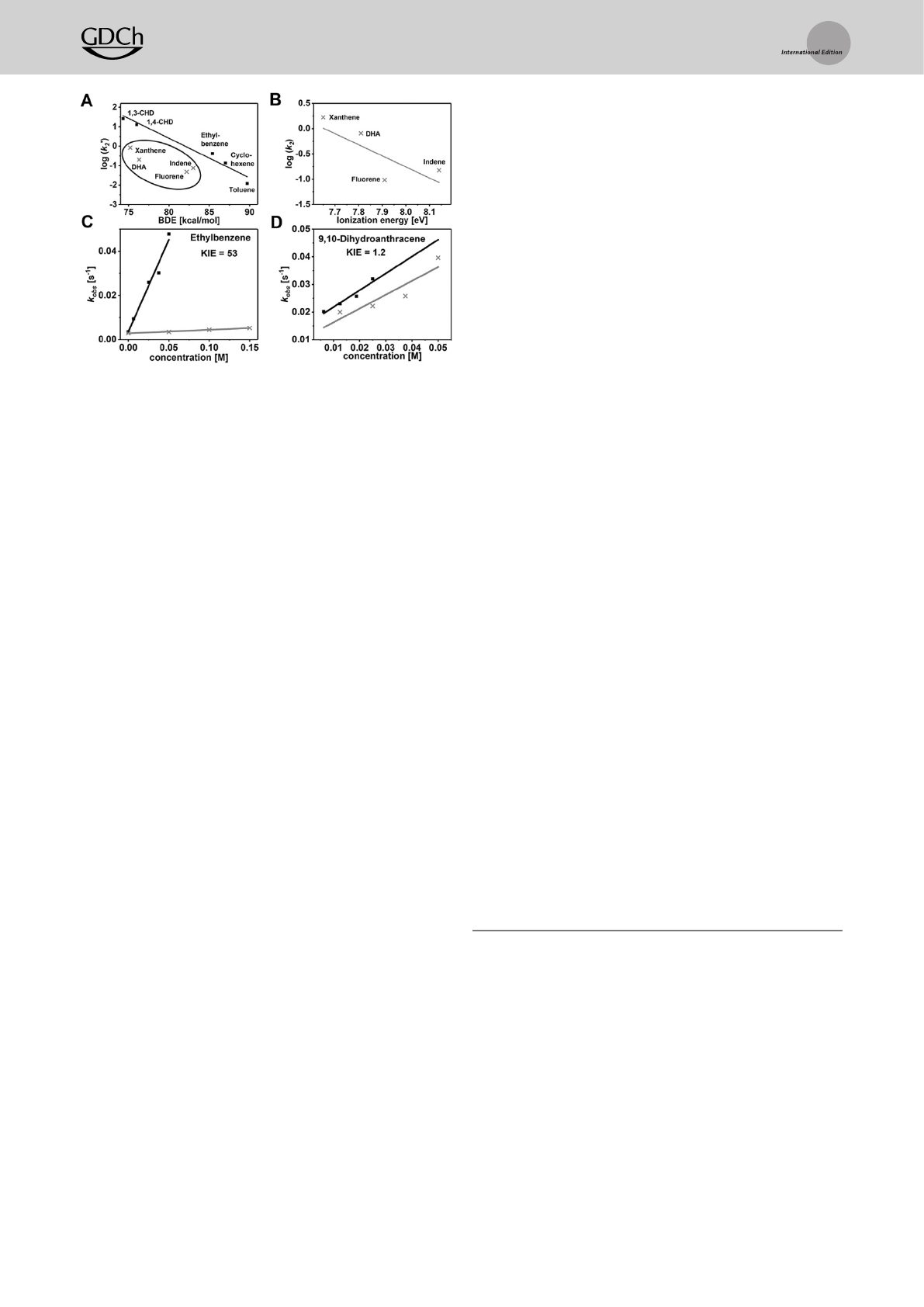
not valid for 2. While the respective log(k2) values associated
with 2for the oxidation of 1,4-CHD, 1,3-cyclohexadiene (1,3-
CHD), ethylbenzene, cyclohexene and toluene fall on a line
(Figure 2A, black points), xanthene, DHA, indene and
fluorene substrates (Figure 2A, inset) deviate from this
pattern and exhibit significantly lower rates than predicted
by the linear relationship. Particularly interesting is the large
rate difference of two orders of magnitude for DHA and 1,4-
CHD, which are known to have small difference in BDEC-H
values.[18] Furthermore, large deuterium KIEs of 7 (Fig-
ure S9), 12 (Figure S10), and 53 (Figure 2C, Figure S11) were
Table 2: Comparison of the reaction rate constants k2’(normalized to the
number of equivalent H atoms) at 40
8
C for the CH activation reaction
of 2and the highly reactive intermediates (TMCO)FeIV=O,
(Me3NTB)FeIV=O and (TQA)FeIV=O towards a selection of substrates.
Substrate
(BDEC-H, kcal/mol)
k2’[M1s1]
2(TMCO)
FeIV=O
(Me3NTB)
FeIV=O
(TQA)
FeIV=O
1,4-CHD (76.0) 1.0102[a] nd 7.8102nd
DHA (76.3) 1.6[b] Too fast (90
8
C) 2.4102nd
Ethylbenzene (85.4) 3.3[b] 0.10[c] 0.75 1.1
Toluene (89.7) 0.43[b] 0.0044[c] 0.16 0.21
nd=rate not determined;k2’values at 40
8
C were calculated from the
values measured at [a] 90
8
C; [b] 70
8
C; [c] 60
8
C; [d] 50
8
C and
corrected for the temperature difference by doubling the rate for every 10
degrees rise in temperature.
A
ngewandte
Chemi
e
Research Articles
6754 www.angewandte.org 2020 The Authors. Angewandte Chemie International Edition published by Wiley-VCH GmbH Angew. Chem. Int. Ed. 2021,60, 6752 – 6756
recorded for toluene, 1,4-CHD, and ethylbenzene reactions,
respectively, suggesting a HAA mechanism with significant
contribution of hydrogen-tunnelling, as is frequently pro-
posed in CH bond activation reactions of FeIV=O species.[7]
In contrast, significantly reduced KIEs of 1.2 (Figure 2D,
Figure S12) and 2.1 (Figure S13) were determined for DHA
and xanthene, respectively, thereby pointing to a change of
mechanism. Further mechanistic insights were obtained by
plotting the rate constants against the pKaand the ionization
energies (IE) of the substrates. The log(k2) vs. IE plot
(Figure 2B, Figure S20B) revealed that for reactions of 2with
xanthene, DHA, indene and fluorene the rate decreased
linearly with increasing IE, whereas the rates for 1,4-CHD,
1,3-CHD, ethylbenzene, cyclohexene and toluene scatter
irregularly. Furthermore, no linear trend was observed in
the log(k2)vs.pKaplot (Figure S20C) for all the investigated
substrates. Thus, the tBu3tacn ligand blocks the HAA pathway
by presumably impeding access of the bulkier polycyclic
hydrocarbons to the Fe=O unit in 2. An alternative oxidative
asynchronous PCET mechanism (Scheme 2) prevails in such
cases, which are typically characterized by low KIEs and
a linear correlation of the reaction rates to IEs.
Conclusion
Taken together the results presented herein unequivocally
validate the formation of a terminal oxoiron(IV) complex 2in
a pseudotetrahedral geometry. The computational and ex-
perimental analyses are consistent with the presence of an S=
2Fe
IV=O core in 2. Complex 2represents the only example of
a high-spin complex with metal-ligand multiple bond charac-
ter in a pseudotetrahedral geometry; notably, a pseudotetra-
hedral oxoiron(IV) complex has been very recently demon-
strated to possess an S=0 state in the gas-phase.[19] The
absorption spectrum, Mçssbauer DEQ, Fe K-edge energy, and
the n(Fe=O) mode of 2(Table 1) bear very close resemblance
to the corresponding spectroscopic properties of TauD-J.2
also exhibits the distinct high-reactivity features known from
the strongly oxidizing iron-oxo cores in biology and accord-
ingly possesses one of the most reactive oxoiron(IV) cores
that have been synthesized to date. Furthermore, a large KIE
of 53 has been determined for the reaction of 2with
ethylbenzene, which compares well with the KIE of 57[1]
determined for the oxidation of taurine by TauD-J.The
uniqueness of 2within the non-heme oxoiron family is,
however, emphasized in its ability to oxidize sterically
hindered CH bonds by an IE-driven asynchronous PCET
mechanism. Although limited examples of CH oxidation by
a basicity controlled PCET mechanism (Scheme 2) are
known,[8,20] evidence of oxidative PCET mechanism has
stayed elusive prior to this study. In conclusion, the high
reactivity and the similar spectroscopic parameters of 2and
TauD-Jmake 2one of the best structural, electronic and
functional models for TauD-J.
Acknowledgements
This work was funded by the Deutsche Forschungsgemein-
schaft (DFG, German Research Foundation) under Germa-
nys Excellence Strategy—EXC 2008–390540038—UniSys-
Cat to K.R., P.H., and H.D., and the Heisenberg-Professor-
ship to K.R., and MINECO (CTQ2017-87392-P) and FED-
ER (UNGI10-4E-801) to M.S. K.W. also thanks Einstein
Foundation Berlin (ESB)—Einstein Center of Catalysis
(EC2) for its support. Open access funding enabled and
organized by Projekt DEAL.
Conflict of interest
The authors declare no conflict of interest.
Keywords: bioinorganic chemistry · enzyme models ·
high-valent iron · hydrogen atom abstraction · electron transfer
[1] a) J. C. Price, E. W. Barr, B. Tirupati, J. M. Bollinger, C. Krebs,
Biochemistry 2003,42, 7497–7508; b) J. M. Bollinger, Jr., J. C.
Price, L. M. Hoffart, E. W. Barr, C. Krebs, Eur. J. Inorg. Chem.
2005, 4245–4254; c) C. Krebs, D. Galonic
´Fujimori, C. T. Walsh,
J. M. Bollinger, Acc. Chem. Res. 2007,40, 484 – 492.
[2] S. Sinnecker, N. Svensen, E. W. Barr, S. Ye, J. M. Bollinger, F.
Neese, C. Krebs, J. Am. Chem. Soc. 2007,129, 6168–6179.
[3] a) C. A. Grapperhaus, B. Mienert, E. Bill, T. Weyhermller, K.
Wieghardt, Inorg. Chem. 2000,39, 5306–5317; b) J.-U. Rohde, J.-
H. In, M. H. Lim, W. W. Brennessel, M. R. Bukowski, A. Stubna,
E. Mnck, W. Nam, L. Que, Science 2003,299, 1037; c) M. S. Seo,
N. H. Kim, K.-B. Cho, J. E. So, S. K. Park, M. Clmancey, R.
Garcia-Serres, J.-M. Latour, S. Shaik, W. Nam, Chem. Sci. 2011,
Figure 2. A) Plot of the logarithm of the second order rate constants
k2’(normalized to the number of equivalent H atoms) of the reactions
of 2with different substrates vs. the BDEC-H of the respective
substrates; the inset shows the substrates that deviate from a linear
correlation; B) Plot of the logarithm of the second order rate constants
k2of the reactions of 2with different polycyclic substrates vs. the
ionization energy of the respective substrates; C) plot of the first-order
rate constants kobs vs. the concentration of ethylbenzene (black) and
d10-ethylbenzene (grey) for determination of the second-order rate
constants k2and the deuterium KIE; D) plot of the first-order rate
constants kobs vs. the concentration of DHA (black) and d4-DHA (grey)
for determination of the second-order rate constant k2and the
deuterium KIE.
A
ngewandte
Chemi
e
Research Articles
6755Angew. Chem. Int. Ed. 2021,60, 6752 – 6756 2020 The Authors. Angewandte Chemie International Edition published by Wiley-VCH GmbH www.angewandte.org

2, 1039–1045; d) S. Meyer, I. Klawitter, S. Demeshko, E. Bill, F.
Meyer, Angew. Chem. Int. Ed. 2013,52, 901–905; Angew. Chem.
2013,125, 935–939; e) D. Wang, K. Ray, M. J. Collins, E. R.
Farquhar, J. R. Frisch, L. Gmez, T. A. Jackson, M. Kerscher, A.
Waleska, P. Comba, M. Costas, L. Que, Chem. Sci. 2013,4, 282–
291; f) I. Monte Prez, X. Engelmann, Y.-M. Lee, M. Yoo, E.
Kumaran, E. R. Farquhar, E. Bill, J. England, W. Nam, M. Swart,
K. Ray, Angew. Chem. Int. Ed. 2017,56, 14384–14388; Angew.
Chem. 2017,129, 14576–14580; g) J. B. Gordon, A. C. Vilbert,
I. M. DiMucci, S. N. MacMillan, K. M. Lancaster, P. Monne-
Loccoz, D. P. Goldberg, J. Am. Chem. Soc. 2019,141, 17533–
17547; h) W. Nam, Acc. Chem. Res. 2015,48, 2415–2423; i) V. A.
Larson, B. Battistella, K. Ray, N. Lehnert, W. Nam, Nat. Rev.
Chem. 2020,4, 404–419; j) X. Engelmann, I. Monte-Prez, K.
Ray, Angew. Chem. Int. Ed. 2016,55, 7632 – 7649; Angew. Chem.
2016,128, 7760–7778; k) J. J. D. Sacramento, D. P. Goldberg,
Acc. Chem. Res. 2018,51, 2641–2652; l) J. Chen, Z. Jiang, S.
Fukuzumi, W. Nam, B. Wang, Coord. Chem. Rev. 2020,421,
213443; m) M. Guo, T. Corona, K. Ray, W. Nam, ACS Cent. Sci.
2019,5, 13– 28; n) L. Que, Acc. Chem. Res. 2007,40, 493–500;
o) A. R. McDonald, L. Que, Jr., Coord. Chem. Rev. 2013,257,
414–428.
[4] a) S. Shaik, H. Hirao, D. Kumar, Acc. Chem. Res. 2007,40, 532–
542; b) L. Bernasconi, M. J. Louwerse, E. J. Baerends, Eur. J.
Inorg. Chem. 2007, 3023– 3033; c) A. Decker, J.-U. Rohde, E. J.
Klinker, S. D. Wong, L. Que, E. I. Solomon, J. Am. Chem. Soc.
2007,129, 15983–15996; d) C. Geng, S. Ye, F. Neese, Angew.
Chem. Int. Ed. 2010,49, 5717–5720; Angew. Chem. 2010,122,
5853–5856.
[5] a) J. England, Y. Guo, K. M. Van Heuvelen, M. A. Cranswick,
G. T. Rohde, E. L. Bominaar, E. Mnck, L. Que, J. Am. Chem.
Soc. 2011,133, 11880– 11883; b) J. England, M. Martinho, E. R.
Farquhar, J. R. Frisch, E. L. Bominaar, E. Mnck, L. Que, Jr.,
Angew. Chem. Int. Ed. 2009,48, 3622– 3626; Angew. Chem.
2009,121, 3676–3680; c) D. C. Lacy, R. Gupta, K. L. Stone, J.
Greaves, J. W. Ziller, M. P. Hendrich, A. S. Borovik, J. Am.
Chem. Soc. 2010,132, 12188–12190; d) J. P. Bigi, W. H. Harman,
B. Lassalle-Kaiser, D. M. Robles, T. A. Stich, J. Yano, R. D. Britt,
C. J. Chang, J. Am. Chem. Soc. 2012,134, 1536–1542; e) A. N.
Biswas, M. Puri, K. K. Meier, W. N. Oloo, G. T. Rohde, E. L.
Bominaar, E. Mnck, L. Que, J. Am. Chem. Soc. 2015,137,
2428–2431; f) M. Puri, L. Que, Acc. Chem. Res. 2015,48, 2443–
2452.
[6] A. Thangavel, M. Wieliczko, J. Bacsa, C. C. Scarborough, Inorg.
Chem. 2013,52, 13282–13287.
[7] a) D. Mandal, S. Shaik, J. Am. Chem. Soc. 2016,138, 2094–2097;
b) D. Mandal, D. Mallick, S. Shaik, Acc. Chem. Res. 2018,51,
107–117; c) E. J. Klinker, S. Shaik, H. Hirao, L. Que, Jr., Angew.
Chem. Int. Ed. 2009,48, 1291–1295; Angew. Chem. 2009,121,
1317–1321.
[8] M. K. Goetz, J. S. Anderson, J. Am. Chem. Soc. 2019,141, 4051–
4062.
[9] G. J. Karahalis, A. Thangavel, B. Chica, J. Bacsa, R. B. Dyer,
C. C. Scarborough, Inorg. Chem. 2016,55, 1102–1107.
[10] P. J. Riggs-Gelasco, J. C. Price, R. B. Guyer, J. H. Brehm, E. W.
Barr, J. M. Bollinger, C. Krebs, J. Am. Chem. Soc. 2004,126,
8108–8109.
[11] a) M. Swart, M. Gruden, Acc. Chem. Res. 2016,49, 2690–2697;
b) M. Swart, Chem. Phys. Lett. 2013,580, 166–171.
[12] D. Macikenas, E. Skrzypczak-Jankun, J. D. Protasiewicz, J. Am.
Chem. Soc. 1999,121, 7164–7165.
[13] D. F. Evans, J. Chem. Soc. (Resumed) 1959, 2003–2005.
[14] T. A. Jackson, J.-U. Rohde, M. S. Seo, C. V. Sastri, R. DeHont, A.
Stubna, T. Ohta, T. Kitagawa, E. Mnck, W. Nam, L. Que, J. Am.
Chem. Soc. 2008,130, 12394–12407.
[15] J. F. Berry, S. DeBeer George, F. Neese, Phys. Chem. Chem.
Phys. 2008,10, 4361–4374.
[16] a) T. A. Betley, J. C. Peters, J. Am. Chem. Soc. 2003,125, 10782–
10783; b) X. Hu, K. Meyer, J. Am. Chem. Soc. 2004,126, 16322–
16323; c) R. E. Cowley, R. P. Bontchev, J. Sorrell, O. Sarracino,
Y. Feng, H. Wang, J. M. Smith, J. Am. Chem. Soc. 2007,129,
2424–2425; d) C. T. Saouma, J. C. Peters, Coord. Chem. Rev.
2011,255, 920–937; e) B. Wu, R. Hernndez Snchez, M. W.
Bezpalko, B. M. Foxman, C. M. Thomas, Inorg. Chem. 2014,53,
10021–10023; f) D. T. Shay, G. P. A. Yap, L. N. Zakharov, A. L.
Rheingold, K. H. Theopold, Angew. Chem. Int. Ed. 2005,44,
1508–1510; Angew. Chem. 2005,117, 1532– 1534; g) J. J. Sce-
paniak, C. S. Vogel, M. M. Khusniyarov, F. W. Heinemann, K.
Meyer, J. M. Smith, Science 2011,331, 1049–1052; h) K. Ray, F.
Heims, F. F. Pfaff, Eur. J. Inorg. Chem. 2013, 3784–3807.
[17] M. K. Goetz, E. A. Hill, A. S. Filatov, J. S. Anderson, J. Am.
Chem. Soc. 2018,140, 13176–13180.
[18] a) Y.-R. Luo, Comprehensive Handbook of Chemical Bond
Energies, CRC, Boca Raton, 2007; b) J. E. M. N. Klein, B. Dereli,
L. Que, Jr., C. J. Cramer, Chem. Commun. 2016,52, 10509–
10512.
[19] E. Andris, K. Segers, J. Mehara, L. Ruls
ˇek, J. Roithov, Angew.
Chem. Int. Ed. 2020,59, 23137–23144.
[20] a) D. Usharani, D. C. Lacy, A. S. Borovik, S. Shaik, J. Am. Chem.
Soc. 2013,135, 17090–17104; b) T. H. Parsell, M.-Y. Yang, A. S.
Borovik, J. Am. Chem. Soc. 2009,131, 2762–2763.
Manuscript received: November 29, 2020
Accepted manuscript online: December 21, 2020
Version of record online: February 15, 2021
A
ngewandte
Chemi
e
Research Articles
6756 www.angewandte.org 2020 The Authors. Angewandte Chemie International Edition published by Wiley-VCH GmbH Angew. Chem. Int. Ed. 2021,60, 6752 – 6756
Loading more pages...