
Anastasia Kraskov, Johannes von Sass, Anh Duc Nguyen, Tu Oanh
Hoang, David Buhrke, Sagie Katz, Norbert Michael, Jacek Kozuch,
Ingo Zebger, Friedrich Siebert, Patrick Scheerer, Maria Andrea
Mroginski, Nediljko Budisa, Peter Hildebrandt
Local electric field changes during the
photoconversion of the bathy phytochrome Agp2
Open Access via institutional repository of Technische Universität Berlin
Document type
Journal article | Accepted version
(i. e. final author-created version that incorporates referee comments and is the version accepted for
publication; also known as: Author’s Accepted Manuscript (AAM), Final Draft, Postprint)
This version is available at
https://doi.org/10.14279/depositonce-12714
Citation details
Kraskov, A., von Sass, J., Nguyen, A. D., Hoang, T. O., Buhrke, D., Katz, S., Michael, N., Kozuch, J., Zebger, I.,
Siebert, F., Scheerer, P., Mroginski, M. A., Budisa, N., Hildebrandt, P. (2021). Local Electric Field Changes
during the Photoconversion of the Bathy Phytochrome Agp2. In Biochemistry (Vol. 60, Issue 40, pp.
2967–2977). American Chemical Society (ACS). https://doi.org/10.1021/acs.biochem.1c00426.
This document is the Accepted Manuscript version of a Published Work that appeared in final form in
Biochemistry, copyright © American Chemical Society after peer review and technical editing by the publisher.
To access the final edited and published work see https://doi.org/10.1021/acs.biochem.1c00426.
Terms of use
This work is protected by copyright and/or related rights. You are free to use this work in any way permitted by
the copyright and related rights legislation that applies to your usage. For other uses, you must obtain
permission from the rights-holder(s).

1
Local electric field changes during the photoconversion of the bathy
phytochrome Agp2
Anastasia Kraskov§1, Johannes von Sass§1, Duc A. Nguyen1, Tu Oanh Hoang1, David Buhrke1,6,
Sagie Katz1, Norbert Michael1, Jacek Kozuch3, Ingo Zebger1, Friedrich Siebert2, Patrick
Scheerer4, Maria Andrea Mroginski1*, Nediljko Budisa5*, Peter Hildebrandt1*
1 Technische Universität Berlin, Institut für Chemie, Sekr. PC14, Straße des 17. Juni 135, D-
10623 Berlin, Germany
2 Albert-Ludwigs-Universität Freiburg, Institut für Molekulare Medizin und Zellforschung,
Sektion Biophysik, Hermann-Herderstr. 9, D-79104 Freiburg, Germany
3 Freie Universität Berlin, Fachbereich für Physik, Arnimallee 14, D-14195 Berlin, Germany
4 Charité – Universitätsmedizin Berlin, corporate member of Freie Universität Berlin and
Humboldt-Universität zu Berlin, Institute of Medical Physics and Biophysics, Group Protein
X-ray Crystallography and Signal Transduction, Charitéplatz 1, D-10117 Berlin, Germany
5 University of Manitoba, Department of Chemistry, 144 Dysart Rd, 360 Parker Building, R3T
2N2 Winnipeg, MB, Canada
6 present address: University of Zürich, Department of Chemistry, Winterthurerstr. 190, CH-
8057 Zürich, Switzerland
§ equal contributions to the work
* corresponding authors

2
Abstract
Phytochromes switch between a physiologically inactive and active state via a light-induced
reaction cascade, which is initiated by isomerization of the tetrapyrrole chromophore and leads
to the functionally relevant secondary structure transition of a protein segment (tongue).
Although details of the underlying cause-effect relationships are not known, electrostatic fields
are likely to play a crucial role in coupling chromophore and protein structural changes. Here,
we studied local electric field changes during the photoconversion of the dark state Pfr to the
photoactivated state Pr of bathy phytochrome Agp2. Substituting Tyr165 and Phe192 in the
chromophore pocket by para-cyanophenylalanine (pCNF), we monitored the respective nitrile
stretching modes in the various states of the photoconversion (vibrational Stark effect).
Resonance Raman and IR spectroscopic analyses revealed that both pCNF-substituted variants
undergo the same photoinduced structural changes as wild-type Agp2. Based on a structural
model for the Pfr state of F192pCNF, a molecular mechanical – quantum mechanical approach
was employed to calculate the electric field at the nitrile group and the respective stretching
frequency in excellent agreement with the experiment. These calculations serve as a reference
for determining the electric field changes in the photoinduced states of F192pCNF. Unlike
F192pCNF, the nitrile group in Y165pCNF is strongly hydrogen bonded such that the
theoretical approach is not applicable. However, in both variants the largest changes of the
nitrile stretching modes occur in the last step of the photoconversion, supporting the view that
the proton-coupled restructuring of the tongue is accompanied by a change of the electric field.
3
Introduction
Phytochromes are sensory photoreceptors that use the ratio of light intensities as a source of
information to initiate physiological processes.1,2 The light-absorbing unit is a linear methine-
bridged tetrapyrrole which is covalently bound to the protein in the photosensory core module
(PCM) constituted by a PAS-GAF-PHY domain triade.2 The PCM interconverts between the
red absorbing Pr and far-red absorbing Pfr state, in which the chromophore adopts a ZZZssa
and ZZEssa configuration, respectively. Phytochromes are found in plants, fungi, and bacteria.
In eukaryotic and most bacterial phytochromes, Pr is the stable dark state (prototypical
phytochromes), in contrast to bathy bacterial phytochromes, where Pfr is the thermally stable
state. Despite different domain compositions and different types of tetrapyrrole chromophores,
all phytochromes share common features of photoinduced reaction cascades (Figure 1).
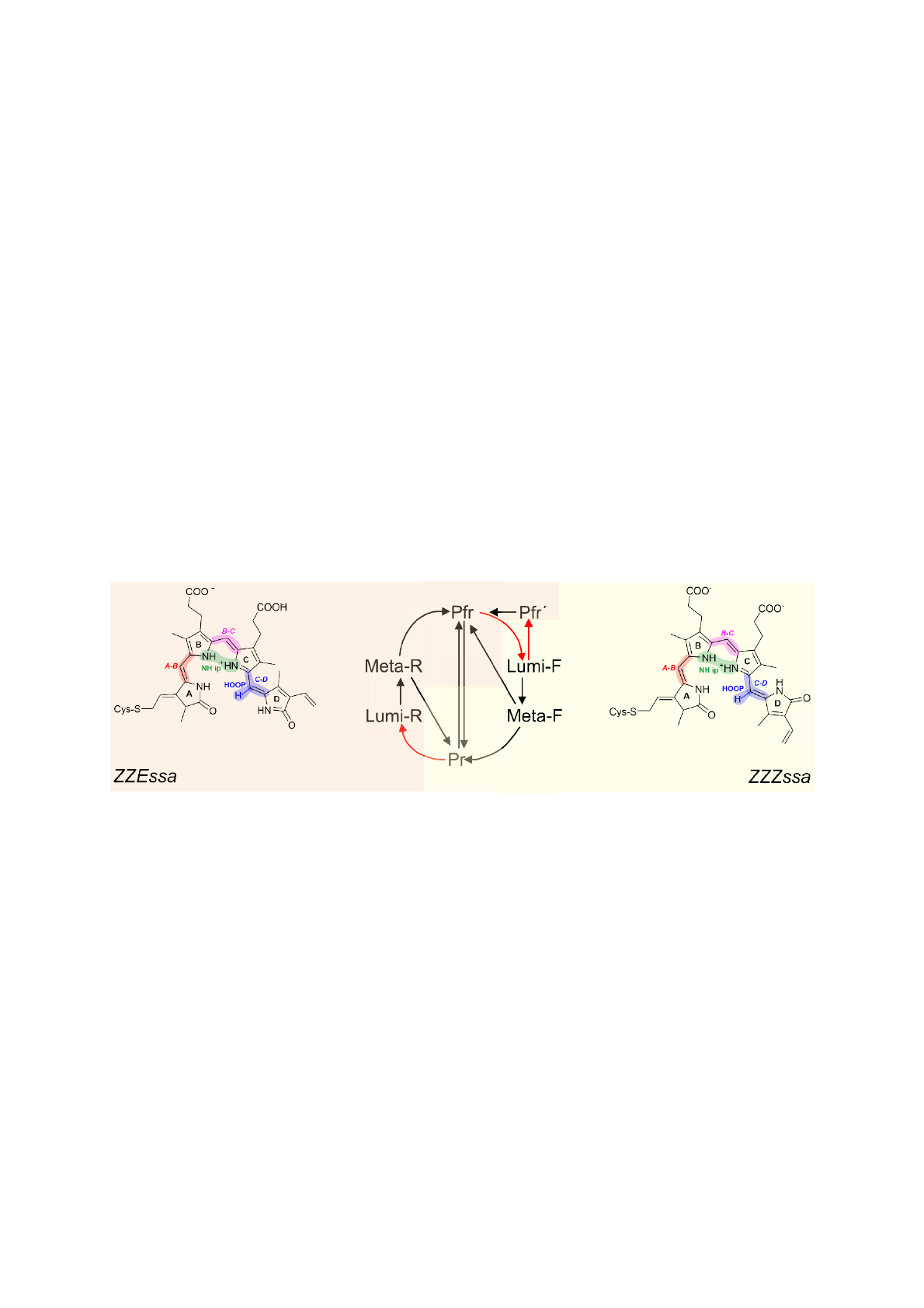
Figure 1. Simplified scheme of the photoinduced reactions in phytochromes. Photochemical
and thermal reactions are indicated by red and black arrows, respectively. Further details are
given in the Supporting Information (Fig. S3). The various states of phytochrome with the
chromophore in the ZZZssa (right) and ZZEssa configuration (left) are highlighted by the
yellow and red background color, respectively. The structural formulas also indicate the
localization of important vibrational modes of the chromophore.

4
The photoinduced conversion between Pr and Pfr starts with double bond photoisomerization
at the methine bridge between rings C and D to yield a distorted, energy-rich ZZEssa (Pr ®
Lumi-R) or ZZZssa (Pfr ® Lumi-F) configuration, presumably with only minor structural
adjustments of the amino acid residues near the chromophore isomerization site.3 The primary
processes are followed by chromophore relaxations and structural rearrangements in the
chromophore binding pocket in the Meta-R and Meta-F states. The decay of the Meta states to
the final photoconversion products is coupled with crucial protein structural changes. This
primarily involves the secondary structure transition of the tongue, a peptide segment in the
PHY domain.4 In prokaryotic phytochromes, this transition represents an important step to
communicate PCM activation or deactivation to the output module, often a histidine kinase.
Particularly detailed insights into the coupling between chromophore and protein structural
changes in the PCM were gained for the bathy phytochrome Agp2 from Agrobacterium fabrum,
based on crystal structures determined for the parent Pfr and the Meta-F states of the wild-type
Agp2-PCM and its variant Agp2-PAiRFP2, and a large body of spectroscopic data (Figure
1).5,6,7,8 The results indicate that E ® Z photoisomerization of the biliverdin (BV; Figure 1)
chromophore leads to reorientations of key amino acid residues in the chromophore binding
pocket, accompanied by a reorganization of the extended hydrogen bond (H-bond) network
around the chromophore. Eventually, a rotation of Tyr165 and Phe192 as well as a removal of
a water molecule on ring D of BV leads to the movement of Gln190 towards Trp440 resulting
in a destabilization of the coil region of the tongue.5 However, a complete conversion of the
tongue from the a-helical to the b-sheet structure requires the proton transfer from the propionic
side chain of BV´s ring C (propC) to His278, which occurs during the decay of Meta-F to Pr.8
On the basis of spectroscopic studies of site-specifically engineered Agp2 variants and Agp2
adducts with BV monomethylester,7,8 we suggested that proton translocation alters the overall
Loading more pages...