
RESEARCH ARTICLE
How to tackle complexity in urban climate
resilience? Negotiating climate science,
adaptation and multi-level governance in
India
Mahendra SethiID
1,2,3
*, Richa Sharma
4
, Subhakanta MohapatraID
5
, Shilpi Mittal
3,6
1Technical University of Berlin, Berlin, Germany, 2Mercator Research Institute on Global Commons and
Climate Change, Berlin, Germany, 3Indian Society for Applied Research & Development, New Delhi, India,
4India Public Health Foundation of India, New Delhi, India, 5School of Sciences, Indira Gandhi National
Open University, New Delhi, India, 6G.D. Goenka University, Gurugram, Haryana, India
*m.sethi@campus.tu-berlin.de
Abstract
As the world’s population is expected to be over 2/3
rd
urban by 2050, climate action in cities
is a growing area of interest in the inter-disciplines of development policy, disaster mitigation
and environmental governance. The climate impacts are expected to be quite severe in the
developing world, given its urban societies are densely packed, vastly exposed to natural
elements while possessing limited capabilities. There is a notable ambiguity and complexity
that inhibits a methodical approach in identifying urban resilience measures. The complexity
is due to intersection of large number of distinct variables in climate geoscience (precipita-
tion and temperature anomalies at different locations, RCPs, timeline), adaptation alterna-
tives (approach, priority, intervention level) and urban governance (functional mandate,
institutional capacity, and plans & policies). This research examines how disparate and
complex knowledge and information in these inter-disciplines can be processed for system-
atic ‘negotiation’ to situate, ground and operationalize resilience in cities. With India as a
case, we test this by simulating mid-term and long-run climate scenarios (2050 & 2080) to
map regional climate impacts that shows escalation in the intensity of climate events like
heat waves, urban flooding, landslides and sea level rise. We draw on suitable adaptation
measures for five key urban sectors- water, infrastructure (including energy), building, urban
planning, health and conclude a sleuth of climate resilience building measures for policy
application through national/ state policies, local urban plans and preparation of city resil-
ience strategy, as well as advance the research on ‘negotiated resilience’ in urban areas
1. Introduction
Climate action in urban areas is a growing area of interest in the inter-disciplines of develop-
ment policy, disaster mitigation and environmental governance [1–3]. By 2050, the world’s
population is expected to be 68% urban [4], flaring concerns on how rapidly growing, yet
PLOS ONE
PLOS ONE | https://doi.org/10.1371/journal.pone.0253904 July 1, 2021 1 / 21
a1111111111
a1111111111
a1111111111
a1111111111
a1111111111
OPEN ACCESS
Citation: Sethi M, Sharma R, Mohapatra S, Mittal S
(2021) How to tackle complexity in urban climate
resilience? Negotiating climate science, adaptation
and multi-level governance in India. PLoS ONE
16(7): e0253904. https://doi.org/10.1371/journal.
pone.0253904
Editor: Ghaffar Ali, Shenzhen University, CHINA
Received: October 12, 2020
Accepted: June 13, 2021
Published: July 1, 2021
Copyright: ©2021 Sethi et al. This is an open
access article distributed under the terms of the
Creative Commons Attribution License, which
permits unrestricted use, distribution, and
reproduction in any medium, provided the original
author and source are credited.
Data Availability Statement: All relevant data are
within the paper and its Supporting Information
files.
Funding: The first author acknowledges the
Alexander von Humboldt Foundation for the
generous research fellowship.
Competing interests: The authors have declared
that no competing interests exist.

financially incapacitated cities would respond to climate impacts, particularly in the develop-
ing world [5–7]. These impacts would be quite severe in Asia, given its urban societies are
densely packed, vastly exposed to natural elements while possessing limited capabilities [8–
10]. The last decade has witnessed a growing role of cities in the global energy, environment
and sustainability policies [3,11–14], yet the effective pursuit of urban resilience in developing
contexts lacks sufficient scientific rigor and policy clarity at the implementation level. The
United Nations Framework Convention on Climate Change (UNFCCC) in its last two scien-
tific assessments, most notably in AR5 [3], exhaustively covered global policies and scholarly
literature on how urban systems worldwide are combating climate impacts, the intervening
barriers and knowledge gaps. Despite the original focus on mitigation in science-policy dis-
course in urban systems [15,16], latest bibliometric analysis of urban climate change literature
shows that adaptation is now receiving considerable attention [17]. The local climate plans
usually identify adaptation pathways for specific climate hazards in an urban sector for e.g.
floods. An assessment of climate action tools relevant to urban areas reports that 39% urban
climate tools are adaptation centric [18].
In practice, adaptation and resilience accounts for a marginal 12.1% of the global urban ini-
tiatives [19], although the need of having a science-based policy approach in greater under-
standing urban vulnerabilities and shaping appropriate responses has been constantly
emphasized [20–22]. There is a notable ambiguity and complexity that inhibits a methodical
approach in identifying public management of urban resilience measures. The complexity is
due to intersection of large number of distinct variables in climate geoscience (precipitation
and temperature anomalies at different locations, RCPs, timeline), adaptation alternatives
(approach, priority, intervention level) and urban governance (functional mandate, institu-
tional capacity, and plans & policies). This creates an ambiguity in answering the following key
research-policy questions: (a) what are the downscaled climate scenarios and how these per-
petuate regional vulnerabilities? (b) how to identify and prioritize adaptation options across
different sectors?, (c) how to strategically integrate climate actions with multi-level policies
and governance, particularly at the urban level.?
The complex situation necessitates a planned and methodical approach in devising a cli-
mate-resilient urban future [23] that underscores the process of ‘negotiation’ to situate, ground
and operationalize ‘resilience’. The concept puts particular accent on the procedural orienta-
tion of resilience–it is not something that ‘exists’ and that we can uniformly define, rather it is
a process that requires engagement with diverse actors and interests, both in specific places
and across scales. We internalize this process of engagement in the research methodology by
examining how disparate and complex knowledge and information in the inter-disciplines of
climate geoscience, adaptation, and policy & governance be systematically processed to arrive
at urban resilience measures. We test this by mapping mid-term and long-run climate scenar-
ios (2050 & 2080) in a rapidly developing context like India as a case to map regional climate
impacts, evaluate plausible adaptation measures to negotiate suitable urban resilience mecha-
nisms within the current multi-level governance system. Unlike more technocratic (top-
down) approaches in evaluating climate responses, our approach engages with their diverse
interests, mandates, policies and capacities of local stakeholders to deal with climate resilience
issues evident across the national and urban landscape.
Climate change impacts in India are already being felt and impacting human life and liveli-
hoods of many. Hundreds of people are losing their lives and falling ill due to the intensive
heat waves during summers every year [24]. The population in Indian cities is vulnerable to
floods that are detrimental to the economy, lives, and livelihoods, and thousands are being ren-
dered homeless while losing their possessions and assets [7]. The intense rain and extensive
flash flood episodes in Mumbai, Srinagar, Chennai, Bengaluru, etc. in the last one decade have
PLOS ONE
Negotiating complexity of climate science, adaptation and multi-level governance in urban resilience
PLOS ONE | https://doi.org/10.1371/journal.pone.0253904 July 1, 2021 2 / 21

revealed what mayhem and misery climate hazards could unfold in large settlements. Being
prepared and resilient to climate change should therefore be a high priority for cities when
planning for development and this requires a better understanding of climate impacts and
actions at different levels- national, state, regional, local, neighbourhood, building and individ-
ual level. The complete absence of a nation-wide urbanization policy and the uncertainties in
local implementation of an obsolete national climate policy makes this enquiry even more
challenging and opportune. For example, India formulated the National Climate Change
Action Plan (NAPCC) in 2008 [25], wherein eight missions have been identified for mitigation
and adaption actions, including for sustainable habitat, water, Himalayan ecosystem, green
India and sustainable agriculture. The states are supposed to implement these keeping in view
their own vulnerabilities and priorities. But in practice, this approach lacks knowledge on
regional climate scenarios and their specific impacts. At the same time, the sectoral policies on
environment, water, sanitation, energy and transport are not framed to specifically deal with
climate change. With India urbanizing rapidly, cities need to become more responsive and
resilient to climate impacts on five crucial urban sectors, namely water, infrastructure, build-
ings, urban planning and health. As per the local regulations (discussed in the governance sec-
tion, energy is not a municipal subject, thus specific resilience related energy issues have been
dealt within respective urban sectors, for e.g. infrastructure, buildings, etc. This investigation
would thus serve to address these complex issues and challenges by testing how scientific
knowledge on regional climate variabilities, theory and methods for adaptation measures and
governance systems can be reasonably utilized to mainstream climate resilience in urban
areas.
2. Review of literature
The process of implementing urban resilience theories is a complex and an evolving process.
even more cumbersome in developing contexts, where lack of access to adequate, reliable
infrastructure & urban services continues to impede the economic growth [26], while national
environmental objectives and local governance issues are a key concern that not just under-
mine the climate cause, but associated direct, in-direct and ancillary benefits too [27]. Several
studies in the last decade [28–32] have used diverse methods to demonstrate climate impacts
on urban systems, owing to multiple exposures yet there is no universal framework to analyze
urban climate resilience. According to Hammer et al. (2011) [33], there are three distinct
approaches. The first is the coping/reduced sensitivity or engineering resilience approach that
emphasizes the importance of relatively short term means of enhancing strength, fortification
and resistance of the critical infrastructure in urban systems [34–36]. Coping approaches
bring immediate benefits that tend to diminish with new and diversified disasters and hence
incur higher costs overtime. The second set of approach emphasize the application of climate
projections to determine future risks and the identification of specific measures for responding to
these [37–39]. The typical methodology follows prediction, prevention and making policies,
practices and plans in order to avoid negative impacts of climate change [40]. In recent years,
the Local Climate Zones system and its mapping emerged as an important approach to study
the variations of local climates at the sub-national level [41]. Even though such a scientifically
planned approach can help prevent losses and prepare for the changing climate, still adapta-
tion cannot avoid all the impacts due to various limitations, which arise from socio-technical
and governance related issues. Thus, a third set of framework argues complex urban systems
to strategically build ‘adaptive capacity’ in order to manage unanticipated stresses and shocks
[32,42–44]. It closely aligns with the core idea of enhancing climate resilience, understood as
the ability of a system or society exposed to hazards to resist,absorb and recover from its effects
PLOS ONE
Negotiating complexity of climate science, adaptation and multi-level governance in urban resilience
PLOS ONE | https://doi.org/10.1371/journal.pone.0253904 July 1, 2021 3 / 21

in a timely and efficient manner,including through the preservation and restoration of its essen-
tial basic structures and functions [45,46].
There is growing knowledge on the theory, methods, and practice of resilience across a vari-
ety of country and case contexts, that demonstrates how a resilience-based approach can help
further improve infrastructure, vibrant societies, and sustainable environments and ecologies,
among many others [47]. At the same time, it is pertinent to explore how pursuing urban resil-
ience would be different from implementing climate adaptation measures in cities. Adaptation
and resilience are two concepts originally developed in dissimilar problem contexts but which
are of significant importance for our ability to respond to a changing climate. A better appreci-
ation of the relationship between the concepts of adaptation and resilience will provide more
effective tools to plan for, and respond to, current and future change [48]. This research makes
an attempt in this direction as we focus on how could climate resilience be pursued in urban
areas while considering adaptation alternatives, in addition to several other complex variables
in climate geoscience and urban governance (discussed above).
Drawing from [23,31,48], we understand negotiated resilience from the perspective of
incessant development policy and local governance based on localized climate change studies
that offer clear benefits while employing downscaled Regional Concertation Pathways (RCPs)
to establish a scientific justification for local adaptation policy.
However, in contrast to risk management, comprehensive approaches to assessing resil-
ience at appropriate and operational scales, reconciling analytical complexity as needed with
stakeholder needs and resources available, and ultimately creating actionable recommenda-
tions to enhance resilience are still evolving [49]. The 4×4 Resilience Matrix is one such frame-
work for the performance assessment of integrated complex through an adverse event, where
the rows describe the four general management domains of any complex system: physical,
information, cognitive, social and the columns describe plan/prepare, absorb/withstand,
recover, adapt [50]. Through case studies of cities, such tools have been used to organize the
many government agencies and community institutions across different spatial scales that con-
tribute to the operation of each critical service. In this research, we try to upscale similar tools
for country-wide application in response to future climate scenarios, thereby arriving at entry
points for mainstreaming resilience at various levels of governance, and incorporation of cli-
mate resilience building measures into different types of local/ urban plans.
3. Data and methods
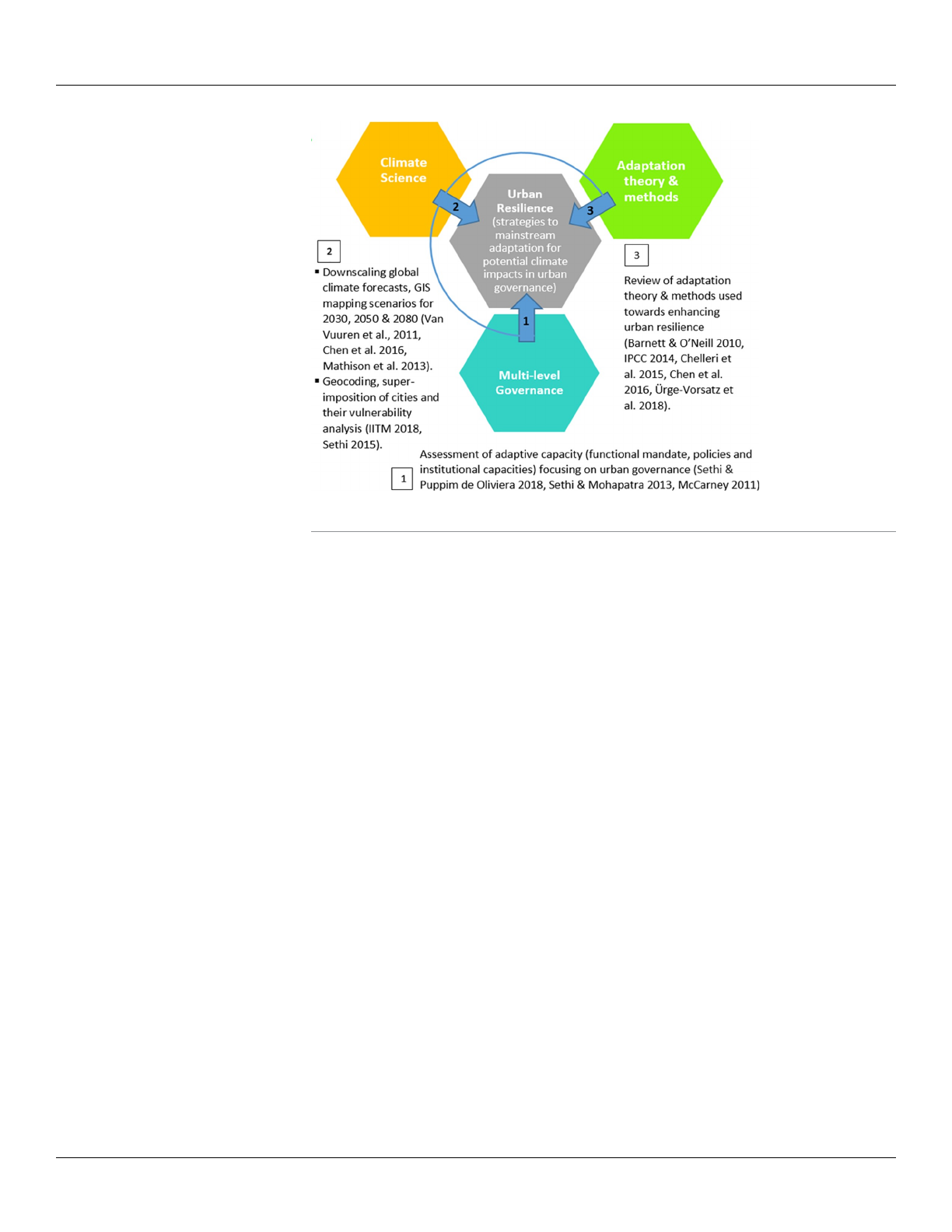
Based on the above theories, we formulate an integrated analytical framework (Fig 1), with the
following techniques (and data) outlined to be performed sequentially:
3.1. Multi-level governance assessment
We draw from secondary sources of information spanning from 1992 to 2020, essentially in
the form of policy studies and peer-reviewed papers, to conduct a qualitative assessment of
multi-level governance systems, especially relevant to urban areas [10,28,51,52]. This assess-
ment of the state of the affairs on the ground focuses on three core governance domains,
namely functional mandate, plans and policies, and institutional capacities of Indian cities.
3.2. Simulating local climate scenarios
Using data from the Indian Institute of Tropical Meteorology (IITM) on their climate data
portal [53], we retrieved the RCP 4.5 and 8.5 climate scenarios from the Coordinated Regional
Downscaling Experiment (CORDEX. Here, we utilize techniques for downscaling global cli-
mate forecasts [54–56], mapping regional temperature (˚C) and precipitation changes (in
PLOS ONE
Negotiating complexity of climate science, adaptation and multi-level governance in urban resilience
PLOS ONE | https://doi.org/10.1371/journal.pone.0253904 July 1, 2021 4 / 21
mm/day) across different geographic regions in Arc Map (version 10.2) for 2030, 2050 & 2080
and geocoding, super-imposition of cities for their vulnerability assessment [57]. The data
sources and technique are elaborated in S1 Appendix.
3.3. Assessment of adaptation alternatives
On the basis of analyzing long-term forecasted climate scenarios and governance capacity of
Indian cities, we identify adaptation options for definite climate impacts (temperature rise and
extreme rainfall as the two primary ones, and sea-level rise and landslide as the secondary ones)
for five key urban sectors in India, namely water, infrastructure, buildings, urban planning and
health. In doing so, we refer to urban adaptation assessment and prioritization methods [3,58–
60]. We evaluate these on the basis of (1) priority (medium, high, very high), (2) implementation
time (short-, mid- and long-term) and (3) intervention level (State, city, sub-city, building, etc.).
3.4. Negotiating resilience into governance
Based on definite adaptation measures in key urban sectors, we infer specific policy actions
and governance mechanisms to be undertaken by different stakeholders at multiple scales. We
expand matrix methods used in individual cities [50] to infer negotiated climate resilience
measures for national, state and local levels of governance, particularly focusing on their inter-
nalization into different types of urban policies and plans.
4. Discussion of results
4.1. Multi-level governance assessment in India
The multi-level governance of environment and climate identifies the gaps and needs in the
functional mandates, plans and policies, and the institutional capacities of Indian cities, as
elaborated:
Fig 1. Theoretical framework for integrating climate science, adaptation theory and urban governance to deal
with complex issues in urban resilience.
https://doi.org/10.1371/journal.pone.0253904.g001
PLOS ONE
Negotiating complexity of climate science, adaptation and multi-level governance in urban resilience
PLOS ONE | https://doi.org/10.1371/journal.pone.0253904 July 1, 2021 5 / 21
Loading more pages...