48 | Soft Matter, 2022, 18, 48–52 This journal is © The Royal Society of Chemistry 2022
Cite this: Soft Matter, 2022,
18, 48
On the cross-streamline lift of microswimmers in
viscoelastic flows†
Akash Choudhary * and Holger Stark *
The current work studies the dynamics of a microswimmer in
pressure-driven flow of a weakly viscoelastic fluid. Employing a
second-order fluid model, we show that a self-propelling swimmer
experiences a viscoelastic swimming lift in addition to the well-
known passive lift that arises from its resistance to shear flow. Using
the reciprocal theorem, we evaluate analytical expressions for the
swimming lift experienced by neutral and pusher/puller-type swim-
mers and show that they depend on the hydrodynamic signature
associated with the swimming mechanism. We find that, in com-
parison to passive particles, the focusing of neutral swimmers
towards the centerline can be significantly accelerated, while for
force-dipole swimmers no net modification in cross-streamline
migration occurs.
Biological microswimmers are ubiquitous in polymeric media
such as cervical, bronchial, and intestinal mucus films.
1,2
During the generation of biofilms most bacteria release a
mixture of proteins, DNA, and polysaccharides, endowing the
fluid with viscoelastic properties,
3,4
which significantly alter the
swimmer’s dynamics.
5,6
Pathogens like ulcer-causing Helico-
bacter pylori survive in a harsh acidic environment by altering
the rheology of the mucus lining in the stomach.
7
Several
theoretical and experimental studies on the dynamics of motile
microorganisms in Newtonian flows have revealed their rich
dynamics and ability to swim against fluid flows, which aids in
seeking nutrients and in reproduction.
8–15
Although recent works have provided insights into self-
propulsion in non-Newtonian environments,
15–32
few have stu-
died the impact of fluid rheology on the dynamics of micro-
swimmers in confined flows.
33–36
Mathijssen et al.
33
developed
a model to predict the dynamical states of microswimmers in
non-Newtonian Poiseuille flows. Employing a second-order
fluid model, they demonstrated that normal-stress differences
reorient the swimmers to cause centerline upstream migration
(rheotaxis). This suggests that non-Newtonian properties can
help microorganisms evade the boundary accumulation, pre-
valent in quiescent Newtonian fluids.
37,38
The evidence of centerline reorientation of microswimmers
can be traced back to pioneering studies on viscoelastic focus-
ing of passive particles in Poiseuille flows.
39–41
These studies
showed that normal stresses exert a lift force that focuses the
particles on the centerline. Ho and Leal
41
used the reciprocal
theorem and derived an analytical expression for this lift in
weakly elastic Boger fluids. The study suggested that the
hydrodynamic disturbances around the particle produce a
hoop stress that, in the presence of non-uniform shear rate,
generates a cross-streamline lift. Recent progress in
electrophoresis
42–44
has also shed light on the importance of
hydrodynamic disturbances in determining these lift forces.
Active microswimmers, as opposed to passive particles,
generate additional disturbance flow fields in the fluid due to
their self-propulsion. Therefore, the associated lift force or
velocity should also have an active component that is charac-
teristic of the self-propulsion mechanism. Since this compo-
nent is absent in the recently proposed models,
33
in this
communication we derive the ‘swimming lift’ in a second-
order fluid (SOF), and show how it affects the dynamics of a
microswimmer in the Poiseuille flow of a viscoelastic fluid. We
choose the SOF model because it provides an asymptotic
approximation for a majority of slow and slowly varying viscoe-
lastic flows.
45,46
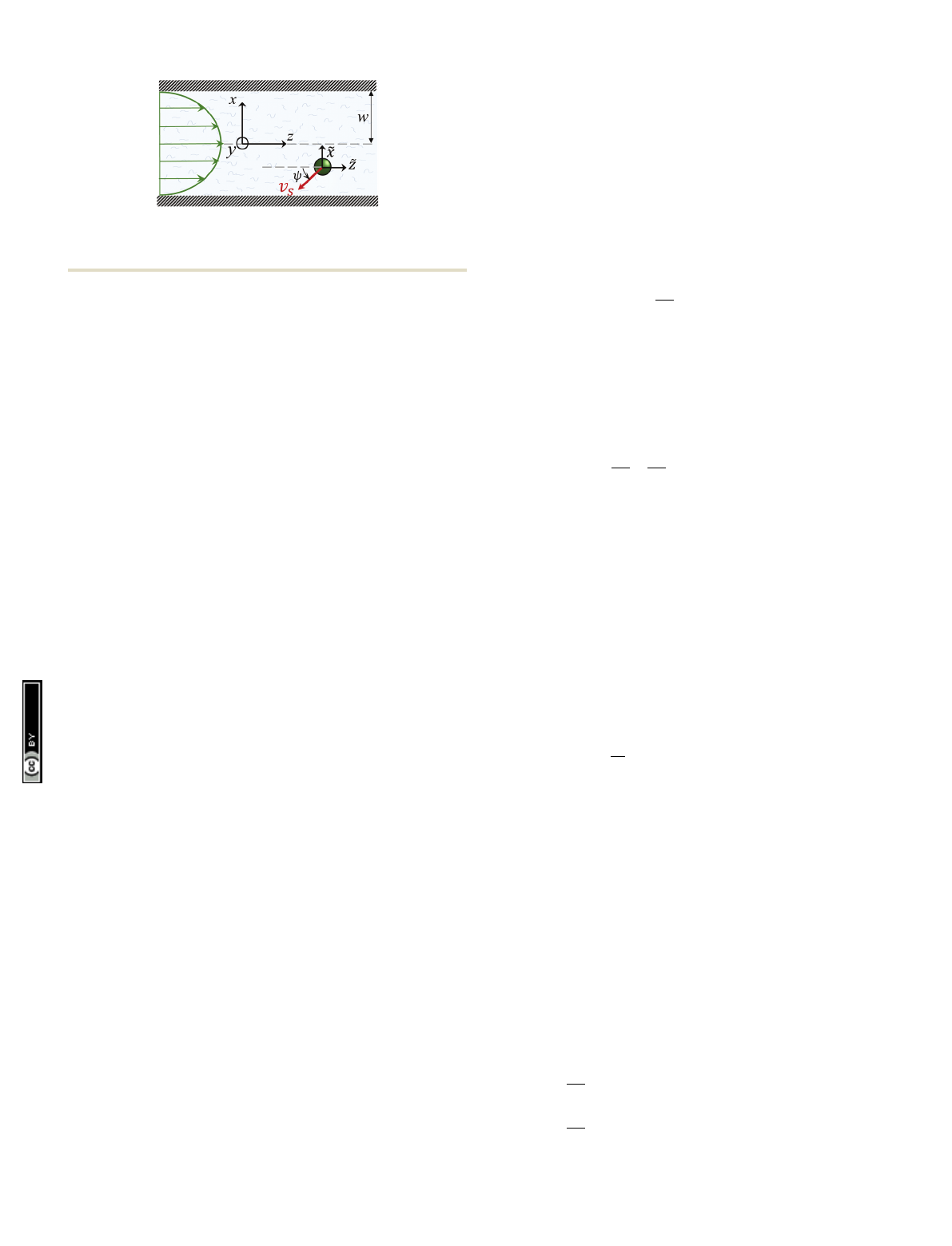
Fig. 1 shows a spherical swimmer of radius aat position r
that self-propels with velocity v
s
=v
s
pin a two-dimensional
pressure-driven flow v
f
=v
m
[1 (x/w)
2
]e
z
, where v
m
is the
maximum flow velocity and wis the half channel width. The
flow profile of the second-order fluid is identical to Poiseuille
flow but the pressure field varies in the x-direction.
41
In the
absence of noise, the swimmer’s dynamics is governed by
_
r¼pþ
vfþFðx;pÞex;_
p¼1
2r
vfÞp;ð(1)
Institute of Theoretical Physics, Technische Universita
¨t Berlin, 10623 Berlin,
†Electronic supplementary information (ESI) available. See DOI: 10.1039/
d1sm01339d
Received 15th September 2021,
Accepted 24th November 2021
DOI: 10.1039/d1sm01339d
rsc.li/soft-matter-journal
Soft Matter
COMMUNICATION
Open Access Article. Published on 24 November 2021. Downloaded on 4/11/2022 7:57:27 AM.
This article is licensed under a
Creative Commons Attribution 3.0 Unported Licence.
View Article Online
View Journal
| View Issue
This journal is © The Royal Society of Chemistry 2022 Soft Matter, 2022, 18, 48–52 | 49
where the velocities are non-dimensionalized by swimming speed
(%
v
f
=v
f
/v
s
,%
v
m
=v
m
/v
s
), lengths by w,andtimebyw/vs. Fdenotes the
total viscoelastic lift velocity, which comprises the passive and
swimming lift. Below, we derive the analytical expressions for the
lift velocities. We note that normalstressesalsomodifytheparticle
rotation and the drift velocity along the channel axis. We evaluated
these modifications and found that they do not play a significant
role in determining the swimmer dynamics.
The inertia-less or creeping flow hydrodynamics is governed
by the continuity equations for mass and momentum, which we
formulate here in the co-moving swimmer frame {x
˜,y
˜,z
˜} as:
~
rV¼0;~
rT¼0(2)
in order to calculate the viscoelastic lift velocity. The length,
velocity, and pressure in (2) are non-dimensionalized by a,kv
m
,
and mkv
m
/a, respectively. Here, kis the particle to channel
width ratio (a/2w) and mis the fluid viscosity. In the above
equation, Vis the total velocity field, Tis the total stress tensor
of a second-order fluid and thus has the form:
46
T=PI+2E+
WiS. Here, Edenotes the rate of strain tensor, Sthe total
polymeric stress tensor, and Wi = (C
1
+C
2
)G/mis the shear
based Weissenberg number, where mis the viscosity, G=v
m
/2w
characterizes the shear rate in the background flow, and C
1
,C
2
represents the dimensional steady-shear normal stress coeffi-
cients that are measured experimentally.
46
The polymeric stress
tensor S¼4EEþ2dE
Dis non-linear in Eand contains the
lower-convected time derivative of Edenoted by D. The visco-
metric parameter d=C
1
/2(C
1
+C
2
) generally varies from 0.5
to 0.7 for most viscoelastic fluids.
47–49
We now focus on determining the lift velocity of a micro-
swimmer that disturbs the background flow in two ways. First
of all, the microswimmer resists straining by the flow and
second, it generates a flow field characteristic of its swimming
mechanism, for which we first take a source-dipole swimmer.
We split the total velocity field (V=v
N
+v) into background
flow field v
N
(in our case the Poiseuille flow in the co-moving
swimmer frame) and disturbance field v, and adopt the same
nomenclature for the polymeric stress tensor, S=s
N
+s, where
sis the polymeric stress tensor associated with the disturbance
flow field. We show its full form in the ESI.†Substituting this in
the governing eqn (2) yields the equation for the disturbance
field v:
~
rv¼0;~
rpþ~
r2v¼Wið~
rsÞ:(3)
The methodology of evaluating the lift velocity closely follows
the recent analysis of Choudhary et al.
43
Here, we only sum-
marize the basics and elaborate on details in the ESI.†Assum-
ing weak viscoelasticity (Wi {1), we perform a perturbation
expansion in Wi and only take the first two contributions of
eqn (3) in this expansion: the Stokes equation for the zeroth
order of the disturbance field, ~
rp0þ~
r2v0¼0and ~
rp1þ
~
r2v1¼~
rs0for the first order. Following earlier works on
viscoelastic lift,
41,43
we use the reciprocal theorem to attain the
lift velocity from the first-order problem,
F¼
Wi
6pðVf
s0:~
rutdV:(4)
Here, u
t
is the auxiliary or test velocity field that belongs to a
forced particle moving along the x-direction with unit velocity
in a Newtonian fluid. The polymeric stress tensor s
0
is asso-
ciated with the Stokes solution v
0
of the microswimmer. The
zeroth order of the disturbance flow field consists of (i) a
source-dipole field, which we adopt from the squirmer
model,
50–52
vswim
0¼~
vsp
2~
r33~
r~
r
~
r2I
;and (ii) the passive distur-
bance field v
passive
0
, where v
˜
s
=v
s
/(v
m
k). For the latter, the
leading contribution is the stresslet, while higher-order terms
due to the curvature in the Poiseuille flow profile are obtained
from Lamb’s general solution.
53
The bounding channel walls
modify these bulk flow fields. However, by using the method of
reflections for small particles (k{1), one can show that they
do not alter the lift velocity in leading order in k.
43
Therefore,
it is sufficient to perform the integration in eqn (4) in the
infinite domain. Using the s
0
corresponding to Stokes velocity
field in eqn (4), results in the viscoelastic lift velocity given in
units of v
s
:
Fðx;cÞ¼F
passive þFswim
¼Wi 80
9x
vmk2ð1þ3dÞxð1þdÞcos c
:
(5)
The first component in eqn (5) is the passive lift Fpassive.
41
By
fixing dto a widely-used value of 0.5 (i.e. C
2
= 0), we observe
that Fpassive focuses the swimmer towards the centerline. The
second component is the swimming lift Fswim that arises due to
the source-dipole disturbance created by the neutral swimmer.
We note two striking features of Fswim: the dependence on
swimmer orientation through cos cand that its magnitude is
larger by a factor k
2
compared to the first term.‡
Now, we substitute Finto the dynamic eqn (1) and examine
the effect of Fswim on the microswimmer dynamics. We find
two fixed points in the x–cplane at x= 0, with the micro-
swimmer oriented upstream (c= 0) or downstream (c=p). A
linear stability analysis provides the following eigenvalues for
these fixed points:
lup Wi
18 9ð1þdÞþ80ð1þ3dÞk2
vm
i
vm1=2;
ldown Wi
18 9ð1þdÞþ80ð1þ3dÞk2
vm
vm1=2:
(6)
Fig. 1 A spherical microswimmer with velocity v
s
pmoves in a pressure-
driven flow of a second-order fluid inside a channel with half width w.The
coordinate frame {x
˜,y
˜,z
˜} co-moves with the swimmer.
Communication Soft Matter
Open Access Article. Published on 24 November 2021. Downloaded on 4/11/2022 7:57:27 AM.
This article is licensed under a
Creative Commons Attribution 3.0 Unported Licence.
View Article Online
50 | Soft Matter, 2022, 18, 48–52 This journal is © The Royal Society of Chemistry 2022
For a typical value of d=0.5 and weak viscoelasticity limit
(Wi {1), the downstream orientation corresponds to a saddle
fixed point (associated with l
down
), while the upstream orienta-
tion and swimming along x= 0 corresponds to a stable fixed
point (associated with l
up
). For d=0.5, the sign of the real
part of l
up
shows that both swimming and passive lift compo-
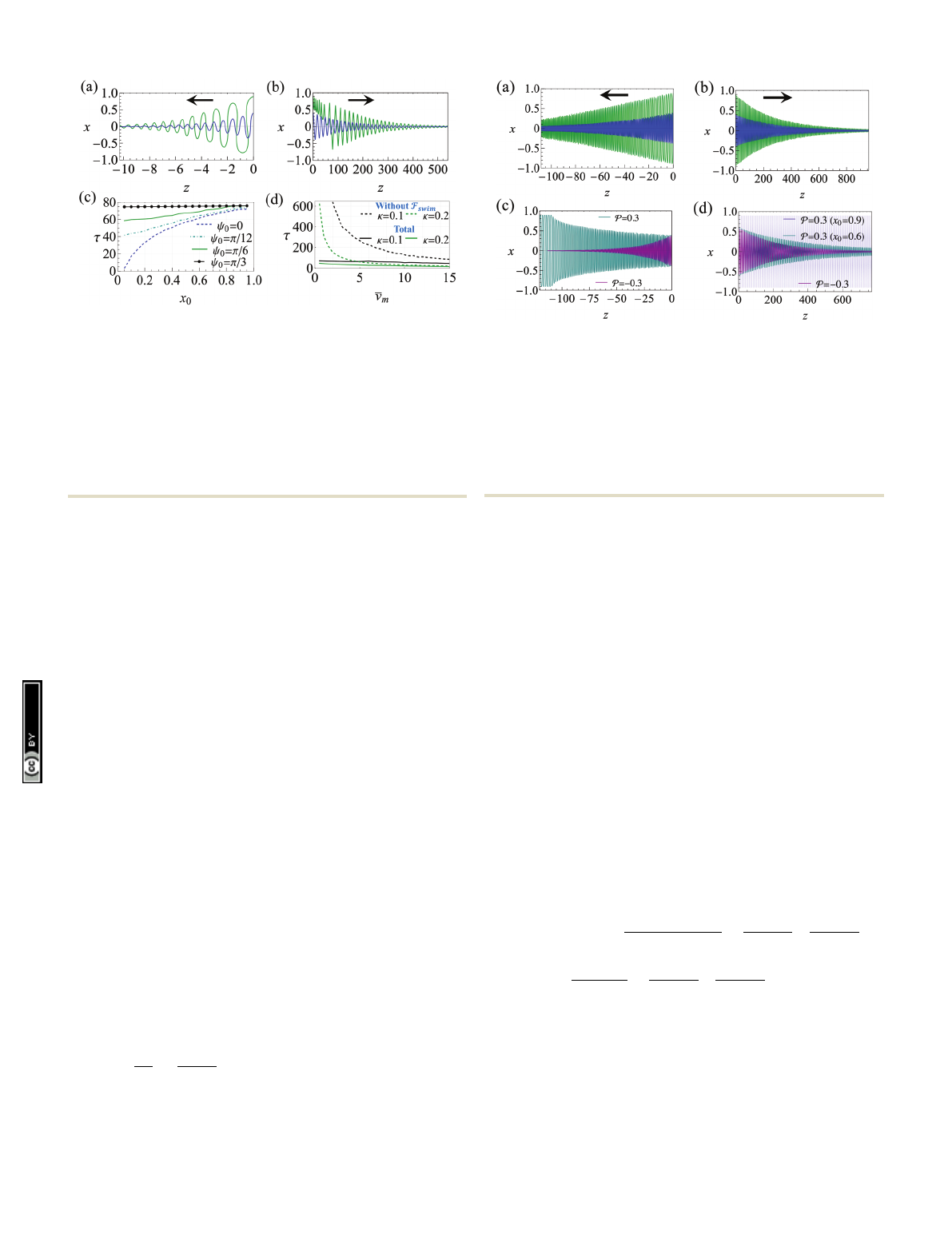
nents stabilize the upstream orientation. Fig. 2(a) and (b) show
the upstream and downstream trajectories of the swimmer. In
both cases the swimmer attains the upstream orientation,
which is stabilized by both Fpassive and Fswim. The strong
swimming lift helps the neutral microswimmer reach the
centerline more rapidly, as suggested by the factor of k
2
in
eqn (5). To quantify this accelerated focusing, we calculate the
focusing time tas the time required for the oscillatory ampli-
tudes to decrease to 5% of the half channel width, i.e.,x= 0.05.
For upstream swimming at low flow rate (%
v
m
= 0.9), Fig. 2(c)
shows how the focusing time changes with initial position and
orientation. We further evaluate the impact of Fswim on the
focusing time in Fig. 2(d). At low flow rates (%
v
m
B1), the
centerline focusing is much faster when Fswim is taken into
account, however, this difference withers as the flow rate
increases; this can also be observed from the analytical expres-
sion (5). We further analyze the focusing time over a wider
range of parameters in the ESI.†
Now, we shift our attention from neutral squirmers to
flagellated microorganisms, such as E. coli and Chlamydomo-
nas, that generate a force-dipole field at the leading order:
37,54
v0¼P
~
vsr1
r3þ3rpðÞ
2
r5
"#
. Here Pis the force-dipole strength in
units of 8pma
2
v
s
, which depends on the swimming
mechanism.
37,55,56
Earlier studies on E. coli
56,57
and Chlamydo-
monas
58
suggest that P
jj
varies roughly between 0.04 and 0.3.
Following the procedure outlined for a source-dipole swimmer,
we obtain the swimming lift velocity of the force-dipole swim-
mer in the units of v
s
as
Fswim ¼ð8=3ÞWikPð1þ3dÞsin 2c;(7)
and find it to depend on the constant curvature in Poiseuille
flow, as detailed in the ESI.†Although this lift is O(k
1
) larger
than Fpassive, it does not result in net cross-stream migration
because it is independent of lateral position. The trajectories in
Fig. 3(a) and (b) show the dynamics of a force-dipole swimmer.
In the steady state, the swimmer shows a stable upstream
orientation and swims along the centerline since a deviation
from c= 0 is counteracted by flow vorticity. For c=0,Fswim
vanishes and the focusing along the centerline is purely due to
Fpassive.
So far we have neglected the hydrodynamic interactions of
microswimmers with the bounding channel walls. For force-
dipole swimmers, the hydrodynamic wall interactions add a
modification of order k
2
and k
3
to the evolution equations of
position and orientation, respectively:
11,59
_
x¼sin cþF3Pð3 sin2c1Þ
8k21
ð1xÞ21
ð1þxÞ2
;
_
c¼x
vm3Psin 2c
16 k31
ð1xÞ3þ1
ð1þxÞ3
:
(8)
Upstream trajectories in Fig. 3(c) closely resemble the behavior
reported previously for pure Newtonian fluids.
11
We observe
that the hydrodynamic wall attraction of pushers
37
overcomes
Fpassive and results in swinging across the whole channel cross
section, where the strong vorticity near the walls always re-
orients the swimmer away from it. In contrast, for downstream
Fig. 2 Trajectories showing the centerline focusing of a neutral (source-
dipole) swimmer oriented upstream while (a) swimming upstream
(%
v
m
= 0.9, ’) and (b) swimming downstream (%
v
m
=8,-). The blue and
green trajectories only differ in the initial condition x
0
; for both trajectories
we choose c
0
= 0. Other parameters: Wi = 0.1, k= 0.1, d=0.5.
(c) Variation of focusing time tfor different initial conditions x
0
and c
0
.
Parameters: %
v
m
= 0.9, Wi = 0.1, k= 0.1. Trajectories are considered focused
when the amplitude of oscillations reaches x= 0.05. (d) Focusing time for
various flow rates and two different Fswim swimmer sizes. Dashed lines
depict the focusing time in the absence of Fswim. We plot the maximum
focusing time that occurs for the initial condition x
0
= 0.9, c
0
=0.
Fig. 3 Trajectories showing the centerline focusing of pusher P¼0:3
ðÞ
in
(a) upstream swimming (%
v
m
= 0.9, ’) and (b) downstream swimming
(%
v
m
=3,-). The trajectories for a puller are similar. The blue and green
trajectories in (a) and (b) only differ in the initial condition x
0
; for both
trajectories we choose c
0
= 0. (c) Upstream (%
v
m
= 0.9) and (d) downstream
trajectories (%
v
m
= 3) with hydrodynamic wall interactions (8) incorporated.
For the initial condition, x
0
= 0.9, the blue trajectory in the background of
(d) shows downstream swinging across the whole channel cross
section. We employ hard-core repulsion at the walls. Other parameters:
Wi = 0.1, k= 0.1, d=0.5.
Soft Matter Communication
Open Access Article. Published on 24 November 2021. Downloaded on 4/11/2022 7:57:27 AM.
This article is licensed under a
Creative Commons Attribution 3.0 Unported Licence.
View Article Online
This journal is © The Royal Society of Chemistry 2022 Soft Matter, 2022, 18, 48–52 | 51
swimming at larger flow rates [Fig. 3(d)], Fpassive competes with
the hydrodynamic wall interactions, which results in some
trajectories focusing at the centerline and some following
channel-wide swinging depending on the initial condition.
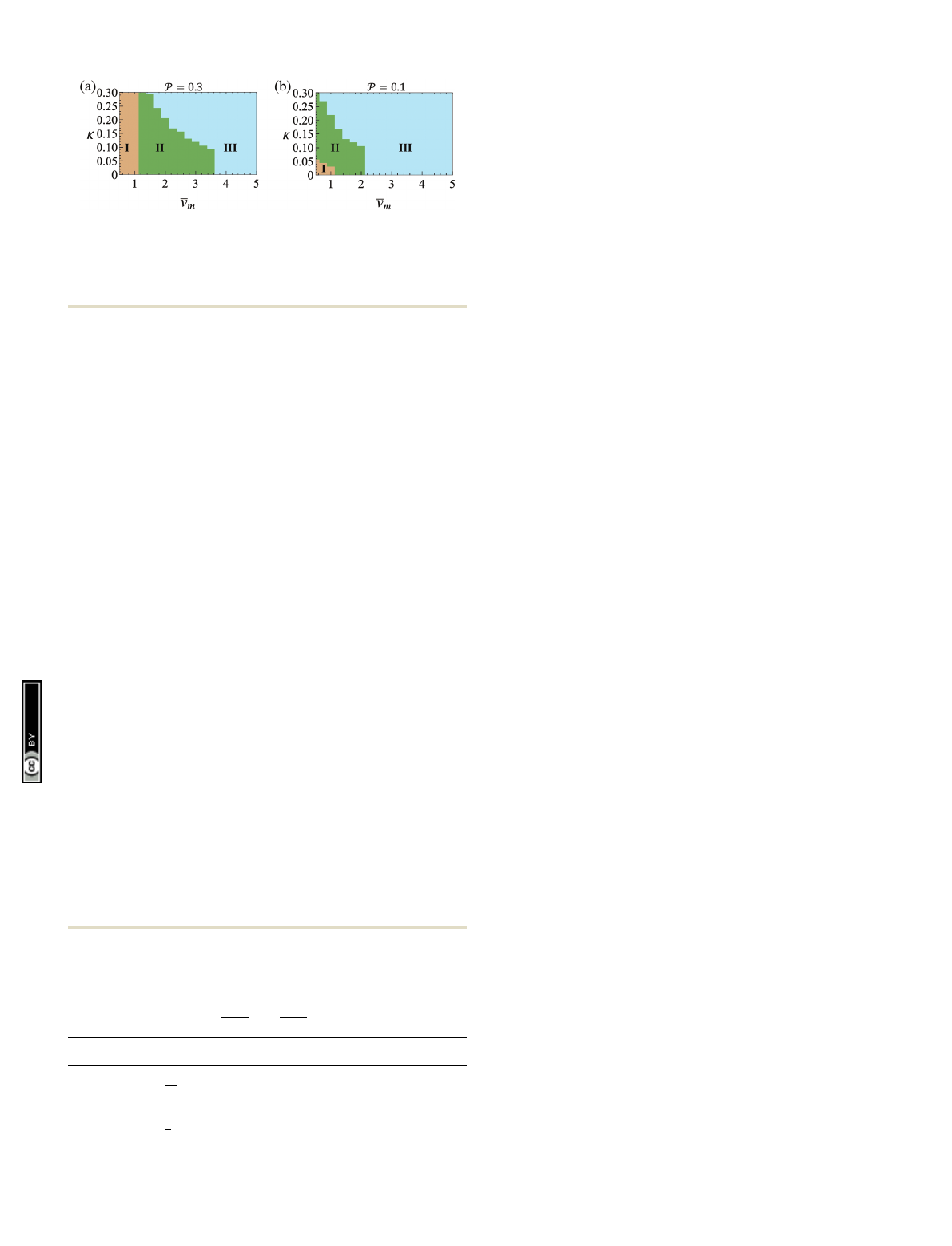
The state diagram in Fig. 4(a) illustrates this behavior of
pushers for a wide range of parameters. At low flow rates
(region I) hydrodynamic wall interactions dominate and thus
channel-wide swinging occurs. As the flow rate increases the
system enters region II. Here, the realized trajectories depend
on the initial condition as depicted in Fig. 3(d): swimmers
starting near the walls follow downstream swinging across the
channel cross-section, whereas swimmers near the center focus
at the centerline. A further increase in flow rate or swimmer
size increases the magnitude of Fpassive relative to wall effects,
which results in centerline focusing (region III). For the same
reason, as the force-dipole strength decreases [see Fig. 4(b)], the
regions of swinging state (region I) and coexisting states (region
II) shrink. Pullers, on the other hand, are hydrodynamically
repelled from the walls
11
and therefore always complement
Fpassive in centerline focusing [Fig. 3(c) and (d)]. We note that
for source-dipole swimmers the hydrodynamic wall interac-
tions are weaker compared to force dipoles since they scale
with k
3
, and therefore hardly influence the trajectories. In
Table 1, we list expressions for swimming lift and wall interac-
tions that alter the cross-stream migration.
In conclusion, the current study analyzes microswimmers in
weakly viscoelastic pressure-driven flows. For neutral and
pusher/puller microswimmers, we derive an additional swim-
ming lift velocity depending on the swimmer’s hydrodynamic
signature that adds to the passive viscoelastic lift.
33,41,60,61
For source-dipole (neutral) swimmers, the swimming lift is
two orders of magnitude stronger than the passive lift, which
was considered alone in a recent study.
33
The current work
shows that the swimming lift accelerates the centerline focus-
ing. For force-dipole swimmers (pusher/puller), the swimming
lift does not contribute to a net cross-streamline migration.
Incorporating hydrodynamic wall interactions, we show that
upstream swimming for weak flow strengths qualitatively fol-
lows the behavior in Newtonian fluids:
11
attraction of pushers
towards the channel walls and repulsion of pullers. The down-
stream swimming along the centerline qualitatively remains
the same as that of a passive particle. Finally, we stress that our
analysis is valid for an arbitrary swimming direction, which can
be decomposed in swimming along and perpendicular to the
shear plane.
Interestingly, the results suggest that normal stresses in
viscoelastic fluids generated by the flow field of a neutral
swimmer can accelerate the centerline focusing. However, this
strongly depends on the hydrodynamic signature of the micro-
swimmer. Even for a weakly viscoelastic fluid (Wi = 0.1), we
observe rapid focusing within a traveled distance of
10–500 times the channel width (Fig. 2), which amounts to
ca. 1–50 mm and is quite realistic for microfluidic channels.
Thereby, this work contributes to the understanding of swim-
ming in more realistic biological fluids. We note that higher
order multipoles like force quadrupole, rotlet dipole and so on,
will have their own Fswim. Therefore, we foresee further devel-
opment in understanding the trajectories of microswimmers
that exhibit higher order multipoles in their hydrodynamic
disturbance. Furthermore, the current work offers several new
directions to explore. For instance, elongated microswimmers,
like passive particles, perform Jeffery orbits in sheared New-
tonian fluids.
62
In viscoelastic fluids the flow disturbances from
swimming will alter the orientation evolution of these orbits
and hence the swimmer dynamics.
34
The impact of shear-
thinning fluids is also an interesting outlook, which can be
achieved by the use of more detailed rheological models.
46
Conflicts of interest
There are no conflicts to declare.
Acknowledgements
Support from the Alexander von Humboldt Foundation is
gratefully acknowledged.
Notes and references
‡The correction to the drift velocity in z-direction is Wixksin c(1 + d),
and the correction to rotation is found to be 2Wiksin c. We verified
that these modifications do not qualitatively alter the dynamics and
thus neglect their contributions for simplicity. Details are provided in
the ESI.†
1 S. S. Suarez and A. Pacey, Hum. Reprod. Update, 2006, 12,
23–37.
Fig. 4 State diagram for pushers (a) P¼0:3and (b) P¼0:1. Region I:
unstable trajectories that spiral out to result in channel-wide swinging,
Region III: stable centerline swimming, Region II: both dynamic states
coexist; they depend on the initial condition. Other parameters: Wi = 0.1,
c
0
=0.
Table 1 Summary of leading-order contributions in Wi that determine the
lift velocity of a microswimmer in the pressure-driven flow of a second-
order fluid. Here, SD and FD refer to source-dipole (neutral squirmer) and
force-dipole (pusher/puller) swimmers, respectively. In the third column 1/
e
n
represents the function 1
1x
n
1
1þx
n
Type Lift velocity pWi Wall contribution to :
x
Passive 80
9x
vmk2ð1þ3dÞ—
SD x(1 + d)cos c(sin c)k
3
/e
3
FD 8
3kPð1þ3dÞsin 2cð3=8ÞPð13 sin2cÞk2=e2
Communication Soft Matter
Open Access Article. Published on 24 November 2021. Downloaded on 4/11/2022 7:57:27 AM.
This article is licensed under a
Creative Commons Attribution 3.0 Unported Licence.
View Article Online
52 | Soft Matter, 2022, 18, 48–52 This journal is © The Royal Society of Chemistry 2022
2 R. Levy, D. B. Hill, M. G. Forest and J. B. Grotberg, Integr.
Comp. Biol., 2014, 54, 985–1000.
3 A. Persat, C. D. Nadell, M. K. Kim, F. Ingremeau,
A. Siryaporn, K. Drescher, N. S. Wingreen, B. L. Bassler,
Z. Gitai and H. A. Stone, Cell, 2015, 161, 988–997.
4 J. C. Conrad and R. Poling-Skutvik, Annu. Rev. Chem. Biomol.
Eng., 2018, 9, 175–200.
5 M. Jabbarzadeh, Y. Hyon and H. C. Fu, Phys. Rev. E, 2014,
90, 043021.
6 A. E. Patteson, A. Gopinath and P. E. Arratia, Curr. Opin.
Colloid Interface Sci., 2016, 100, 86–96.
7J.P.Celli,B.S.Turner,N.H.Afdhal,S.Keates,I.Ghiran,
C. P. Kelly, R. H. Ewoldt, G. H. McKinley, P. So and S. Erramilli,
et al.,Proc.Natl.Acad.Sci.U.S.A., 2009, 106, 14321–14326.
8 F. Bretherton and N. M. V. Rothschild, Proc. Biol. Sci., 1961,
153, 490–502.
9 J. Hill, O. Kalkanci, J. L. McMurry and H. Koser, Phys. Rev.
Lett., 2007, 98, 068101.
10 R. Nash, R. Adhikari, J. Tailleur and M. Cates, Phys. Rev.
Lett., 2010, 104, 258101.
11 A. Zo
¨ttl and H. Stark, Phys. Rev. Lett., 2012, 108, 218104.
12 A. Zo
¨ttl and H. Stark, Eur. Phys. J. E, 2013, 36, 1–10.
13 C.-k. Tung, F. Ardon, A. Roy, D. L. Koch, S. S. Suarez and
M. Wu, Phys. Rev. Lett., 2015, 114, 108102.
14 A. J. Mathijssen, N. Figueroa-Morales, G. Junot, E
´. Cle
´ment,
A. Lindner and A. Zo
¨ttl, Nat. Comm., 2019, 10, 1–12.
15 E. Lauga, The fluid dynamics of cell motility, Cambridge
University Press, 2020, vol. 62.
16 E. Lauga, Phys. Fluids, 2007, 19, 083104.
17 X. Shen and P. E. Arratia, Phys. Rev. Lett., 2011, 106, 208101.
18 L. Zhu, E. Lauga and L. Brandt, Phys. Fluids, 2012,
24, 051902.
19 O. S. Pak, L. Zhu, L. Brandt and E. Lauga, Phys. Fluids, 2012,
24, 103102.
20 N. C. Keim, M. Garcia and P. E. Arratia, Phys. Fluids, 2012,
24, 081703.
21 G. J. Elfring and E. Lauga, Complex fluids in biological
systems, Springer, 2015, pp. 283–317.
22 J. Sznitman and P. E. Arratia, Complex Fluids in Biological
Systems, Springer, 2015, pp. 245–281.
23 G. Li and A. M. Ardekani, J. Fluid Mech., 2015, 784, R4.
24 C. Datt, L. Zhu, G. J. Elfring and O. S. Pak, J. Fluid Mech.,
2015, 784, R1.
25 G. Li and A. M. Ardekani, Phys. Rev. Lett., 2016, 117, 118001.
26 G. Li and A. M. Ardekani, Eur. J. Comput. Mech., 2017, 26,
44–60.
27 T. R. Ives and A. Morozov, Phys. Fluids, 2017, 29, 121612.
28 C. Datt, G. Natale, S. G. Hatzikiriakos and G. J. Elfring,
J. Fluid Mech., 2017, 823, 675–688.
29 Y. Zhang, G. Li and A. M. Ardekani, Phys. Rev. Fluids, 2018,
3, 023101.
30 A. Zo
¨ttl and J. M. Yeomans, Nat. Phys., 2019, 15, 554–558.
31 A. Choudhary, T. Renganathan and S. Pushpavanam, J. Fluid
Mech., 2020, 899, A4.
32 J. P. Binagia, A. Phoa, K. D. Housiadas and E. S. Shaqfeh,
J. Fluid Mech., 2020, 900, A4.
33 A. J. Mathijssen, T. N. Shendruk, J. M. Yeomans and
A. Doostmohammadi, Phys. Rev. Lett., 2016, 116, 028104.
34 M. De Corato and G. D’Avino, Soft Matter, 2017, 13, 196–211.
35 A. M. Ardekani and E. Gore, Phys. Rev. E, 2012, 85, 056309.
36 A. Zhang, W. L. Murch, J. Einarsson and E. S. Shaqfeh,
J. Nonnewton. Fluid Mech., 2020, 104279.
37 A. P. Berke, L. Turner, H. C. Berg and E. Lauga, Phys. Rev.
Lett., 2008, 101,038102.
38 D. Smith, E. Gaffney, J. Blake and J. Kirkman-Brown, J. Fluid
Mech., 2009, 621, 289–320.
39 A. Karnis and S. Mason, J. Rheol., 1966, 10, 571–592.
40 F. Gauthier, H. Goldsmith and S. Mason, J. Rheol., 1971, 15,
297–330.
41 B. Ho and L. Leal, J. Fluid Mech., 1976, 76, 783–799.
42 D. Li and X. Xuan, Phys. Rev. Fluids, 2018, 3, 074202.
43 A. Choudhary, D. Li, T. Renganathan, X. Xuan and
S. Pushpavanam, J. Fluid Mech., 2020, 898, A20.
44 A. Choudhary, T. Renganathan and S. Pushpavanam, Phys.
Rev. Fluids, 2021, 6, 036701.
45 L. Leal, J. Nonnewton. Fluid Mech., 1979, 5, 33–78.
46 R. B. Bird, C. F. Curtiss, R. C. Armstrong and O. Hassager,
Dynamics of polymeric liquids, fluid mechanics, Wiley, 1987,
vol. 1.
47 B. Caswell and W. Schwarz, J. Fluid Mech., 1962, 13,
417–426.
48 L. Leal, J. Fluid Mech., 1975, 69, 305–337.
49 D. L. Koch and G. Subramanian, J. Nonnewton. Fluid Mech.,
2006, 138, 87–97.
50 M. Lighthill, Commun. Pure Appl. Math., 1952, 5, 109–118.
51 J. R. Blake, J. Fluid Mech., 1971, 46, 199–208.
52 A. Zo
¨ttl and H. Stark, J. Phys.: Condens. Matter, 2016,
28, 253001.
53 H. Lamb, Hydrodynamics, Cambridge, Cambridge University
Press, 6th edn, 1975.
54 T. Pedley and J. O. Kessler, Annu. Rev. Fluid Mech., 1992, 24,
313–358.
55 K. Drescher, R. E. Goldstein, N. Michel, M. Polin and
I. Tuval, Phys. Rev. Lett., 2010, 105, 168101.
56 K. Drescher, J. Dunkel, L. H. Cisneros, S. Ganguly and
R. E. Goldstein, Proc. Natl. Acad. Sci. U. S. A., 2011, 108,
10940–10945.
57 S. Chattopadhyay, R. Moldovan, C. Yeung and X. Wu, Proc.
Natl. Acad. Sci. U. S. A., 2006, 103, 13712–13717.
58 I. Minoura and R. Kamiya, Cell Motil. Cytoskeleton, 1995, 31,
130–139.
59 S. E. Spagnolie and E. Lauga, J. Fluid Mech., 2012, 700,
105–147.
60 E. F. Lee, D. L. Koch and Y. L. Joo, J. Nonnewton. Fluid Mech.,
2010, 165, 1309–1327.
61 G. D’Avino, F. Greco and P. L. Maffettone, Ann. Rev. Fluid
Mech., 2017, 49, 341–360.
62 G. B. Jeffery, Proc. Math. Phys. Eng., 1922, 102, 161–179.
Soft Matter Communication
Open Access Article. Published on 24 November 2021. Downloaded on 4/11/2022 7:57:27 AM.
This article is licensed under a
Creative Commons Attribution 3.0 Unported Licence.
View Article Online
Loading more pages...