
Environ. Res. Lett. 16 (2021) 113003 https://doi.org/10.1088/1748-9326/ac1b58
OPEN ACCESS
RECEIVED
30 December 2018
REVISED
25 June 2021
ACCEPTED FOR PUBLICATION
6 August 2021
PUBLISHED
21 October 2021
Original content from
this work may be used
under the terms of the
Creative Commons
Attribution 3.0 licence.
Any further distribution
of this work must
maintain attribution to
the author(s) and the title
of the work, journal
citation and DOI.
TOPICAL REVIEW
Coal transitions—part 1: a systematic map and review of case
study learnings from regional, national, and local coal phase-out
experiences
Francesca Diluiso1,∗, Paula Walk2, Niccol`
o Manych1,2, Nicola Cerutti1, Vladislav Chipiga1,
Annabelle Workman3, Ceren Ayas3, Ryna Yiyun Cui4, Diyang Cui4, Kaihui Song4,5,
Lucy A Banisch1, Nikolaj Moretti1, Max W Callaghan1,6, Leon Clarke4, Felix Creutzig1, Jéroˆme Hilaire1,7,
Frank Jotzo8, Matthias Kalkuhl1,9, William F Lamb1,6, Andreas Löschel10, Finn Müller-Hansen1,7,
Gregory F Nemet11, Pao-Yu Oei2,12, Benjamin K Sovacool13, Jan C Steckel1,7, Sebastian Thomas14,
John Wiseman3,15 and Jan C Minx1,6
1Mercator Research Institute on Global Commons and Climate Change, Torgauer Straße 12–15, EUREF Campus #19, 10829 Berlin,
Germany
2TU Berlin, Str. des 17. Juni 135, 10623 Berlin, Germany
3Climate and Energy College, University of Melbourne, 187 Grattan Street, Carlton, Victoria 3053, Australia
4Center for Global Sustainability, University of Maryland, 3101 Van Munching Hall, College Park, MD 20742, United States of America
5Department of Geographical Sciences, University of Maryland, College Park, MD 20740, United States of America
6School of Earth and Environment, University of Leeds, Leeds LS2 9JT, United Kingdom
7Potsdam Institute for Climate Impact Research (PIK), Post Box 601203, 14412 Potsdam, Germany
8Australian National University, Crawford School of Public Policy, ANU, Canberra, ACT, 2601, Australia
9Faculty of Economic and Social Sciences, University of Potsdam, August-Bebel-Str. 89, 14482 Potsdam, Germany
10 Center for Applied Economic Research, University of Münster, Stadtgraben 9, 48143 Münster, Germany
11 University of Wisconsin-Madison, La Follette School of Public Affairs, 1225 Observatory Drive, Madison, WI 53706, United States of
America
12 Europa-Universität Flensburg, Center for Sustainable Energy Systems (ZNES), Munketoft 3b, 24937 Flensburg, Germany
13 Science Policy Research Unit, University of Sussex Business School, BN1 9SL Brighton, United Kingdom
14 Sustainable Engineering Group, Curtin University, Kent Street, Bentley 6102 Western Australia
15 Melbourne Sustainable Society Institute, University of Melbourne, Parkville, Victoria 3010, Australia
∗Author to whom any correspondence should be addressed.
E-mail: [email protected]
Keywords: climate change mitigation, coal transitions, evidence synthesis, political economy, systematic map
Abstract
A rapid coal phase-out is needed to meet the goals of the Paris Agreement, but is hindered by
serious challenges ranging from vested interests to the risks of social disruption. To understand
how to organize a global coal phase-out, it is crucial to go beyond cost-effective climate mitigation
scenarios and learn from the experience of previous coal transitions. Despite the relevance of the
topic, evidence remains fragmented throughout different research fields, and not easily accessible.
To address this gap, this paper provides a systematic map and comprehensive review of the
literature on historical coal transitions. We use computer-assisted systematic mapping and review
methods to chart and evaluate the available evidence on historical declines in coal production and
consumption. We extracted a dataset of 278 case studies from 194 publications, covering coal
transitions in 44 countries and ranging from the end of the 19th century until 2021. We find a
relatively recent and rapidly expanding body of literature reflecting the growing importance of an
early coal phase-out in scientific and political debates. Previous evidence has primarily focused on
the United Kingdom, the United States, and Germany, while other countries that experienced large
coal declines, like those in Eastern Europe, are strongly underrepresented. An increasing number of
studies, mostly published in the last 5 years, has been focusing on China. Most of the countries
successfully reducing coal dependency have undergone both demand-side and supply-side
© 2021 The Author(s). Published by IOP Publishing Ltd

Environ. Res. Lett. 16 (2021) 113003 F Diluiso et al
transitions. This supports the use of policy approaches targeting both demand and supply
to achieve a complete coal phase-out. From a political economy perspective, our dataset
highlights that most transitions are driven by rising production costs for coal, falling prices
for alternative energies, or local environmental concerns, especially regarding air pollution.
The main challenges for coal-dependent regions are structural change transformations, in
particular for industry and labor. Rising unemployment is the most largely documented
outcome in the sample. Policymakers at multiple levels are instrumental in facilitating coal
transitions. They rely mainly on regulatory instruments to foster the transitions and
compensation schemes or investment plans to deal with their transformative processes.
Even though many models suggest that coal phase-outs are among the low-hanging fruits
on the way to climate neutrality and meeting the international climate goals, our case
studies analysis highlights the intricate political economy at work that needs to be
addressed through well-designed and just policies.
1. Introduction
A rapid coal phase-out is a key step to achieve the
goal of keeping global warming well below 2 ◦C.
Several elements make the global energy transition
away from coal the main road to achieve climate
targets. Coal accounts for about a third of global
CO2emissions (Friedlingstein et al 2019), is the most
carbon intensive fossil fuel, has significant negat-
ive externalities on human health and environment,
and it is easier to replace than oil and gas (Luderer
et al 2018). Phasing out coal is thus becoming a pri-
ority on the agenda of many countries and polit-
ical debates increasingly focus on how coal exits
can be organized over the next few decades (Garg
and Steckel 2017). However, current national emis-
sion reduction commitments (nationally determined
contributions—NDCs) of major coal-producing and
-consuming countries fall short of the required ambi-
tion and do not include clear clauses for a coal
exit. A global coal phase-out remains the elephant
in the room of international climate negotiations
(Edenhofer 2015).
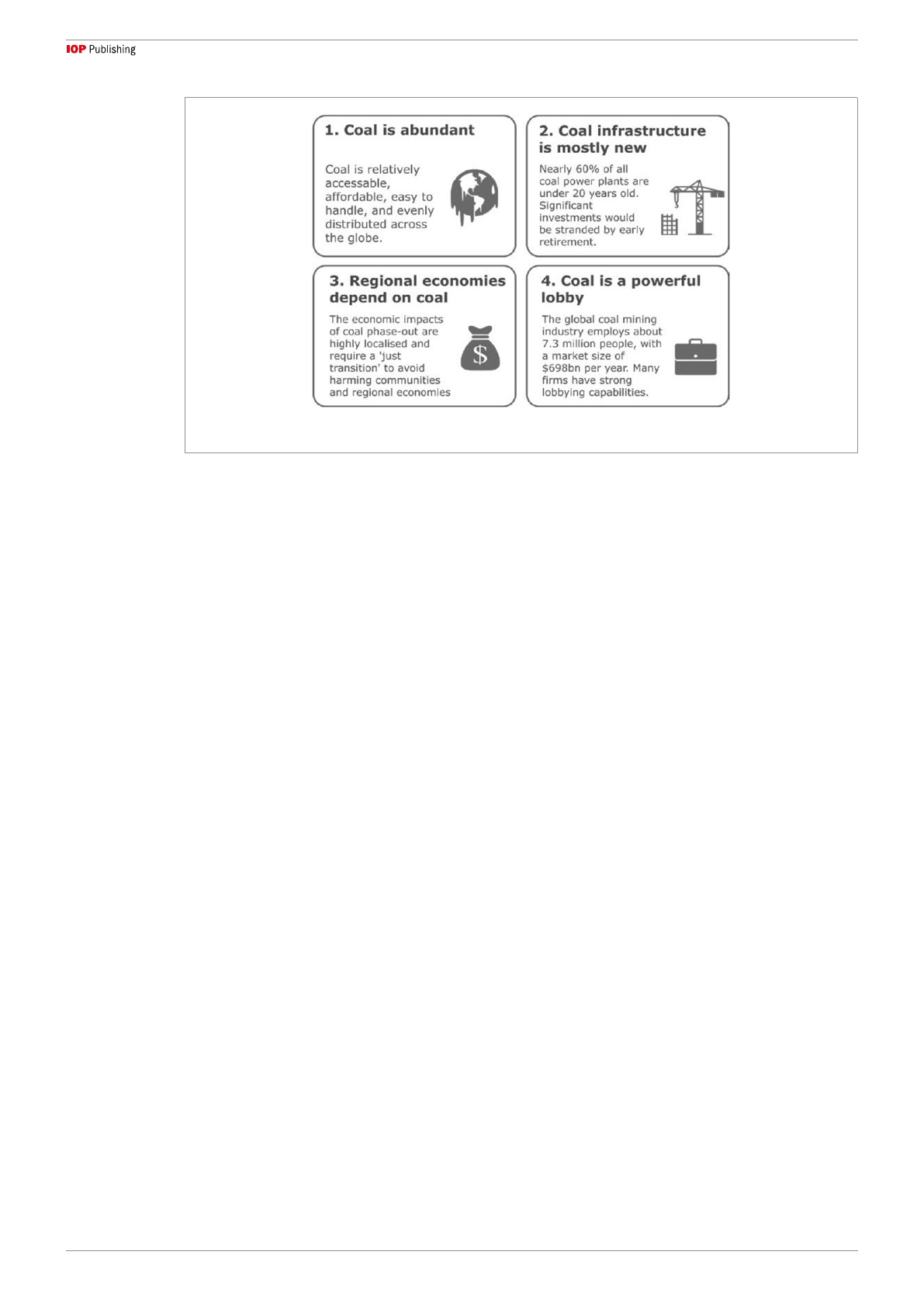
It is possible to identify four main arguments
as to why phasing out coal may prove, in prac-
tice, extremely challenging (figure 1). First, coal is
historically and even currently abundant, based on
established technologies, and relatively easy to handle
(Steckel et al 2020). Coal use also allows many devel-
oping countries, where electrification is still in pro-
gress, to access affordable and reliable electricity
(Kalkuhl et al 2019). Its relative accessibility and
distribution across the globe make it attractive for
many countries as the real societal costs of coal (i.a.
environmental degradation, air and water pollution,
forced relocations, and global heating) are not fully
internalized (Muller et al 2011, Cardoso 2015, Sova-
cool et al 2021). Environmental and health benefits
alone would outweigh the direct policy costs of a coal
phase-out (Rauner et al 2020). However, not tak-
ing all these societal costs into consideration, coal is
often falsely perceived as cheap. In addition, costs of
renewable energies are decreasing but are penalized
by high capital costs, especially in the Global South
(Schmidt 2014, Hirth and Steckel 2016). Alternatives
to coal have a higher capital intensity per Megawatt,
making them less attractive for low- and middle-
income countries (Steffen 2020). Finally, the major-
ity of the operating coal fleet is located in regu-
lated or semi-regulated markets and still benefits
fromdirect or indirect fossil fuel subsidies (Edenhofer
2015, Bodnar et al 2020). This creates an economic
and regulatory lock-in, decreasing the attractiveness
of alternative sources, even when competitive and
cheaper.
Second, 60% of all coal power plants, mostly
constructed in the Global South, are younger than
20 years. Coal-fired power plants require high ini-
tial capital costs, which have to be amortized along
the average life of the plant. These lifetimes can even
extend to half a century or more. Early retirement
would imply sunk investments for a large part of the
coal fleet, making coal plants stranded assets (Calde-
cott et al 2016).
Third, the coal industry is deeply rooted in the
culture and the economy of territories. Economic and
employment impacts from coal phase-out policies
are highly localized, making the phase-out a sensitive
issue in specific areas and for specific communities.
Local and national policymakers are therefore under
increasing pressure to guarantee a ‘just transition’
(Sartor 2018). This implies the management of short-
and medium-term costs of the phase-out through the
provision of an effective social security system, a shift
in the economicstructure of coal regions through well
designed investment plans, and the development of a
new collective territorial and cultural identity (Jabob
et al 2020b, Oei et al 2020, Pai et al 2020).
Fourth, the coal industry is a powerful economic
stakeholder with significant vested interests and lob-
bying power. The coal mining industry employs
about 7.3 million people worldwide, with a global
market size of $698bn per year (IBISWorld 2019).
Moreover, coal-dependent economies often share
2
Environ. Res. Lett. 16 (2021) 113003 F Diluiso et al
Figure 1. Four common arguments why phasing out coal is difficult.
an institutional design more susceptible to vested
interests and corruption (Lamb and Minx 2020).
Against this background, Paris-consistent mitig-
ation scenarios provided by Integrated Assessment
Models (IAMs) generally envisage a rapid and sub-
stantial decline of coal in the next 30 years (Rogelj
et al 2018, Cui et al 2019, Minx et al 2022). Even if
the trajectories arising from different scenarios and
different models are extremely heterogeneous, a con-
sensus is rising on the possibility of phasing out coal
fairly quickly and relatively easy compared to other
fossil fuels (Kriegler et al 2018). Although helpful
in translating mitigation targets into policy actions,
these scenarios cannot capture the full complexity of
coal phase-out dynamics and their political economy
aspects. These models usually adopt a cost-effective
approach that does not take into account the dis-
tinct patterns of constraints linked to coal depend-
ency. Politics often must face trade-offs in terms of
feasibility andease ofimplementation whichmaylead
to less cost-effective solutions. Even if not explicitly
introduced in the models, political economy con-
straints should be kept in mind while interpreting
policy scenarios. Another limitation of model-based
evidence comes from the fact that most of the mod-
els ignore climate damages as well as the potential co-
benefits of actions to limit warming, as, for example,
health and environmental benefits, that in the case
of a coal phase-out are extremely relevant. Other
issues include the limited geographical resolution of
IAMs, which generally model the global economy and
energy systemdividedinto tens ofregions, ratherthan
hundreds of countries. This lack of disaggregation
and granularity makes it hard to rescale the results to
the national or subnational level, while, as explained,
transitions away from coal impact, in particular, spe-
cific territories and communities with geographical
imbalances of losses and benefits constituting further
important challenges and barriers for the transition.
Finally, as a general remark, it is important to con-
sider that scenario projections are run under a wide
range of uncertainties, ranging from implementation
of climate actions, availability and costs of technolo-
gies, and socio-economic and lifestyle changes. The
degree to which emissions can be reduced in the
short-medium run ultimately depends on the polit-
ical willingness, the plurality of interests, and tech-
nology and demand patterns that are crucial in shap-
ing the opportunity costs of the phase-out. Therefore,
while evidence coming from IAMs suggests a rapid
coal phase-out, there is a potential wedge between
policy actions that are efficient and effective, as sug-
gested by models, and the ones that are feasible1.
Linking model-based scenarios and political eco-
nomy considerations is thus important for identify-
ing viable pathways to climate change mitigation. To
provide solution-oriented knowledge it is useful to
draw on historical evidence of previous coal trans-
itions, to understand common patterns and key les-
sons from countries that have already experienced
declines in coal production and/or consumption.
Despite the relevance of the topic, evidence remains
fragmented throughout different research fields, and
not easily accessible. Some recent works on coal trans-
itions have provided a series of case-studies evidence
on coal phase-outs in major coal-consuming eco-
nomies (Caldecott et al 2017, Sartor 2018). While
these have been important early efforts, the number
of countries and case studies considered is limited,
specifically selected, and the work is undertaken with
no employment of systematic methods for assessing
the literature. To address this gap, this paper provides
a systematic map and comprehensive review of the
literature on historical coal transitions, with a specific
1For a comprehensive assessment of scenario evidence on coal
transitions in mitigation scenarios consistent with the Paris Agree-
ment see part 2 of this review (Minx et al 2022).
3

Environ. Res. Lett. 16 (2021) 113003 F Diluiso et al
focus on the different political economy dimensions
associated with a sustained decline in coal produc-
tion or consumption. To the best of our knowledge,
this is the first attempt to systematically character-
ize the literature landscape on past coal transitions.
In the spirit of our systematic exercise, the paper
develops around the following main research ques-
tion: what evidence exists on previous coal transitions?
The goal is to retrieve the evidence available in Eng-
lish to (a) understand main transition patterns across
countries and identify knowledge gaps and know-
ledge clusters and (b) provide an overview of different
political economy aspects of the transitions that have
been mentioned by previous studies. To deal with the
vast amount of literature and the rapid expansion
of evidence across disciplines, we rely on computer-
assisted techniques and machine learning algorithms
to find, screen, and identify the relevant literature
(Haddaway et al 2020). We identified 194 publica-
tions from 42 713 search results using a supervised
active learning approach that trained a support vec-
tor machine model using 1–2 word ngrams from the
article abstracts2. From these publications we coded
278 studies, collecting information on type of trans-
ition experienced, drivers and barriers, outcomes,
and policy instruments. In the first part of the ana-
lysis we map the literature on historical episodes of
declines in coal production and consumption in dif-
ferent periods and locations to answer the following
question: what happened, where, and when? The aim
is to identify common trends and transition waves
across countries and periods and to detect know-
ledge clusters and knowledge gaps, by confronting
the literature landscape with data on coal production
and consumption. In the second part of the paper
we want to shed light on political economy aspects
and answer the following research questions: what
were the main drivers and barriers for past coal trans-
itions? What have been the main outcomes of previous
coal-phase outs? Which actors have been involved and
which policy instruments have been adopted to address
the transformative processes required by the trans-
ition? Answering these questions can provide useful
policy insights and contribute to the understanding
of how to manage the rapid coal phase-out needed
to address the challenges at hand of global climate
stability.
The remainder of the paper is organized as fol-
lows. Section 2provides an overview of the current
state and trends of coal production and consump-
tion; section 3describes the research design adop-
ted in the paper; sections 4and 5present the res-
ults of our systematic map of the literature; section 6
discusses the main findings and provides some con-
cluding remarks.
2For an overview of this approach and its replicability see O’Mara-
Eves et al (2015).
2. Coal production and consumption:
current trends and historical declines
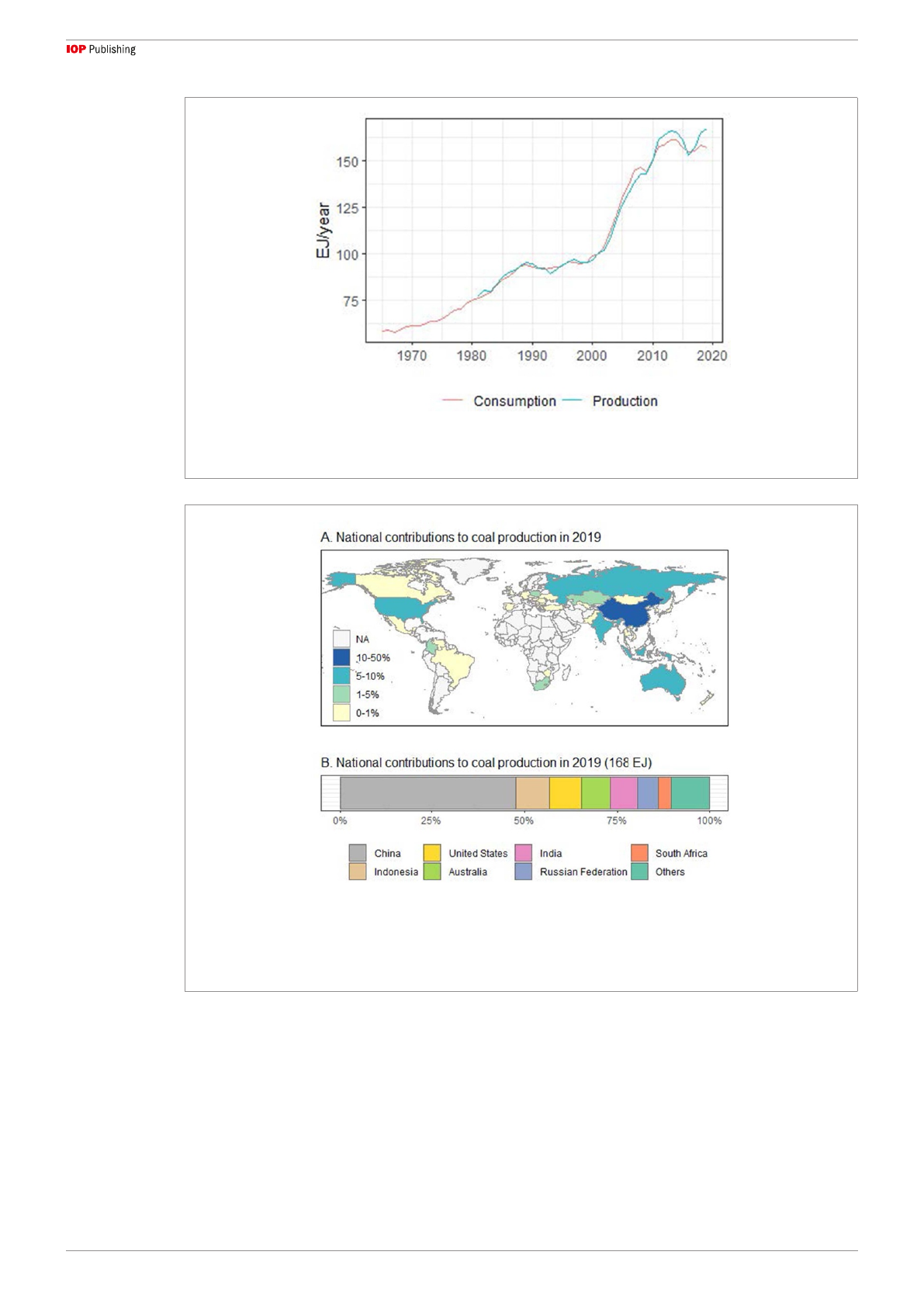
Global coal production and consumption has
increased three-fold over the past 50 years (figure 2).
Coal is the second-largest energy source after oil,
accounting for 27% of primary energy consumption
(BP 2020), and is the primary source for electricity
generation (IEA 2020a). Despite a growing awareness
of climatechange, as well as progressive climate policy
in some nations, the fastest period of global coal
growth occurred in the early 2000s (figure 2). This
‘renaissance of coal’ was led by China, but also took
place in many rapidly growing economies (Steckel
et al 2015, Jiang and Guan 2016).
Nonetheless,most coalproductionand consump-
tion remains concentrated in a small number of coun-
tries. Looking at the distribution of coal production
we see that seven countries, namely China, Indone-
sia, the United States, Australia, India, the Russian
Federation, and South Africa account for almost 90%
of world production (figure 3). The consumption
of coal is similarly concentrated: China is the major
consumer, followed by India and the United States,
which, together with Japan, South Africa and the
Russian Federation, make up 80% of the total con-
sumption (figure 4)3. The strong demand for coal in
Asia favors the Pacific exporters: looking at the coal
trade balance, Australia and Indonesia account for
more than half of the total coal export, with China
being the major coal importer, followed by India (IEA
2020a).
Global growth in coal production and consump-
tion stabilized between 2010 and 2019 (figure 2).
This triggered much speculation on whether global
CO2emissions may have peaked around 2016, which
turned out to be premature when emissions started to
rise in subsequent years (Jackson et al 2016, Figueres
et al 2018, Peters et al 2020). The underlying trend
was strongly driven by coal dynamics, particularly in
China, which experienced a slowdown in economic
growth after 2010 and limited the investment in new
coal capacity (Friedlingstein et al 2019, Peters et al
2020).
Whether or not a peak in coal production and
consumption has been reached depends on a regional
outlook and balance of trends. Coal production and
consumption are following a declining trend in the
United States and in most of the European countries,
however this decrease is offset by a larger production
and consumption by Asian economies, in particular
Indonesia. Europe is rapidly reducing coal consump-
tion dependency. In 2015, the UK, formerly ‘king
coal’, was a frontrunner in announcing an explicit
3These six countries, together with the Republic of Korea, Indone-
sia, Germany, Vietnam, Poland, Australia, Turkey, and Kazakh-
stan (in order or consumption) account for 90% of global coal
consumption.
4
Environ. Res. Lett. 16 (2021) 113003 F Diluiso et al
Figure 2. Global coal production and consumption. Source of data: BP (2020). Production refers to commercial solid fuels only,
i.e. bituminous coal and anthracite (hard coal), and lignite and brown (sub-bituminous) coal, and other commercial solid fuels. It
includes coal produced for coal-to-liquids and coal-to-gas transformations.
Figure 3. Coal production worldwide. Panel (A) shows country coverage and national contributions to global coal production
(%). Panel (B) lists the countries that account for more than 90% of global coal production. Source of data: BP (2020).
Production refers to commercial solid fuels only, i.e. bituminous coal and anthracite (hard coal), and lignite and brown
(sub-bituminous) coal, and other commercial solid fuels. It includes coal produced for coal-to-liquids and coal-to-gas
transformations. NA values in panel A do not necessarily indicate 0 coal production, but missing data where BP has aggregated
smaller producers into an ‘other’ category where individual national values cannot be distinguished.
coal phase-out (Brauers et al 2020). Since then, 14
other European countries committed to phase-out
coal generation by 2030 (EMBER 2019). Exceptions
are Belgium, which managed to become coal-power-
free already in 2016, as well as Germany and Czech
Republic, which agreed on a phase-out by 2038 (even
if in Germany there is the possibility of bringing the
phase-out date forward to 2035).
The United States did not declare a phase-out
date but showed no plans to build new coal plants
either. The coal-fired capacity in the United States has
been declining since 2011, after many plants retired
or switched to other fuels and the utilization rate of
running plants was reduced (EIA 2020). Neverthe-
less, about 500 GW of new coal-fired power plants
are globally planned or already under construction,
foremost in Asia (Global Energy Monitor 2020).
The successful construction (and utilization) of these
capacities in China, India, and other Asian coun-
tries would counterbalance current and prospective
reductions of coal use in the United States and Europe
and fail climate targets.
5
Loading more pages...