Citation: Xia, F.; Ye, S.; Chen, D.;
Tang, L.; Wang, C.; Ge, M.; Neitzel, F.
Advancing the Solar Radiation
Pressure Model for BeiDou-3 IGSO
Satellites. Remote Sens. 2022,14, 1460.
https://doi.org/10.3390/rs14061460
Academic Editor: Roberto Peron
Received: 4 February 2022
Accepted: 15 March 2022
Published: 18 March 2022
Publisher’s Note: MDPI stays neutral
with regard to jurisdictional claims in
published maps and institutional affil-
iations.
Copyright: © 2022 by the authors.
Licensee MDPI, Basel, Switzerland.
This article is an open access article
distributed under the terms and
conditions of the Creative Commons
Attribution (CC BY) license (https://
creativecommons.org/licenses/by/
4.0/).
remote sensing
Article
Advancing the Solar Radiation Pressure Model for BeiDou-3
IGSO Satellites
Fengyu Xia 1,2 , Shirong Ye 1,*, Dezhong Chen 1, Longjiang Tang 3,4 , Chen Wang 5, Maorong Ge 2,4
and Frank Neitzel 2
1GNSS Research Center, Wuhan University, 129 Luoyu Road, Wuhan 430079, China;
2Institute of Geodesy and Geoinformation Science, Technische Universität Berlin, Straße des 17. Juni 135,
3School of Geomatics, Liaoning Technical University, Fuxin 123000, China; [email protected]
4German Research Centre for Geosciences (GFZ), 14473 Potsdam, Germany
5College of Geology Engineering and Geomatics, Chang’an University, Xi’an 710054, China;
*Correspondence: [email protected]
Abstract:
In the absence of detailed surface information, empirical solar radiation pressure (SRP)
models, such as the five-parameter Empirical CODE Orbit Model (ECOM1) and its extended version-
ECOM2, are widely used for modeling SRP forces acting on GNSS satellites. This study shows
that the orbits of BeiDou-3 Inclined Geosynchronous Orbit satellites (IGSOs) determined with the
ECOM1 model suffer from systematic once-per-revolution radial orbit errors, which can be partly
reduced by the ECOM2 model. To eliminate such orbit errors, the BeiDou-3 IGSO optical coefficients
are solved by using an adjustable box-wing (ABW) model and then introduced into an a priori
box-wing SRP model to enhance the ECOM1 model (ECOM1 + BW). In the ABW solution, in addition
to satellite body and solar panels, the contributions of the communication payloads installed on
BeiDou-3 IGSO
±X
panels on the SRP are also considered, which markedly improves the stability
of the optical coefficient estimates. The efficiency of the developed a priori box-wing model is
demonstrated through eliminated once-per-revolution radial orbit errors and decreased day boundary
discontinuities. However, the orbit solutions still show significant degradations during eclipse
seasons. The results of the first yaw-attitude analysis for eclipsing BeiDou-3 IGSOs show that their
yaw behaviors are the same as those of BeiDou-3 CAST (China Academy of Space Technology) MEOs
(Medium Earth Orbit satellites), and have been well considered in the study. This rules out the
possibility that attitude errors are the potential reason for the orbit deterioration. By introducing a
once-per-revolution sine term in the Sun direction (
Ds
term) and keeping
Ds
active during the Earth’s
shadow transitions to the ECOM1 + BW model, the orbit performance inside the eclipse seasons is
significantly improved and can be comparable to that outside the eclipse seasons.
Keywords:
solar radiation pressure; BeiDou-3 IGSOs; box-wing model; eclipse seasons; yaw-attitude
1. Introduction
The third-generation BeiDou Navigation Satellite System (BeiDou-3) announced its
operational services for the global region on 31 July 2020. The BeiDou-3 constellation
consists of 3 satellites in Geostationary Orbit (GEO), 3 in Inclined Geosynchronous Orbit
(IGSO) and 24 in Medium Earth Orbit (MEO) [
1
]. Compared with the regional BeiDou
satellite navigation system (BeiDou-2), BeiDou-3 satellites are equipped with inter-satellite
links (ISLs) payloads and adds three new services signals, namely B1C at 1575.42 MHz, B2a
at 1176.45 MHz and B2b at 1207.14 MHz [
2
,
3
]. The updated rubidium atomic frequency
standards (RAFSs) and passive hydrogen masers (PHMs) have been used by BeiDou-3
satellites. The stability of these new onboard atomic clocks has been improved by a factor of
Remote Sens. 2022,14, 1460. https://doi.org/10.3390/rs14061460 https://www.mdpi.com/journal/remotesensing
Remote Sens. 2022,14, 1460 2 of 17
10 compared with the RAFSs adopted onboard the BeiDou-2 satellites, and can be compared
to the RAFSs employed onboard the GPS III satellites, as well as the PHMs used onboard
the Galileo satellites [4].
The high-accuracy orbit and clock products are key requirements for the most demand-
ing applications of the BeiDou satellites [
5
,
6
]. Solar radiation pressure (SRP) is the largest
non-gravitational perturbation for high-altitude satellites and constitutes a major challenge
for navigation satellite systems that require cm-level orbit knowledge. The perturbing
accelerations aroused by SRP for a satellite depends on its attitude, mass and dimensions
as well as the optical properties of each surface facing the Sun [
7
]. Without precise surface
information, the five-parameter Empirical CODE Orbit Model (ECOM) [
8
], developed at
the Center for Orbit Determination in Europe (CODE), is widely applied for GNSS precise
orbit determination (POD). However, for satellites of newly emerging systems, the model
must be adapted and optimized as systematic once-per-revolution radial orbit errors were
found. For example, the orbits of European Galileo and Japanese QZSS satellites with
rectangular shapes based on the five-parameter ECOM model suffer from radial orbit errors
with an orbital periodicity [
9
,
10
]. Montenbruck et al. [
9
] identified that the stretched shape
of navigation satellites introduces additional accelerations that cannot be considered by
the ECOM model as the cause for these systematic radial orbit errors. Such errors in the
Galileo and QZSS orbits have been proved to be reduced by using the extended ECOM
model (ECOM2) [
11
,
12
] or almost eliminated by adopting an a priori high-accuracy SRP
model with the ECOM [9,10].
A similar orbit error has been found while using the legacy five-parameter ECOM
model for BeiDou-3 MEOs with a notably stretched body [
13
–
15
]. This can be confirmed
by the BeiDou-3 MEO clock estimates and Satellite Laser Ranging (SLR) residuals. Based
on the adjustable box-wing model (ABW) with clear physical interpretation for SRP [
16
],
the a priori SRP models for BeiDou-3 MEOs have been established by Yan et al. [
14
] and
Wang et al. [13], which could effectively reduce the systematic radial orbit errors.
According to the BeiDou-3 metadata released by [
17
], BeiDou-3 IGSOs exhibit a no-
tably rectangular shape. Hence, similar to BeiDou-3 MEOs, Galileo and QZSS, the BeiDou-3
IGSO orbits determined with the five-parameter ECOM model may also suffer from system-
atic radial orbit errors. More information from China Satellite Navigation Office (CSNO)
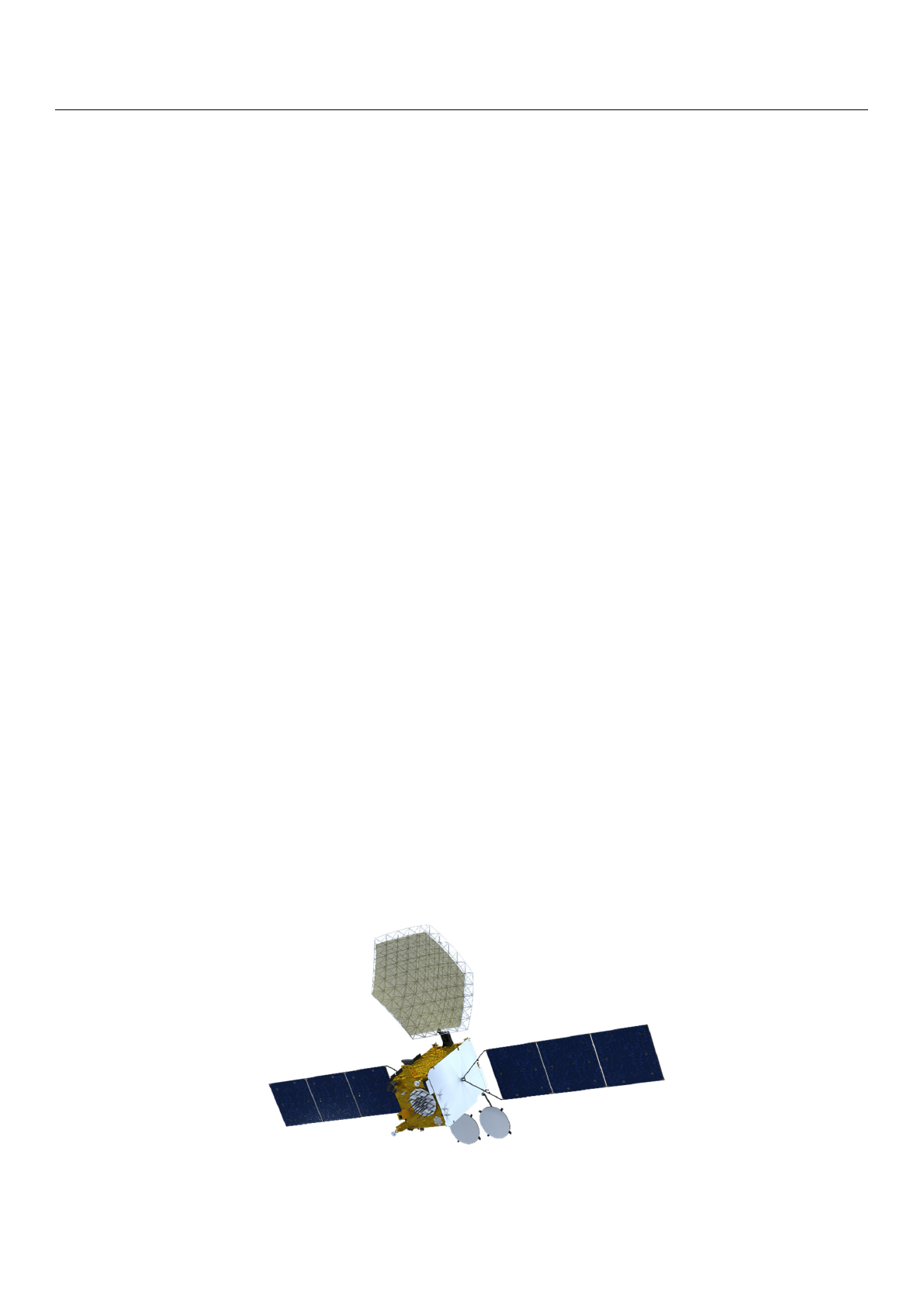
demonstrates that BeiDou-3 IGSOs carry a regular hexagon and two circular communi-
cation payloads on the
±X
surfaces, as shown in Figure 1. There is a challenge to model
BDS-3
IGSO SRP perturbations, as the contribution of communication payloads should be
considered [
18
,
19
]. Moreover, the GNSS orbits always show a lower performance during
eclipse seasons than non-eclipse seasons. It is usually caused by the inaccurate attitude
modeling [
20
] and unaccounted non-conservative forces, such as spacecraft’s thermal ef-
fects during eclipse seasons [
21
–
23
]. At present, there is no systematic investigation on the
POD performance of eclipsing BeiDou-3 IGSOs.
Remote Sens. 2022, 14, x FOR PEER REVIEW 3 of 18
Figure 1. BeiDou-3 IGSOs unfolding on-orbit (http://www.csno-tarc.cn/en/system/introduction
(accessed on 15 November 2021)).
First, the ECOM, ECOM2 and box-wing (BW) models are introduced. The data
collection and POD processing strategies are then presented as the study is to a large
extent based on numerical investigation. An a priori BW model is established by
estimating the optical properties of BeiDou-3 IGSOs. The performance of the five-
parameter ECOM model with and without this a priori BW model, as well as the seven-
parameter ECOM2 model, is evaluated. An effective strategy for improving eclipsing
BeiDou-3 IGSOs orbit performance is recommended. Finally, the key conclusions are
summarized.
2. Materials and Methods
2.1. ECOM-Type Models
To improve GPS orbit accuracy, the ECOM model was developed in the 1990s [8].
The ECOM models the SRP force in a Sun-oriented DYB frame with axes
D
pointing
from the satellite to the Sun, Y along the solar panel axis, and
B
completing a right-
handed system. The modelled force in each direction is described by a constant and
optional periodic terms depending on the satellite’s argument of latitude
u
, which is
expressed as follows [8]:
0
0
0
=+ +
=+ +
=+ +
cos sin
cos sin
cos sin
Dcs
Ycs
Bc s
aDD uD u
aYY uY u
aBB uB u
(1)
In general, only five parameters
0
D,
0
Y,
0
B,
c
B,
s
B are estimated for the proper
modeling of SRP forces acting on GPS satellites, which is called the five-parameter ECOM
model or ECOM1 model. It is worth mentioning that some studies show that the
s
D term
should be considered during eclipse seasons and kept also active during Earth’s shadow
transitions because it helps to improve the orbit quality during eclipse seasons [22,23]. In
this study, the ECOM1 model with the
s
D term active also in Earth’s shadows is named
the ECOM1D model.
However, as mentioned earlier, the ECOM1 model has been found to cause
systematic once-per-revolution radial orbit errors for navigation satellites with a notably
stretched body, such as Galileo and BeiDou-3 MEOs [9,13]. In order to cope with this
systematic effect, the extended ECOM model (ECOM2) was developed [11]:
{}
{}
02 2
1
0
021 21
1
22
21 21
=
−−
=
=+ Δ+ Δ
=
=+ −Δ+ −Δ
,,
,,
cos( ) sin( )
cos(( ) ) sin(( ) )
D
B
n
Dic is
i
Y
n
Bic is
i
aD D iuD iu
aY
aB B i uB i u
(2)
Figure 1.
BeiDou-3 IGSOs unfolding on-orbit (http://www.csno-tarc.cn/en/system/introduction
(accessed on 15 November 2021)).

Remote Sens. 2022,14, 1460 3 of 17
Overall, currently, there are no published studies on the SRP modeling of BeiDou-3
IGSOs and the POD performance of BeiDou-3 IGSOs during eclipse seasons. The purpose
of this study is to carry out the SRP modeling for BeiDou-3 IGSOs and to investigate and
improve their orbit performance during eclipse seasons.
First, the ECOM, ECOM2 and box-wing (BW) models are introduced. The data
collection and POD processing strategies are then presented as the study is to a large extent
based on numerical investigation. An a priori BW model is established by estimating the
optical properties of BeiDou-3 IGSOs. The performance of the five-parameter ECOM model
with and without this a priori BW model, as well as the seven-parameter ECOM2 model, is
evaluated. An effective strategy for improving eclipsing BeiDou-3 IGSOs orbit performance
is recommended. Finally, the key conclusions are summarized.
2. Materials and Methods
2.1. ECOM-Type Models
To improve GPS orbit accuracy, the ECOM model was developed in the 1990s [
8
]. The
ECOM models the SRP force in a Sun-oriented
DYB
frame with axes
D
pointing from the
satellite to the Sun,
Y
along the solar panel axis, and
B
completing a right-handed system.
The modelled force in each direction is described by a constant and optional periodic terms
depending on the satellite’s argument of latitude u, which is expressed as follows [8]:
aD=D0+Dccos u+Dssin u
aY=Y0+Yccos u+Yssin u
aB=B0+Bccos u+Bssin u
(1)
In general, only five parameters
D0
,
Y0
,
B0
,
Bc
,
Bs
are estimated for the proper mod-
eling of SRP forces acting on GPS satellites, which is called the five-parameter ECOM
model or ECOM1 model. It is worth mentioning that some studies show that the
Ds
term
should be considered during eclipse seasons and kept also active during Earth’s shadow
transitions because it helps to improve the orbit quality during eclipse seasons [
22
,
23
]. In
this study, the ECOM1 model with the
Ds
term active also in Earth’s shadows is named the
ECOM1D model.
However, as mentioned earlier, the ECOM1 model has been found to cause systematic
once-per-revolution radial orbit errors for navigation satellites with a notably stretched
body, such as Galileo and BeiDou-3 MEOs [
9
,
13
]. In order to cope with this systematic
effect, the extended ECOM model (ECOM2) was developed [11]:
aD=D0+nD
∑
i=1
{D2i,ccos(2i∆u) + D2i,ssin(2i∆u)}
aY=Y0
aB=B0+nB
∑
i=1
{B2i−1,ccos((2i−1)∆u) + B2i−1,ssin((2i−1)∆u)}
(2)
where
∆u
is the difference between the satellite’s argument of the latitude and the Sun’s ar-
gument of the latitude in the orbital plane, and the upper limit values
nD
and
nB
are defined
by users. At the beginning of 2015, the nine-parameter ECOM2 model
(nD=2, nB=1)
was recommended by CODE. Since 28 June 2015, the estimated parameter number of
the ECOM2 model in CODE products was reduced from 9 to 7 by excluding 4-times-per-
revolution parameters as they deteriorated the GLONASS orbit solutions [
24
]. Following
the CODE data processing strategy, the seven-parameter ECOM2 model
(nD=
1,
nB=
1
)
is used in this study.
2.2. Box-Wing Model
The ECOM1 model can also be applied if a proper box-wing model is involved to
consider the systematic impact caused by the stretched satellite shape. The structure
of a GNSS satellite can be simplified to a cuboid body with six faces (box) plus solar

Remote Sens. 2022,14, 1460 4 of 17
panels (wings). Total SRP acceleration can be theoretically obtained by summing the
SRP acceleration for each illuminated satellite surface and solar panel. This modeling
method, commonly referred to as the box-wing model, was originally established for
Topex/Poseidon POD [
25
]. According to Milani et al. [
26
], the acceleration produced by
the physical interaction between the solar radiation and a flat surface of the satellites can
be formulated by:
a=−A
M
S0
ccos θ(α+δ)→
eD+2(δ
3+ρcos θ)→
eN(3)
where
S0
is the total solar irradiance at the 1 AU, and
M
is the satellite’s mass. The
parameter
c
is the velocity of light and
A
is the illuminated surface area. The terms
→
eD
and
→
eN
indicate the satellite-Sun unit vector, and the normal vector of the illuminated surface,
respectively. The term
θ
is the angle between
→
eD
and
→
eN
, and the parameters
α
,
δ
and
ρ
(with
α+δ+ρ=
1, Milani et al. [
26
]) are the absorption, diffuse and specular reflection
coefficients of illuminated surface, respectively.
Under the assumption of mostly balanced thermal re-mission from the front and
back-side of the solar panels, the SRP acceleration
asp
on the satellite solar panels can be
described by using Equation (3) [
16
]. For the nominal attitude [
27
], the satellite solar panels
are perpendicular to the Sun direction with
cos θsp =
1 and
→
eN,sp =→
eD
. Equation (3) can
be reformulated as [16]:
asp =−A
M
S0
c(1+ρ+2
3δ)→
eD(4)
The satellite bus is covered by multilayer insulation for thermal protection. According
to Lambert’s law, the accelerations
ai,th
aroused by the immediate thermal re-radiation from
the satellite bus surfaces can be obtained by [7]:
ai,th =−A
M
S0
ccos θ2
3α→
eN(5)
where subscript
i
represents the illuminated satellite body surface. According to the IGS
convention [
27
], for satellite bodies in nominal attitude, only their
+X
,
+Z
,
−Z
surfaces
are illuminated by the Sun.
By adding the instantaneous thermal re-radiation accelerations
ai,th
to Equation (3),
the accelerations abacting on satellite bus are expressed as [16]:
ab=−A
M
S0
ccos θ(α+δ)(→
eD+2
3
→
eN) + 2ρcos θ→
eN(6)
Currently, only the absorption coefficient
α
for BeiDou-3 IGSO surfaces is disclosed by
CSNO [
17
], which hinders the formation of a proper BW model. Therefore, in the study,
the adjustable box-wing model developed by [
16
] is used to solve the optical coefficients
for BeiDou-3 IGSOs with real tracking measurements. For the satellites in nominal attitude,
there are nine estimated parameters in the ABW model, i.e., the absorption plus diffuse
reflection
(α+δ)
as well as the specular reflection
(ρ)
for each illuminated satellite sur-
face
(+X
,
+Z
,
−Z)
, the scale parameter for solar panels 1
+ρ+2
3δ
, and two non-optical
parameters Ybias (Y0)and solar panel rotation lag angle (SB).
From Equations (4) and (6), the partial derivatives of the acceleration w.r.t the optical
properties of the satellite bus and panel surfaces can be obtained as [16]:
∂ab
∂(αi+δi)=−Ai
M
S0
ccos θi(→
eD+2
3
→
eN,i)(7)
∂ab
∂ρi
=−Ai
M
S0
c2 cos2θi·→
eN,i(8)

Remote Sens. 2022,14, 1460 5 of 17
∂asp
∂(1+ρ+2
3δ)sp
=−Asp
M
S0
c
→
eD(9)
Two non-optical parameters, i.e.,
SB
and
Y0
, are considered in the ABW model to
compensate for the potential misalignments of the solar panels around the
Y
-axis and
constant accelerations along the
Y
-axis, respectively. The
Y0
parameter of the ABW model
is the same as that of the ECOM-type models. The partial derivatives of the acceleration
w.r.t parameter SB can be obtained as [16]:
∂asp
∂SB =−Asp
M
S0
c2(δsp
3+ρsp)sign(•
ε)→
eB(10)
where
→
eB
is the unit vector of the
B
-axis of Sun-oriented
DYB
frame [
8
], and
ε
is Sun–
spacecraft–Earth angle, which can be expressed as:
cos ε=cos βcos U(11)
where
β
is the sun elevation angle above the satellite orbital plane, and
U
is a geocentric
orbit angle between the satellite and the midnight point in the orbital plane.
2.3. BeiDou-3 IGSOs’ Structure
Based on the above description, the knowledge of satellite structure information is
the prerequisite to conducting the ABW solution. From the BeiDou-3 metadata released
by CSNO [
17
], the box-shaped body of BeiDou-3 IGSOs has, essentially, a rectangular
cross-section of 2.098
×
2.358 m, and a length of 3.602 m. Moreover, BeiDou-3 IGSOs carry
a regular hexagon and two circular communication payloads on the
±X
surfaces, as shown
in Figure 1. These payloads will not only increase the illuminated area of
±Z
surfaces
but also may shadow the
+X
surfaces. Unfortunately, the installation information (angle,
location and distance relative to the spacecraft body) and dimensions for these payloads
are not disclosed.
In this study, the following assumptions were made for the ABW solution. The radius
of the two circular payloads is 0.5 m, and the side length of the regular hexagon payload
is the same as that of the
Y
side of the spacecraft’s body. These payloads are mounted
vertically on
±X
surfaces, and the resulting SRP perturbations are treated in the same
way as for the
±Z
surfaces by simply increasing the area. Considering that the specific
distance and installation locations for these payloads, relative to the spacecraft body, are
not available, the potential shading effects are neglected. The coarse reference values for
BeiDou-3 IGSO geometrical dimensions and optical properties are given in Table 1. Since
the diffuse and specular reflection coefficients are not yet released, their initial values are
assumed to be 0 and 1
−α
, respectively. Optical parameters of satellite surfaces are adjusted
following the same procedures as Rodriguez-Solano et al. [16].
Table 1.
Reference values of optical absorption
α
, reflectivity
δ
, and diffusion
ρ
as well as geometrical
dimensions of satellite bus and solar panels (SPs) for BeiDou-3 IGSOs. Values in brackets were the
areas of ±Zpanels without considering communication payloads. The unit of Area is m2.
Panel Area α δ ρ
+X 8.496 0.350 0 0.650
+Z 20.871 (4.956) 0.870 0 0.130
−Z20.871 (4.956) 0.870 0 0.130
SPs 17.700 0.920 0 0.080
3. Results
In this study, 15 months of GNSS data from 1 January 2020 to 31 March 2021, collected
by 21 iGMAS (International GNSS Monitoring and Assessment Service) stations [
28
] and
34 Multi-GNSS Experiment (MGEX) stations [
29
], were selected to determine precise orbits
Loading more pages...