
1
Vol.:(0123456789)
Scientific Reports | (2021) 11:22706 | https://doi.org/10.1038/s41598-021-02103-7
www.nature.com/scientificreports
Oscillatory active microrheology
of active suspensions
Miloš Knežević*, Luisa E. Avilés Podgurski & Holger Stark
Using the method of Brownian dynamics, we investigate the dynamic properties of a 2d suspension of
active disks at high Péclet numbers using active microrheology. In our simulations the tracer particle is
driven either by a constant or an oscillatory external force. In the first case, we find that the mobility
of the tracer initially appreciably decreases with the external force and then becomes approximately
constant for larger forces. For an oscillatory driving force we find that the dynamic mobility shows a
quite complex behavior—it displays a highly nonlinear behavior on both the amplitude and frequency
of the driving force. In the range of forces studied, we do not observe a linear regime. This result is
important because it reveals that a phenomenological description of tracer motion in active media in
terms of a simple linear stochastic equation even with a memory-mobility kernel is not appropriate, in
the general case.
In the past three decades microrheology1–4 has emerged as a useful technique for characterizing rheological prop-
erties of complex fluids, i.e. fluids that incorporate mesoscopic building units such as colloids, polymers or more
complicated self-assembled structures. Unlike traditional rheology5 which quantifies the viscoelastic properties
of complex fluids by connecting stresses and (rates of) strain in the medium, in a typical microrheological6–12
measurement one follows the trajectory of a probe particle (tracer) embedded in the medium under considera-
tion. A microrheological study can be conducted in two ways: passive and active. Passive microrheology, in
which one tracks the random motion of the tracer induced by fluctuations in the medium, has been employed to
study a broad assortment of complex systems, spanning from colloidal suspensions13–15 to biological matter16,17.
In active microrheology, one either measures the mobility of the tracer particle driven by a static force18–20, or
probes the frequency dependence of mobility by subjecting the tracer to an oscillatory external driving force21.
Additional information about the material’s response can be acquired by utilizing rotational microrheology of
anisotropic probes22.
In this article we investigate the active microrheological response of a low Reynolds number suspension
of active disks exhibiting self-propulsive motion23–26. They expend energy to propel themselves forward, and
therefore constitute a nonequilibrium suspension, which displays a plethora of intriguing properties. For exam-
ple, active particles can exert an active pressure on confining surfaces27–31 while getting stranded at them32,33,
which can be exploited for constructing rotational34–36 and translational37–40 ratchet motors powered by active
particles as well as for cargo transport41,42 and active self-organization43–45. Despite these dazzling features of
active suspensions, their microrheological properties are still not sufficiently explored46–52. Previous theoretical
studies have mainly focused on passive microrheology53–56 and in particular probing the fluctuation-dissipation
relations in active media57–61, or on a constant force active microrheology, either by relying on the low-density
description based on the Smoluchowski equation62, or on numerical simulations for a wide range of suspension
densities63. Here we use Brownian dynamics simulations to study the active microrheological response of active
suspensions. Firstly, we extend the results of reference63 by subjecting the tracer to a broad range of external
forces, and report new results on the resulting nonlinear dependence of the tracer mobility on the driving force.
Secondly, for the first time in literature, we report an oscillatory active microrheological study of active suspen-
sions. We reveal that the frequency-dependence of tracer mobility can be described by a Lorentzian form in the
low frequency domain.
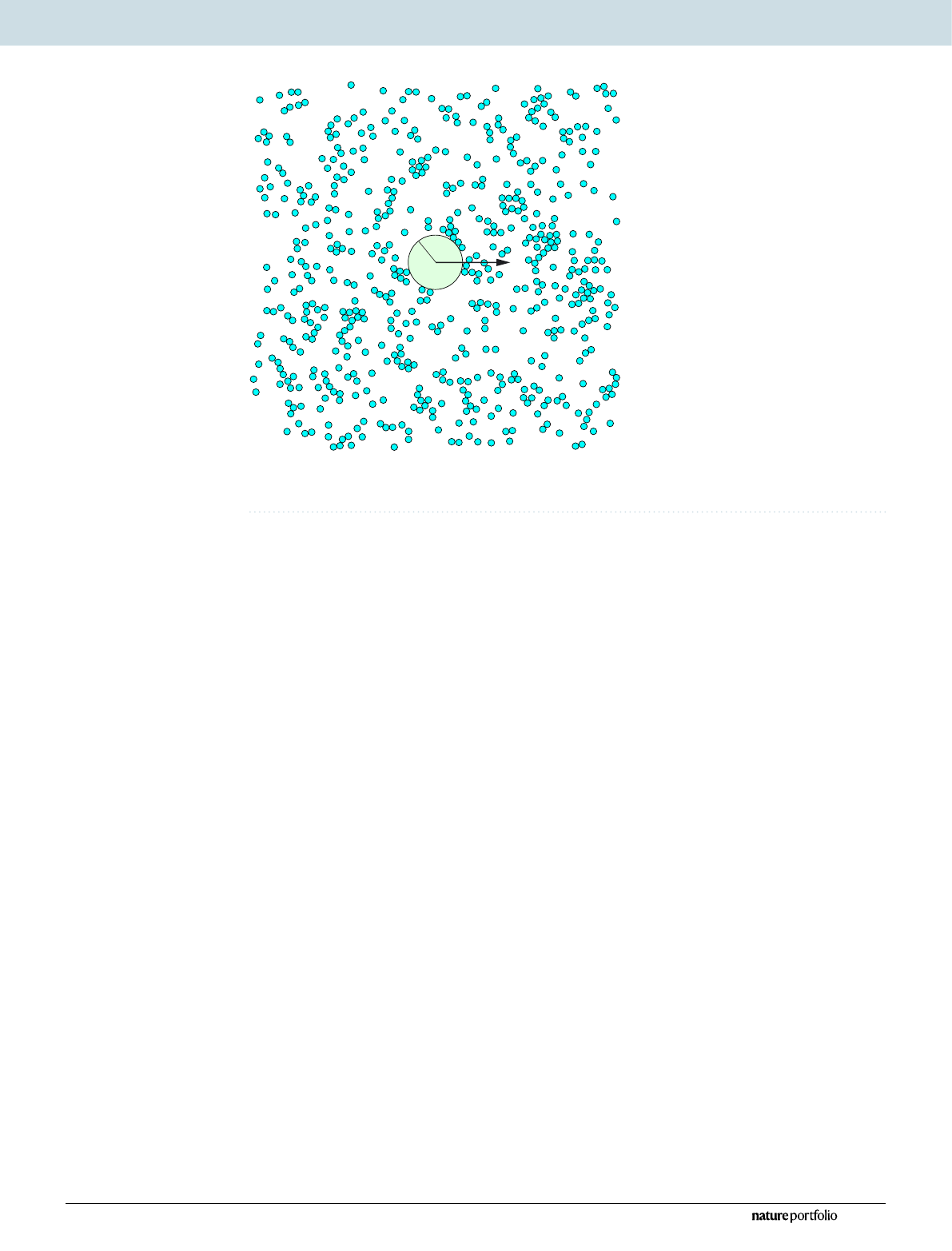
Our setup is depicted in Fig.1: We study a tracer particle of radius R, immersed in a two dimensional suspen-
sion of active disks, and driven by an external force
Fe(t)
. The active disks have a fixed self-propulsion speed
vA
,
diameter
σ
, mobility
µA
and they perform persistent motion within a characteristic time
τR=D−1
R
, where
DR
is their rotational diffusion constant. They interact among themselves and with the tracer via purely repulsive
steric forces. The “bare” mobility of the tracer in a fluid free from active disks is then
µT=µAσ/2R
. Neglecting
hydrodynamic interactions, the motion of the tracer and active disks is described with a set of overdamped sto-
chastic equations, which we solve numerically. The equations of motion and details of the numerical integration
OPEN
Institut für Theoretische Physik, Technische Universität Berlin, Hardenbergstraße 36, 10623 Berlin, Germany. *email:
2
Vol:.(1234567890)
Scientific Reports | (2021) 11:22706 | https://doi.org/10.1038/s41598-021-02103-7
www.nature.com/scientificreports/
scheme are presented in the Methods section. The suspension of active disks is described by two dimensionless
parameters: the Péclet number
Pe =σvA/D
and the total area fraction occupied by disks
φ=Nσ2π/(4A)
; here
N is the number of disks, D is their translational diffusion constant, and A is the total area of the simulation box.
The Péclet number compares the time
tD=σ2/D
it takes an active disk to diffuse its own length with the time
tS=σ/vA
it takes the disk to swim the same distance. For
Pe ≫1
the active motion dominates over the diffusive
transport, while for
Pe ≪1
the disk behaves as a passive particle exhibiting diffusive motion. Throughout this
study we set
φ=0.12
, so that motiltiy-induced phase separation64–66 does not occur, and select several values of
Pe
ranging from the limit of suspensions of passive disks,
Pe =0
, to highly active disks,
Pe =240
.
The tracer is driven through the active medium with the external force
Fe(t)
acting along the x-direction with
the aim to probe the microrheological properties of the suspension. The collisions with active disks influence
the mobility of the tracer in the direction of applied force: instead of having the bare mobility
µT
the tracer now
acquires an effective mobility
µ
.
Firstly, we examine the case in which a constant external force,
Fe(t)=F=const
is applied on the tracer.
We define the static mobility
where
v
is the average speed of the tracer in the x-direction in the steady state. We introduce a dimensionless
parameter
f=σF/(2RfA)
, where
fA=vA/µA
can be interpreted as the force to stop an active disk from moving.
It is easy to see that the tracer driven by a force
f=1
, in a fluid free from disks, moves with a speed
v=vA
. It is
expected therefore that the speed of the tracer moving in an active suspension should be much smaller than
vA
for
f≪1
, and conversely much larger than
vA
for
f≫1
. According to our results these two regions are sepa-
rated by a relatively narrow crossover region located in the vicinity of
f≈1
. Indeed, we find that the mobility
µ
of the tracer in the active suspension displays a nonlinear dependence on f below this crossover value (
f1
),
and it is amplified with respect to the mobility of a tracer driven through the bath of passive disks. On the other
hand, for larger forces (
f1
) the tracer mobilities in passive and active baths match each other, and we find
that they are independent of f in this region.
Secondly, we study a tracer driven by a harmonic external force
Fe(t)=Fsin(ωt)
, where
ω
is the frequency
of oscillations, and F now denotes the force amplitude. We find that the velocity
v=˜vsin(ωt+φ)
of the tracer,
averaged over many independent realizations, oscillates with the same frequency
ω
as the driving force, with the
phase angle
φ≈0
; on the other hand, the velocity amplitude depends on both the amplitude and the frequency
of the driving force,
˜v=˜v(F,ω)
. As a consequence of this the dynamic mobility,
depends on
ω
and F as well. For small values of driving force amplitude (
f1
) we find that the dynamic mobility
decreases rather quickly with
ω
up to some limiting value of
ω
and that our results fit well to a Lorentzian. The
Lorentzian spreads out for larger values of f. It turns out, however, that for sufficiently large values of f (depend-
ing on setup conditions) the mobility
µ
changes its behavior—it is increasing rather than decreasing with
ω
.
Demonstrating that the dynamic mobility significantly depends on frequency for small driving forces but also
on the driving forces itself is the main result of our study.
(1)
µ=�v�/F,
(2)
µ(F,ω) =˜v(F,ω)/F,
Fe
R
Figure1. A snapshot of a passive tracer of radius R driven by an external force
Fe(t)=Fe(t)ex
through a bath
consisting of active disks.
3
Vol.:(0123456789)
Scientific Reports | (2021) 11:22706 | https://doi.org/10.1038/s41598-021-02103-7
www.nature.com/scientificreports/
Recently, it has become common in literature to describe the motion of a tracer in an active bath via a set of
effective coarse-grained stochastic equations with a time-independent37,40,51 effective friction coefficient. As our
results suggest, it is hardly possible to get a satisfactory description in terms of linear stochastic equations in
general. They also suggest that in the limit where a linear response is applicable one has to include a memory-
mobility kernel51,56,67 instead of simply a constant mobility.
The rest of the article is organized as follows. The “Results” section is partitioned into two segments present-
ing constant force and oscillatory force microrheology of suspensions of active disks, respectively. We elaborate
the implications of our oscillatory force results and offer our conclusions in the Discussion section. Finally,
the Methods section presents equations of motion of the tracer and active disks and provides details of their
numerical integration.
Results
In the first part of this section we present our results obtained for the tracer driven through a suspension of
active disks by a constant external force, while the second part shows our findings for the tracer guided through
the suspension by a harmonic force.
Constant force microrheology. Taking the average of Eq. (8) from the Methods section, which describes
the tracer dynamics, and using Eq. (1), we find that the effective mobility of the tracer driven by a constant force is
where the sum goes over all active disks in the bath and
FT
ix
is the x-component of the force exerted on the tracer
by the i-th disk. We first perform an average over 100 independent simulation runs and then a time average
over the steady-state motion of the tracer (see Methods section for details). This double averaging is denoted by
...
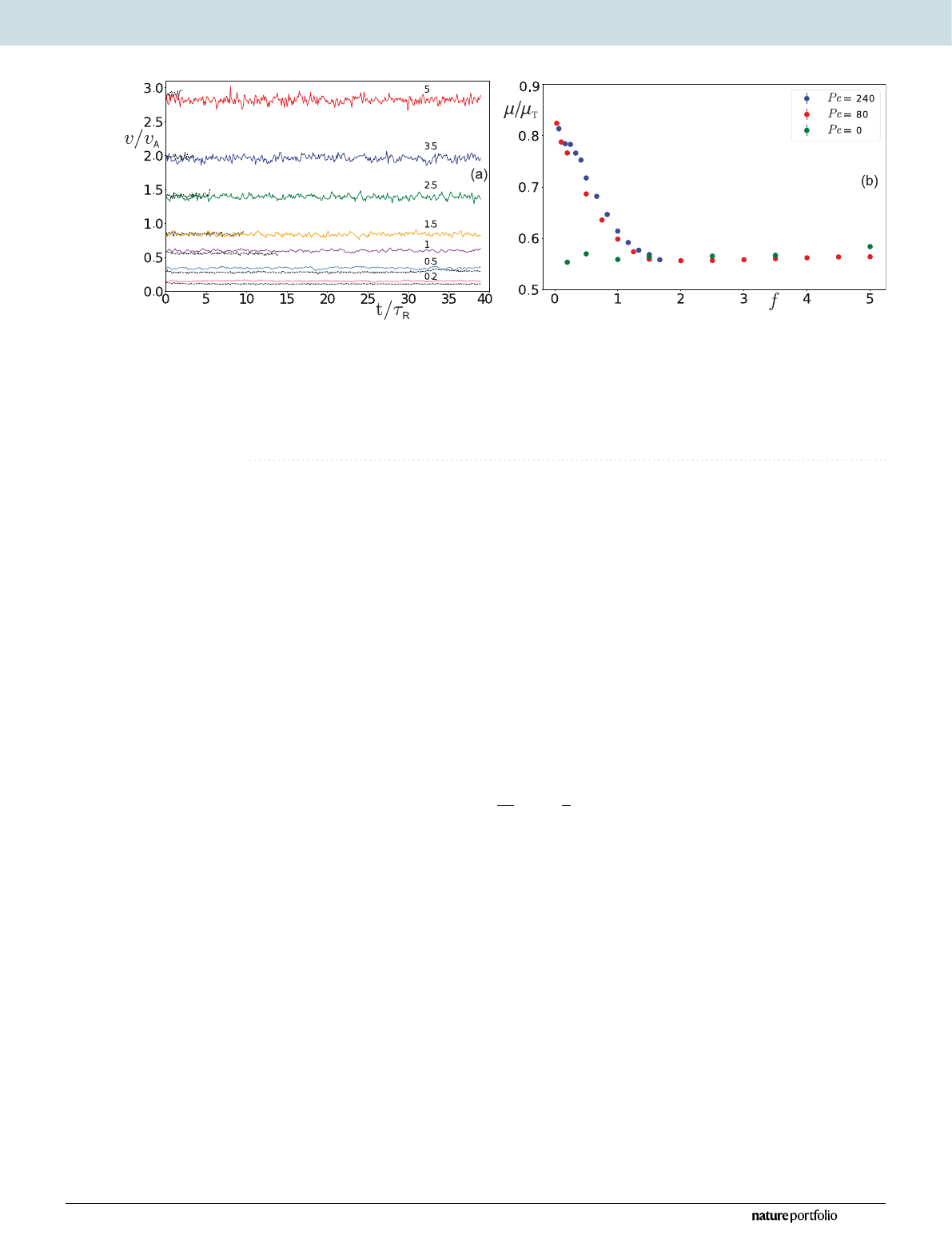
. In Fig.2a (solid lines) we show the temporal fluctuations of the tracer speed v, obtained by averaging over
independent simulation runs only, for several external force amplitudes f. One observes a clear increase in tracer
speed v with increasing driving force f. For the same set of external forces f we also show (black dashed lines)
the tracer speed v in a bath of passive disks (
Pe =0
). For values of driving force
f1
, including the narrow
crossover region located around
f≈1
, we find that the tracer moves with a larger speed in an active than in a
passive bath, and thus has a higher effective mobility, as clearly illustrated in Fig.2b. On the other hand, for larger
external forces,
f1
, the tracer moves with approximately equal speed in the passive and active baths. Thus,
in this regime the tracer speed increases linearly with f and the mobility
µ
does not depend on f. In addition, we
find that the mobility
µ
versus f data fall roughly on top of each other for baths with different but large activities
Pe =80
and
Pe =240
. This is due to using the rescaled external force
f=σF/(2RfA)
, where
fA=vA/µA
is
the characteristic force scale of the active bath. For the range of external forces considered, the tracer mobility
in the passive bath does not change with f, as shown in Fig.2b. This seems to be in agreement with the findings
presented in Ref.15 in the limit of low bath densities.
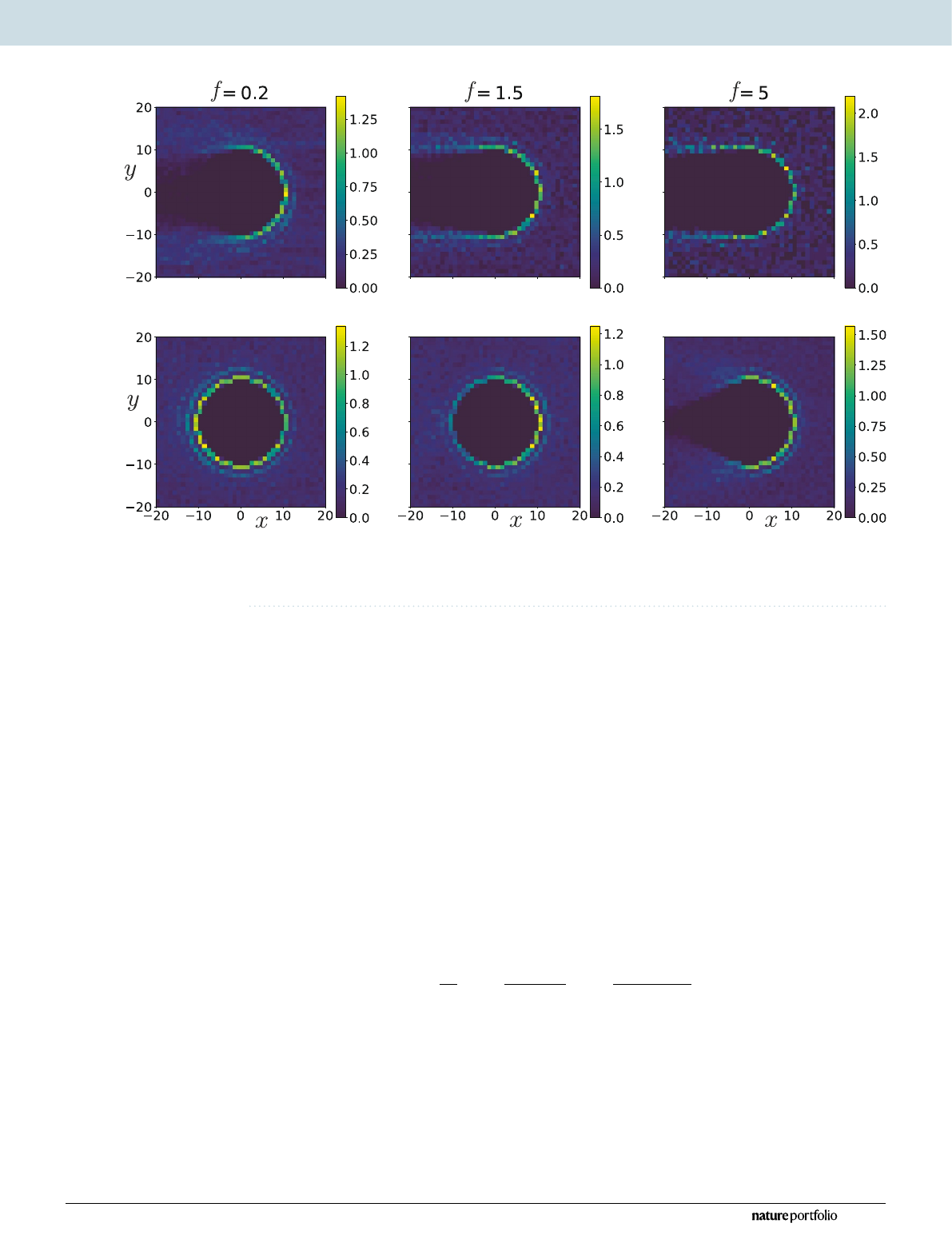
To develop some understanding for the observed behavior, in Fig.3 we plot the average density of disks in the
vicinity of the tracer driven through passive and active baths. In passive baths the tracer leaves behind a channel
free from disks, which is qualitatively similar for all external forces f that we have considered. For
f≥0.2
the
tracer moves so fast that the diffusing passive disks cannot immediately fill the space behind the tracer (see Sup-
plementary Movie 1, displaying a tracer driven through a passive bath with
f=0.2
). Thus, the tracer pushes the
(3)
µ
µ
T
=1+
1
F
i
FT
ix
,
Figure2. (a) The time fluctuations of the tracer speed v obtained by averaging over 100 independent
simulation runs; v is measured in units of active disk speed
vA
and time t in units of active disk reorientation
time
τR
. For each value of the driving force
f=0.2, 0.5, 1, 1.5, 2.5, 3.5, 5
two sets of lines are displayed: the
colored solid lines correspond to the tracer in an active bath with
Pe =80
, while the neighboring dashed black
lines represent the case of a passive bath,
Pe =0
. (b) Effective mobility
µ
of the tracer measured in units of bare
mobility
µT
as a function of force f for three different baths described by
Pe =0, 80, 240
. Note, to rescale the
driving forces for the passive bath, we use the force scale of the active bath with
Pe =80
.
4
Vol:.(1234567890)
Scientific Reports | (2021) 11:22706 | https://doi.org/10.1038/s41598-021-02103-7
www.nature.com/scientificreports/
passive disks in front of it forward, which in turn reduces its mobility with respect to
µT
, while leaving behind
it a trace without disks (cf. Fig.3, top row). We find the tracer speed to increase linearly with external driving f,
leading to a constant mobility
µ
for the range of forces considered, Fig.2b.
In contrast to the passive bath, the tracer moving through the active bath with
Pe =80
displays a much richer
behavior with changing f in the same range, as the bottom panels in Fig.3 demonstrate. For large force
f=5
, the
tracer moves faster than the active disks,
v>vA
, and consequently leaves a wake behind it; this is illustrated in
Movie 2. The shape of the wake is somewhat different compared to the passive bath since the active disks move
ballistically into the wake, which hence assumes the shape of a cone (compare top and bottom right panels of
Fig.3). Nevertheless, the motion of the tracer is qualitatively similar in these two cases. Indeed, the tracer moving
with a large speed does not distinguish whether the disks it encounters on its front are passive or active, mean-
ing it has the same effective mobility
µ
in both types of baths as demonstrated in Fig.2b. As the driving force is
gradually reduced towards
f=1
, by entering the crossover region the speed of the tracer becomes roughly equal
to the active disk speed,
v≈vA
, and the active disks start to catch up with the tracer, allowing them to push it
from behind. In the density profile of Fig.3, middle bottom panel, this manifests itself by the disappearance of the
void at the rear side of the tracer. For even lower external force,
f=0.2
, the active disks move significantly faster
than the tracer, and accumulate more at the rear than at the front side of the tracer, left bottom panel in Fig.3
and Movie 3. Thus, they also push the tracer forward. This explains the increase of the mobility with decreasing
f and is investigated in more detail in the following.
The force
i
F
T
ix =
FF
+
F
R
, with which active disks push against the tracer, can be split into two components
FF
and
FR
. They are exerted by the active disks along the x-direction on the front half and rear half of the tracer,
respectively. We can rewrite Eq. (3) to get
where we have introduced
fF=σFFµA/(2RvA)
and
fR=σFRµA/(2RvA)
. Note that
fR
has the sign of the
x-component of tracer’s velocity, while
fF
has the opposite sign (
fR>0
,
fF<0
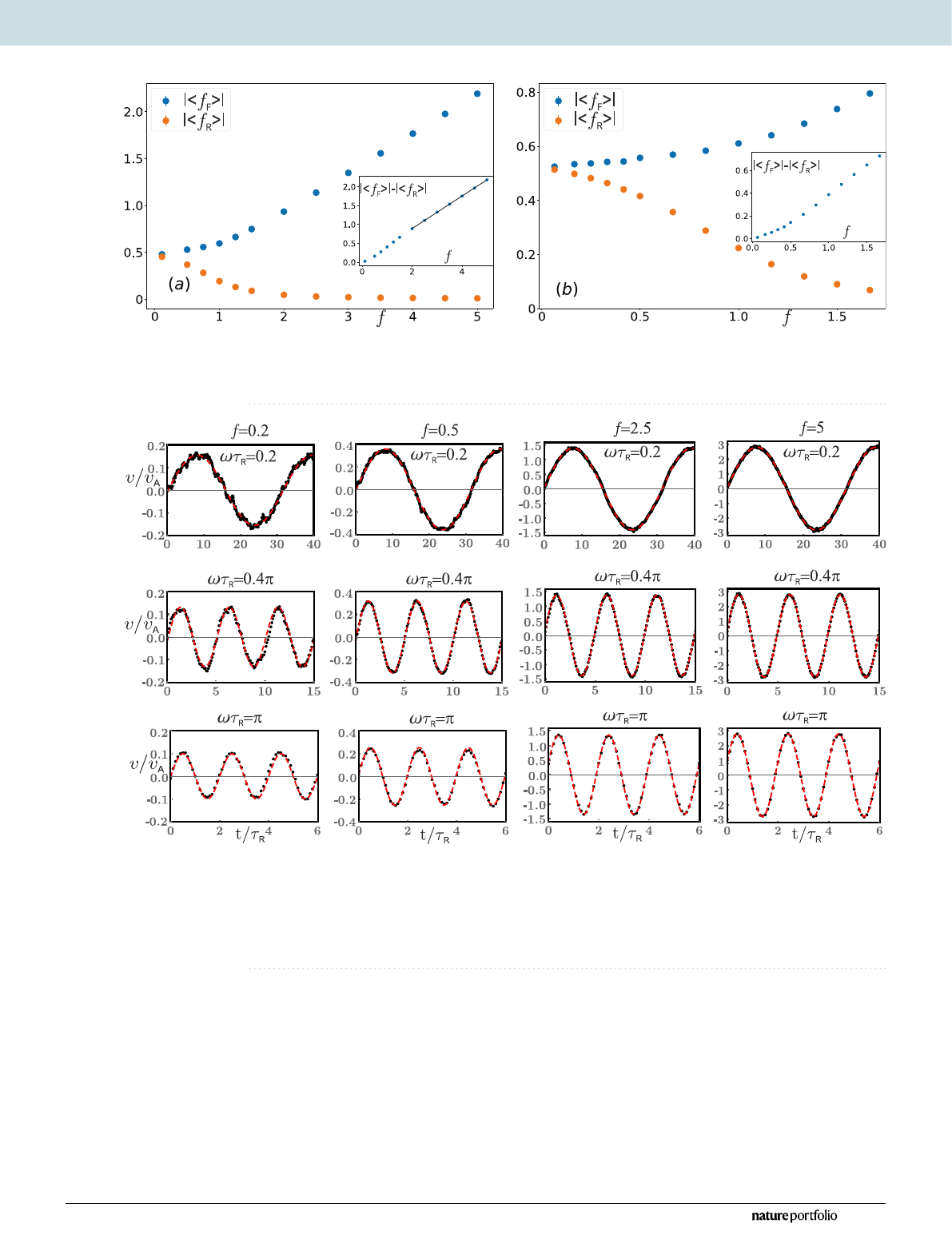
). In Fig.4a we plot the absolute
values
|�fF�|
and
|�fR�|
as functions of the external force f for an active bath with
Pe =80
. Obviously, the front force
has a higher magnitude than the rear force,
|�fF�| >|�fR�|
. As can be inferred from Fig.4a, for
f1
the force
exerted on the tracer front scales linearly with f, while the force acting on the rear side of the tracer is vanish-
ingly small,
|�fR�| ≈ 0
. This behavior agrees well with our previous observation of constant tracer mobility
µ
for
large external force (cf. Fig.2b). One can also notice that
|�fF�|
further decreases with f but in a nonlinear fashion
in the region
f1
. On the other hand,
|�fR�|
gradually increases with decreasing f in the same region, which
corresponds to the onset of active disk accumulation at the rear-side of the tracer as observed in Fig.3. Taken
(4)
µ
µT
=
1
+�f
F
�+�f
R
�
f=
1
−|�f
F
�| − |�f
R
�|
f,
Figure3. Average density (in units of
σ
−2
) of disks around the tracer in a passive bath (top row), and in an
active bath with
Pe =80
(bottom row) for three different external force values
f=0.2, 1.5, 5
. In both passive
and active bath settings, the force scale of the active bath is used to define the rescaled force f.
5
Vol.:(0123456789)
Scientific Reports | (2021) 11:22706 | https://doi.org/10.1038/s41598-021-02103-7
www.nature.com/scientificreports/
together these effects lead to an overall increase of mobility observed for
f1
. It turns out that in the region
f1
we obtained qualitatively similar behavior for larger values of
Pe
number (see Fig.4b for the case
Pe =240
).
Oscillatory force microrheology. Having established how the tracer mobility depends on a static exter-
nal force f in an active suspension, we turn to the case of an oscillatory external force. We subject the tracer to
a sinusoidal force
f
e
(t)=fsin(ωt)
acting along the x-axis where f denotes the force amplitude and
ω
the fre-
quency. For a bath with
Pe =80
the time profiles of the tracer velocity v along the x-axis for some representative
values of f and
ω
are shown in Fig.5. The time evolution of the velocity v(t) has been calculated by averaging over
100 independent simulation runs. The velocity profiles were then fitted to a simple form
v(t)=˜vsin(ωt+φ)
,
with the velocity amplitude
˜v
and phase shift
φ
being the fit parameters. We have been able to get very good fits
with
φ≈0
for all amplitudes f and frequencies
ω
examined in our study, which clearly has to be assigned to the
active or nonequilibrium nature of the bath particles performing an overdamped motion. On the other hand, we
Figure4. The absolute values of average forces
|�fF�|
and
|�fR�|
exerted by active disks on the front and rear side
of the tracer, respectively, as a function of the external force f for an active bath characterized by (a)
Pe =80
and
(b)
Pe =240
. The insets show the difference
|�fF�| − |�fR�|
versus f.
Figure5. The x-component of tracer velocity v measured in units of active disk speed
vA
as a function of
time t expressed in units of active disk reorientation time
τR
. The tracer is driven with an external force
fe(t)=f
sin
(ωt)
through an active bath characterized by
Pe =80
. The columns correspond to force amplitudes
f=0.2, 0.5, 2.5, 5
while the rows correspond to driving frequencies
ωτR
=
0.2, 0.4π,π
, respectively. Here,
black points present simulation data averaged over 100 independent simulation runs for each t, while red dashed
lines provide the best fits of the data to the form
˜vsin(ωt+φ)
.
Loading more pages...