
BRIEF REPORT
SUSTAINABILITY
SCIENCE
No aggregate deforestation reductions from rollout of
community land titles in Indonesia yet
Sebastian Krausa,b,1 , Jacqueline Liua,c ,NicolasKoch
a,d,e , and Sabine Fussa,f
aMercator Research Institute on Global Commons and Climate Change, 10829 Berlin, Germany; bDepartment of Economics of Climate Change, Technical
University of Berlin, 10623 Berlin, Germany; cHertie School, 10117 Berlin, Germany; dPotsdam Institute for Climate Impact Research, 14473 Potsdam,
Germany; eIZA Institute of Labor Economics, 53113 Bonn, Germany; and fInstitute of Geography, Humboldt University of Berlin, 12489 Berlin, Germany
Edited by Ruth DeFries, Columbia University, New York, NY, and approved September 13, 2021 (received for review January 14, 2021)
In Indonesia, 60 million people live within 1 km of state forest.
The government of Indonesia plans to grant community titles
for 12.7 million hectares of land to communities living in and
around forests. These titles allow for using nontimber forest
products, practicing agroforestry, operating tourism businesses,
and selective logging in designated production zones. Here, we
estimate the early effects of the program’s rollout. We use data on
the delineation and introduction date of community forest titles
on 2.4 million hectares of land across the country. We find that,
contrary to the objective of the program, community titles aimed
at conservation did not decrease deforestation; if anything, they
tended to increase forest loss. In contrast, community titles in
zones aimed at timber production decreased deforestation, albeit
from higher baseline forest loss rates.
land tenure reform | stacked difference-in-differences | Indonesia |
conservation | restoration
In 2015, Indonesia was the world’s fourth largest emitter of
greenhouse gas emissions. Almost 60% of its carbon emissions
were from land use change (1). Since 2016, deforestation in
Indonesia has fallen by 30% (comparing 2009–2016 with 2017–
2019) (2). This has, in part, been credited to a policy mix including
bans on primary forest clearing and peat drainage, a review of
land concessions, and a moratorium on new palm oil planta-
tions and mines (3). Meanwhile, certification has helped protect
forests on existing plantations (4). Indonesia has also initiated
a large-scale land titling program that consists of the release of
land for agriculture and a social forestry component. The social
forestry program aims to title 12.7 million hectares as community
forest. By improving livelihoods, resolving tenure conflicts, and
involving communities in forest management, the program also
aims at slowing deforestation. Here, we investigate the early
effects of the rollout of the Indonesian social forestry policy on
forest loss. We analyze data on the extent and the titling year of
4,349 land titles covering 2.4 million hectares (median size 70 ha).
Our sample of titled areas runs from 2009 to 2019, and titling
accelerated markedly after 2016. We compare these treated areas
to control areas (median size 55 ha) from the pool of candidate
areas designated for titling by the Ministry of Environment. We
use satellite-based measurements of annual forest loss between
2001 and 2019 (2, 5) to compare changes in treatment and control
areas before and after the introduction of each land title with a
regression-based stacked difference-in-differences design.
In Indonesia, much of the land on the outer islands is
designated as state forest zone. Consequently, 6 million people
live on and 60 million live within 1 km of land designated
as state forest (own estimates; SI Appendix). The population
close to forest frontiers still relies, at least partially, on land
for their livelihoods, either for nontimber forest products
and smallholder agriculture or for ownership of or work on
plantations. Devolving land rights to communities has been
described as an intervention to foster the sustainable use of
natural resources (6), but governments tend to use community
land titles in areas with low pressure on forests. It has been
unclear whether they would work at deforestation frontiers.
In contrast with typical programs in other countries, the
Indonesian social forestry program targets comparatively densely
populated, fragmented landscapes with high pressure on forest.
Many of the land titles are granted for areas on the edges of
primary forest (Fig. 1).
The Indonesian government hopes to reduce deforestation
rates by giving communities land use rights through its social
forestry program (7). The program’s theory of change relates
to two important observations in the literature: 1) Community
institutions can mitigate the overexploitation of common-pool
resources (6), and 2) smallholder practices tend to create less
environmental degradation than industrial agriculture, because
of locally adapted farming techniques and lower labor and trans-
action costs in the same household (8). In practice, the impetus
for the strengthening of the social forestry program was a 2012
decision on indigenous lands by the Indonesian Constitutional
Court (Court Decision 35/PUU-X/2012). Thus, the program’s
principal normative goal is to correct injustices in land access.
The government expects deforestation reductions only as an
indirect result of reductions in land conflicts and poverty cre-
ated by the policy (7). However, the success of the program
critically hinges on an alignment of social forestry institutions
with economic incentives and on the enforcement of community
institutions in practice (overview in SI Appendix). Indonesian
deforestation frontiers tend to be connected to markets for palm
oil and other commodities with an elastic demand. This market
access leads to increased land demand for plantations and shifts
in the placement of other land uses, such as subsistence agri-
culture. High private discount rates of smallholders (9) further
increase the opportunity cost of forest conservation. In addition,
communities lack capacity and resources for monitoring and
enforcement of social forestry institutions (10). Therefore, we
hypothesize that the social forestry program cannot systemati-
cally decrease deforestation rates without additional resources
or incentives.
Results
We estimate the average countrywide effect of the community
titling policy and test one of its main hypotheses: that community
land titling reduces forest loss. Indonesian social forestry
titles allow communities to use nontimber forest products,
practice agroforestry, and operate ecotourism businesses in
areas designated as protection zones by the government.
Author contributions: S.K., J.L., N.K., and S.F. designed research; S.K. and J.L. performed
research; S.K. and N.K. analyzed data; and S.K. wrote the paper.
The authors declare no competing interest.
This article is a PNAS Direct Submission.
This open access article is distributed under Creative Commons Attribution License 4.0
(CC BY).
1To whom correspondence may be addressed. Email: [email protected].
This article contains supporting information online at https://www.pnas.org/lookup/
suppl/doi:10.1073/pnas.2100741118/-/DCSupplemental.
Published October 18, 2021.
PNAS 2021 Vol. 118 No. 43 e2100741118 https://doi.org/10.1073/pnas.2100741118 1of3
Downloaded by guest on January 11, 2022
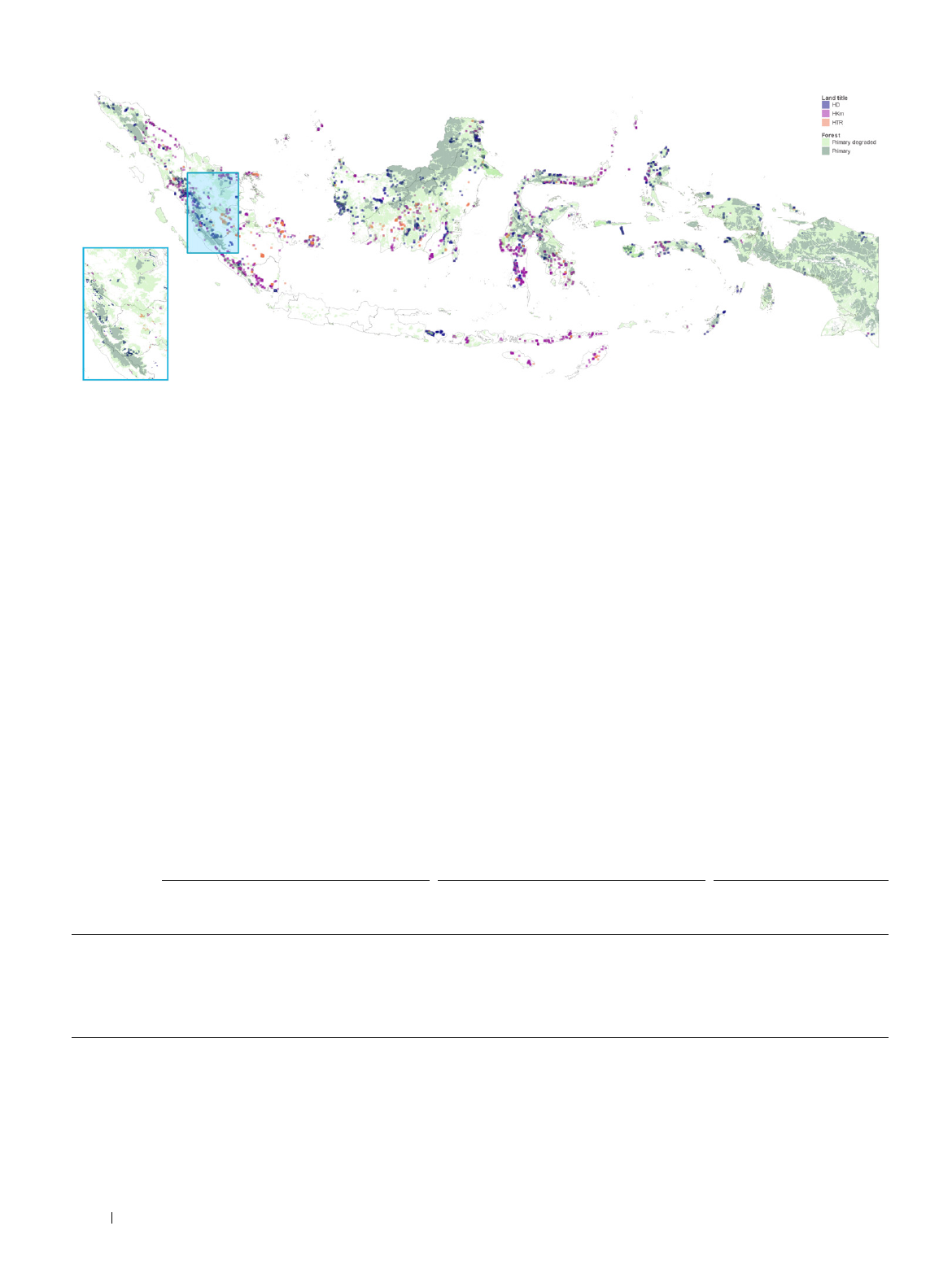
Fig. 1. This map shows the three main types of social forestry: HD and HKm, which allow nontimber forest product collection, agroforestry, ecotourism,
and some selective logging; and HTR, which aims at restoring degraded areas for community timber plantations. Primary forest and primary degraded forest
in 2000 are shown in the background (5), and province boundaries are in gray. Inset in lower left corner is a zoomed map of the smaller area marked in blue
on the main map.
In government-designated production zones, they also allow
selective logging and, in specific cases (HTR titles), timber
plantations.
We differentiate between the three main types of land titles:
1) village forests (hutan desa, HD), 2) community forests (hutan
kemasyarakatan, HKm), and 3) community plantation forests
(hutan tanaman rakyat, HTR). These titles are granted to villages
(HD), cooperatives (HKm and HTR), or individual farmers
(HTR) for 35 y (10). HD and HKm allow for restricted (50 m3
per year) logging for noncommercial purposes, conditional on
avoiding net deforestation (11), and only in areas defined as
production zones by the government. For HD titles, this is the
case for 42% of the total titled area. HTR titles are established
on plantation forests and degraded areas, for which communities
or farmers can obtain licenses to operate and restore timber
plantations. Our main sample contains 950 HD areas with a
median size of 807.8 ha, 1,224 HKm areas with a median size of
246 ha, and 2,175 HTR areas with a median size of 1.3 ha.
We compare areas with land titles, before and after approval,
to control areas, which are planned to get community titles in
the future, in a stacked difference-in-differences design using
Poisson regressions. The estimates in Table 1 can be interpreted
as changes in deforestation rates in treated areas compared to
control areas.
We find that the main types of community titles (HD and
HKm), on average, do not decrease deforestation rates (columns
A to F in Table 1). If anything, we find increases in forest loss
for these two pillars of the social forestry program. However,
the 95% CIs for the positive estimates, in most cases, include
increases in deforestation that are small or even slightly negative.
For HD titles, we can thus rule out substantial reductions in
deforestation for all types of tree cover pooled into one category
(column A), degraded primary forest (column B), and undis-
turbed primary forest (column C). This result contrasts with ear-
lier findings based on a sample of 93 HD areas (12). Our results
are stable to specifications with sample restrictions in terms of in-
cluded cohorts, types of forest zones, and forest loss year observa-
tions that make our estimation sample similar to the earlier study
based on a smaller sample (12). This difference could result from
selection into treatment effects, because titles may be granted for
the most promising areas first. It could also point to remaining
omitted variable bias in the earlier study, which our stacked
Table 1. Effect of community land titling on deforestation
HD HKm HTR
(A) (B) (C) (D) (E) (F) (G) (H)
All forest Degraded Primary All Degraded Primary All Degraded
Land title 0.14** 0.27*** 0.35* 0.08 0.00 0.75** –0.10 –0.83***
[0.02, 0.26] [0.08, 0.46] [-0.03, 0.73] [-0.06, 0.21] [-0.26, 0.27] [0.16, 1.34] [-0.24, 0.05] [-1.21, -0.46]
Precipitation –0.15*** –0.16*** –0.32*** –0.15*** –0.16*** –0.31*** –0.15*** –0.16***
[-0.20, -0.11] [-0.23, -0.09] [-0.52, -0.11] [-0.20, -0.11] [-0.23, -0.09] [-0.51, -0.11] [-0.20, -0.11] [-0.22, -0.09]
Clusters 18,552 10,554 1,497 18,746 10,438 1,416 19,259 10,246
N 3,714,021 2,073,305 287,727 3,717,707 2,071,101 286,188 3,727,454 2,067,453
Estimates from Poisson regressions on a stacked sample of treatment and control groups. The row “Land title” reports the coefficient on the interaction
term between an indicator for treatment and an indicator for years after treatment (SI Appendix,Eq.S1). The unit of analysis is the study area. Treated units
are areas with community titles, and control units are areas designated for treatment by the government. SEs are clustered at the study area level, where
treatment is assigned (see number of “Clusters”). The number of units of analysis corresponds to the number of clusters. The total number of observations (N)
corresponds to all units and years in the stacked panel dataset. We differentiate between the three types of social forestry: HD, HKm, and HTR. The outcome
is the deforestation rate, that is, area deforested divided by total area, at the level of the unit of observation. We show results for deforestation rates in
all forest combined (2) and restricted to degraded primary forest and primary forest (5). All regressions include study area fixed effects, year fixed effects,
a fixed effect indicating whether an observation is before or after the treatment year of a cohort, and a fixed effect indicating whether an observation is
in the treated or in the control group for a given cohort. All regressions control for annual precipitation (CHIRPS, standardized). The 95% CI is shown in
brackets. Significance levels are indicated by *, **, and *** for 10%, 5%, and 1%, respectively.
2of3 PNAS
https://doi.org/10.1073/pnas.2100741118
Kraus et al.
No aggregate deforestation reductions from rollout of community land titles in Indonesia yet
Downloaded by guest on January 11, 2022

BRIEF REPORT
SUSTAINABILITY
SCIENCE
difference-in-difference design helps to correct (Materials and
Methods).
An exception to the overall lack of reductions in deforesta-
tion rates can be found for HTR areas, which are granted on
plantation forests. HTR areas have higher forest loss rates than
HD and HKm areas before the introduction of the community
title (around double for all tree cover combined, and 50% more
for degraded primary forest areas). For these titles, we find sub-
stantial decreases in forest loss rates on degraded primary forest
(column H in Table 1). This is indicative of increased efforts to
restore forests for timber production in the HTR subsample.
Discussion
We find that the main building blocks of the Indonesian commu-
nity titling program (HD and HKm titles) overall have not led to
decreases in forest loss. Case study evidence points to two main
explanations for this result: 1) a lack of institutional capacity at
the community level (10) and 2) the economic opportunity costs
of conservation (13). Many communities lack the resources to
monitor their areas or agree upon and enforce rules on resource
use (10). In addition, in contexts with suitable market access for
plantation-based cash crops, a reduced risk of expropriation may
have led to investments in land clearing rather than restoration or
forest-based activities (13). The main pillars of the program (HD
and HKm) allow only the extraction of nontimber forest products
and activities based on ecosystem services (for instance, tourism)
or selective logging, depending on government zoning. These
activities may not provide sufficient incentives to increase con-
servation efforts. Payments for ecosystem services, for instance,
based on ecological intergovernmental transfers to villages, could
help increase the value of conservation for these communities
above the opportunity costs of logging and agriculture (14)
or help subsistence households meet consumption needs and
reduce their reliance on forests as a safety net (15).
Prior research has found forest loss reductions in a sample of
early social forestry areas (12). This result indicates that, under
favorable conditions, the policy can reduce deforestation. Our
result indicates that, on aggregate, the program does not deliver
these reductions yet.
For a subpart of the program focused on community timber
production on plantations and in degraded areas (HTR titles), we
find evidence for forest loss reductions, indicating an opportunity
for increased conservation by including Indonesian communities
in efforts to restore degraded plantations. However, HTR titles
only constitute 6.3% of the granted social forestry area, and their
median size is small (1.3 ha). Further research could investigate
whether this result is related to increased expected future returns
from standing forest due to improved tenure security or whether
the reductions in forest loss merely result from less efficient har-
vesting, for instance, because of coordination problems between
forest owners and timber companies.
Materials and Methods
Land Title Data. We use boundaries and land title identifiers of community
titles as published by the Indonesian Ministry of Environment and Forestry
(version: 14 September 2020). We also use areas designated for social
forestry by the Ministry, which serve as a control group. These data are
based on the Indicative Social Forestry Map PIAPS (Peta Indikatif dan Areal
Perhutanan Sosial; SI Appendix).
Forest Data. We use version 1.7 of the Hansen Global Forest Change data
(2) and the Margono natural forest data for Indonesia (5). We reclassify
the Margono categories of primary forest into primary (2, 4–9, 13–15) and
primary degraded forest (1, 10–12). The outcome “all forest” is based on
the Hansen data only, which detects any tree cover change, including on
plantations. We use Google Earth Engine to extract the annual sum of de-
forested hectares for treatment and control areas (script in code repository).
The outcome variable “annual deforestation rate” is the sum of deforested
hectares divided by the total size of an area.
Econometrics. We use a stacked difference-in-differences design with
Poisson regressions to estimate the effect of a land title on deforestation
rates. We leverage variation in the timing of treatment and use areas that
have not been titled yet as a counterfactual.
The main empirical challenge is to construct credible counterfactuals for
the treated areas. Governments, communities, and NGOs may work toward a
title for a specific area, if it is particularly easy to lower deforestation there.
However, they may also react to high local pressure on forests, leading to
bias in the opposite direction. Often, the underlying factors are time variant
and difficult to measure. Therefore, the direction of the bias in a research
design relying on control areas matched based on measurable factors, such
as topography or climate, would be theoretically unclear. We compare areas
with land titles, before and after approval, to control areas that serve as
counterfactual units. These counterfactual units are areas designated by the
Indonesian Ministry of Environment and Forestry to get community titles in
the future (PIAPS map; SI Appendix).
Data Availability. Maps and code data have been deposited in Zenodo
(10.5281/zenodo.4314767) (16).
ACKNOWLEDGMENTS. We thank Mhabeni Bhona for background research
and support with research design. S.K. and S.F. acknowledge funding by the
RESTORE+ project (https://www.restoreplus.org/), part of the International
Climate Initiative, supported by the Federal Ministry for the Environment,
Nature Conservation, and Nuclear Safety on the basis of a decision adopted
by the German Bundestag.
1. World Resources Institute, CAIT Climate Data Explorer: Country greenhouse gas
emissions data. https://datasets.wri.org/dataset/cait-country. Accessed 1 September
2020.
2. M. C. Hansen et al., High-resolution global maps of 21st-century forest cover change.
Science 342, 850–853 (2013).
3. J. Busch et al., Reductions in emissions from deforestation from Indonesia’s morato-
rium on new oil palm, timber, and logging concessions. Proc. Natl. Acad. Sci. U.S.A.
112, 1328–1333 (2015).
4. K. M. Carlson et al., Effect of oil palm sustainability certification on deforestation
and fire in Indonesia. Proc.Natl.Acad.Sci.U.S.A.115, 121–126 (2018).
5. B. A. Margono, P. V. Potapov, S. Turubanova, F. Stolle, M. C. Hansen, Primary
forest cover loss in Indonesia over 2000–2012. Nat. Clim. Chang. 4, 730–735
(2014).
6. E. Ostrom, Governing the Commons: The Evolution of Institutions for Collective
Action (Cambridge University Press, 1990).
7. World Bank, “Strengthening of Social Forestry in Indonesia (P165742)” (Proj. Ap-
praisal Doc. PAD3214, World Bank, 2020).
8. R. M. Netting, Smallholders, Householders: Farm Families and the Ecology of
Intensive, Sustainable Agriculture (Stanford University Press, 1993).
9. A. W. Sarwosri, O. Mußhoff, Are risk attitudes and time preferences crucial factors
for crop diversification by smallholder farmers? J. Int. Dev. 32, 922–942 (2020).
10. A. Rakatama, R. Pandit, Reviewing social forestry schemes in Indonesia: Opportuni-
ties and challenges. For. Policy Econ. 111, 102052 (2020).
11. T. Santika et al., Heterogeneous impacts of community forestry on forest conserva-
tion and poverty alleviation: Evidence from Indonesia. People Nat 1, 204–219 (2019).
12. T. Santika et al., Community forest management in Indonesia: Avoided deforesta-
tion in the context of anthropogenic and climate complexities. Glob. Environ.
Change 46, 60–71 (2017).
13. J. D. Langston, R. A. Riggs, Y. Sururi, T. Sunderland, M. Munawir, Estate crops more
attractive than community forests in West Kalimantan, Indonesia. Land (Basel) 6,12
(2017).
14. S. Wunder, J. Börner, D. Ezzine-de Blas, S. Feder, S. Pagiola, Payments for environ-
mental services: Past performance and pending potentials. Annu. Rev. Resour. Econ.
12, 209–234 (2020).
15. P. J. Ferraro, R. Simorangkir, Conditional cash transfers to alleviate poverty also
reduced deforestation in Indonesia. Sci. Adv. 6, eaaz1298 (2020).
16. S. Kraus, J. Liu, N. Koch, S. Fuss, socialForestryIDN: Submission release. Zenodo.
https://zenodo.org/record/4314767. Deposited 10 December 2020.
Kraus et al.
No aggregate deforestation reductions from rollout of community land titles in Indonesia yet
PNAS 3of3
https://doi.org/10.1073/pnas.2100741118
Downloaded by guest on January 11, 2022
Loading more pages...