
Review on Polymeric, Inorganic, and Composite Materials
for Air Filters: From Processing to Properties
Laura M. Henning,* Amanmyrat Abdullayev, Cekdar Vakifahmetoglu, Ulla Simon,
Hiba Bensalah, Aleksander Gurlo, and Maged F. Bekheet
1. Introduction
Air pollution causes an estimated seven million premature
deaths worldwide every year, i.e., one in every nine deaths,
according to the World Health Organization (WHO). More than
80% of people in urban areas, most severely in low- and middle-
income countries, are exposed to air pollution levels that exceed
WHO guideline limits.
[1]
Hence, they suffer elevated risks for
cardiovascular and respiratory illnesses. In addition of being a
threat to human health, air pollution is
also closely interlinked to climate change
and problems associated therewith.
[2]
Undoubtedly and above all, it is most desir-
able to develop and apply techniques gen-
erating fewer air pollutants to preserve
human and environmental health. Until
that is accomplished, and for indoor areas
in which sufficient reduction cannot be
achieved easily, e.g., airborne pathogens
such as the current severe acute respiratory
syndrome coronavirus 2 (SARS-CoV-2)
provoking the Coronavirus disease 2019
(COVID-19), air filters are a trusted and
proven instrument to achieve improved
or innocuous air qualities.
[3]
Nonmedical
cloth face masks, also known as commu-
nity masks, were found to reduce the trans-
mission of SARS-CoV-2, but do not reach
the performance and protection provided by filtering facepiece
respirators.
[4]
In everyday life, air filters are mostly used to filtrate cabin air
in vehicles such as cars and airplanes. They are also used in clean
rooms and other air-handling installations, for example, in ware-
houses or laboratories. Other common applications include gas
turbines, compressors, and engines. To be used as personal pro-
tective equipment, elastic bands are attached to the produced fil-
ter material to form surgical or face masks. This is of particular
importance for people working in areas potentially harmful to
health, such as medical institutions or on construction sites.
For special applications or long-time usage, the filter material
can be fit into reusable rubber masks, e.g., made from silicone,
yielding professional gas masks.
The first modern air-purifying respirator with a filter made of
moistened wool was invented by Lewis Haslett, in 1849.
[5]
By
today, air filtration was already improved significantly with
respect to performance, sustainability, and multifunction. A gen-
eral overview of different air filtration technologies for indoor
building ventilation is available.
[6]
Furthermore, the progress
on particulate matter (PM) filtration and face masks was more
recently reviewed, emphasizing different materials and their per-
formance.
[7–9]
It becomes apparent that the majority of modern
air filters is based on synthetic, polymeric materials. Polymers
are most commonly processed into fibrous structures at moder-
ate temperatures by spinning techniques, with electrospinning
leading the way. The production of air filters from polymers
and biopolymers by the electrospinning process was recently dis-
cussed in several review articles.
[10–13]
However, polymer-based
L. M. Henning, A. Abdullayev, Dr. U. Simon, Dr. H. Bensalah,
Prof. A. Gurlo, Dr. M. F. Bekheet
Fachgebiet Keramische Werkstoffe/Chair of Advanced Ceramic Materials,
Institut für Werkstoffwissenschaften und -technologien
Fakultät III
Technische Universität Berlin
Hardenbergstr. 40, 10623 Berlin, Germany
E-mail: laura.m.henning@ceramics.tu-berlin.de
Prof. C. Vakifahmetoglu
Department of Materials Science and Engineering
Izmir Institute of Technology
35430 Urla, Izmir, Turkey
The ORCID identification number(s) for the author(s) of this article
can be found under https://doi.org/10.1002/aesr.202100005.
© 2021 The Authors. Advanced Energy and Sustainability Research pub-
lished by Wiley-VCH GmbH. This is an open access article under the terms
of the Creative Commons Attribution License, which permits use,
distribution and reproduction in any medium, provided the original
work is properly cited.
DOI: 10.1002/aesr.202100005
Particulate and gaseous air pollutants pose a threat to human health and
contribute to climate change. By today, air filters, stationary and portable, are
markedly improved and can often provide innocuous air pollution levels. After
introducing the classification and standards on air filters, the influence of the
processing route and its parameters on the resulting air filter properties and
consequently its performance are discussed. Numerous tools are presented to
adjust structural properties such as fiber or pore diameter, specific surface area,
surface charge, hydrophilicity, or photocatalytic activity to achieve the desired
performance in terms of high filtration efficiencies, sufficient mechanical stability,
regeneration eligibility, antimicrobial and optical properties. In particular, inor-
ganic and composite materials as well as nonfibrous structures are covered,
which are currently holding an outsider position in an air filter community
dominated by polymeric materials and fibrous structures.
REVIEW
www.advenergysustres.com
Adv. Energy Sustainability Res. 2021,2, 2100005 2100005 (1 of 30) © 2021 The Authors. Advanced Energy and Sustainability Research
published by Wiley-VCH GmbH
air filters often lack sufficient regeneration options and their
single-use does not reflect the spirit of the times. In contrast,
inorganic materials such as ceramics and metals are more easily
regenerable due to their higher resistance towards elevated tem-
peratures and harsh chemical conditions. Recently, researchers
provided insights into the removal of air pollutants by activated
carbon (AC) and carbon nanotubes (CNTs).
[14,15]
The utilization
of inorganic materials, on their own or in the form of composites,
and alternative processing techniques open up new possibilities
in enhancing modern air filters.
However, previous reviews mainly focused on fibrous struc-
tures, polymeric materials, and electrospinning fabrication tech-
nology. Less or no attention was paid to the competitive
properties of nonfibrous structures, inorganic and composite
materials, and other processing routes. Our review aims to fill
the gap by giving an overview of processing techniques and fil-
tration mechanisms for both fibrous and nonfibrous air filters
composed of polymeric, inorganic, and composite materials.
First, the classification of air pollutants and their impact on
human beings and the environment will be introduced.
Afterward, the mechanisms of air filtration, performance evalu-
ation, and worldwide classification will be elucidated. In the main
part of this Review, the latest progress on processing techniques
of fibrous, cellular, and granular air filters will be discussed, as
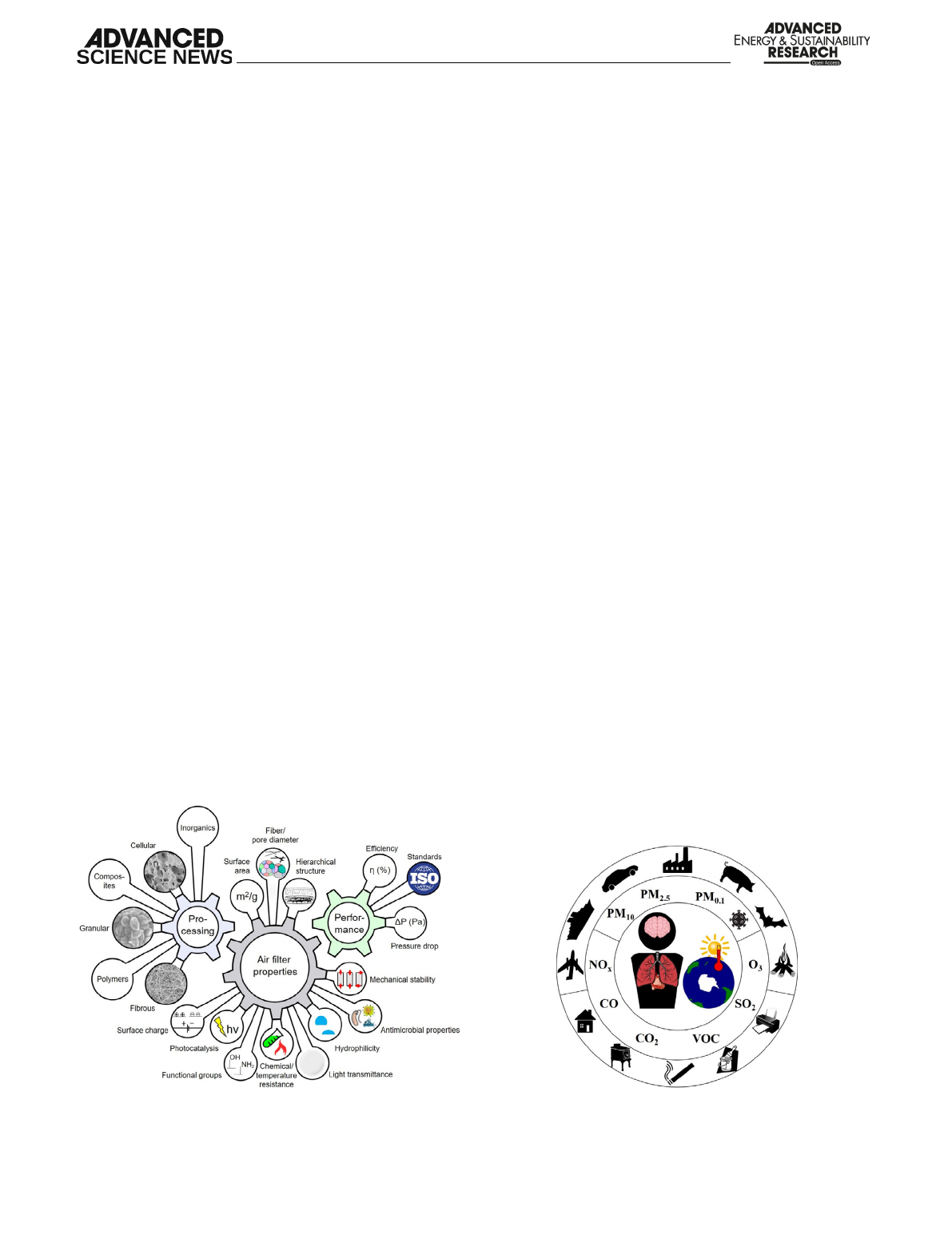
shown in Figure 1. Emphasis will be put on air filters for room
temperature applications and filtration of PM. Processing param-
eters, possibilities, and limits will be described for polymeric,
composite, and inorganic materials. In the following, special
attention will be devoted to tailoring structural and material prop-
erties to improve the properties and performance of air filters.
Additional filter features such as antibacterial properties and fil-
tration of gaseous pollutants will be exploited. All things consid-
ered, the reader will be provided with a well-resourced toolbox for
air filter understanding and performance optimization, consider-
ing sustainability and filter regeneration. Finally, remaining chal-
lenges and possible solutions within the progress of air filter
research will be addressed.
2. Air Pollutants and Their Impact
A variety of gaseous and particulate substances from both natural
and anthropogenic sources can cause air pollution, leading to
short- and long-term harm to human and environmental health,
as schematically shown in Figure 2. Air pollutants can be classi-
fied according to their source, chemical composition, size, or
release mode. Common classifications are primary versus sec-
ondary, indoor versus outdoor, and gaseous versus particulate
pollutants.
[16]
Primary pollutants such as oxides of sulfur, nitro-
gen, and carbon, as well as PM from ash, smoke, and dust, are
directly emitted into the atmosphere from natural and anthropo-
genic sources. When primary pollutants react with atmospheric
constituents, secondary pollutants such as ground-level ozone,
nitrogen oxides, or acid rain are produced.
[17]
Air pollutants
can also be classified according to the place of emission. For
instance, combustion products and volatile organic compounds
(VOCs) released from indoor activities, e.g., cooking, smoking,
and heating, furniture, building materials, and paint, are called
indoor pollutants. In contrast, outdoor pollutants are predomi-
nantly generated from power plants, industries, and vehicles,
which emit large amounts of various pollutants. However, the
most common classification of pollutants is gaseous versus
particulate.
The main gaseous pollutants are volatile oxides of nonmetallic
elements such as sulfur, nitrogen, and carbon, and VOCs. On the
contrary, particulate pollutants or PM refer to the solid particles,
liquid droplets, or mixtures of both, including aerosols formed
with viruses, bacteria, and spores. PM is usually further subclas-
sified according to the size, denoted as PM
x
, whereby xdescribes
the maximum particle diameter in micrometer (μm). Established
classes are coarse PM
10
,fine PM
2.5
, and ultrafine PM
0.1
. This
well-known filterable PM (FPM) is distinguished from condens-
able particulate matter (CPM).
[18]
CPM is gaseous at fuel gas tem-
perature but forms a solid or liquid substance after dilution and
cooling, which belongs to harmful PM
2.5
. Frequent precursors of
CPM are VOCs and sulfur oxides.
The UN General Assembly listed air pollution within the five
main risks for noncommunicable diseases. The harmful effect of
air pollutants on human health strongly depends on the type of
Figure 1. Schematic illustration of this Review showing the dependence of
the air filter performance on the air filter properties, which are governed by
the choice of material and processing technique.
Figure 2. Schematic illustration of the main gaseous and particulate air
pollutants produced from selected outdoor and indoor sources and their
harmful effects on human and environmental health.
www.advancedsciencenews.com www.advenergysustres.com
Adv. Energy Sustainability Res. 2021,2, 2100005 2100005 (2 of 30) © 2021 The Authors. Advanced Energy and Sustainability Research
published by Wiley-VCH GmbH
pollutant, its amount, as well as the time of exposure and possible
accumulation in the body over time.
[19]
It is widely accepted that
air pollution causes respiratory diseases such as chronic obstruc-
tive pulmonary disease (COPD), asthma, and lung cancer. In that
respect, nitrogen dioxide and sulfur dioxide, in particular, were
found to be noticeably associated with respiratory diseases and
lung cancer mortality, respectively.
[20]
Furthermore, acute and
chronic cardiovascular diseases such as myocardial ischemia
and infarctions, heart failure, and strokes were found to be pro-
voked by air pollutants, predominantly by fine PM
2.5
and ultra-
fine PM
0.1
.
[21]
The PM inhaled into the pulmonary tree may harm the human
body via: i) instigation of systemic inflammation and/or oxidative
stress, ii) alterations in autonomic balance, and iii) direct actions
upon the vasculature of particle constituents. Other than that,
pathogens such as influenza or SARS viruses can spread by air-
borne or aerosol transmission, followed by disease outbreaks.
[22]
Without protection using air filters or other means, outbreaks
can possibly evolve into pandemics and endanger the health
and life of millions of people. Examples include the 1918 influ-
enza pandemic, also known as Spanish flu, or the current
COVID-19 pandemic.
Air pollution does not only cause harm to human health, but
also to the environment. Major damaging effects include i) acid
rain, which acidifies water and soil environments, ii) haze from
PM dispersed in air, iii) ozone thinning in Earth’s protective
stratospheric layer, and iv) climate change, including global
warming induced by elevated emission of greenhouse pollutants,
such as carbon and nitrogen oxides and methane.
[23]
In addition,
climate change is expected to exacerbate further human health
impacts by increasing weather conditions that enhance air pol-
lution exposure, mainly to PM
2.5
and ozone.
[24,25]
To break the
cycle of air pollution and climate change, air pollution needs
to be restricted more drastically. In this regard, air filters provide
a suitable method for air purification.
3. Fundamental Principles of Air Filters
In the following section, the mechanisms of air filtration of par-
ticulate and gaseous pollutants will be introduced. Furthermore,
key factors in the evaluation of air filter performance will be
presented. An overview of the worldwide classification and stan-
dardization of air filters according to these key factors will be pro-
vided. Furthermore, the influence of the model pollutant on the
air filter performance will be discussed.
3.1. Mechanisms of Air Filtration
Particulate and gaseous adsorbents significantly differ in size
and chemical composition. Thus, they behave differently within
the air flow and require different approaches for removal. In the
following, the underlying mechanisms for the removal of partic-
ulate and gaseous pollutants will be elucidated.
3.1.1. Filtration of Particulate Pollutants
Several mechanisms were reported to be involved in the filtration
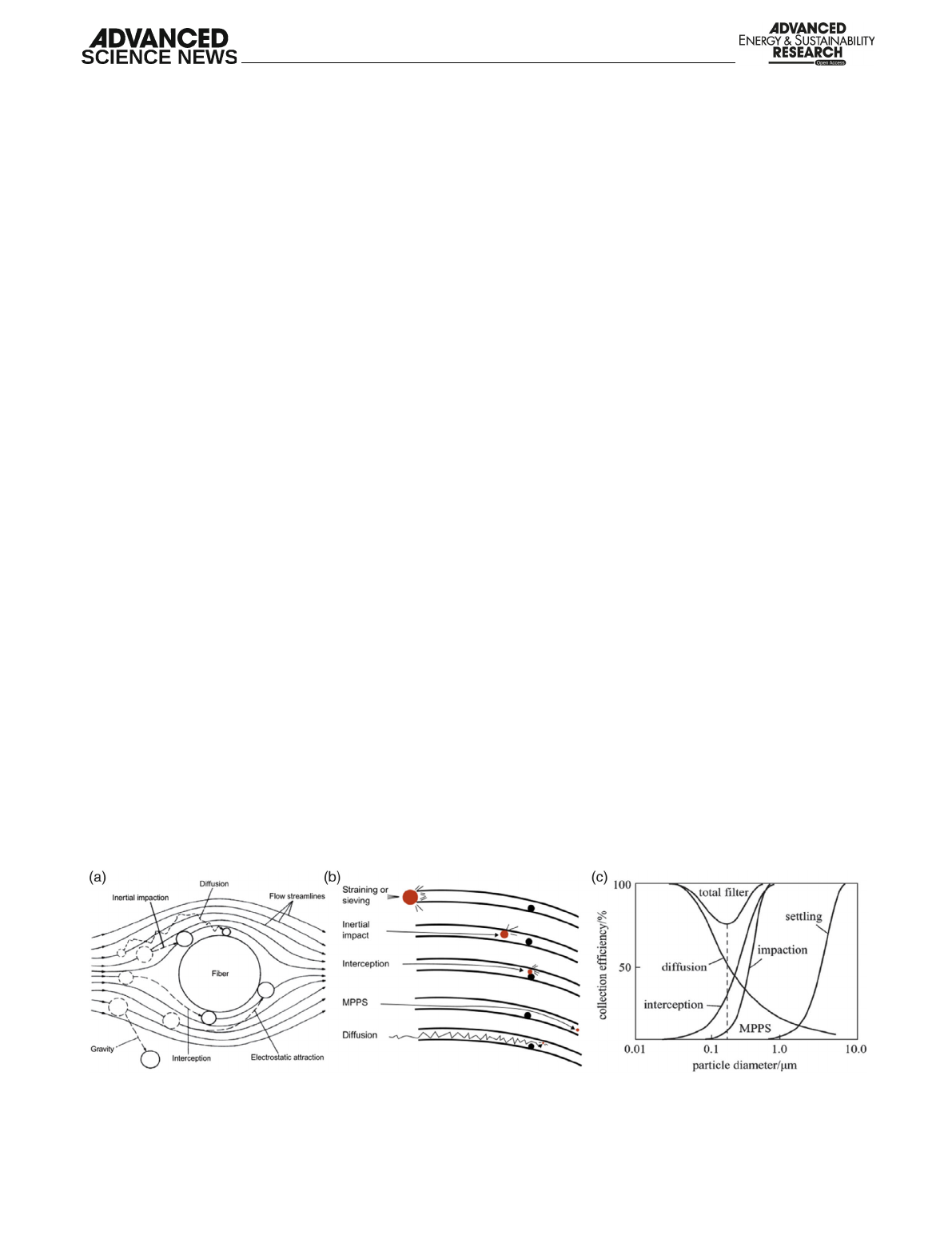
of PM, as shown in Figure 3a,b, namely sieving, gravity settling,
inertial impaction, interception, diffusion, and electrostatic
attraction.
[26,27]
Sieving takes place when the particles are too large to enter the
pores of the filters and are retained on the barrier. As sieving
requires adequately small pore sizes, usually in the range of
3–8 nm,
[28,29]
the corresponding pressure drop is commonly
in the range of a few hundreds or thousands of Pa. This is much
higher than that of other mechanisms, making sieving hardly
competitive as the main filtration mechanism for air filters, com-
pare Section 4.
Particles larger than 5 μm experience a significant net down-
ward motion and can be filtered by gravity settling. This mecha-
nism is barely relevant for common air filters as such particles
often settle before reaching the filter surface. In contrast, small
particles with high inertia that can enter the filter material have
sufficient momentum to break away from the air streamline and
collide with the filter medium, being separated by impaction.
Thus, this mechanism is called inertial impaction. In case the
particles do not have sufficient inertia to depart from the gas
streamline, they can still be filtered by collision with the filter
medium, i.e., by interception mechanism. Both inertial impac-
tion and interception mechanisms are more likely to occur with
higher internal tortuosity of the filter medium and are among the
most common filter mechanisms, especially for fibrous filters.
Figure 3. Schematic representation of the major filter mechanisms sieving, gravity settling, inertial impaction, interception, diffusion, and electrostatic
attraction for particle matter a) past a single fiber and b) through a pore. Reproduced with permission.
[26]
Copyright (2016), Elsevier. MPPS describes the
most penetrating particle size for which a filter is least effective. c) Dependence of the particle size on the major filter mechanisms and the resulting total
filter efficiency, Reproduced with permission.
[230]
Copyright 2012, John Wiley and Sons.
www.advancedsciencenews.com www.advenergysustres.com
Adv. Energy Sustainability Res. 2021,2, 2100005 2100005 (3 of 30) © 2021 The Authors. Advanced Energy and Sustainability Research
published by Wiley-VCH GmbH

The exploitation of these mechanisms comes along with low
pressure drop values, mostly below 100 Pa, compare Section 4.
Diffusion is based on the Brownian motion and migration of
particles smaller than 0.5 μm within the gaseous medium with
concentration gradients of particles from the regions of higher
concentration to those of lower local concentration, i.e., to the
surface of the filter medium. Electrostatic attraction, based on
the surface electrical charge of the particle and/ or fiber medium,
causes particles to divert from the streamline and settle on the
fiber medium. The electrical field can also be externally imposed.
Electrostatic pollutant capture emerged as the most frequently
applied filtration mechanism, as it conveniently allows to obtain
pressure drop values below 50 Pa down to values as low as
0–0.5 Pa, compare Section 5. Still, there usually exist particles
small enough to stay with the streamline, regardless of wall
surfaces or other obstacles. As a result, those cannot be withheld
by the filter medium. Among that, as shown in Figure 3c, differ-
ent mechanisms are dominant for different particle sizes. As a
result, for each filter, there exists a particle size, for which filters
are least effective, called the most penetrating particle size
(MPPS). The MPPS usually is in the particle size range of
0.04–0.4 μm. Research emphasis is mostly focused on removing
the particles within this size range, as they are hard to remove
and might pose a serious health threat due to their ability to enter
the lower respiratory tract.
In addition to the methods mentioned earlier, adsorption is
often proposed as one of the underlying filtration mechanisms,
not specifying the exact nature of pollutant adhesion, compare
Section 4. As adsorption occurs at the surface, the available sur-
face area of the filter material is of most importance. In addition,
adsorption can be significantly enhanced by functional surface
groups.
[30–32]
3.1.2. Filtration of Gaseous Pollutants
Chemical air filters, also called air purifiers, can be applied to
remove gaseous pollutants from the air via physisorption,
and/or chemisorption.
[33]
Physisorption is based on weak van
der Waals forces between the filter material and the pollutant.
van der Waals bonds are comparably weak, whereas a strong
bond between the filter material and pollutant can be formed dur-
ing chemisorption. Hence, molecules bond by physical adsorp-
tion can migrate about the surface and be easily removed from
the filter surface during regeneration. In contrast, molecules
bond by chemical sorption are restricted to specific surface sites
and can hardly be removed by reasonable energy demands.
3.2. Performance Evaluation
3.2.1. Model Pollutants
When determining the performance of an air filter, the size of
the model pollutant is not the only important factor to consider,
but so is its shape, surface charge, or ability to form stable aero-
sols. Air filter performance factors are most commonly deter-
mined using NaCl as a model pollutant because it forms
cubic particles with round edges. Furthermore, it is a low-cost
material, which is easy to handle and easily available. NaCl is well
suited to average filtration efficiencies considering that spherical
particles like spherical polystyrene latex result in higher filtration
efficiency compared with cubic particles like MgO of the same
aerodynamic size.
[34]
Incense smoke is another commonly used
model pollutant, which produces particles mostly smaller than
2.5 μm as well as gas products like CO, CO
2
,NO
2
,SO
2
, and
VOCs such as benzene, toluene, xylenes, aldehydes, and polycy-
clic aromatic hydrocarbons.
[35]
Thus, incense smoke exhibits
both polar functional groups such as C─O, C═O, and C─N,
and nonpolar functional groups like C─C, C─H, and C═C.
[36]
To represent organic matter and oil droplets, di-ethyl-hexyl-
sebacat (DEHS) is a frequently used model pollutant as it forms
a stable aerosol.
[37]
Depending on the temperature and relative
humidity, changes in the morphology or state of the test pollu-
tants may occur and should be considered.
[38]
Recently, a low-cost
optical measurement for testing the efficacy of facemasks against
expelled droplets during the speech was presented and applied to
commercial masks and mask alternatives such as neck fleece and
bandanas.
[39]
The evaluation of antimicrobial properties is usually ascer-
tained by aerosol filtration and subsequent cell incubation or
in liquid media, which can be problematic due to safety concerns.
Instead, testing in liquid media can be carried out. Recently,
researchers presented a novel method of determining the antivi-
ral performance of air filters against airborne infectious viruses.
This allows deriving results for tests in an air medium from tests
in a liquid medium without the need for aerosolized viruses.
[40]
3.2.2. Key Performance Indicators
The removal or filtration efficiency η, which is one of the most
important factors to evaluate the performance of any filter, is
defined as the percentage of contaminant removed by the filter,
according to Equation (1), where c0and c1(μgm
3
) are the
upstream and downstream concentrations of the contaminant,
respectively.
ηð%Þ¼ðc0c1Þ
c0
100 (1)
In contrast to the filtration efficiency, which should be as high
as possible, the pressure drop ΔP, which represents the pressure
loss through the filter, should be remained as small as possible.
This reduces both energy demand and breathing resistance. The
pressure drop ΔP(Pa) is practically determined by measuring the
difference between upstream and downstream pressure P0and
P1(Pa), respectively, according to Equation (2).
ΔP¼P0P1(2)
The pressure drop ΔP(Pa) can be expressed by Darcy’s law,
according to Equation (3), where h,μ,U, and kare the filter thick-
ness (m), gas viscosity (Pa s), gas velocity at the surface of the
filter (m s
1
), and permeability (m
2
), respectively. As shown
in Equation (3), Darcy’s model represents a linear relationship
between the pressure drop and the gas velocity in porous media.
Accordingly, the gas velocity should be considered when compar-
ing the pressure drop values of different air filters. However, in
some cases, especially at high gas velocities and for complex pore
www.advancedsciencenews.com www.advenergysustres.com
Adv. Energy Sustainability Res. 2021,2, 2100005 2100005 (4 of 30) © 2021 The Authors. Advanced Energy and Sustainability Research
published by Wiley-VCH GmbH

structures, deviations from Darcy’s model can be observed. Thus,
other models, such as the Forchheimer model, can be used to
correlate this nonlinear relationship between pressure drop
and the gas velocity based on inertial effects.
[41]
The
Forchheimer model extends Darcy’s linear law by an additional
quadratic term βρU
2
, where βrepresents the inertial coefficient
(m
1
) and ρis the air density (kg m
3
), to account for the change
in pressure drop.
[42]
The Forchheimer number, which refers to
the ratio between the viscous and inertial effects, can be used as
criterion to decide for the applicability of the respective mod-
els.
[43]
ΔP
h¼μU
k(3)
Finally, the overall filtration performance of a filter can be eval-
uated by calculating the quality factor, QF, according to
Equation (4), considering both efficiency and pressure drop fac-
tors. Thus, the QF is considered as a benefit-to-cost ratio.
QF ¼lnð1ηÞ
ΔP(4)
3.3. Classification and Standardization of Air Filters
Air filters can be classified according to their performance, appli-
cation, operation principle, or material composition. Commonly,
air filters are classified according to their efficiency based on reg-
ulations published by international organizations such as the
International Organization for Standardization (ISO), regional
organizations such as the European Committee for
Standardization (Comité Européen de Normalisation, CEN),
Europe’s Industry Association for Indoor Climate (HVAC),
Process Cooling, and Food Cold Chain Technologies
(EUROVENT), or national organizations such as the American
Society for Testing and Materials (ASTM), American Society
of Heating, Refrigeration and Air Conditioning Engineers
(ASHRAE), and from the China Association for
Standardization (CAS) and China Household Electric
Appliance Research Institute (CHEARI), among others. These
organizations do not only classify air filters, but also recommend
widely accepted regulations for air filter testing.
For instance, according to the European standard EN 1822,
from which the current international standard ISO 29463 was
derived, air filters are classified as efficient particulate air
(EPA) filters with efficiencies of 85–99.5%, high-efficiency partic-
ulate air (HEPA) filters with efficiencies of 99.95–99.995%, and
ultralow penetration air (ULPA) filters with efficiencies of
99.9995–99.999995%. Air filters are commonly tested with par-
ticle sizes of 0.3–0.5 μm. Concerning filtering respirators, the
European filtering face piece (FFP) classification and the U.S.
National Institute for Occupational Safety and Health
(NIOSH)’s air filtration rating are well-established standards.
The European standard EN 149 describes filtering half masks
labeled as FFP1, FFP2, and FFP3, which filter at least 80%,
94%, and 99% of the test pollutants. Tests are conducted with
NaCl particles of 0.02–2μm, having a mean diameter of
0.6 μm and a concentration of 8 4mg m
3
, as well as with
paraffin oil, at 95 L min
1
. The breathing the resistance may
not exceed 210, 240, and 300 Pa for FFP1, FFP2, and FFP3 fil-
tering half masks, respectively, for the flow rate given. In the
U.S., as governed by Part 84 of Title 42 of the Code of
Federal Regulations (CFR), minimum efficiency levels of 95%,
99%, and 99.97% for particles ≥0.3 μm, made from NaCl or oily
dioctylphthalate (DOP), are assigned to respirator classes X95,
X99, and X100, respectively. Thereby, Xis replaced with Nfor
respirators not resistant to oil, i.e., particular filtration only, R
for respirators resistant to oil, and Pfor oil-proof and reusable
respirators. More recently, the People’s Republic of China
updated the national standard GB 2626 for respiratory protection,
whose effective date was postponed to July 2021 by the
Standardization Administration of China (SAC) due to the
COVID-19 pandemic to ensure stable respiratory production.
The classification contains the filter categories KN for nonoily
particles and KP for oily and nonoily particles with the suffix
90, 95, or 100 that refer to the filter efficiencies.
4. Processing Technologies and Performance of
Fibrous Air Filters
4.1. Electrospinning
Electrospinning is a commonly used technique to produce fibers
and fiber-based meshes by applying a high voltage to a polymeric
solution or melt, as shown in Figure 4a. During the electrospin-
ning process, the solution becomes electrically charged and over-
comes its surface tension, forming a Taylor cone at the needle
tip, which is subsequently stretched in a jet form toward a
grounded plate or rotary collector. On its way to the collector,
the jet dries, and the present solvent evaporates, resulting in
fibers having diameters in the range of tens to a few hundred
nanometers.
[12]
Electrospinning allows for the production of con-
tinuous fiber assemblies such as nonwoven, aligned, and pat-
terned fiber meshes, as well as random 3D structures, evolved
from a long fiber overlaying on itself multiple times.
[44]
Exemplary structures for polymeric, inorganic, composite, and
metallized fiber structures are shown in Figure 4b-i.
Common polymeric building blocks for electrospinning
include polyacrylonitrile (PAN), polyvinylidene fluoride
(PVDF), polyurethane (PU), polylactic acid (PLA), polybenzimi-
dazole (PBI), polyamide (PA), poly(methyl methacrylate)
(PMMA), polydimethylsiloxane (PDMS), and mixtures
thereof.
[45–54]
However, natural materials, including silk, wool,
cellulose, soy protein, gelatin, and chitosan, took on greater sig-
nificance due to increasing awareness for sustainability.
[13,55–60]
Furthermore, expanded polystyrene (EPS) waste was successfully
used for the production of air filters by electrospinning.
[61]
In
addition to the material type and additives, which can be used
to functionalize the formed fibers,
[12]
process variables such as
applied voltage, flow rate, type of collector, and distance between
needle tip and collector were adjusted to tailor the final fiber
properties such as diameter, length, porosity, pore size, and mor-
phology.
[62]
For instance, uniform polymeric PBI nanofiber fil-
ters were obtained by electrospinning with a single solvent,
see Figure 4b,
[51]
whereas the usage of a mixed solvent system
allows producing polymer-rich and polymer-lean phases within
www.advancedsciencenews.com www.advenergysustres.com
Adv. Energy Sustainability Res. 2021,2, 2100005 2100005 (5 of 30) © 2021 The Authors. Advanced Energy and Sustainability Research
published by Wiley-VCH GmbH
Loading more pages...