
Citation: Yan, S.; Yin, D.; He, F.;
Cai, J.; Schliermann, T.; Behrendt, F.
Characteristics of Smoldering on
Moist Rice Husk for Silica Production.
Sustainability 2022,14, 317. https://
doi.org/10.3390/su14010317
Academic Editor:
Alberto-Jesus Perea-Moreno
Received: 2 December 2021
Accepted: 24 December 2021
Published: 29 December 2021
Publisher’s Note: MDPI stays neutral
with regard to jurisdictional claims in
published maps and institutional affil-
iations.
Copyright: © 2021 by the authors.
Licensee MDPI, Basel, Switzerland.
This article is an open access article
distributed under the terms and
conditions of the Creative Commons
Attribution (CC BY) license (https://
creativecommons.org/licenses/by/
4.0/).
sustainability
Article
Characteristics of Smoldering on Moist Rice Husk for
Silica Production
Shengtai Yan 1, Dezheng Yin 1, Fang He 1,*, Junmeng Cai 2, Thomas Schliermann 3and Frank Behrendt 1,4
1School of Transportation and Vehicle Engineering, Shandong University of Technology, Zibo 255049, China;
2
School of Agriculture and Biology, Shanghai Jiao Tong University, Shanghai 200240, China; [email protected]
3DBFZ Deutsches Biomasseforschungszentrum Gemeinnützige GmbH, 04347 Leipzig, Germany;
4Institute of Energy Engineering, Technische Universität Berlin, 10623 Berlin, Germany
*Correspondence: [email protected]
Abstract:
In order to assess the possibility of silica production via smoldering of moist rice husk,
experiments of washed (moist) rice husk (7 kg with moisture content of 51%) in a newly designed
smoldering apparatus was performed. The temperature inside the fuel bed during smoldering was
recorded, and characteristics of ash were analyzed. Results showed that the highest temperature in
the middle of the naturally piled fuel bed was about 560.0
◦
C, lower than those in most of combustors.
Some volatiles from the lower part of the fuel bed adhere to its upper ash during piled smoldering.
Silica content and specific surface area of ash from smoldering of washed (moist) rice husk were
86.4% and 84.9 m
2
/g, respectively. Compared to our experiments, they are close to smoldering of
unwashed rice husk (89.0%, 67.7 m
2
/g); different from muffle furnace burning (600
◦
C, 2 h) of washed
(93.4%, 164.9 m
2
/g) and un-washed (90.2%, 45.7 m
2
/g) rice husk. The specific surface area is higher
than those from most industrial methods (from 11.4 to 39.3 m
2
/g). After some improvements, the
smoldering process has great potential in mass product of high quality silica directly from moist
rice husk.
Keywords: smoldering; rice husk; high moisture content; silica; specific surface area
1. Introduction
Smoldering is slow, low-temperature, and flameless burning of porous fuels, which
is an important and complex phenomenon [
1
,
2
]. The application of it in the field of
waste-to-energy conversion such as sludge treatment [
3
], recovery of resources from waste
streams [
4
], and biomass energy conversion [
5
] has attracted lots of attention in recent years.
The main advantages are its low temperature of the solid phase [
6
] and self-sustainability
in a fuel bed with high moisture content (75–80 wt.%) [
7
]. From an environmental point of
view, these characteristics avoid the ash-related slagging/corrosion [
8
], making nutrients
recovery easy via recycling of ash directly to farms [
9
] and reducing the pollution of solid
waste. As to energy consumption, it makes the complete burning of moist solid waste
possible [10], reducing the energy consumption for drying fuel.
Rice husk is a typical biomass waste [
11
], accounting for 14–25% of the grain’s overall
mass [
12
]. In 2021, approximately 150 million tons of rice husk were produced around the
world, with China contributing approximately 40 million tons. Nowadays most rice husk
is directly buried or open burned [
13
] due to its low nutritive value for humans compared
with rice grain and rice bran [
14
]. Direct burying results in soil pollution, because of its
slow decomposition owing to its hard surface resulting from its high silicon and high
lignin content [
15
]. Open burning leads to air pollution because of the release of fine dust
and incomplete combustion gases of CO, NO
x
, CH
4
, poly-cyclic hydrocarbons (PAH) and
soot [16].
Sustainability 2022,14, 317. https://doi.org/10.3390/su14010317 https://www.mdpi.com/journal/sustainability

Sustainability 2022,14, 317 2 of 13
There is great potential in producing silica from rice husk due to its high content
of amorphous silica (around 18–23% [
17
]) and ash (around 85–95% [
18
]). Silica is an
important inorganic material and is widely used in various fields such as fertilizer, insulator,
adsorbent and catalyst [
19
]. It is characterized by high mechanical strength, good chemical
stability, high-temperature resistance, easy dispersion in solvents, etc [
20
,
21
]. With the
widespread application of silica, a variety of methods have been adopted to produce it, such
as precipitation, plasma synthesis, chemical vapor deposition, micro emulsion processing,
combustion synthesis and hydrothermal technique [
22
,
23
]. At present, most popular mass
producing methods are precipitation from alkaline silicates and hydrothermal treatment
of sand with lye [
24
]. However, both methods are expensive, intensive energy input, and
environmentally harmful due to the production of dust, nitrogen and sulfur oxides, etc in
the process of obtaining silica [25,26].
Producing silica from thermochemical conversion of rice husk has received consid-
erable attention due to its economic and environmental advantages [
27
]. As to lab-scale
production, Dizaji et al. [
28
] prepared silica by burning raw rice husk and pretreated rice
husk (water washing at 50
◦
C for 2 h) in a muffle furnace at 600
◦
C for 4 h. The specific
surface area was around 45.0 and 240.0 m
2
/g, respectively. Abu Bakar et al. [
29
] prepared
silica by burning rice husk (unleached/acid-leached) in a muffle furnace (600
◦
C for 2 h).
The purity of silica from unleached and acid-leached rice husk was 95.8 and 99.6 wt.%
(XRF results), respectively, and specific surface area was 116.0 and 218.0 m
2
/g, respectively.
Almeida et al. [
30
] prepared a mixture of silica and carbon by pyrolysis of raw rice husk in
a tubular furnace. The obtained silica was black, in a mixture of amorphous and crystalline,
with purity of 81.6 wt.% and specific surface area of 114.0 m
2
/g. Schliermann et al. [
31
]
obtained ashes produced from water washed (50
◦
C for 2 h) rice husk using ÖKOTHERM
®
furnaces. The ashes are post-treated with acid and then thermally treated at 650
◦
C using a
muffle furnace. The specific surface area of silica is about 150–200 m
2
/g. As to industrial
production, Fernandes et al. [
32
] investigated characteristics of ash from burning rice husk
in a grate furnace, a fluidized bed, and a suspension/entrained combustor. The silica
content in these three types of ash was 90.0, 96.7, 93.6 wt.%, and the specific surface area
was 39.3, 11.4, 26.7 m
2
/g, respectively. The specific surface area of silica from mass pro-
duction tends to be lower than that prepared in a laboratory, which may be related to none
pretreatment of rice husk and the high burning temperature in industrial combustors. It is
recorded that high combustion temperature results in the transformation of amorphous
silica to crystalline material [33].
Pretreatment of rice husk is an effective way to increase the purity and specific sur-
face area of silica and typical pretreatments for rice husk are acid-leaching and water-
washing [
29
,
34
,
35
]. Moisture content of the treated rice husk is normally high. According to
our pre-experiments, moisture content of rice husk is around 50% after washing. The moist
rice husk is not suitable to be burned directly in a normal combustor (the moisture content
in a fluidized bed combustor needs to be <35% [
36
], for a suspension burner <15% [
37
]).
Smoldering might be a good choice for thermochemical conversion of moist rice husk di-
rectly to silica. Yet, to the best of our knowledge there are no experiments using smoldering
in literature.
The objective of this study is to assess the possibility of silica production via smoldering
of rice husk with high moisture content omitting a drying step before thermochemical
conversion. A smoldering apparatus was designed and smoldering experiment of rice husk
with high moisture content was performed. Temperature inside a fuel bed was recorded
and characteristics of ash (silica content, specific surface area and mass loss characteristic)
were analyzed.
2. Materials and Methods
2.1. Material
Rice husk was collected from rural southern China in 2021. Two types of rice husk
(washed/unwashed) were chosen as raw material in the experiment. The washing process
Sustainability 2022,14, 317 3 of 13
is the following: 3.5 kg of rice husk was put into a bucket (
φ
42 cm diameter
×
40 cm height),
then the bucket was filled with tap water (mass ration of water to rice husk: 10:1). The
mixture was stirred for 10 min at ambient temperature. After being immersed for 12 h, rice
husk was taken out and leaked above a screen in air for 1 h. The proximate and ultimate
analysis of washed and unwashed rice husk were performed three times and the results
were shown in Table 1.
Table 1.
Proximate and elemental analysis of the rice husk. Oxygen is calculated by difference
(C + H + O + N + S + Ash = 100 wt.%, dry basis).
Proximate Analysis (Arrival Basis, wt.%) Elemental Analysis (Dry Basis, wt.%)
Moisture Volatile Ash Fixed Carbon C H O N S
Washed 51.0 ±0.2 32.0 ±1.5 9.3 ±0.3 7.7 ±0.8 40.2 ±0.3 5.5 ±0.1 35.0 ±0.2 0.3 ±0.1 <0.1
Unwashed
8.1 ±0.1 59.0 ±1.4 18.4 ±0.1 14.5 ±0.7 38.7 ±0.3 5.4 ±0.1 35.5 ±0.2 0.2 ±0.1 <0.1
2.2. Experimental Set-Up
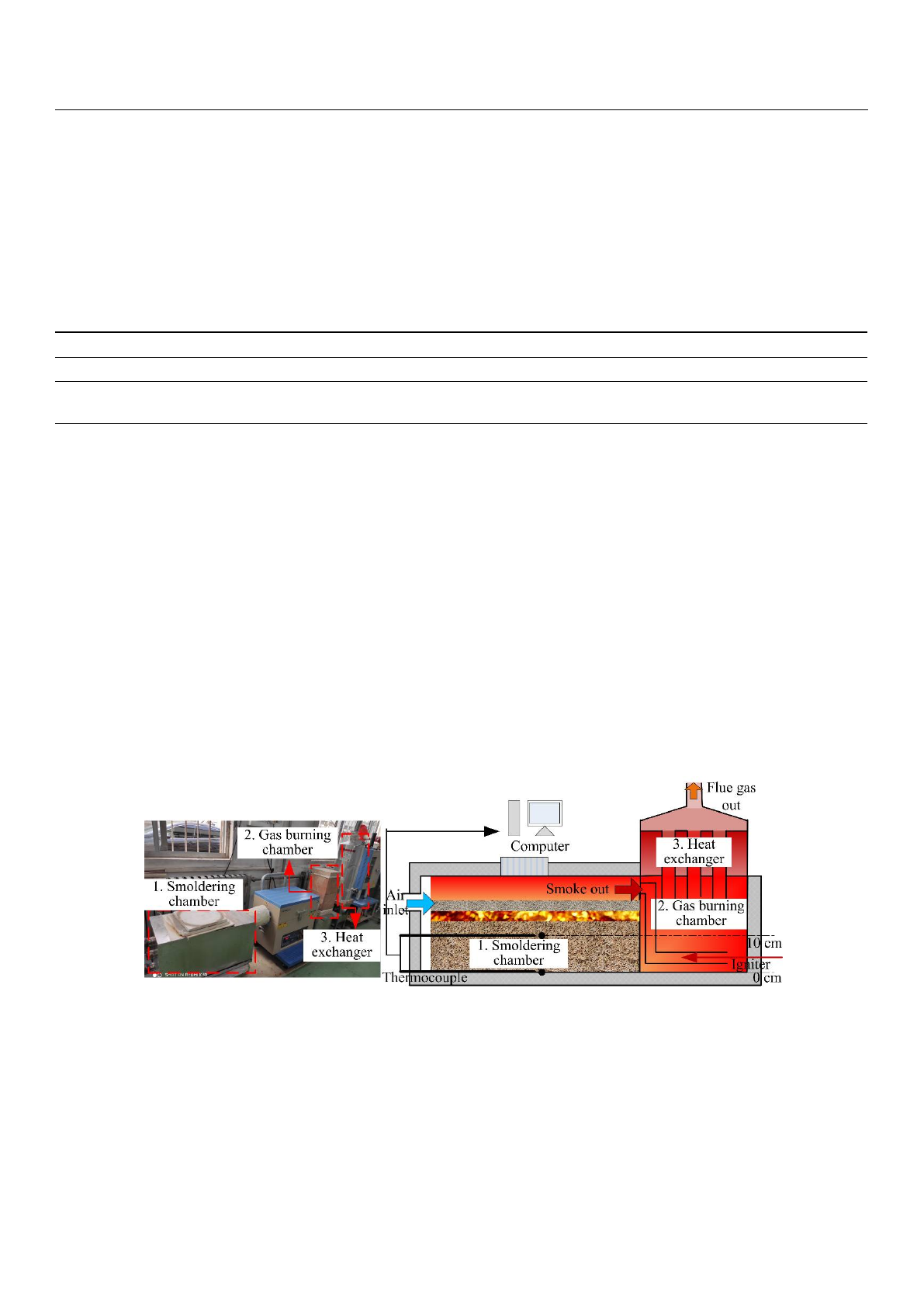
A batch smoldering apparatus consisting of three parts (a smoldering chamber, a
gas burning chamber and a heat exchanger) was designed, as shown in Figure 1. The
smoldering chamber is rectangular (inner size 60
×
30
×
30 cm) with an insulation layer
(4 cm) outside of its inner wall. An air inlet (
φ
5 cm) and a flue gas outlet (
φ
5 cm) are
on the left and the right wall, respectively. A hole (
φ
30 cm) with door on the top wall is
used for material feeding and ash removal. The gas burning chamber is a square cavity
(30 ×30 ×30 cm)
with an insulation layer (4 cm) outside of its inner wall. Its inlet (
φ
5 cm)
on the left wall is connected with the flue gas outlet of the smoldering chamber. A quartz
glass tube inside the burner is used to introduce the incomplete combustion flue gas from
the smoldering chamber to the bottom of the burner, then the gas is ignited using an igniter.
The heat exchanger is a cylinder with a diameter of 30 and a height of 100 cm. The heat is
transferred from high temperature flue gas through three tubes (diameter of 5 and a height
of 40 cm) to the water outside them. Rice husk is smoldered in the smoldering chamber,
smoke is burned out in the gas burning chamber, and flue gas is discharged into the air
after cooled in the heat exchanger.
Sustainability 2022, 13, x FOR PEER REVIEW 3 of 13
Rice husk was collected from rural southern China in 2021. Two types of rice husk
(washed/unwashed) were chosen as raw material in the experiment. The washing process
is the following: 3.5 kg of rice husk was put into a bucket (Ф42 cm diameter × 40 cm
height), then the bucket was filled with tap water (mass ration of water to rice husk: 10:1).
The mixture was stirred for 10 min at ambient temperature. After being immersed for 12
h, rice husk was taken out and leaked above a screen in air for 1 h. The proximate and
ultimate analysis of washed and unwashed rice husk were performed three times and the
results were shown in Table 1.
Table 1. Proximate and elemental analysis of the rice husk. Oxygen is calculated by difference (C +
H + O + N + S + Ash = 100 wt.%, dry basis).
Proximate Analysis (Arrival Basis, wt.%) Elemental Analysis (Dry Basis, wt.%)
Moisture Volatile Ash Fixed Carbon C H O N S
Washed 51.0 ± 0.2 32.0 ± 1.5 9.3 ± 0.3 7.7 ± 0.8 40.2 ± 0.3 5.5 ± 0.1 35.0 ± 0.2 0.3 ± 0.1 <0.1
Unwashed 8.1 ± 0.1 59.0 ± 1.4 18.4 ± 0.1 14.5 ± 0.7 38.7 ± 0.3 5.4 ± 0.1 35.5 ± 0.2 0.2 ± 0.1 <0.1
2.2. Experimental Set-Up
A batch smoldering apparatus consisting of three parts (a smoldering chamber, a gas
burning chamber and a heat exchanger) was designed, as shown in Figure 1. The smol-
dering chamber is rectangular (inner size 60 × 30 × 30 cm) with an insulation layer (4 cm)
outside of its inner wall. An air inlet (Ф5 cm) and a flue gas outlet (Ф5 cm) are on the left
and the right wall, respectively. A hole (Ф30 cm) with door on the top wall is used for
material feeding and ash removal. The gas burning chamber is a square cavity (30 × 30 ×
30 cm) with an insulation layer (4 cm) outside of its inner wall. Its inlet (Ф5 cm) on the left
wall is connected with the flue gas outlet of the smoldering chamber. A quartz glass tube
inside the burner is used to introduce the incomplete combustion flue gas from the smol-
dering chamber to the bottom of the burner, then the gas is ignited using an igniter. The
heat exchanger is a cylinder with a diameter of 30 and a height of 100 cm. The heat is
transferred from high temperature flue gas through three tubes (diameter of 5 and a height
of 40 cm) to the water outside them. Rice husk is smoldered in the smoldering chamber,
smoke is burned out in the gas burning chamber, and flue gas is discharged into the air
after cooled in the heat exchanger.
Figure 1. Photo and schematic of the smoldering apparatus.
2.3. Ash Preparation and Treatment
2.3.1. Ash Preparation from Rice Husk
For comparison, four types of ash―from washed/unwashed rice husk via smolder-
ing and muffle furnace burning―were prepared. The washed and unwashed rice husk
(3.5 kg of raw materials) were put naturally piled into the smoldering chamber. The height
of the fuel beds was around 24 and 20 cm, and the bulk density were about 160 and 100
kg/m3, respectively. Then, it was ignited with a block of solid alcohol at the air inlet. Two
Figure 1. Photo and schematic of the smoldering apparatus.
2.3. Ash Preparation and Treatment
2.3.1. Ash Preparation from Rice Husk
For comparison, four types of ash—from washed/unwashed rice husk via smoldering
and muffle furnace burning—were prepared. The washed and unwashed rice husk (3.5 kg
of raw materials) were put naturally piled into the smoldering chamber. The height of the
fuel beds was around 24 and 20 cm, and the bulk density were about 160 and 100 kg/m
3
,
respectively. Then, it was ignited with a block of solid alcohol at the air inlet. Two
thermocouples (
φ
1 mm, KMTXL-040-G) were put into the bottom and middle (10 cm from
the bottom) layer of the fuel bed to monitor the change of temperature inside the fuel bed,

Sustainability 2022,14, 317 4 of 13
and data were recorded every 60 s. It was found that a thin layer of upper ash was black
due to the low temperature and the other part of ash was homogeneous after extinguishing
and cooling of the fuel bed. A vacuum cleaner was used to remove the black ash on the
upper layer and 200 g rice husk ash was taken out from the center of the piled residue
every time.
About 3 g of washed and unwashed rice husk were put into an ash tray (6
×
3
×
2 cm)
respectively, heated in a muffle furnace from ambient temperature to 600
◦
C at 10
◦
C /min
and holding for 2 h. Air entered the muffle furnace through a 2–3 cm gap between the
furnace door and the wall. Then the ash was taken out and cooled to ambient temperature
in a desiccator for later use.
2.3.2. Grinding and Drying of Ash
For homogeneity in the subsequent measurements, the four types of ash were sepa-
rately crushed to powder with a particle size <120 mesh using an agate mortar. After that,
these powders were dried in an oven at 105 ◦C for 24 h.
2.4. Thermal and Physical Characterization of Ash
Mass loss characteristic was analyzed using a simultaneous thermogravimetric analy-
sis (TGA DSC1, Mettler TOLEDO). To avoid corrosion to the instrument, a pair of crucibles
(inner: alumina 50
µ
L, outer: platinum 70
µ
L) were used in experiments. About 8 mg of ash
was put into the inner crucible and heated from 50 to 950
◦
C at a heating rate of
10 ◦C /min.
An air flow rate of 200 mL/min was used as reactive gas and 20 mL/min of N2 was used
as protective gas. Each experiment was repeated three times to check reproducibility.
The contents of silica and other elements in ash were triplicate and measured by
Wavelength Dispersive X-Ray Fluorescence Spectrometer (ZXS100e, Rigaku Corporation)
at room temperature. It should be noted that contents are only reliable for elements with
atomic weight
≥
23 [
38
]. Because of the data overflow of the results of carbon and boron,
the results of them were deleted before calculation of the oxides’ content.
Specific surface area was evaluated according to the Brunnauer, Emmett and Teller
(BET) method and based on the nitrogen adsorption of the material at 77K. It was deter-
mined in the pressure range of p/p
0
= 0.05–0.3 [
28
], where p is the system pressure, and
p
0
is the initial pressure (1 bar in this experiment). The measurement was conducted in a
surface area analyzer (ASAP 2460, Micromeritics).
3. Results and Discussion
3.1. Characteristics of Smoldering Process
3.1.1. Temperature inside Fuel Bed
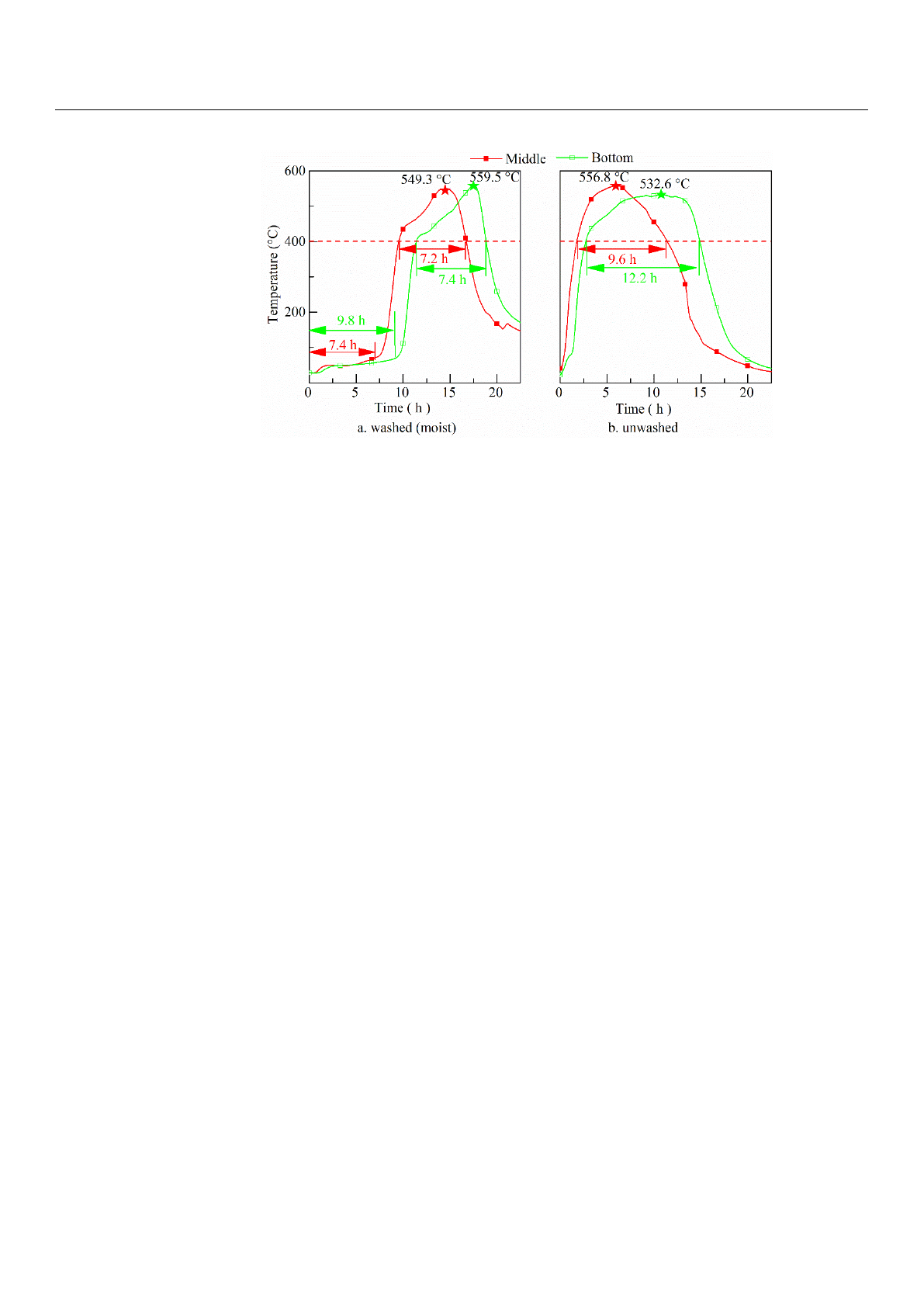
Temperature inside the washed (moist) and unwashed fuel bed is shown in
Figure 2
.
The temperature history at one spot of the batch fuel bed can be divided into two
stages—drying and oxidation. At the drying stage, the temperature first increases and then
stabilizes at a temperature of about 60
◦
C. This is similar to the temperature of smoldering
pine bark particle [
39
] and sewage sludge [
4
], which is different from the temperature
(around 100
◦
C) of smoldering corn stalk powder [
40
] and corn flour [
6
]. Supplement
experiments show this temperature is always around 60
◦
C in natural piled rice husk. In
our experiments of smoldering branches, there is even no obvious plat temperature at
the preheating period, which is similar to smoldering of unwashed rice husk. It implies
temperature in the fuel bed at drying stage might be related to the porosity inside the
fuel bed, materials, particle size, air flow, etc. The detailed analysis of this will be left
for future work. At the oxidation stage, the temperature first increases rapidly and then
increases at a stable rate. It drops quickly at the end stage of oxidation. For both cases the
highest temperatures are around 560.0
◦
C, being much lower than those in most combustors
(>700 ◦C)
[
41
,
42
]. The low temperature is favorable to maintain the amorphous state of the
silica [43].
Sustainability 2022,14, 317 5 of 13
Sustainability 2022, 13, x FOR PEER REVIEW 5 of 13
temperatures are around 560.0 °C, being much lower than those in most combustors (>700
°C) [41,42]. The low temperature is favorable to maintain the amorphous state of the silica
[43].
Comparing the temperature development of the washed (moist) fuel bed with the
unwashed fuel bed, the former has a longer duration of drying stage. The lower the part
of the zone in the fuel bed, the longer the drying stage lasts. At oxidation stage, the dura-
tion of temperature > 400 °C of the moist fuel bed is shorter than for the unwashed fuel
bed. This happens due to more heat generated in the process of smoldering is used to dry
the moist rice husk and heat transfer rate to dry fuel is bigger than those for unwashed
rice husk. The oxidation duration is also affected by bulk density of the fuel bed. In our
supplementary experiments, smoldering of unwashed rice husk with bulk density of 170
kg/m3 was performed in a small apparatus. It was found that the maximum temperature
becomes higher (around 600 °C) than for naturally piled rice husk. The bigger bulk density
decreases the porosity inside the fuel bed, reducing thermal dispersions [39]. Besides, an-
other possible reason is that the dwell time of gaseous species is extended resulting in
longer duration.
Figure 2. History of temperature of middle and bottom layer of washed (a) and unwashed (b) fuel
bed (red and green pentacles for the maximum temperatures of middle and bottom layers, respec-
tively).
3.1.2. Absorption of Volatiles by the Upper Ash
A one-dimensional simplified illustration on temperature field of the whole fuel bed
after formation of a thin layer of ash at top surface is shown in Figure 3. It was drawn
according to the history of temperature inside the fuel bed, our previous experiments [40]
and the characteristic temperature profile in a forward smoldering system in the literature
[4]. Due to the longer drying time of the moist fuel bed than an unwashed one shown in
Figure 2, the former has a thinner layer of high temperature area (reaction zone) than the
latter after a short time, as illustrated in the curve of Figure 3. The amount of the unreacted
rice husk (without pyrolysis) is proportional to the marked area of the left side. During
their devolatilization, part of the volatiles can be absorbed by the upper ash due to its low
temperature. As a result, the ash of the moist fuel bed has a higher tendency to absorb
volatiles from its lower part than the ash of fuel with less moisture.
Figure 2.
History of temperature of middle and bottom layer of washed (
a
) and unwashed (
b
) fuel bed
(red and green pentacles for the maximum temperatures of middle and bottom layers, respectively).
Comparing the temperature development of the washed (moist) fuel bed with the
unwashed fuel bed, the former has a longer duration of drying stage. The lower the part of
the zone in the fuel bed, the longer the drying stage lasts. At oxidation stage, the duration of
temperature > 400
◦
C of the moist fuel bed is shorter than for the unwashed fuel bed. This
happens due to more heat generated in the process of smoldering is used to dry the moist
rice husk and heat transfer rate to dry fuel is bigger than those for unwashed rice husk. The
oxidation duration is also affected by bulk density of the fuel bed. In our supplementary
experiments, smoldering of unwashed rice husk with bulk density of 170 kg/m
3
was
performed in a small apparatus. It was found that the maximum temperature becomes
higher (around 600
◦
C) than for naturally piled rice husk. The bigger bulk density decreases
the porosity inside the fuel bed, reducing thermal dispersions [
39
]. Besides, another possible
reason is that the dwell time of gaseous species is extended resulting in longer duration.
3.1.2. Absorption of Volatiles by the Upper Ash
A one-dimensional simplified illustration on temperature field of the whole fuel bed
after formation of a thin layer of ash at top surface is shown in Figure 3. It was drawn
according to the history of temperature inside the fuel bed, our previous experiments [
40
]
and the characteristic temperature profile in a forward smoldering system in the litera-
ture [
4
]. Due to the longer drying time of the moist fuel bed than an unwashed one shown
in Figure 2, the former has a thinner layer of high temperature area (reaction zone) than the
latter after a short time, as illustrated in the curve of Figure 3. The amount of the unreacted
rice husk (without pyrolysis) is proportional to the marked area of the left side. During
their devolatilization, part of the volatiles can be absorbed by the upper ash due to its low
temperature. As a result, the ash of the moist fuel bed has a higher tendency to absorb
volatiles from its lower part than the ash of fuel with less moisture.
Loading more pages...