Juliana Garcia Leo
n,
Jörn Gertenbac
h,
Maximilian Hin
z,
Tildem Kirtak, Katrina Neelands Malinski,
Natasha Nurul
Annisa, Jessica Voth (TU Berlin), Peter Máthé, Anna Rodriguez
Bisbicus, Lara Stöhlmacher (UDK Berlin)
Julia Köpper, Dagmar Pelger, Martha Wegewitz
Prof. Jörg Stollmann
Chair for Urban Design and Urbanisation, TU Berlin 2021
www.cud.tu-berlin.de
In cooperation with Katharina Koch and Sylvia Sadzinski
alpha nova & galerie futura
www.galeriefutura.de
Handdrawing, August 2020
CUD Work Reports No.1:
fem*MAP BERLIN. Feminist Spatial Systems for a non-sexist City. DOI: http://dx.doi.org/10.14279/depositonce-11708
fem*MAP BERLIN
FEMINIST SPATIAL
SYSTEMS FOR A
NON-SEXIST CITY
What does a feminist appropriation of (urban) space mean
for critical planning practice? What role do women* play in
architecture, planning and urban politics?
21/08 - 23/08
2049
fem* FESTIVAL
PROGRAM
The time has come! We warmly welcome you to the
Olympiastadion for the start of the international FEM *
festival! To mark the 30th anniversary of International
Women’s Day as a public holiday in Berlin, you can look
forward to 3 days of exchange with people from all over
the globe. We are particularly excited to welcome so many
members of the women, trans* and inter communities
to our city. The whole event is accompanied by exciting
programing and a threeday parade through Berlin, exploring
the history of feminist urban planning!
DAY 1 / START: 12 AM 21-08-2049
We start at the Olympiastadion (1) with our first destination
in mind: the Irmgard-Keum-Bibliothek (2), which is located
in the former epicenter of the West Berlin women’s
movement, where in 1978 hundreds of women wanted to
save the most important archive of the women’s movement
and founded the ffbiz women’s shop and the feminist archiv.
We continue along Kantstraße, where the first collectively
organized women’s bookshops (3) opened in 1975. Earlier
these bookstores were an important meeting point, free
of patriarchal knowledge structures. Today every second
shop on the street is run by women. We next stroll by
the Käthe-Kollwitz-Museum (4), a visit this weekend
would be especially worthwhile, because to honor this
year’s anniversary the museum has also opened the new
permanent exhibition “Alte Meisterinnen”. We continue
towards Schöneberg where the women’s health center
FFGZ (feminist women’s health centre) (5) has also
grown in recent years. They are proud to show off their
new extension, housing a consultation centre for male
contraception. The 75 years of competence they bring to
heath care is easy to see.
Something exiting has happened at Nollendorfplatz (6).
Berlin’s first play neighborhood has emerged from the
formerly busy intersection. The Kiezeltern e.V. – the
neighborhood’s self-organized and paid childcare - take care
of the little townspeople who can run around freely through
the streets. This is especially fun because everything in
the neighbourhood is geared towards the needs of Berlins
smaller residents.
REMEMBRANCE,
REPRESENTA-
TION & POLITICS
Critical feminist representation along the
U1 in Berlin
A speculative view into a feminist future cityscape alongside
Berlin’s U1 subway line:
We enter the U1 at Warschauer Straße, heading to an Exhibition
at Käthe-Kollwitz-Museum in Charlottenburg. Passing by
Skalitzer Straße, large murals show the faces of Berlin’s female
mayors and we note that throughout the past ten years the office
was continuously held by women*.
At Kottbusser Tor, the loud speaker reminds us of the nearby
‘Museum of Intersectional Feminism’. Departing Gleisdreieck,
we spot the Pachamama Sculptures that have been erected
during the protests to prevent international investors from
constructing a high rise complex next to Gleisdreieck-Park.
At Kurfürstenstraße, the train descends underground and
activists enter the train, asking us to sign a petition in support of
local sex workers.
Nollendorfplatz has not changed at all in the last years, however
at Wittenbergplatz we are happy to see beautiful sexism free
advertisements from international fair trade fashion brands in
the train station.
Soon it is time to get off. The loud speaker calls the name of
the recently renamed ‘Uhlandstraße’, now referring to one
of the most influential feminist artist of the 20th century:
‘Valie-Export-Straße! Last stop of the line! Please leave the
train here!’ Up in the daylight, we cross the bike lane and are
not afraid to get run over by a car since Kurfürstendamm was
turned into a 30 km/h zone. I stop in front of an old street lamp
because one of the many stickers catches my eye that says ‘Boys
welcome’. It is an announcement from a female student group
who offer free mathematics coaching in the Rooftop Restaurant
of KaDeWe on Sundays.
Although the discrimination of non-male people cannot
be overcome by stickers and street names, the spatial
representation of women* contributes to the political process
of accomplishing gender equality because it configures the
environment where our thoughts and beliefs are shaped.
Hsiao-Lan Chuang, Natasha Nurul Annisa, Paul Bostanjoglo
CAREWORK
Neighbourhood of Care
Community-based care relies on infrastructures and resources
from the other sectors. It often is sustained through commoning
- concerted actions of members of individual households. At the
same time it often depends on infrastructures sustained in the
logics of the public and private sector, like public playgrounds or
small shops allowing for encounters.
However, community-based care is essential in filling the
abundant gaps in between the other sectors. It can relieve the
burden on individuals, mostly women, which always only partly
can rely on the state to provide child care, since schools close
in the afternoon and someone has to accompany the child from
home to care institution. Help from neighbours allows elderly
people to live at home longer. Collective organizing has the
potential of communalizing care work.
In our society care work in the household is unpaid and in the
public and private sector usually paid - Community-based care
work is in between. Sometimes it is done next to paid work,
sometimes it is unpaid, in all cases it calls for a redrawing of
the line and can move the unpaid care work in an individual
household towards being remunerated.
Community-based care...
...is not visible in the discourse on care work
...is part of a future, non-sexist empowering system of care work
...needs space and suitable infrastructures
André Sacharow, Juliana Garcia Leon, Julia Gersten
body & health care
child & youth care
elderly care
emotional & psychosocial care
providing food
caring for a place
paid unpaid
community-based
community-based
+
institutional
institutional
types of care
original use
visibility
accessibility
season
week days
time of the day
all winter spring summer
all mon-fri
day
shopempty lot
not visiblevisible
easy medium difficult
night day & night
weekend spontaneous
autumn
space qualities care qualities
time qualities
Legend
NIGHTSCAPES
We wonder how walkable Berlin city is from a feminist
perspective during the night.
By scanning the local news and social media one can discover a
few representations of places, identified as unsafe. Topics like
gender-oriented crime, sexual harassment
and violent assaults evidently appear. In regard of that it
becomes clear that an unsafe feeling is actually caused by other
people.
But obviously space and built surroundings are able to
reproduce those feelings or even to stimulate those situations.
Urban planning already has at least a concept to approach
gender based safe urban environment, but situations can
completely
change their qualities during night or day. Via talking to
women* living in Berlin, we want to consider, if the criterias,
developed from the urban planners, really effect their feeling of
safetyness, especially during the night.
We are going to retrace the daily night routes of women* to
compare their subjective experiences with the design rules
of the planners, which are intended to be objective. Thereby
we want to create a subjective safety catalogue of individual
perceived objects and spatial conditions in Berlin, which could
be called as Night Typologies.
Yu-Pin Chiu, Tamar Gürciyan, Maximilian Hinz, Tildem Kirtak,
Kamal Maharjan, Santiago Sánchez
MORE OFTEN THAN EVERY
THIRD DAY IN GERMANY, ONE
WOMAN IS KILLED BY HER
PARTNER
REPORTED VICTIMS OF DOMESTIC
VIOLENCE IN 2019
AMONG THEM:
!"#$%
"&" 988
VIOLENCE IN THE FAMILY
!"#$"%&'(")*+)$#,-".)*+)#"/*#&"0)$'.".
/'&&%"#.1,/)2,*3"%$"4)5678
9*0:),%;<#:
=1#"'&
>"2"#")
/"#.*%'3),%;<#:
>&'3?,%()
@&1"#)A*"#$,*%
Offence against
&1")."B<'3)
."3+C0"&"#-,%'&,*%
@&1"#
D6E
75E
77E
8E
FE
5E
GE
HOW MANY CASES END UP THE OFFICE
OF THE ATTORNEY GENERAL
9"#3,%4)5678
H%2".&,('&,2"
/#*$"0<#"
H%2".&,('&,2"
/#*$"0<#"
I$$<."
!"%'3&:
HOW MANY CASES END UP
PROSECUTOR
A1'#(".)*#)
$#,-,%'3)*#0"#.
9"#3,%4)5678
1096
!'!
JK4LE
M*-"%
VICTIMS OF SEXUAL
ABUSE
VICTIMS OF THREATS,
STALKING OR
()*+(,)-.,-./0*.
PARTNERSHIP
KK4FE
M*-"%
KK4FE
M* "%
1,(/,23.)4.
INTENTIONAL BODY
INJURY
8J4JE
M*-"%
5*+*.6,77*8
88E
M*-"%
IN TOTAL
3,368 PEOPLE IN
PRISON IN 2018*
* for different crime
JL4GE)N)GO788
-"%
5*+*.()*+(*89.
THREATENED OR ATTACKED BY THEIR
PARTNERS OR FORMER PARTNERS
5DO666)-"%)
P76E
THE INCREASE IN
8)2*3/,(.1,)7*-(*.
DURING
CORONAVIRUS
UNEMPLOYED WOMEN
UNEMPLOYMENT ALLOWANCE FOR SINGLE 432
.................
FOR A CHILD UNDER 5 YEARS +250
................. 6 - 13 YEARS +308
&:;%%#
1498€ IS A MINIMUM SALARY(2017)
.61% OF ALL EMPLOYEES
AT THE MINIMUM WAGE
ARE WOMEN
692.500 (=19.45%) !
"#$%&'"(!$"&$%"!
)"*"+,"(!-."!
#+/+#0#!12%2)'!&)!
%"11!
$!<
(2019)
POPULATION DEVELOPMENT
$==#
$==%
$==&
$=='
2009
$=!=
$=!!
$=!$
$=!:
$=!"
:9:==9===
:9"==9===
:9#==9===
UNDER 300
300 TO 499
300 TO 699
700 TO 899
900 TO 1,099
1100 TO 1,299
1300 TO 1,499
1500 TO 1,999
2000 TO 2,599
2600 AND OVER
=
#=
!==
!#=
$==
$#=
:==
:#=
"==
THOUSAND
PEOPLE
EMPLOYED PERSONS MONTHLY NET INCOME
.
GENDER PAY GAP
THE EXPECTED INCREASE IN THE
POPULATION OF BERLINERS FROM
3,769,000 IN 2019 TO 4,437,187 IN 2030
afforda-
!"#"$%&
FOUR OUT OF FIVE GERMANS SAID THEY BELIEVE
HIGH LIVING COSTS CREATE A CONSIDERABLE
POVERTY RISK.
SHORTAGE OF
AFFORDABLE HOUSING
310,000 APARTMENTS
ANY APARTMENT
76% OF ALL APARTMENT
61% OF ALL APARTMENT
POVERTY LINE
25% OF ALL APARTMENT
HOUSEHOLDS .(2017)
TOTAL - 2,002,900
54,700 = 2,7%
193,700 = 9,7%
126,700 = 6,3%
1,049,100 = 52,4%
578,700 = 28,9%
:=<
THRESHOLD OF AFFORDABILITY
RENT VALUE
-).>
,-()2*
RENTAL FLATS
'#<
!#<
FREE-HOLD FLATS
100% = 1.9 MLN DWELLINGS .
Q7FOD66)/"*/3"
86E)M*-"%
(2017)
(2017)
THE BIGGEST SHORTAGE IS TO BE FOUND
AMONG SINGLES LIVING UNDER THE
POVERTY LINE WHO HAVE INCOMES OF
LESS THAN 60 PERCENT OF THE MEAN.
(C.) BERLIN-BASED RESEARCHER
ANDREJ HOLM
STATS OF DOMESTIC VIOLENCE
AGAINST
WOMEN IN BERLIN
SHORTAGE OF
AFFORDABLE HOUSING MAKES
FINDING PROTECTION
DIFFICULT
DOMESTIC VIOLENCE
!"#$%&#
BERLIN HOUSING CRISIS
POPULATION STATS
FLATMATE OR STRANGER?
LOW INCOME
LACK OF AFFORDABILITY
WHAT FACTORS MAKE THIS
SITUATION MORE DIFFICULT
FOR WOMEN?
WHAT ARE THE STATISTICS OF
DOMESTIC VIOLENCE FROM
FLATMATE OR STRANGER?
8J4JE
M*-"%
!"#$%&'()
$*+,(-$+)$./($%&'()01$1/(*.(21$+)$3456
!#6$7/+*-2()
8
5449
[ 729 PLACES
IN TOTAL ]
:$
FRAUENHÄUSER
REFUGE APARTMENTS
[ 298 ][ 301 ] [ 130 ]
SECOND-LEVEL
APARTMENTS
D
E
L
L
I
F
Y
L
E
T
E
L
P
M
O
C
3";:9
*+,($/(2($<&2$
=$"$'&)./1
SOME WOMEN STAY HERE
UNTIL 18 MONTHS
HIGH
WORKLOAD
&<$1/(*.(21
LACK OF
SPACE FOR
&./(21
INCREASE IN
TIME SPENT
+)$1/(*.(21
DIFFICULTIES
+)$./($
HOUSING
5449
KEEPING IN MIND MIN WAGE 1,584 € PER MONTH (2020) AND 30% AS A
THRESHOLD OF AFFORDABILITY FOR RENT VALUE, WE WERE
SEARCHING "THE AFFORDABLE" ACCOMODATION IN BERLIN WITH COST
475.2 EURO PER MONTH
WE FOUND AFFORDABLE APARTMENTS IN ONLY ONE PLACE IN BERLIN
56># MIXED FLAT SHARE
%&'()
'()
'+?(-
WG
FLAT
1 BEDROOM
APARTMENT
1/&2.$.(2'
WG-GESUCHT BERLIN ADSWG-GESUCHT RENTAL TYPE
LONG TERM
SAMPLE SIZE
336
AVERAGE RENT
493€
AVERAGE ROOM
5!@#'3
WOMEN`S FLAT SHARE
MEN`S FLAT SHARE
LGBTQIA+FRIENDLY
INTERNATIONAL`S WELCOME
>:5
!#
"45
>!3
53>5 '()$$$$%&'()$
%&'()$$$$$%&'()$
%&'()$$$$$'()$
'()$$$$'()$5356
534#
!4#
5::
>>
5> 3 5 250€ 350€ 450€ 550€ 650€ 750€ 850€ 950€
559
539
19%
89%
69%
>>9
>!9
!9
*WG-GESUCHT.DE BERLIN [15.06.2020]
NUMBER OF ADS 4731
HOUSING CHOICES IN BERLIN
(FEM*HOUSES)
EMERGENCY HOUSING
LIVING ON YOUR OWN
WG*
IF YOU ARE NOT SAFE AT HOME
(FOR WHATEVER REASON)
WHAT ARE THE OPTIONS?
SHORT TERM LONG TERM
STUDENT HOUSING
EMERGENCY HOUSING
FURNISHED FLATS WG (SHARED FLATS) FLAT FOR ONE PERSON
CO-HOUSING
CO-OP
WG (SHARED FLATS)
STUDIO FLATS
AIRBNB
HOTELS, HOSTELS
MICRO HOUSES
FRAUENHÄUSER
(WOMEN SHELTERS)
WOMEN ONLY WG
LGBTQIA+ FRIENDLY WG
STUDIO FLATS
STUDENTWERK RESIDENCES
PRIVATE STUDENT RESIDENCES
WG (SHARED FLATS)
SELF-INITIATIVES
|COMMUNITY CREATION|
SOCIAL HOUSING
MICRO HOUSES
FLATS WITH 2+ROOMS
AFFORDABLE
SAFE
RENTAL
OWNERSHIP
?
?
?
?
?
!"#$%&'()*+,-*./*
MARZAHN-HELLERSDORF
001&*2)3&)*+4&-3)&51&6"
ALL-FEMALE WGS
3
WHAT CAN BE DONE?
The behaviour is mostly run between
home and the university. Other than
that, more localised behaviour is present,
mostly in a 3 km radius. It is reported
that the S-Bahn in Warschauer Strasse
gets cancelled very often and that the bus
provided instead is not convinent, and
for this reason interviewee prefers to take
her bike with her to this location.
Behavioural Type C has a localised
pattern. Home is the single centre. It
is the pattern where we see the supply
avaibility is the highest in a smaller
raidus. Preference of the way of moving
is priorily by walking or by cycling.
Public Transport is not preffered by
the interviewee, except for occasional
lake trips. Also, as reported by the
interviewee, here is no good public
transport connection between home and
kita, so bicycle is preferred for this route.
This information graphics show the
process of the research as overall
narrative. Taking domestic violence as
a starting point, statistics of domestic
violance are presented. Rather than
concentrating on the reasons and
outcomes of domestic violance from
family/partner; the research takes a
position to bring the inexplicit situations
of domestic violance into light. It
takes Berlin‘s current housing crisis in
center and evaluates this in a feminist
perspective. How safe and affordable
is renting in Berlin as a single/young
women?
Representing Berlin: U1 Line
U1 is the oldest U-bahn line in Berlin.
Spanning 9 km, it connects the east
to the west part of the city center,
from Frederichshain-Kreuzberg
to Tempelhof-Schöneberg and
Charlottenburg- Wilmersdorf. Mapping
the neighborhoods along this line makes
it possible to see the links between and
beyond neighborhoods, and help de
ne shared spaces. Unlike the S-bahn,
the U-bahn is more deeply woven into
local neighborhoods, enabling closer
observation into the urban fabric.
Mapping of relationships between queer
feminist spaces, events and institutions
within Berlin.
Data gathered from literature research
as well as field observations of the spaces.
Relationships are sorted by nature
(financial support, advertising, etc.) and
direction. Sources of income and the type
of each entity is also noted.
DAY 2 / START 10 PM 22-08-2049
After dusk it’s off to Tiergarten (7)! The illuminated bike
paths, drink vendors and kiosks have livened up even the
furthest corners of the park. Fortunately, exercising or just
taking relaxed stroll is no longer just a daytime but also a
nighttime activity.
The hustle and bustle in the dark helps everyone feeling
safe, this particularly has improved the park considerably in
recent years, and we are quite proud of this improvement.
We make a short stop opposite the Soviet Memorial. Here
we pause for a moment at The Memorial (8) commemorating
the fallen in the worldwide struggle against the patriarchy.
Walking parallel to Clara-Zetkin-Allee, we continue through
the Brandenburg Gate and along Unter den Linden. From a
distance we can already see the Mont Femott (9). Any who
wish to stop off and visit are warmly welcome. Otherwise,
we continue onward to Kottbusser Tor, weaving through the
streets in which the Berlin’s first women’s housing projects
were founded in the early 1980s. On the way, feel free to
distribute the stickers (10) of all the international groups
taking part in this year’s festival.
In the pedestrian zone of Kottbusser Tor (11) we end
our journey at the night bazaar. The members of the
Hatun Sürücü e.V. are also here, playing their nightly
Backgammon-games – new players always welcome! A free
shuttle is available to Audre Lorde Street, where ADEFRA is
hosting a party.
DAY 3 / START: 12 AM 23-08-2049 Bike Day
We meet on the Oberbaumbrücke and follow the banks of
the Spree. This area was one of the first to be included in
the city’s “Islands of affordability” (12) program, producing
a variety of affordable and inclusive housing. At the same
time, the banks of the Spree were made accessible to
the public via a beautiful boardwalk. The surrounding
neighborhoods are proud of the diversity and culture that
has emerged in the area. On the other side of the river, a
visit to alpha nova & galerie futura is always worthwhile.
The A100 bicycle highway (13) continues to the former
women’s prison in Lichtenberg - today one of the world’s
leading all bodies holistic health centers (14). With the new
fast bike connection, we end our trip in Marzahn at the new
Centre for Environmental Justice (15). Stay a while and take
a look!
Fotos: Juliana Garcia Leon, Katrina
Neelands Malinski, Dagmar Pelger
QUEER*
FEMINIST
SPACES OF
EMPOWERMENT
Mapping Social and Physical Networks
In order to approach a non-sexist city, it is important to
understand its structural conditions in all their subtleties and
various dimensions. Cities can be described as conglomerates
composed of material and non-material conditions, such as the
built environment and the social sphere.
Queer feminist spaces of empowerment rely largely on the
behavior of their users to function. In order to enable this, a
code of inhabiting space has developed across a geographically
disparate but socially networked series of spaces throughout
Berlin. By mapping the network of spaces where this code of
conduct is present, we seek to understand the variety of ways
in which they are linked socially and financially, while exploring
how this code of conduct manifests spatially in individual
PARKDAYTIME USE
PARKING LOTS
COVERED SPACES
7/8 ASSESSMENTS
5/8 ASSESSMENTS
4/8 ASSESSMENTS
3/8 ASSESSMENTS
7/8 ASSESSMENTS
ADVERTISEMENT
NICHES
TRAFFIC LIGHTS
BAR / RESTAURANT
TAKE AWAY
SHOPS
!
85 % Safety Perception 66 % Safety Perception
100 % Unsafety Perception60 % Unsafety Perception
100 % Unsafety Perception
100 % Unsafety Perception 66 % Safety Perception 66 % Safety Perception
100 % Unsafety Perception
80 % Safety Perception
!
!
!
!
!!
?
?
Lively
Enough Distance
LIGHT
QUALITY
SAFETY
PERCEPTION
ACTIVITY
PEOPLE
PROXIMITY
VISIBILITY
Perceived as Men
Perceived as Women*
Suspicious
Not Visible / Unclear
Observe Attentive
Feel Observed
Narrow Distance
Lonely
OBJECT
QUALITY Enclosed
Dark
Light
Mid-light
Safe
Unsafe
Opened
?
!
!
!
VARIABLE
AND
SOCIAL
PERMANENT
AND
PHYSICAL
Activity
Safety Perception
Light Quality
Object Properties
Visual Relation
People
!!
Proximity
Type Icon
!
1
1
€
€
€
€
€
€
€
€
Lebensberatung
Schokofabrik
Silverfuture
Wildwasser e.V.
Unteilbar
Teddy
Queerberg
Liebig34
Möbel Olfe
Behindert
Pride Parade
Lesbisch
Schwule Stadtfest
Berlin Porn
Film Festival
Berlin Feminist
Film Festival
Siegessäule
female:pressure
Kotti & Co.
PorYes
Gladt e.V.
Pansy Presents
Creamcake
Missy Magazine
Bikeygees
e
l
oh
W
l
a
v
i
t
s
e
F
r
e
eu
Q
Gegen
Mint
Room 4 Resistance
Aha-Berlin e.V.*
Schwuz
Rad und Tat
Dyke March
Aquarium
OYA
LesMigraS
Cafe Kotti
Other Nature
Refugio
BEGiNE
://about blank
Sexclusivitäten
n
e
d
a
lo
f
n
I
.
q
.
a
.
f
Ipek
SO36
Südblock
entity type
form of income
members of the network.
The research zooms into three queer spaces located at
Kottbusser Tor, each selected from a list of suggestions
provided during our initial survey. Using three different spaces -
Südblock, Schokofabrik and Café Kotti - the different layers are
analysed to understand how social and physical factors come
together to create a space of empowerment.
Although these places are spatially fragmented, they are
part of a very close and diverse network. This includes actors
from different fields: political groups, festivals, magazines,
performers and many more. External circumstances or
threats can also be adequately responded to as a community.
In this network not only feminist questions and problems are
addressed, but also topics such as racism and classism.
Another point that creates a connection between the spaces is
the code of conduct users of the spaces adhere to - sometimes
it is spatially manifested in form of a poster, sometimes there
are social agreements that are reflected in the behaviour of the
visitors.
This above all demands openness and tolerance and often
explicitly forbids anti-discriminatory behaviour of various kinds.
As an example of how these social agreements can be expressed
spatially, gender neutral toilets can be mentioned here. On the
social level, heteronormative gender roles are deconstructed,
gender binarity is dissolved and space for different genders is
created. In the actual space, however, there is then a departure
from the traditional division of toilets into women and men,
which means that gender neutral toilets are used.
This example, which is also used in our case studies, is intended
to illustrate that there is always an interaction between the
social and the physical layer and that both influence each other.
The network as well as the Code of Conduct are subject to
constant negotiation processes and at the same time are
continuously being expanded. Both are not tied to any specific
place, which means that they can be expanded or transferred to
any place at any time.
Rowaa Ibrahim, Sebastian Georgescu, Katrina Neelands
Malinski, Solveigh Paulus
MOVING
TROUGH BERLIN
A feminist traffic turn
A great amount of literature is provided on mobility and gender
drawing out two disparate trends of thinking. While one focusses
on how mobility shapes gender, the other has examined how
gender shapes mobility.
The mobility research studies that focus on the differences
between genders shows the very much simplified conclusion
that women have a more vivid movement pattern with much
more steps in between, while men just move from home to work
and back again. This pattern can for sure not unconditionally
be applied to all women in every society. We believe that
it is strongly connected to the personal circumstances and
additionally the unbalanced distribution of care work and
therefore the social roles ascribed by most societies and not the
biological gender.
Most studies on mobility (and gender) are also not dealing with
the spatial transfer of the findings. We believe that there needs
to be a shift to research agendas that also take geographic,
social and cultural but especially spatial context into account.
Simply put, how do women shape mobility spaces in Berlin
and how do mobility spaces in Berlin shape women’s mobility
behaviour?
In our Berlin-specific research we found a set of parameters
that are worth looking at in greater depth. First, the distribution
of productive and reproductive work does play a role and
especially the connection of this topic with the configuration
of the direct living environment is very important. Second,
multimodality and shared mobility are important trends that
influence the opportunities for better mobility choices of
women. Third the safety of all kinds of mobility infrastructures
from bike lanes to streetlights or public transport spaces seem
to have an enormous effect on how women move through Berlin.
The fem*MAP Mobility is the result of the attempt to spatialise
the topics we found in various interviews on the Berlin
cityscape. In addition to that, we used other ways of mapping
and visualising the complex relationship of gender, space and
mobility in Berlin.
Reaching a more gender-sensitive perspective on space and
mobility will help to improve existing infrastructures and
offering more equal levels of accessibility for transport to all
different groups.
Elif Civici, Jörn Gertenbach, Sena Gür, Jessica Voth
GENDER-BASED
HOUSING
The Berlin housing crisis for women,
or: Häuserkampf ist Frauen*kampf
Gender-based violence is a global pandemic. It has infiltrated
every possible place; in every possible form. It exists in both the
public and the private realms. It cat-calls women as they walk in
the street, it gropes and grabs where it shouldn’t, and it makes
the home a dangerous place. There is a spectrum of violence
against women, and it spans different degrees of severity,
locations, and people. Though every situation is different, all
Within a one week mapping camp in August 2020, the research
and the mappings produced in the seminar
fem*MAP BERLIN were brought together into a common vision
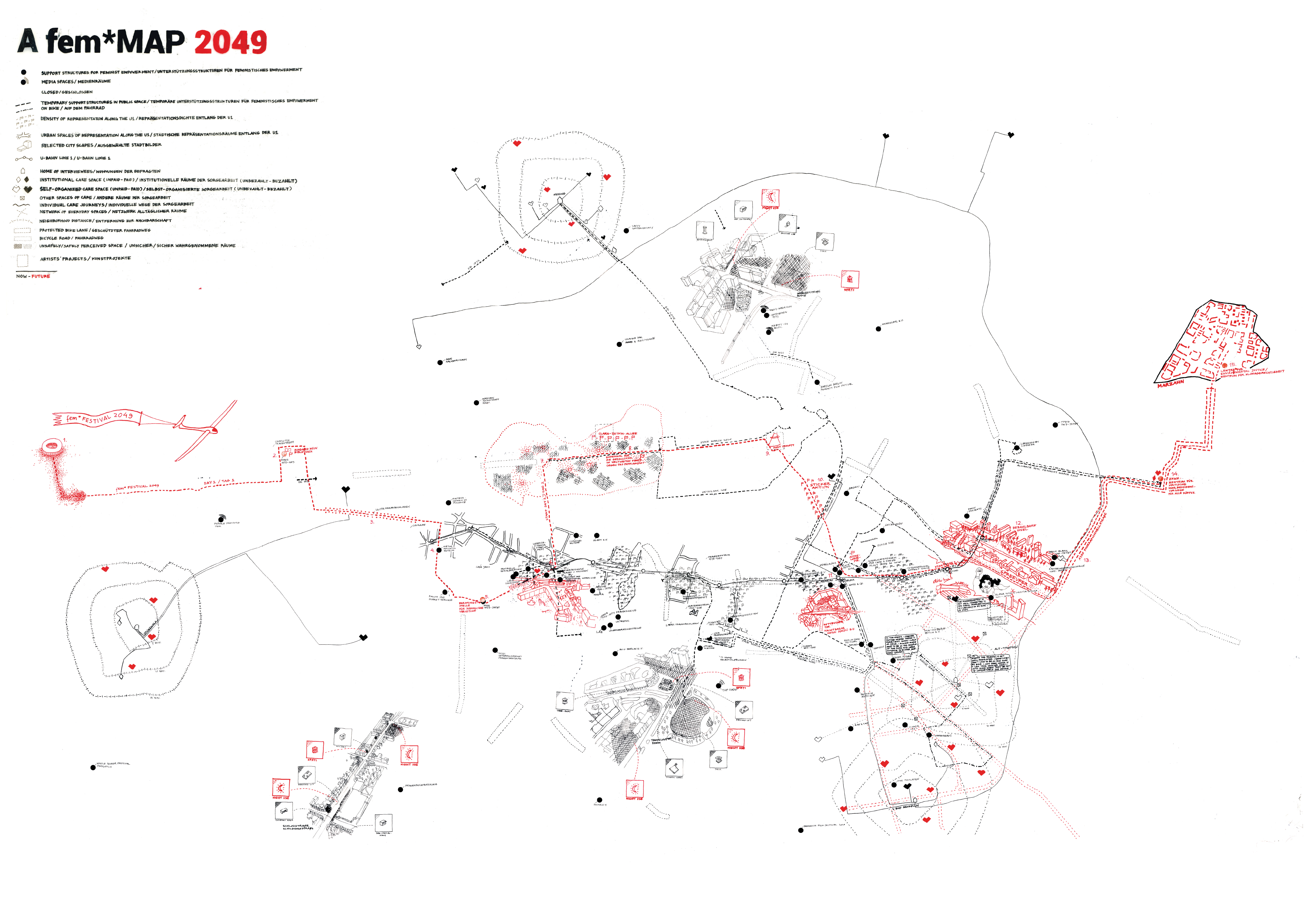
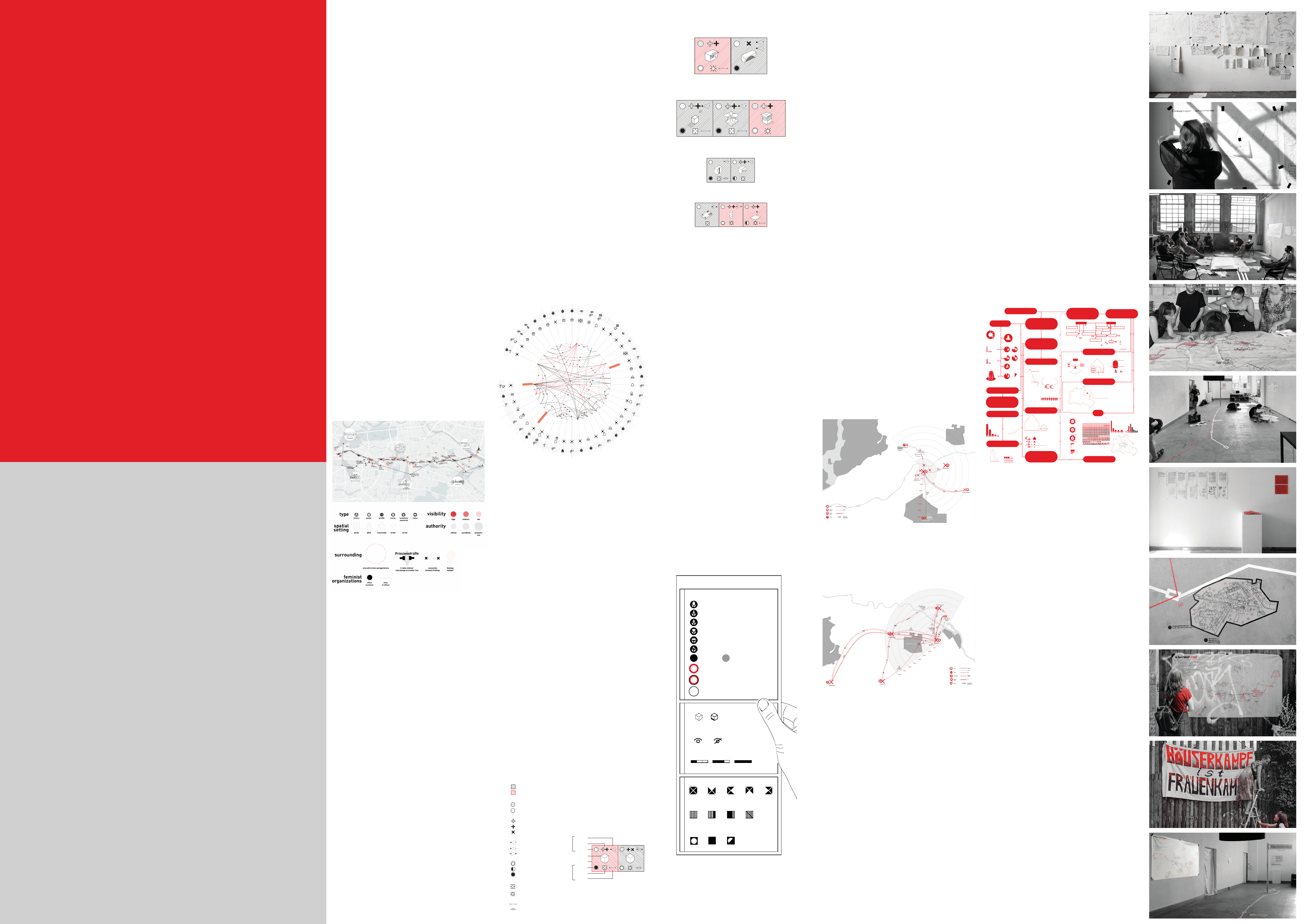
for the future of Berlin, the fem*MAP 2049.
The goal of creating this map was to make the contents of the
atlases accessible and readable in one integrated document.
The collectively drawn and conceptualized map shows
the transformative potential of the 8 different hypotheses
formulated in the seminar: feminist urban structures of
political representations, institutions of empowerment,
neighbourhoods of care, diverse modes of mobility, illuminated
nightscapes and accessible and adequate housing provision.
Throughout the week the key elements and transformative
potentials of the different mappings were identified and
overlaid with each other to create the new integrated map.
The individual elements were expanded and put in relation to
each other. A common legend and colour code for the fem*MAP
2049 was developed, showing the interrelation of the different
spatial systems 2020 in black. Possible transformative spaces
and practices were projected into the future and drawn in red.
The main elements of fem*MAP 2049 were also transformed
into a cartographic spatial installation on the floor of the
gallery space of alpha nova & galerie futura, as well as a
banner for affordable housing and the announcement of a
feminist festival. Together with the fem*MAP 2049 at a scale of
1:10.000, the floor mapping and the banners integrate the six
artistic positions into a "feminist perspective for Berlin today"
– in preparation for a non-sexist city in the near future.
Confronted with questions raised in
the exhibition “A feminist perspective
for Berlin today! [Reuschling 2017]
What could a non-sexist city look like?
[Hayden 1982]” a research seminar and
a one week mapping camp was held in
summer 2020. Six artistic positions on
feminist spaces, practices and visions in
architecture and urban planning were
the starting point for applying spatial,
analytical, artistic and social research
methods to develop several thematic
mappings that locate the positions in
Berlin’s urban fabric. The essential
elements of these mappings were
brought together to form a shared vision
for the future of Berlin as a cartographic
spatial installation: the fem*MAP 2049.
Julia Köpper, Martha Wegewitz, Dagmar Pelger,
Prof. Jörg Stollmann
Chair for Urban Design and Urbanisation,
TU Berlin 2021.
www.cud.tu-berlin.de
In cooperation with Katharina Koch & Sylvia Sadzinski,
alpha nova & galerie futura.
www.galeriefutura.de
With support of Helle Panke e.V. - Rosa-Luxemburg-Stiftung
Berlin, www.helle-panke.de
The Seminar was organized in the frame of the exhibition
“A feminist perspective for Berlin today! What could a non-
sexist city look like?” with Sarah Held, Elke Krasny & Sophie
Lingg & Claudia Lomoschitz, Dorothea Nold, Banu Çiçek
Tülü, Lena Wegmann and Ina Wudtke at alpha nova & galerie
futura, 22.8.-19.9.2020.
Authors of the map: Juliana Garcia Leon, Jörn Gertenbach,
Maximilian Hinz, Tildem Kirtak, Katrina Neelands Malinski,
Natasha Nurul Annisa, Jessica Voth (TU Berlin), Peter
Máthé, Anna Rodriguez Bisbicus, Lara Stöhlmacher (UDK
Berlin)
This map is part of the publication:
Julia Köpper, Dagmar Pelger, Martha Wegewitz, and Jörg
Stollmann (eds.), CUD Work Reports / CUD Arbeitsberichte
No.1: fem*MAP BERLIN. Feminist Spatial Systems for a non-
sexist City.
DOI: http://dx.doi.org/10.14279/depositonce-11708
This publication is licensed under the Creative Commons
License CC BY 4.0 License: Creative Commons 4.0
International http://creativecommons.org/licenses/by/4.0/
CUD Work Reports No.1: fem*MAP BERLIN. Feminist Spatial Systems for a non-sexist City. DOI: http://dx.doi.org/10.14279/depositonce-11708
incidents are harmful. Gender-based violence is most visible
in the public realm, but this investigation seeks to uncover
the affects of violence against women in the home; domestic
violence. In Germany, more than 80% of victims are women*.
A woman* could be assaulted in her home by a partner,
roommate, or even a visitor. The incidents include assaults,
harassment, intimidation, you name it.
Meanwhile, Berlin is currently in a housing crisis. In the past
ten years, rents have more than doubled. The population is
growing exponentially, estimated to pass the 4-million-mark
by 2025. The local government has taken steps to counter the
skyrocketing rental prices, including banning mega-landlords
and the recently introduced 5-year rental freeze. However,
finding a home in Berlin is still extremely difficult. And it seems
to be even harder for women*. In renting, one should consider
the price, location, size, etc. As a woman* an added factor to
consider is that of safety. The majority of ‘short-term’ rentals
in Berlin consist of flat-shares of ‘WGs’. These are apartments
that are usually let by one main tenant, who then rents out the
various bedrooms to other sub-tenants. Financially, women* are
still earning much less than men, meaning that they may have
to compromise on aspects of the apartment when renting. The
gender pay gap in Germany currently sits at a difference of 21%.
The rental crisis is pushing women to live in places that they
feel unsafe, too worried to leave because of how hard it is to find
accommodation in the first place.
What are the housing options for women* in Berlin? And if
you are unsafe at home, what can you do? Frauenhäuser are
women*’s shelters that offer protection for those needing it.
In 2019 a total of 729 places were available in six women*’s
refuges, as well as refuge apartments and second-level
apartments. They are now working intensively on “emergency
accommodation for women* affected by violence in the event
that the needs cannot be met by the women*’s shelters,” writes
press spokesman Moritz Quiske. But these cannot meet the
demand. There seems to be an increasing number of self-made
all-female* WGs.
Ekaterina Kropacheva, Feyza Sayman, Nikita Schweizer
Loading more pages...