Elucidation of the reaction mechanism for the
synthesis of ZnGeN
2
through Zn
2
GeO
4
ammonolysis†
Zhenyu Wang,
ab
Daniel Fritsch,
a
Stefan Berendts,
c
Martin Lerch,
c
Joachim Breternitz *
ad
and Susan Schorr *
ab
Ternary II–IV–N
2
materials have been considered as a promising class of materials that combine
photovoltaic performance with earth-abundance and low toxicity. When switching from binary III–V
materials to ternary II–IV–N
2
materials, further structural complexity is added to the system that may
influence its optoelectronic properties. Herein, we present a systematic study of the reaction of
Zn
2
GeO
4
with NH
3
that produces zinc germanium oxide nitrides, and ultimately approach stoichiometric
ZnGeN
2
, using a combination of chemical analyses, X-ray powder diffraction and DFT calculations.
Elucidating the reaction mechanism as being dominated by Zn and O extrusion at the later reaction
stages, we give an insight into studying structure–property relationships in this emerging class of materials.
Introduction
Most of the promising candidates as alternative solar cell
materials struggle from severe problems concerning elemental
abundance and toxicity. This prominently includes halide
perovskites that predominantly contain toxic lead,
1–3
but also
III–V materials due to the low abundance of In and Ga.
4,5
In
response to the increasing awareness of these “secondary”
judgement parameters –as opposed to a pure focus on solar cell
efficiencies –the problematic cations are being substituted by
abundant elements. The cations in III–V nitride materials are
trivalent, but there is a limited number of trivalent cations they
could be replaced with. Instead, they can be replaced by
a combination of divalent and tetravalent cations,
6
a similar
rationale that also stands behind the development of lead-free
double perovskites.
7,8
Particularly II–IV–N
2
nitride materials have moved into the
focus of research as they seemingly full all the criteria as
outlined above. While the binary nitrides AlN, GaN and InN all
crystallise in the hexagonal wurtzite-type structure (space group
P6
3
mc),
9,10
the situation for the ternary compounds ZnGeN
2
and
ZnSnN
2
is more complex. While ZnGeN
2
is consistently reported
to crystallise in the orthorhombic b-NaFeO
2
-type structure
(space group Pna2
1
, Fig. 1), in which the Zn
2+
and Ge
4+
cations
are ordered on different crystallographic sites, a variable degree
of cation disorder was observed,
11
up to the point where full
disorder and a crystal structure in the wurtzite-type has been
observed. As to what concerns ZnSnN
2
, no compelling experi-
mental evidence for cation ordering has been observed so
far,
12,13
although numerous computational studies unani-
mously identied the b-NaFeO
2
-type structure as the thermo-
dynamically stable crystal structure, similar to ZnGeN
2
.
14
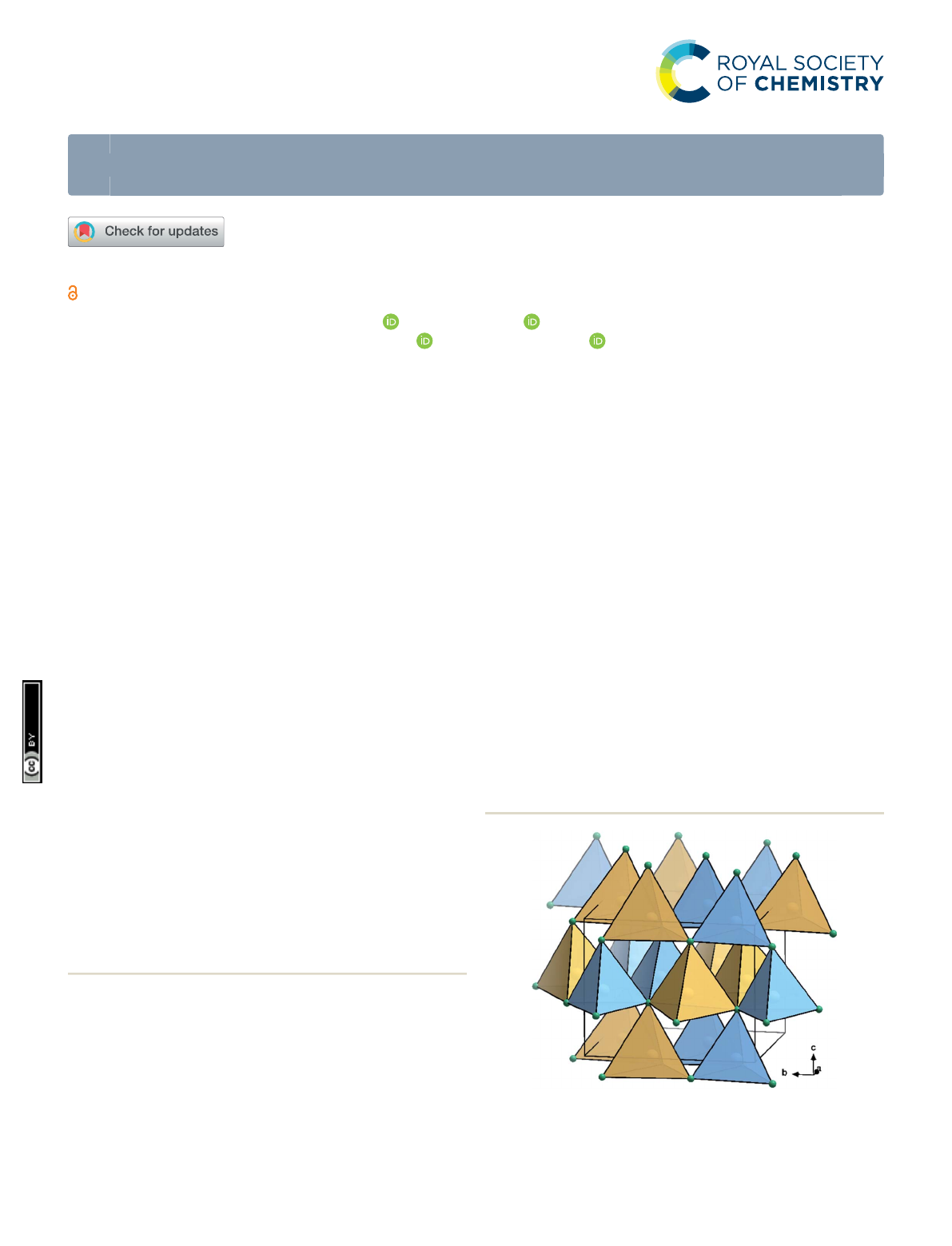
Fig. 1 Crystal structure representation of ZnGeN
2
in the b-NaFeO
2
-
type.
15
N: green, Ge: sky blue, Zn: canary yellow; coordination tetra-
hedra are drawn around the cations in the colours of the central
atoms.
a
Helmholtz-Zentrum Berlin f¨
ur Materialien und Energie GmbH, Department Structure
and Dynamics of Energy Materials, Hahn-Meitner-Platz 1, 14109 Berlin, Germany.
b
Freie Universit¨
at Berlin, Department Geosciences, Malteserstraße 74-100, 12249
Berlin, Germany
c
Technische Universit¨
at Berlin, Fakult¨
at II, Institut f¨
ur Chemie, Straße des 17. Juni 135,
10623 Berlin, Germany
d
Universit¨
at Potsdam, Mathematisch-Naturwissenschaliche Fakult¨
at, Institut f¨
ur
Chemie, Karl-Liebknecht-Straße 24-25, 14476 Potsdam, Germany
†Electronic supplementary information (ESI) available. See DOI:
10.1039/d1sc00328c
Cite this: Chem. Sci.,2021,12, 8493
All publication charges for this article
have been paid for by the Royal Society
of Chemistry
Received 18th January 2021
Accepted 12th May 2021
DOI: 10.1039/d1sc00328c
rsc.li/chemical-science
© 2021 The Author(s). Published by the Royal Society of Chemistry Chem. Sci.,2021,12,8493–8500 | 8493
Chemical
Science
EDGE ARTICLE
Open Access Article. Published on 13 May 2021. Downloaded on 10/27/2021 8:47:00 AM.
This article is licensed under a
Creative Commons Attribution 3.0 Unported Licence.
View Article Online
View Journal
| View Issue
The situation becomes even more complex when taking
oxygen into account: zinc germanium oxide nitrides (ZGON)
exhibit a disordered wurtzite-type structure over a wide range of
chemical compositions.
5,16–19
This is insofar important as traces
of oxygen are present in virtually any nitride material and it is
thus important to disentangle the effect of oxygen on the cation
disorder from exclusive cation disorder very carefully. For this,
we studied the reaction of Zn
2
GeO
4
as ternary oxide precursor
with NH
3
in order to obtain powder samples with a variable
oxygen content. Using a model originally proposed by Bacher
et al.,
19
we studied the behaviour in the oxygen richer regime in
a previous study, where a distinct separation of two competing
processes was observed: (1) nitrogen inclusion on the one hand
and (2) Zn loss on the other hand. In accordance to Bacher et al.,
this can be formulated in two reaction steps:
Zn
2
GeO
4
+2yNH
3
/Zn
2
GeO
43y
N
2y
+3yH
2
O(1)
Zn
2
GeO
4
+2x/3NH
3
/Zn
2x
GeO
4x
+x/3Zn
3
N
2
+xH
2
O(2)
Zn
2
GeO
4
+(2x/3 + 2y)NH
3
/Zn
2x
GeO
4x3y
N
2y
+x/3Zn
3
N
2
+(x+3y)H
2
O
Herein, we explore the later stages of the overall reaction
where the compound is approaching the stoichiometric nitride
ZnGeN
2
. Through a combination of X-ray diffraction and
chemical analyses, we are able to clarify the reaction pathway,
which aids to understand the structural and electronic features
of this class of compounds.
Experimental section
Syntheses
The zinc germanium oxide nitrides were synthesised through
a two-step process as outlined earlier.
5,20
Briey, Zn
2
GeO
4
was
synthesised from binary ZnO (Fisher Scientic, 99%) and GeO
2
(ACROS, 99.999%) at high temperatures and was then used as
precursor in an ammonolysis reaction. For this, Zn
2
GeO
4
was
reacted in a silica glass reaction tube with 4.5 cm diameter. The
samples were treated under a N
2
-ux of 1.5 l min
1
during
heating (250 K h
1
), and were reacted under a NH
3
ux of 0.15
l min
1
(99.8%, AirLiquide) during the dwelling period. Time
and temperature of the dwelling were varied between 10 h–20 h
and 835 C–910 C, respectively, to produce powder samples of
varying oxygen content. The exact reaction conditions of all
samples are given in the ESI.†
Characterisation
X-ray diffraction (XRD) data in a 2qrange from 15to 140were
collected using a Bruker D8 Advance powder diffractometer
with Cu-K
a1
(l¼1.54056 ˚
A) and Cu-K
a2
(l¼1.54439 ˚
A) radi-
ation. The diffraction patterns were analysed using the Rietveld
renement method applying the FullProf Suite 3.0 soware.
21
The starting model for zinc germanium nitride in the
orthorhombic b-NaFeO
2
-type structure was taken from Zhang
et al.
22
In the renement, a linear interpolation background was
used along with a Thompson–Cox–Hastings pseudo-Voigt
prole with anisotropic line broadening correction through
spherical harmonics in the Laue class mmm.
23
X-ray uorescence spectra (XRF) were collected using
a Bruker M4 Tornado system with Rh-microfocus tube for the
determination of the cation ratios. The tube voltage was set to
50 kV. Samples were pressed to pellets with 5 mm in diameter to
avoid contamination when measuring in vacuum. Further, the
pellets offer a at surface for focusing in order to eliminate an
undesired background. For each pellet, data on 6 different
measuring points, at least, were collected with a collection time
of 60 s per point.
Hot-gas extraction method was performed using a LECO TC-
300/EF-300 instrument to determine O and N contents. Samples
of approximately 10 mg were used for each independent
measurement. The average value of three repeated measure-
ments was taken as the nal data with a relative error of 2%.
UV-VIS measurements were performed using a PerkinElmer
LAMBDA 750S with a 100 mm integrating sphere in the range of
1000–250 nm and a step-width of 2 nm. Samples were measured
in diffuse reectance with the powders contained in silica glass
cuvettes. The light absorption was estimated from reection
using the Kubelka–Munk function F(R)¼(1 R)
2
/2R(where Ris
the reectance of the sample).
24
The optical bandgap was then
extracted using a Tauc-plot with [F(R)hn]
2
for a direct, allowed
band gap.
25
Density Functional Theory (DFT) calculations were per-
formed utilising the Vienna ab initio simulations package
(VASP 5.4.4)
26,27
together with the projector-augmented wave
(PAW) method.
28
The 2 22 supercells of the primitive
orthorhombic unit cell of ZGONs were constructed for the
calculations. The supercells contain 128 atoms: 36 Zn, 28 Ge,
60 N and 4 O, according to the Zn/Ge ratio of 1.28 to reect an
experimentally accessed oxide nitride composition. The
initial structural parameters, including lattice parameters
and atomic positions were taken from the Rietveld rene-
ment results of the X-ray diffraction pattern. Given the
crystal structure of this experimentally accessed oxide
nitride that is necessarily disordered, a random distribution
of cations was generated using random shuffle
29
function in
python 3.8, to reect the disordered cations arrangement,
whereas atomic positions remained. Different oxygen-
containing supercell models were built by accommodating
all oxygen atoms in either [OZn
4
], [OZn
3
Ge
1
], [OZn
2
Ge
2
]or
[OZn
1
Ge
3
] tetrahedra. The supercell structures were relaxed
using the PBEsol
30
functional until the forces on all atoms
were below 0.1 eV ˚
A
1
. The lattice parameters were xed
during the optimisation of the atomic positions (a¼
11.03078 ˚
A, b¼12.83132 ˚
A, and c¼10.38778 ˚
A) in a G-point
optimisation. A 2 22G-centred k-point mesh was used
for the subsequent total energy calculation using PBEsol.
Further, G-point HSE06 (ref. 31) calculations were performed
for total energies of the relaxed structures in comparison to
the PBEsol values. Other parameters included a 500 eV cut-
8494 |Chem. Sci.,2021,12,8493–8500 © 2021 The Author(s). Published by the Royal Society of Chemistry
Chemical Science Edge Article
Open Access Article. Published on 13 May 2021. Downloaded on 10/27/2021 8:47:00 AM.
This article is licensed under a
Creative Commons Attribution 3.0 Unported Licence.
View Article Online
offenergy for the plane-wave expansion, and a cut-offfor the
total energy convergence of 10
6
eV.
Results
Chemical composition of the samples
It is not straightforward to determine the four elements of zinc
germanium oxide nitrides at the same time with the methods
that are easily accessible. While XRF is most reliable for zinc
and germanium, the quantisation of the oxygen and nitrogen
contents are limited by this method. Instead, oxygen and
nitrogen can be quantied using a combustive hot gas extrac-
tion method, which is specic to these elements and therefore
does not allow the determination of the Zn and Ge contents.
Therefore, both methods had to be combined to determine the
complete composition of the respective samples.
It proved useful to employ the cation and anion ratios in our
analysis, as they are easily accessible from the experimental
characterisation: the XRF measurements yielded the atomic
ratios of Zn and Ge directly, whereas the weight fractions ob-
tained for O and N [w(O) and w(N) resp.] were converted using
the respective molar masses [M(O) and M(N)]:
5
nðNÞ
nðOÞ¼wðNÞMðOÞ
wðOÞMðNÞ
This latter treatment is facilitating the analysis, as the exact
composition of each individual compound is not known a pri-
ori. The ratio as dened above, however, does not depend on the
knowledge of the exact composition and can hence be directly
calculated on the basis of the experimentally determined values.
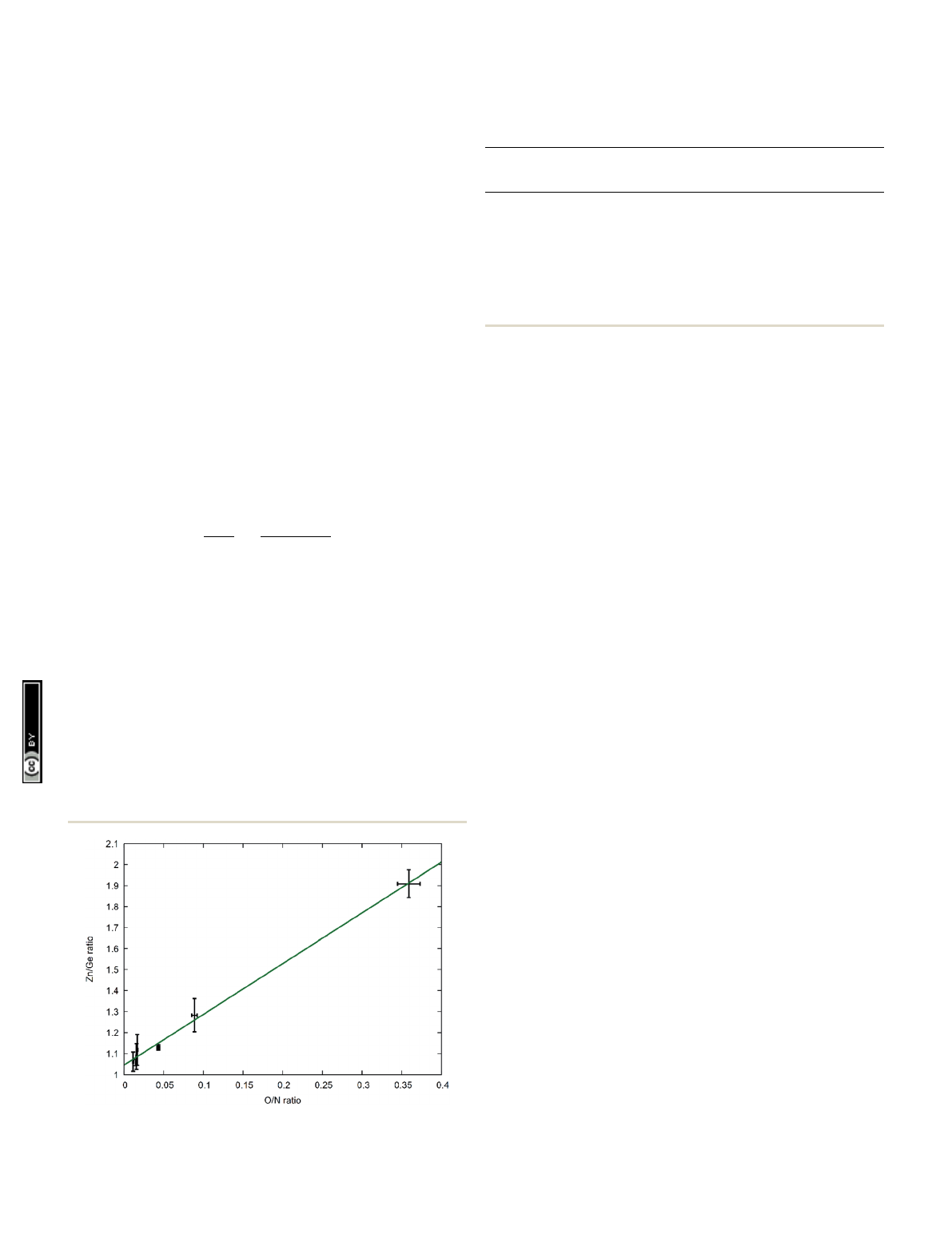
A clear trend between the experimentally determined Zn/Ge
ratio and the O/N ratio is evident throughout the samples
(Fig. 2). Combining the Zn/Ge and O/N ratios, it is possible to
calculate the overall composition using the general equation
Zn
2x
GeO
4x3y
N
2y
(Table 1).
The Zn/Ge ratio varies between 1 and 2, which is in line with
the compositions of the boundary compounds: stoichiometric
ZnGeN
2
with Zn/Ge ¼1 and Zn
2
GeO
4
with Zn/Ge ¼2. While the
samples close to Zn/Ge ¼1 also exhibit an O/N ratio near 0 –as
expected for ZnGeN
2
–the O/N ratio is only at z0.4 for Zn/Ge
reaching to 2. This is in line with our prior ndings that
oxygen richer zinc germanium oxide nitrides preserve a Zn/Ge
ratio close to 2, although they already contain notable
amounts of nitrogen.
The sheer number of parameters that inuence the compo-
sition of the compounds makes a straightforward analysis
difficult. It is, however, evident that the higher the amount of
starting materials is, the higher is the content of oxygen in the
product. Also, the atmosphere under which the sample was
cooled plays an important role in the resulting composition:
when cooling under ammonia, the oxygen amount is consid-
erably lower than cooling under nitrogen ow, which hints that
the reaction continues at lower temperatures during the cooling
period. Also, there is a number of samples with slightly different
compositions, although they are made at nominally similar
conditions, which is a clear sign for the complexity of the
reaction and that the reaction conditions need to be controlled
very carefully.
Crystal structure of the zinc germanium oxide nitrides
All of the compositions showed single phase patterns with the
exception of the oxygen poorest sample, where a miniscule
inclusion of elemental Ge
3
N
4
was found, which was also the
reason not to extend the study further to longer reaction times
and/or reaction temperatures. The crystal structure appears to
be different for the oxygen-poor samples, which crystallise in
the b-NaFeO
2
-type structure (space group Pna2
1
), and for the
oxygen richer samples that appear to crystallise in the wurtzite-
type structure (space group P6
3
mc). It should be noted that b-
NaFeO
2
-type structure space group is a subgroup of the
wurtzite-type structure and it is hence possible to perform the
Rietveld renements for all patterns in the lower symmetry b-
NaFeO
2
-type crystal structure.
32
The three strongest groups of reections between 30–402q
are most indicative for the transition from the hexagonal
wurtzite-type structure to the orthorhombic b-NaFeO
2
-type
structure (Fig. 3). The oxygen richer samples exhibit three
reections, in accordance to the hexagonal wurtzite-type struc-
ture. Still, the 10
10 and 1011reections appear more and more
Fig. 2 Experimentally determined Zn/Ge ratios against the experi-
mentally determined O/N ratios. The green line shows a linear fit of the
data points with f(x)¼2.42(7)x+ 1.04(1).
Table 1 Experimentally determined Zn/Ge ratios and O/N ratios of the
samples in this study together with the compositions as calculated
from the formula Zn
2x
GeO
4x3y
N
2y
. Full synthesis conditions may
be found in the ESI
Sample number Zn/Ge ratio O/N ratio
Nominal
composition
1 1.91(7) 0.36(1) Zn
1.91
GeO
0.75
N
2.10
2 1.28(8) 0.089(4) Zn
1.28
GeO
0.18
N
2.07
3 1.13(1) 0.043(1) Zn
1.13
GeO
0.09
N
2.03
4 1.12(7) 0.017(1) Zn
1.12
GeO
0.03
N
2.05
5 1.09(6) 0.016(1) Zn
1.09
GeO
0.03
N
2.04
6 1.06(1) 0.015(1) Zn
1.06
GeO
0.03
N
2.02
7 1.06(5) 0.011(1) Zn
1.06
GeO
0.02
N
2.03
© 2021 The Author(s). Published by the Royal Society of Chemistry Chem. Sci.,2021,12,8493–8500 | 8495
Edge Article Chemical Science
Open Access Article. Published on 13 May 2021. Downloaded on 10/27/2021 8:47:00 AM.
This article is licensed under a
Creative Commons Attribution 3.0 Unported Licence.
View Article Online
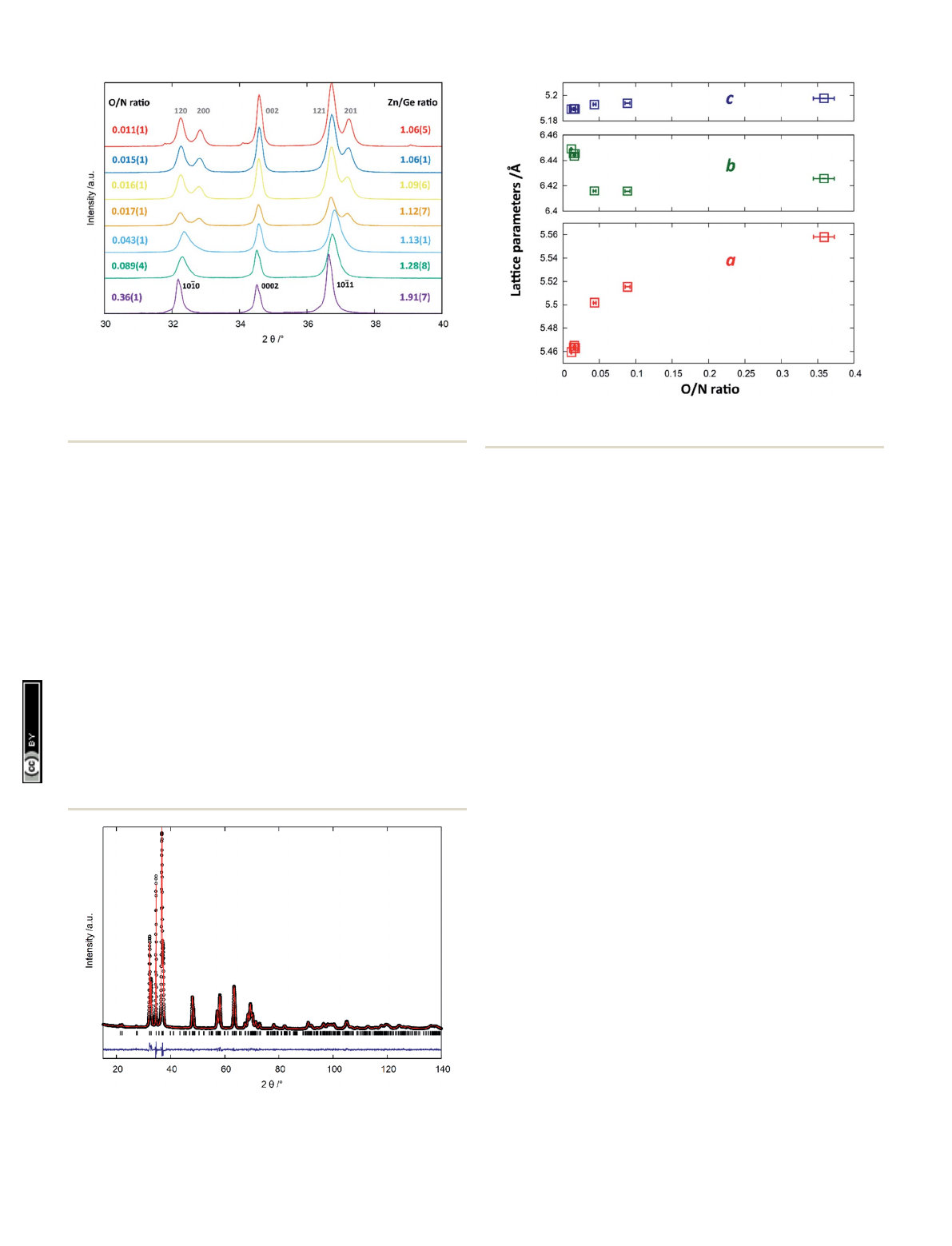
asymmetric the lower the oxygen content becomes, until a very
clear splitting appears, which is indicative of the b-NaFeO
2
-type
structure. The 0002 reection is, however, unaffected by the
group–subgroup transition, as it does not split (002 reection in
the orthorhombic subgroup). Further, the Rietveld renements
(Fig. 4 and ESI†) were performed using an anisotropic line
broadening correction as the 00lreections appear systemati-
cally narrower than the remaining reections, indicative of an
anisotropic particle size.
Since Zn
2+
and Ge
4+
as well as O
2
and N
3
are formally
isoelectronic, they are hardly distinguishable from each other using
X-ray diffraction techniques. Therefore, the Rietveld renements
were mainly performed to conrm the overall crystal structure and
to extract the lattice parameters. While the c-parameter remains
largely unaffected over the entire composition range (Fig. 5), aand
bvary signicantly over the composition range. When approaching
stoichiometric ZnGeN
2
,i.e. an O/N ratio of 0, the a-parameter
shrinks more signicantly than the b-parameter grows leading to an
overall decrease in the unit cell volume. This can be rationalised by
regarding the Shannon radii of the cations: r(Zn
2+
)¼0.6 ˚
Aand
r(Ge
4+
)¼0.39 ˚
A. The oxide nitrides contain a ratio of Zn/Ge that is
above 1, but which reduces to 1 when approaching stoichiometric
ZnGeN
2
. The share of larger Zn
2+
cations, therefore, shrinks from
oxygen richer oxide nitrides to ZnGeN
2
and affects the volume in the
same way.
In order to quantify the deviation of the observed crystal
structure from an idealised wurtzite-type structure in a hexag-
onal unit cell, it is useful to compare the lattice parameters
aand bas if they were in a hexagonal setting. According to the
group–subgroup relationship between the hexagonal wurtzite-
type structure and the orthorhombic b-NaFeO
2
-type struc-
ture,
32
the orthorhombic distortion may be calculated as (a
h2
a
h1
)/a
h1
, where a
hx
are the pseudo-hexagonal lattice parameters,
which relate to the orthorhombic lattice parameters as a
h1
¼a
o
/
O3 and a
h2
¼b
o
/2. This value is lies in a range between 0 for an
ideal wurtzite-type structure and 2.27%, which is the value
observed from DFT crystal structure optimisation.
33,34
UV-VIS measurements
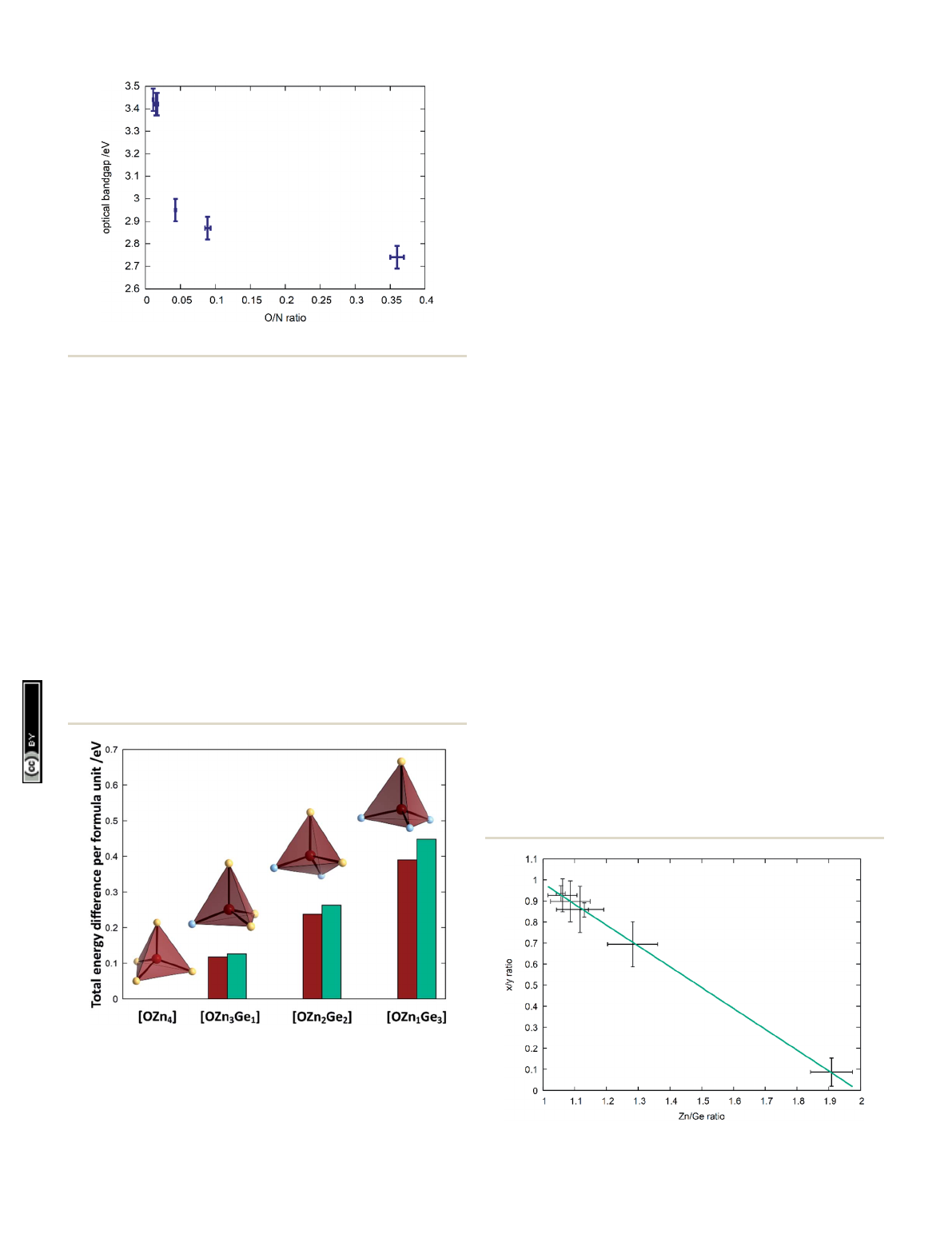
A clear trend can be observed between the chemical composi-
tion of the samples (represented by the O/N ratio in Fig. 6) and
the bandgap in that the bandgap tends to decrease with rising
O/N ratio. This relationship is, however, not linear and the
samples with very low oxygen content show very similar optical
bandgaps of z3.4 eV. Further investigations on the potential
impact of cation order/disorder on this trend are currently
ongoing. It is worth mentioning that a general parabolic rela-
tionship between bandgap and O/N ratio was observed in other
recent study focussing on thin lm syntheses of zinc germa-
nium oxide nitrides, which show disorder of the cations.
35
Finally, an excellent review by Schnepf et al. needs to
Fig. 3 XRD patterns in the region of 30–402qas a function of Zn/Ge
and O/N ratios. The hkl indices according to the hexagonal wurtzite-
type structure (black, bottom) and the hkl indices according to the
orthorhombic b-NaFeO
2
-type structure (grey, top) are given in the
figure.
Fig. 4 Plot of powder X-ray diffraction profile refinement with the
Rietveld method: measured intensities (black circles), calculated
profile (red line), difference between measured and calculated inten-
sities (blue line) and calculated reflection positions (black ticks).
Fig. 5 Change of the lattice parameters a(red), b(blue) and c(green)
as a function of the O/N ratio.
8496 |Chem. Sci.,2021,12,8493–8500 © 2021 The Author(s). Published by the Royal Society of Chemistry
Chemical Science Edge Article
Open Access Article. Published on 13 May 2021. Downloaded on 10/27/2021 8:47:00 AM.
This article is licensed under a
Creative Commons Attribution 3.0 Unported Licence.
View Article Online
mentioned, focussing on the inuence of cation disorder on the
band gaps in this class of materials.
36
DFT calculations
To understand the reaction mechanism, we performed DFT
calculations to probe, whether the arrangement of anions and
cations are dependent of each other. For this, we compare the
total energies of different arrangements within the same overall
composition with each other (Fig. 7). The composition chosen
reects the composition at a Zn/Ge ratio of 1.28 and hence lies
within the experimentally accessed parameter space.
It is very evident from the total energies of the different
arrangements, that oxygen prefers to be surrounded by Zn
rather than Ge. The total energies for the supercell containing
uniquely Zn coordinated O is consistently the lowest
throughout the functionals tested. The energy difference
between the [OZn
4
] and the [OZn
3
Ge
1
] coordinations of 125.5
meV per f.u. (HSE06) would correspond to a thermal activation
temperature of 1456 K, which is considerably above the reaction
temperatures used in this study.
Discussion
Elucidation of the reaction mechanism
As developed by Bacher,
19
one can easily separate the overall
reaction into the part-reactions (1) nitrogen inclusion and (2) Zn
loss. As they both inuence the composition of the product
Zn
2x
GeO
4x3y
N
2y
in a different way –(1) acting upon yand (2)
acting upon x–one can disseminate the contribution of each
partial reaction from the chemical composition of the product.
This does, in fact, allow to elucidate the reaction mechanism
over the course of the reaction conditions studied and hence
allow a more targeted synthesis approach. For this, it is useful to
use the ratio of the parameters xand yas an indicator for the
relative contribution of both part-reactions. It is evident that
there is a very clear relationship between the x/yratio and the
Zn/Ge ratio (Fig. 8) with a general formula of the linear tofx/y
¼1.97(1) 0.99(1)Zn/Ge. Since the relationship x¼2Zn/Ge
is dened through the overall formula and taking the linear t
of the relationship between x/yand Zn/Ge into account, this
essentially means that yz1, throughout the whole composi-
tion range in this study. This in turn means, that the nitrogen
inclusion part reaction is essentially nished and only Zn loss
proceeds through the reaction period. This essentially means
that the simplied formula Zn
2x
GeN
2
O
1x
can be used as
a convenient rst approximation to the accurate chemical
composition, which can be determined on the basis of the Zn/
Ge ratio.
It is important to put this nding in the perspective of the
overall reaction: while we studied the later stages of the reaction
herein, and for which these results are valid, the earlier stages of
the reaction do not necessarily follow the same scheme. In
a previous study,
5
we produced zinc germanium oxide nitrides
Fig. 6 Optical bandgap as a function of the measured O/N ratio.
Fig. 7 Differences of the total energies per formula unit of the
different oxide nitride supercells as a function of the oxygen coordi-
nation environment. The values for 2 22k-point grid PBEsol (red)
and gamma-point HSE06 calculations (green) are given relative to the
energy of the crystal structure, where oxygen is uniquely surrounded
by Zn. The tetrahedra depict one representative tetrahedron for each
coordination environment (O: bordeaux, Zn: canary yellow, Ge: sky
blue).
Fig. 8 x/yratio as a function of the Zn/Ge ratio throughout the
composition range. The green line depicts a linear fit of the data.
© 2021 The Author(s). Published by the Royal Society of Chemistry Chem. Sci.,2021,12,8493–8500 | 8497
Edge Article Chemical Science
Open Access Article. Published on 13 May 2021. Downloaded on 10/27/2021 8:47:00 AM.
This article is licensed under a
Creative Commons Attribution 3.0 Unported Licence.
View Article Online
Loading more pages...