
water
Article
Interacting Effects of Polystyrene Microplastics and
the Antidepressant Amitriptyline on Early Life Stages
of Brown Trout (Salmo trutta f. fario)
Hannah Schmieg 1,* , Janne K.Y. Burmester 1, Stefanie Krais 1, Aki S. Ruhl 2,3, Selina Tisler 4,
Christian Zwiener 4, Heinz-R. Köhler 1and Rita Triebskorn 1,5
1Animal Physiological Ecology, Institute of Evolution and Ecology, University of Tübingen, Auf der
[email protected] (R.T.)
2Chair of Water Quality Control, Technische Universität Berlin, Sekr. KF 4, Str. des 17. Juni 135,
3German Environment Agency (UBA), Section II 3.1 (National and International Development of Drinking
Water Quality and Resource Protection), Schichauweg 58, D-12307 Berlin, Germany
4Environmental Analytical Chemistry, Center for Applied Geoscience, University of Tübingen,
[email protected] (C.Z.)
5Steinbeis Transfer Center for Ecotoxicology and Ecophysiology, Blumenstr. 13,
D-72108 Rottenburg, Germany
*Correspondence: [email protected]
Received: 21 July 2020; Accepted: 20 August 2020; Published: 22 August 2020
Abstract:
Whether microplastics themselves or their interactions with chemicals influence the health
and development of aquatic organisms has become a matter of scientific discussion. In aquatic
environments, several groups of chemicals are abundant in parallel to microplastics. The tricyclic
antidepressant amitriptyline is frequently prescribed, and residues of it are regularly found in surface
waters. In the present study, the influence of irregularly shaped polystyrene microplastics (<50
µ
m),
amitriptyline, and their mixture on early life-stages of brown trout were investigated. In a first
experiment, the impacts of 100, 10
4
, and 10
5
particles/L were studied from the fertilization of eggs until
one month after yolk-sac consumption. In a second experiment, eggs were exposed in eyed ova stages
to 10
5
, 10
6
particles/L, to amitriptyline (pulse-spiked, average 48
±
33
µ
g/L) or to two mixtures for two
months. Microplastics alone did neither influence the development of fish nor the oxidative stress
level or the acetylcholinesterase activity. Solely, a slight effect on the resting behavior of fry exposed
to 10
6
particles/L was observed. Amitriptyline exposure exerted a significant effect on development,
caused elevated acetylcholinesterase activity and inhibition of two carboxylesterases. Most obvious
was the severely altered swimming and resting behavior. However, effects of amitriptyline were not
modulated by microplastics.
Keywords:
microplastics; amitriptyline; brown trout; development; behavior; oxidative
stress; acetylcholinesterase
1. Introduction
Microplastic particles (MP) are detected worldwide from densely populated and rural areas to
remote regions [
1
–
4
]. The presence of MP has globally been reported for sediment, surface water
and even for air samples [
5
–
8
]. Representing the recent state of knowledge in freshwater systems,
Water 2020,12, 2361; doi:10.3390/w12092361 www.mdpi.com/journal/water

Water 2020,12, 2361 2 of 25
MP concentrations range from 0.00012 particles/L up to 2867 particles/L (according to [
9
]). However,
the potential risk for organisms and ecosystems caused by MP is still a matter of discussion. MP were
shown to be ingested and egested by fish [
10
–
12
] and small particles (mostly nanoplastics) can even
transfer into tissues [
13
–
16
]. Microplastic particles can injure organisms mechanically resulting in
inflammation and other histopathological effects in contact epithelia [
17
–
19
], disturb the energy
metabolism [
19
,
20
], and induce oxidative stress [
13
,
18
,
19
]. Early life stages of fish are considered as
very sensitive for pollutants [
21
]. In this context, high concentrations of MP have been shown to
reduce and delay hatching as well as negatively influence growth and heart rate of marine medaka
(Oryzias melastigma) [
11
]. Moreover, Malafaia, et al. [
22
] reported that exposure of zebrafish (Danio
rerio) to polyethylene (PE) MP reduced the hatching time and survival rates and led to morphological
changes. In contrast, LeMoine, et al. [
23
] found no effects of PE MP on hatching, mortality, and growth
rates of zebrafish. However, zebrafish exposed to MP exhibit transcriptomic changes as, for example,
downregulation of genes involved in the neural development. Mazurais, et al. [
12
] observed that a diet
that incorporated about 200 PE microbeads per day caused a slightly higher mortality rate in sea bass
larvae (Dicentrarchus labrax). Apart from that MP had only limited effects on the development of sea
bass larvae in the experiment [12].
The evaluation of the risk of MP for aquatic organisms in general is complex since different
polymer types with manifold additives in various sizes and shapes are present in the environment [
24
].
With our study we therefore solely address a selected aspect of MP aquatic ecotoxicology.
The topic is even more complex since not only MP themselves, but also their interaction with
chemicals have to be regarded. For example, polymerization solvents, residual monomers, plasticizers,
or other additives can leak from the particles and affect MP-exposed organisms [
25
,
26
]. In addition,
MP has the potential to ad- or absorb organic pollutants (reviewed by [
27
] and [
28
]). The sorption
can modulate the toxicity of the pollutants in different ways: If the particles are ingested and excreted
together with an adherent pollutant this would be without consequences for the organism. However,
the bioavailability of otherwise free pollutants may be reduced due to sorption what can led to less
negative effects in organisms [
11
,
29
,
30
]. On the other hand, pollutants ingested together with MP can
desorb in the digestive track, for example due to different pH conditions. In such cases, MP act as a
vector and adverse effects can be enhanced by the presence of MP [
31
–
33
]. Batel, et al. [
10
] showed that
MP and associated benzo[a]pyrene can also be transported along an artificial food web. Nevertheless,
the relevance of MP as vectors for organic pollutants in comparison to other exposure pathways in the
environment remains a matter of discussion [
34
–
36
]. Since the concentrations of persistent organic
pollutants in continental environments are expected to be higher than in marine ecosystems, sorption
of hydrophobic organic pollutants to MP might be especially important for freshwater ecosystems [
37
].
One group of chemicals commonly found in aquatic environments are
pharmaceuticals [38,39].
Residues of these or their metabolites enter surface waters mainly via wastewater treatment
plants [39,40].
Non-selective monoamine reuptake inhibitors more known as tricyclic antidepressants
are one of the oldest groups of pharmaceuticals to treat depression. Amitriptyline is the most prescribed
drug of this group [
41
–
43
]. Beside depression, amitriptyline is also used for migraine prophylaxis and
to treat chronic pain [
43
]. In comparison to other antidepressants, its mode of action is rather unspecific:
In addition to the inhibition of the reuptake of the neurotransmitters serotonin and noradrenaline,
amitriptyline acts as muscarinic acetylcholine receptor antagonist [
44
]. Furthermore, it has been shown
to bind to histamine receptors [
45
] as well as to neurotrophic tyrosine kinase A/B receptors resulting
in an upregulation of acetyl transferase and an influence on cell differentiation [
46
]. Amitriptyline is
mainly metabolized in the liver by cytochrome P450 [
47
]. An important metabolite is nortriptyline
which is also in use as an antidepressant itself [
41
,
47
,
48
]. Amitriptyline has been found in surface
waters around the world [
38
,
48
,
49
]. The highest concentration of 71.0 ng/L was reported by Baker and
Kasprzyk-Hordern [
38
] for a large river in the UK. Mean surface water concentrations are normally in
the low nanogram per liter range up to 22 ng/L [
49
–
51
]. Togola and Budzinski [
52
] reported that in
France residues of amitriptyline (1.4 ng/L) were even found in drinking water. Pharmaceuticals are

Water 2020,12, 2361 3 of 25
designed to be bioactive at low concentrations, and it can be, therefore, not excluded that they also
may affect non-target organisms at low environmental concentrations [39,40].
Demin, et al. [
53
] showed that amitriptyline increases the serotonin-triggered neurotransmission
in the brain of adult zebrafish in a dose-dependent way, with significantly higher 5-hydroxyindoleacetic
(5-HIAA)/serotonin ratios in fish exposed to 5 and 10 mg/L amitriptyline for a few hours. No effects
on the noradrenaline level were shown in this study. In contrast, Meshalkina, et al. [
54
] found a
significant reduction of the 5-HIAA/serotonin ratio and an increased dopamine and noradrenaline level
in the brain of adult zebrafish exposed for two weeks to 10 and 50
µ
g/L amitriptyline. Moreover, the
antidepressant was shown to alter the immune response in
in vitro
studies with primary macrophages
of common carp (Cyprinus carpio) as well as
in vivo
studies with zebrafish [
55
,
56
] and to affect the
oxidative stress level of both fish species [
56
–
58
]. Furthermore, amitriptyline was found to affect
the swimming behavior of zebrafish, by reducing for example the swimming activity as well as the
covered distance, and high concentrations of the antidepressant even led to side or vertical swimming
behavior [
53
,
54
,
59
,
60
]. In addition, exposure of common carp and zebrafish to the antidepressant
stimulated hatching and caused retarded development and malformations in common carp as well as
reduced body length of zebrafish larvae [
56
,
57
]. In contrast, high amitriptyline concentrations were
found to extend the time until hatch and to decrease the heart rate in zebrafish [
60
]. Most studies
about the ecotoxicity of amitriptyline were performed with model species, but ecotoxicological studies
with feral aquatic species are lacking. Brown trout are known to be a sensitive test organism and as
important predators are of ecological relevance [61,62].
In the present study, effects of polystyrene (PS) MP at an environmental relevant concentration of
100 particles/L and higher concentrations of 10
4
and 10
5
particles/L on the development of brown trout
were investigated. Fish were exposed for 182 days from freshly fertilized eggs until about one month
after the fry completed their yolk sac consumption. In a second experiment, eggs were exposed from
eyed ova stage until one week after yolk sac consumption. In addition to PS MP (10
5
and 10
6
particles/L)
fish were also exposed to amitriptyline and co-exposed to the mixtures of PS MP and the antidepressant.
The co-exposure allows to investigate a potential modulation of the effects of amitriptyline by PS MP.
In both experiments, the impact of exposure on the development and biomarkers for oxidative stress
(activity of superoxide dismutase (SOD) and the level of lipid peroxidation (LPO)) were analyzed.
Since the chorion of zebrafish has been reported to act as an effective protective barrier against carbon
nanotubes [
63
], we examined the structure of the chorion of brown trout in the first experiment by
means of scanning electron microscopy. In the second experiment, also the behavior of larvae and
endpoints for neurotoxicity (activity of acetylcholinesterase (AChE) and two carboxylesterases (CbE))
were investigated.
2. Materials and Methods
2.1. Test Organism
Eggs of brown trout (Salmo trutta f. fario) were obtained from a commercial fish breeder
(Forellenzucht Lohmühle, D-72275 Alpirsbach-Ehlenbogen, Germany). According to the EC Council
Directive, the breeding facility is listed as category 1, disease-free [
64
]. All experiments started directly
after purchase of the eggs: In experiment 1, eggs (in total 360 eggs) were exposed on the same day of
their fertilization, in experiment 2 (in total 540 eggs), exposure started 47 days post fertilization (dpf) in
the eyed ova stage.
2.2. Test Substances
In both experiments, transparent PS pellets (Polystyrol 158 K, BASF, Ludwigshafen, Germany,
density 1.05 g/mL) were cryo-milled (CryoMill, Retsch, Haan, Germany) according to the method
of Eitzen, et al. [
65
]. The resulting irregularly shaped particles were suspended in ultra-pure water
(without any surfactant), fractionated using a micro-sieve (polyamide monofilament) with nominal
Water 2020,12, 2361 4 of 25
mesh-size of 50
µ
m and the permeate was used as stock suspension. The particle concentration in the
stock suspensions were analyzed with a particle counter (SVSS, PAMAS, Rutesheim, Germany) by light
extinction in a laser-diode sensor (type HCB-LD-50/50). Exemplary particle numbers with the analyzed
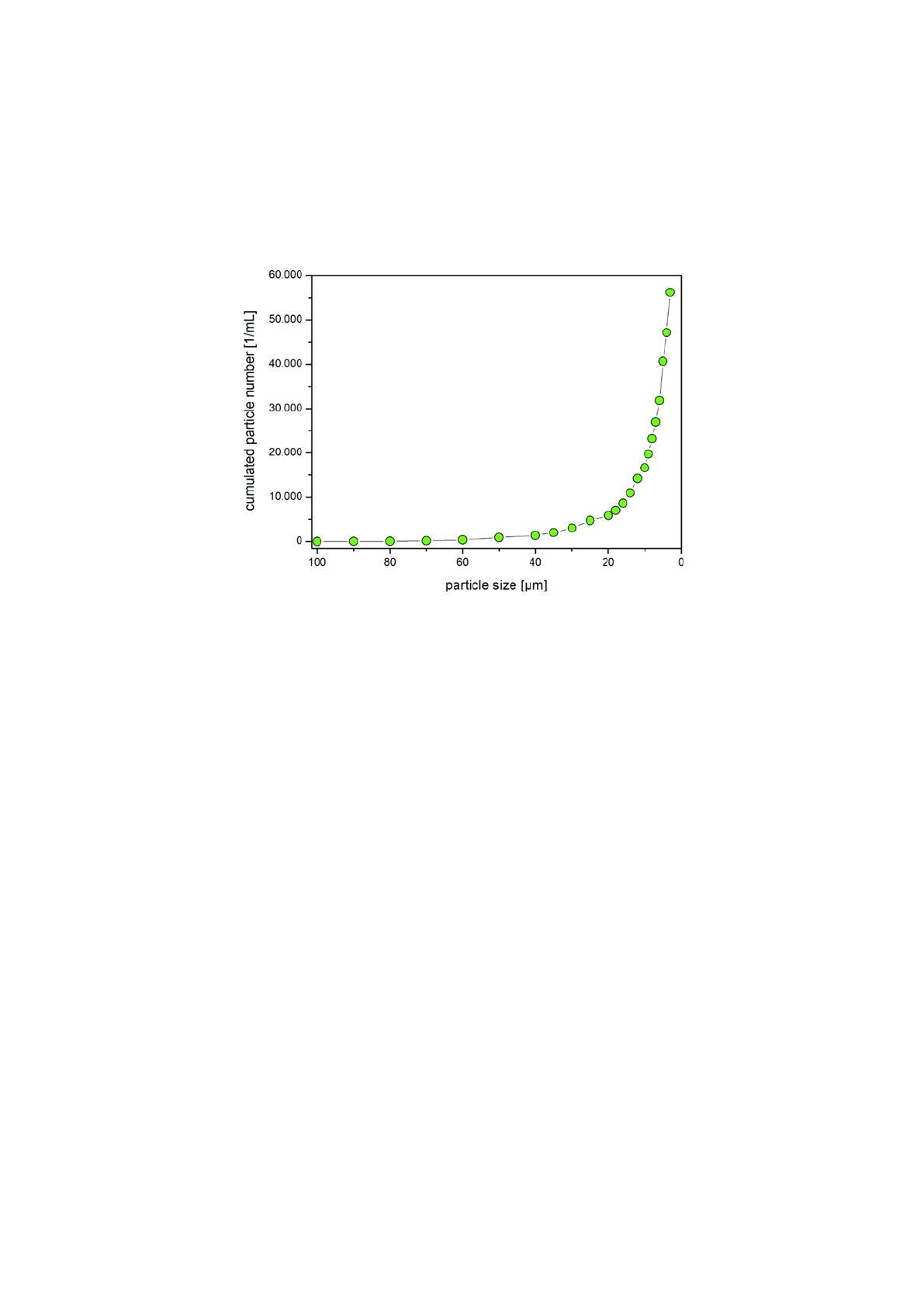
size ranges are provided in Figure 1and in Table S1 in the supplement. The stock suspensions were
diluted with respective ratios to obtain the target particle concentrations for the exposure experiments.
Water 2020, 12, 2361 4 of 26
light extinction in a laser-diode sensor (type HCB-LD-50/50). Exemplary particle numbers with the
analyzed size ranges are provided in Figure 1 and in Table S1 in the supplement. The stock
suspensions were diluted with respective ratios to obtain the target particle concentrations for the
exposure experiments.
Figure 1. Size distribution of the used polystyrene microplastic particles (PS MP).
Amitriptyline hydrochloride was purchased from Sigma Aldrich (CAS Number: 549–18–8; Lot:
BCBV1175; molecular formula: C20H23N · HCl; purity ≥ 98%; molecular weight 313.86). Amitriptyline
hydrochloride in the used concentration is water soluble without adding organic solvents. For the
stock solutions, 8.5 mg/L amitriptyline hydrochloride were solved in bidestilled water. Bottles with
stock solutions were covered in aluminum foil to protect them from light. All further given
amitriptyline concentrations refer to pure amitriptyline not amitriptyline hydrochloride. The
predicted logP octanol-water coefficient (pH 7.4) of amitriptyline is 4.92 [66].
2.3. Exposure and Sampling of Brown Trout
In both experiments, each treatment was tested in triplicates in a semi-static three-block design.
Exposures took place in a thermostat-controlled chamber with a light/dark cycle of 10/14 h. Petri
dishes and aquaria were shaded from direct light. Aquaria were aerated with glass pipettes
connected via silicone tubes to compressed air. Test suspensions were prepared from defined PS MP
stock suspensions (56,240 particles/mL). Vessels containing the respective stock suspension were
rinsed four times to avoid loss of particles. After consumption of the yolk sacs, fish were fed daily
approximately 3% of their body weight with commercial fish feed (0.5 mm, Biomar, Brande,
Denmark). At the end of the experiments, brown trout were anesthetized and killed by an overdose
of tricaine methanesulfonate ((MS-222), 1 g/L, buffered with NaHCO3). Death was ensured by
severance of the spine. Length and weight of each fish were recorded. The level of LPO, the activity
of SOD and the activity of AChE and CbE had to be analyzed in different tissues, due to the small
size of the fish.
2.3.1. Experiment 1a: Exposure of Embryos and Sac-Fry Stages
The first part of experiment 1 was conducted according to the OECD guideline 212 for exposing
fish embryos and sac-fry stages to dissolved chemicals [67]. Freshly fertilized eggs (fertilization and
start of experiment 07 December 2016) were exposed to 0 particles/L (C1), 100 particles/L (MP1h), 104
particles/L (MP1tt) and 105 particles/L (MP1ht). This first part of the experiment 1 was performed in
glass Petri dishes containing 200 mL of the respective test suspension. To achieve the final
concentration, the stock suspension was diluted with aerated artificial water (294 mg/L CaCl2 × 2 H2O,
Figure 1. Size distribution of the used polystyrene microplastic particles (PS MP).
Amitriptyline hydrochloride was purchased from Sigma Aldrich (CAS Number: 549–18–8; Lot:
BCBV1175; molecular formula: C
20
H
23
N
·
HCl; purity
≥
98%; molecular weight 313.86). Amitriptyline
hydrochloride in the used concentration is water soluble without adding organic solvents. For the stock
solutions, 8.5 mg/L amitriptyline hydrochloride were solved in bidestilled water. Bottles with stock
solutions were covered in aluminum foil to protect them from light. All further given amitriptyline
concentrations refer to pure amitriptyline not amitriptyline hydrochloride. The predicted logP
octanol-water coefficient (pH 7.4) of amitriptyline is 4.92 [66].
2.3. Exposure and Sampling of Brown Trout
In both experiments, each treatment was tested in triplicates in a semi-static three-block design.
Exposures took place in a thermostat-controlled chamber with a light/dark cycle of 10/14 h. Petri dishes
and aquaria were shaded from direct light. Aquaria were aerated with glass pipettes connected via
silicone tubes to compressed air. Test suspensions were prepared from defined PS MP stock suspensions
(56,240 particles/mL). Vessels containing the respective stock suspension were rinsed four times to
avoid loss of particles. After consumption of the yolk sacs, fish were fed daily approximately 3% of
their body weight with commercial fish feed (0.5 mm, Biomar, Brande, Denmark). At the end of the
experiments, brown trout were anesthetized and killed by an overdose of tricaine methanesulfonate
((MS-222), 1 g/L, buffered with NaHCO
3
). Death was ensured by severance of the spine. Length and
weight of each fish were recorded. The level of LPO, the activity of SOD and the activity of AChE and
CbE had to be analyzed in different tissues, due to the small size of the fish.
2.3.1. Experiment 1a: Exposure of Embryos and Sac-Fry Stages
The first part of experiment 1 was conducted according to the OECD guideline 212 for exposing
fish embryos and sac-fry stages to dissolved chemicals [
67
]. Freshly fertilized eggs (fertilization and
start of experiment 07 December 2016) were exposed to 0 particles/L (C1), 100 particles/L (MP1
h
),
10
4
particles/L (MP1
tt
) and 10
5
particles/L (MP1
ht
). This first part of the experiment 1 was performed in

Water 2020,12, 2361 5 of 25
glass Petri dishes containing 200 mL of the respective test suspension. To achieve the final concentration,
the stock suspension was diluted with aerated artificial water (294 mg/L CaCl
2×
2 H
2
O, 123.25 mg/L
MgSO
4×
7 H
2
O, 64.75 mg/L NaHCO
3
, 5.75 mg/L KCl in pure water). In each Petri dish, 30 brown trout
eggs were exposed to the test suspensions (90 eggs per treatment). Until the eyed ova stage, the eggs
were kept in complete darkness. The temperature in the Petri dishes was 6.7
±
0.2
◦
C. To maintain good
water quality, 25 to 50% of the test suspensions were renewed every second day (detailed information
in the supplement Table S2). From day 138 dpf, filtered aerated tap water (iron filter, particle filter,
activated charcoal filter) was used to prepare the test suspensions to habituate the growing larvae
to the water used in the second part of the experiment. The first part of the experiment ended after
150 days when the fry had completely consumed their yolk sacs (07 December 2016–05 May 2017).
Investigated parameters were time of development until eyed ova stage, time until hatch, heart rate
93 dpf, and mortality (excluding unfertilized eggs). After the first part of the experiment, ten larvae
were sampled from each Petri dish. For determination of the LPO level, heads of the larvae were
immediately frozen in liquid nitrogen and stored at −80 ◦C until further usage.
2.3.2. Experiment 1b: Exposure of Fry
The second part of experiment 1 lasted 33 days until 182 dpf (05 May 2017–06 June 2017).
The remaining fry of experiment 1a were transferred into 12 L aquaria with 5 L of the corresponding
test suspensions (in total C1: n =57, MP1
h
: n =57, MP1
tt
: n =53 and MP1
ht
: n =58). PS MP
stock suspensions were diluted with filtered tap water. To ensure good water quality, half of the
test suspension was renewed twice a week. Water parameters were checked 177 dpf and at the end
of the experiment (average values: Temperature 6.38
±
0.45
◦
C, pH 8.5
±
0.1, oxygen concentration
12.71 ±0.22 mg/L,
oxygen saturation 107.33
±
1.60%; conductivity 493.33
±
7.30
µ
S/cm; see supplement
Table S3). Samples for analysis of SOD activity (muscle/kidney) as well as for determination of the
LPO level (head) were frozen in liquid nitrogen and stored at −80 ◦C.
2.3.3. Experiment 2
In experiment 2, embryos/larvae were exposed in total for 60 days from eyed ova stage (47 dpf)
until one week after yolk sac consumption (29 December 2017–26/27. February 2018). Exposure groups
included a control group (C2) and groups exposed to 10
5
particles/L (MP2
ht
), 10
6
particles/L (MP2
mio
),
pulse-spiked amitriptyline (AMI2, nominal concentration 300
µ
g/L, average concentration calculated
and given as follows), 10
5
particles/L+pulse-spiked amitriptyline (MIX2
ht
, nominal concentration
300
µ
g/L amitriptyline, average concentration calculated and given as follows), and 10
6
particles/L
+pulse-spiked amitriptyline (MIX2
mio
, nominal concentration 300
µ
g/L amitriptyline, average
concentration calculated and given as follows). Test media were prepared with filtered tap water.
Exposure took place in 12 L aquaria filled with 5 L of the corresponding test media. Per aquarium,
30 individuals were exposed (3
×
30 per treatment group). 2.5 L of the test media were exchanged on
average once a week (see Table S2 in the supplement). Water parameters were determined to control
water quality at the start, after 55 days of exposure and at the end of the experiment. The average
values were pH 8.3
±
0.2, temperature 7.06
±
0.20
◦
C, conductivity 430.83
±
17.24
µ
S/cm, oxygen
content 10.92
±
0.10 mg/L, oxygen saturation 95.06
±
0.79% (see supplement Table S4). Nitrite (NO
2−
)
values did not exceed 0.05 mg/L. The heart rate was counted 21 days after the start of the experiment.
Samples for LPO (head), SOD (muscle/kidney), AChE and CbE (muscle) were frozen in liquid nitrogen
and stored at −80 ◦C.
2.4. Chemical Analyses
At the start of the second experiment as well as prior and past a water exchange (17 January
2018) mixed samples of all three blocks of each treatment group (4 mL per aquarium 12 mL in total)
were taken and frozen at
−
20
◦
C until further analysis. The water concentrations of amitriptyline
were determined using LC-MS with a 1290 Infinity HPLC system (Agilent Technologies, Waldbronn,
Loading more pages...