
chemengineering
Article
A Numerical Implementation of the Soret Effect in
Drying Processes
Bartolomeus Häussling Löwgren 1,*, Julius Bergmann 1and Odilio Alves-Filho 2
1Technische Universität Berlin, Straße des 17. Juni 135, 10623 Berlin, Germany; julius@bei-bergmann.de
2NewDryTech AS, Elvevegen 25, 7031 Trondheim, Norway; [email protected]
*Correspondence: loewgr[email protected]
Received: 24 November 2019; Accepted: 29 January 2020; Published: 17 February 2020
Abstract:
Drying of porous media is strictly governed by heat and mass transfer. However, contrary
to the definition that drying is simultaneous transport mechanisms of heat and mass, most past and
current models either account for temperature or concentration gradient effects on drying. Even
though the complexity of computations of these processes varies with area of application, in most
cases, the Dufour and Soret effects are neglected. This leads to deviations and uncertainties on the
assumptions and interpretations of these and other relevant effects on drying. This paper covers
the theoretical methods to derive the coupled transfer effects. In addition, this work proposes and
formulates relevant heat and mass transfer equations, as well as the governing equations for drying
processes with Dufour and Soret effects. The application of a numerical approach to solve the
equations allows for studying of the influence of these effects on the design and operation of dryers.
It is shown that the Soret effect can be highly relevant on drying operations with dynamic heating
operation. While for drying processes where the steady state drying process predominates, the effect
is deemed negligible.
Keywords:
Soret effect; nonequilibrium thermodynamics; thermodiffusion; drying; numerical
simulation
1. Introduction
Drying is a very energy costly operation and accounts for up to 15% of industrial energy usage,
while the thermal efficiency is only about 25–50% [
1
]. With growing consciousness about sustainability
and the trend towards cleaner production, improving the energy efficiency is one of the key aspects.
It is therefore of great importance to understand and quantify all relevant effects on drying processes
to avoid deviations and uncertainties, leading to more conservative operations.
Most applied heat and mass transport relations for drying processes neglect the Dufour and Soret
effect. These coupled heat and mass transport phenomena are derived in detailed drying process
literature by, e.g., Keey [
2
] or Kowalski [
3
], but only mentioned as being possibly of relevance. In an
earlier conference proceeding by the authors the relevance of the coupled heat and mass transport
effects on drying was argued based on these works. In this contribution the relevance of the coupled
heat and mass transport phenomena on drying processes is shown in detail with the derivation of first
principle flux equations for a drying process, using linear nonequilibrium thermodynamics. The effects
are quantified by a numerical simulation of a drying process model based the derived fluxes. Hence
quantifying the coupled heat and mass transport phenomena for drying processes.
2. Methods
Linear nonequilibrium thermodynamics allow the derivation of coupled transport phenomena,
assuming that the system is close to global equilibrium [
4
]. In the following, first principle flux
ChemEngineering 2020,4, 13; doi:10.3390/chemengineering4010013 www.mdpi.com/journal/chemengineering

ChemEngineering 2020,4, 13 2 of 14
equations are derived, coupling heat and mass transport. The derivation is based on the works by
Demirel [5]. The coupled flux equations are subsequently extended for drying systems.
2.1. Linear Nonequilibrium Thermodynamic Derivation
In linear nonequilibrium thermodynamics all flows can be described as linear functions of the
phenomenological coefficients and the thermodynamic forces [
5
]. Coupled heat and mass transport
can therefore be described as a linear combination of the thermodynamic heat and mass forces.
The thermodynamic forces can either be derived from the entropy production rate [
4
], or more recently
by Demirel from the dissipation function [
5
]. The advantage of the dissipation function
Ψ
is that it can
describe systems arbitrary far from equilibrium. Thermodynamic forces derived from the dissipation
function are hence valid on the same domain. In nonequilibrium thermodynamics the dissipation
function is proportional to the entropy production, which can be derived by combining the entropy
balance and the substantial derivative of the Gibbs relation, assuming local equilibrium. This is done
by exchanging the differential operators in the Gibbs relation with the substantial time derivatives for
a moving fluid element, the extended substantial Gibbs relation is shown in Equation (1).
ρDs
Dt =ρ
T
Du
Dt +ρP
T
Dv
Dt −ρ
T
n
∑
i=i
µi
Dxi
Dt (1)
In Equation
(1)
the substantial time derivatives of the fundamental state variables can
be substituted with expressions derived from a substantial energy and mass balance, seen in
Equations (2)–(4).
ρDu
Dt =−∇Ju−P(∇v)+τi(∇v)+
n
∑
i=1
jiFi(2)
ρDv
Dt =∇v(3)
ρ
n
∑
i=1
µi
Dω
Dt =−
n
∑
i=1
µi∇ji+
l
∑
j=1
AjJrj (4)
Combining these equation with the entropy balance in Equation
(5)
, leads to an expression of the
rate of entropy produced due to local changes, σ, Equation (6).
ρDs
Dt =−∇J00
q
T+
n
∑
i=1
siji+σ(5)
σ=Ju· ∇ 1
T
| {z }
I
−1
T
n
∑
i=1
ji·hT·∇ µi,T
T−Fii
| {z }
II
+τ:1
T(∇ν)
| {z }
III
−
l
∑
j=1
Aj
TJrj
| {z }
IV
(6)
The first term (I) on the right-hand side describes the entropy production associated with heat
transfer. The second term (II) describes the entropy production due to mass transfer. The third term
(III) the entropy production resulting of viscous dissipation of the fluid and the fourth term (IV) that
due to chemical reaction. The Terms are categorised based on their rank. Term (IV) is scalar and
therefore of rank zero, while term (II) and (III) are of rank one. The Curie–Prigogine principle [
6
] states
that scalar and vectoral quantities do not interact in an isotropic medium.
For an isotropic medium without chemical reaction, considering only the heat and mass transfer,
the entropy produced due to local changes, Equation (6), is reduced to Equation (7) [5].
σQM =σI+σII (7)

ChemEngineering 2020,4, 13 3 of 14
To get independent terms for the heat and mass forces, the conduction energy
Ju
is transformed
to the heat flux Jqand the total potential µi,Tto the chemical potential µi, resulting in Equation (8).
σQM =Jq· ∇ 1
T−1
T
n
∑
i=1
ji· ∇T(µi)(8)
2.2. Drying System
The coupled heat and mass transport effects are further on derived for a drying process of an
isotropic porous medium. The progress of the drying process is described by the moisture content.
The moisture content is defined as the ratio of the mass of liquid water in the porous medium
mw
, and
the mass of water at saturation
msat
w=mwet
medium −mdry
medium
, seen in Equation
(9)
. Water is used as an
exemplary solvent, the equations are valid for any other solvent.
Xw=mw
mwet
medium −mdry
medium
(9)
For a medium which does not experience any deformation during drying, the moisture content
can directly be described by the liquid volume in the medium, the porosity,
φ
and the total volume,
Vtot, seen in Equation (10).
Xw=Vl
W
Vtot ·φ(10)
To describe the gas phase in the medium, the remaining void is assumed to be filled with
an-component gas mixture, which is described by an indicator gas phase moisture content
Xvap
,
Equation (11).
Xvap =Vg
Vtot ·φ=(1−Xw)=
n
∑
i=1
Xvap
i(11)
A relative moisture content is introduced in Equation
(12)
. The sum of the relative moisture
contents over all components is equal to
1
. If the gas phase is an ideal mixture, than the relative
moisture content equals the mole fraction xi.
Xrel,vap
i=Xvap
i
Xvap =Vg
i
Vg=ng
i
ng=xi(12)
2.3. Thermodynamic Forces for a n-Component Drying System
The independent thermodynamic forces,
χi
can be derived from the definition of the dissipation
function as seen in Equation
(13)
, using the entropy production in Equation
(8)
. The result is seen in
Equation (14).
Ψ=T·σ=
n
∑
i=1
Jdiss
iχdiss
i(13)
Ψ=Jq· ∇ ln T
|{z}
χq
−
n
∑
i=1
ji· ∇T(µi)
| {z }
χi
(14)
At mechanical equilibrium the sum of
χi
, the second term in Equation
(14)
, can be described using
the Gibbs–Duhem equation, substituting the amount of substance with
Xrel,vap
i
, since solely the gas
phase is assumed to contain a multicomponent mixture.

ChemEngineering 2020,4, 13 4 of 14
n
∑
i=1
∇T(µi)=
n−1
∑
i=1 Xrel,vap
i
Xrel,vap
n
+1!∇T(µi)=
n−1
∑
i=1 Xrel,vap
i
Xrel,vap
n
+1!n−1
∑
j=1
∂µi
∂Xrel,vap
j
T,P,Xj6=i
∇Xrel,vap
j=0
(15)
Inserting the new expression for the isothermal gradient of the chemical potential into the
dissipation function yields Equation
(16)
. In the equation the two independent thermodynamic forces
are indicated by the curly bracket, while the flux jiis not part of the thermodynamic force χi.
Ψ=Jq· ∇ (ln (T) )
| {z }
χq
−
n−1
∑
i=1 Xrel,vap
i
Xrel,vap
n
+1!ji
n−1
∑
j=1
∂µi
∂Xrel,vap
j
T,P,Xj6=i
∇Xrel,vap
j
| {z }
χi
(16)
2.4. Heat and Mass Flux for a Binary Drying System
In a binary drying system containing only water and air, the thermodynamic force χiis reduced
to Equation (17).
χW= Xrel,vap
W
Xrel,vap
air
+1!n−1
∑
j=1 ∂µW
∂Xrel,vap
W!T,P
∇Xrel,vap
W(17)
The coupling of the thermodynamic forces and the fluxes is described by the phenomenological
equations, the relation becomes linear close to the global equilibrium and can be described by
Equation (18).
Ji=
m
∑
k=1
ΛiK ·χi(18)
The heat and mass flux are derived from Equation
(18)
, with the independent thermodynamic
forces highlighted in Equation
(16)
. The fluxes are valid for isotropic, nonelectrolyte mixtures without
external fields or pressure gradients. The heat and mass flux for drying processes with coupled heat
and mass transport are seen in Equations
(19)
and
(20)
respectively. In Equation
(19)
the Dufour effect
is included as the second term on the right-hand side and in Equation
(20)
and the Soret effect is
included as the second term on the right-hand side.
−Jq=Λqqχq+ΛqWχW=Λqq · ∇ (ln (T) ) −ΛqW Xrel,vap
W
Xrel,vap
air
+1! ∂µW
∂Xrel,vap
W!T,P
∇Xrel,vap
W(19)
−jW=ΛWqχq+ΛWWχW=
ΛWq · ∇ (ln (T) ) −ΛWW Xrel,vap
W
Xrel,vap
air
+1! ∂µW
∂Xrel,vap
W!T,P
∇Xrel,vap
W
(20)
3. Results
The coupled heat and mass transport flux equations that are derived from linear nonequilibrium
thermodynamics in the method section, are tested with a numerical simulation of a drying system.
ChemEngineering 2020,4, 13 5 of 14
To systematically analyze the impact of the Soret effect, the coupled heat and mass transport
equations are implemented in a drying model, suitable for the analysis of coupled heat and mass
transport phenomena.
3.1. Drying System and Model
There is a wide variety of partial differential models describing drying processes [
7
]. The most
known model including coupled heat and mass transport effects on the moisture transport is Luikov’s
approach [
8
], though the numerical studies on drying processes with this approach are rare [
9
]. The use
of the model proposed in this section, is to study the relevance of the Soret effect for a conventional
drying technique. To avoid additional model complexity, drying regions not relevant for the Soret
effect are not included. Therefore the four drying regions of a porous medium proposed by Keey [
2
] are
compared. Keeping in mind that the Soret effect is only applicable in a multicomponent mixture [
10
],
the second and the third region are deemed most relevant, since the transport of moisture changes
from liquid to vapour phase diffusion.
The solid matrix of the porous material is regarded as system of parallel tubular channels,
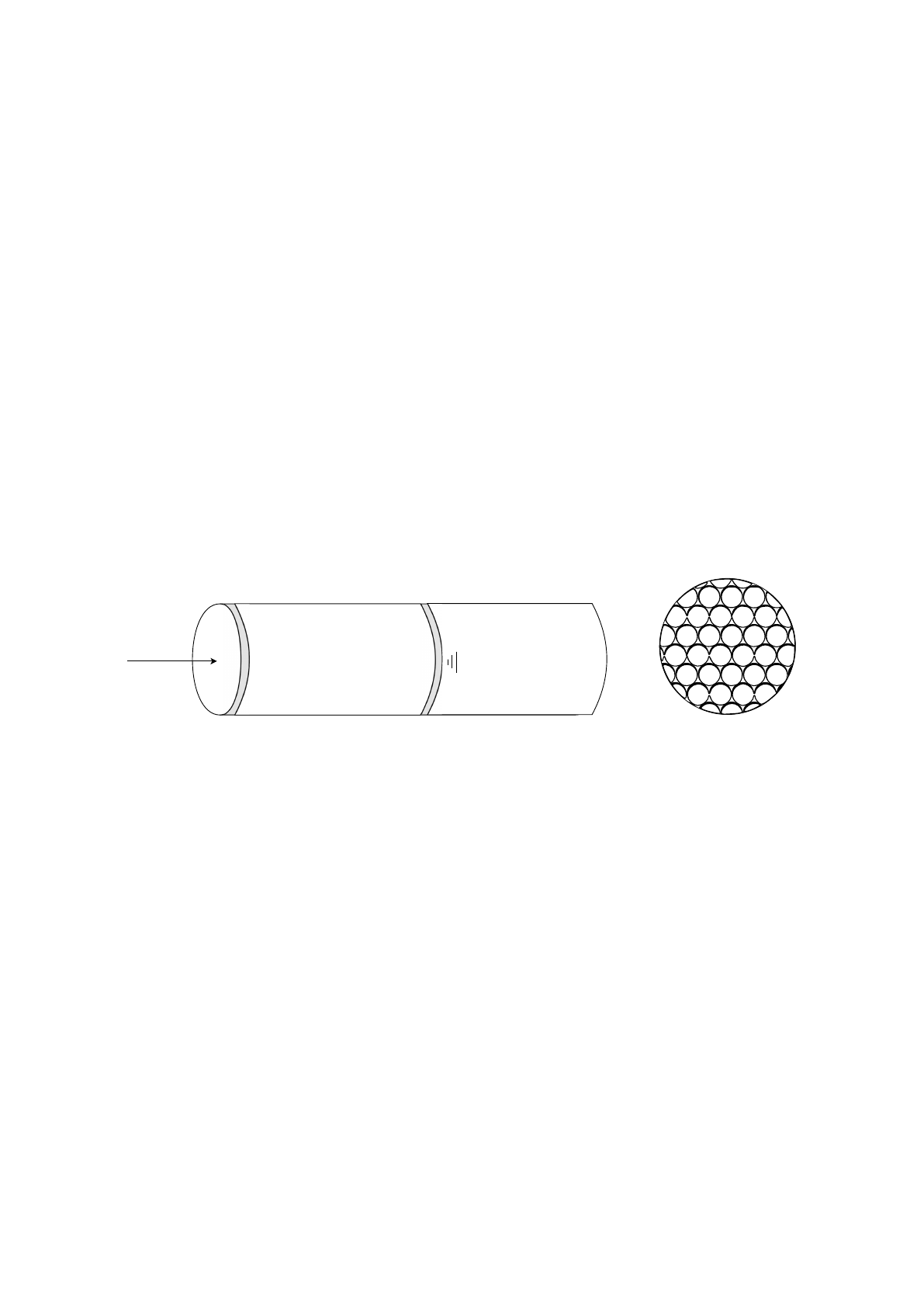
packed in a primitive cubic system, seen in Figure 1(right), the walls of the channels are considered
impermeable. On a macro scale the porous medium is described as a sphere. The drying process
is assumed to be convective drying, which is referred to as the most common drying technique in
literature [
11
]. The external diffusion limitation is nullified by assuming a high bulk-velocity and low
moisture content of the hot air circulating the porous body.
Figure 1.
(
left
) A Schematic description of the channel in which the drying process is simulated, the
arrow indicates the flow direction of bulk, the grey subsections indicate the boundary layers and the
three lines mark the gas-liquid interface, the liquid phase is on the right side and gas phase on the left
side. (right) 2D vertical cut of the spherical macro structure with packed parallel channels.
Given the symmetry of the macro scale, only one tubular channel needs to be modelled. Further
the channel is assumed to be radially and tangentially symmetric, hence the heat and mass transport
are only regarded in axial direction. To simplify the quantification of the Soret effect the channels
are assumed to be horizontally arranged to the mass forces, eliminating the buoyancy effects on
the thermodiffusion. The impact of the buoyancy effects on transport phenomena in porous media
is treated in detail by Saghir [
12
]. The evaporation of water is assumed to be at a sharp receding
gas-liquid interface, moving inwards as the drying process proceeds. This is an ideal consideration, but
a correct simplification for sufficiently small particles and high temperature differences [
7
]. A summery
of the drying system is shown in Table 1.
Loading more pages...