Small-scale mechanical properties and functional fatigue of
Ni-Mn-Ga
Small-scale mechanical properties
and functional fatigue of Ni-Mn-Ga
Adnan Fareed - Dissertation

Small-scale mechanical properties and functional fatigue of
Ni-Mn-Ga
vorgelegt von
Adnan Fareed, M.Sc.
ORCID: 0009-0001-9212-1269
an der Fakultät III - Prozesswissenschaften
der Technischen Universität Berlin
zur Erlangung des akademischen Grades
Doktor der Ingenieurwissenschaften
- Dr.-Ing. -
genehmigte Dissertation
Promotionsausschuss:
Vorsitzender: Dr.-Ing. Sören Müller
Gutachterin: Prof. Dr. Isabella Gallino
Gutachter: Prof. Dr. Robert Maaß
Tag der wissenschaftlichen Aussprache: 26. Juni 2024
Berlin 2024

Small-scale mechanical properties and functional fatigue of Ni-Mn-Ga Adnan Fareed
Abstract
The phenomenon of shape-memory response due to stress has been extensively studied at the bulk
scale for a wide variety of conventional shape-memory alloys, as well as their magnetic counterparts.
With the exception of NiTi and CuAlNi, the response is still largely unexplored at relevant scales for
applications in micro- and nanomechanical systems (MEMS and NEMS, respectively). A size effect
is expected when the surface-to-volume ratio approaches a critical threshold since the functional
characteristics of the Ni-Mn-Ga alloys are heavily dependent upon twin dynamics and martensitic
phase transformations. Given the enormous potential for small-scale actuators in the Ni-Mn-Ga
system under investigation, this work aims to provide an understanding of the stress-induced
martensitic phase transformation when probing small-scale volume, and to use this material in small-
scale applications, how this material responds under stress during cyclic loading (functional fatigue)
for long-term reliability.
First, employing the nanomechanical technique, we examine the temperature-dependent stress-
induced martensitic phase transformation in single-crystalline austenitic thin films. During
nanoindentation of 0.5 µm thin films, a distinct incipient phase transformation to martensite occurs,
leaving regions of residual martensite upon the removal of the load. These pop-ins occur regardless
of deformation rate or temperature, are Weibull-distributed, and show significant spatial variations in
transformation stress. On the contrary, completely reversible transformations occur at a film
thickness of 2 μm, and mechanical loading remains completely smooth. Ab-initio simulations explain
the thickness-dependent nanomechanical behavior by demonstrating how in-plane limitations could
significantly elevate the martensitic phase transformation stress.
For functional fatigue investigation, we employed micro-compression testing on cylindrical
microcrystals of austenitic thin films with a nominal radius of 2 μm. Ni-Mn-Ga exhibits its ability to
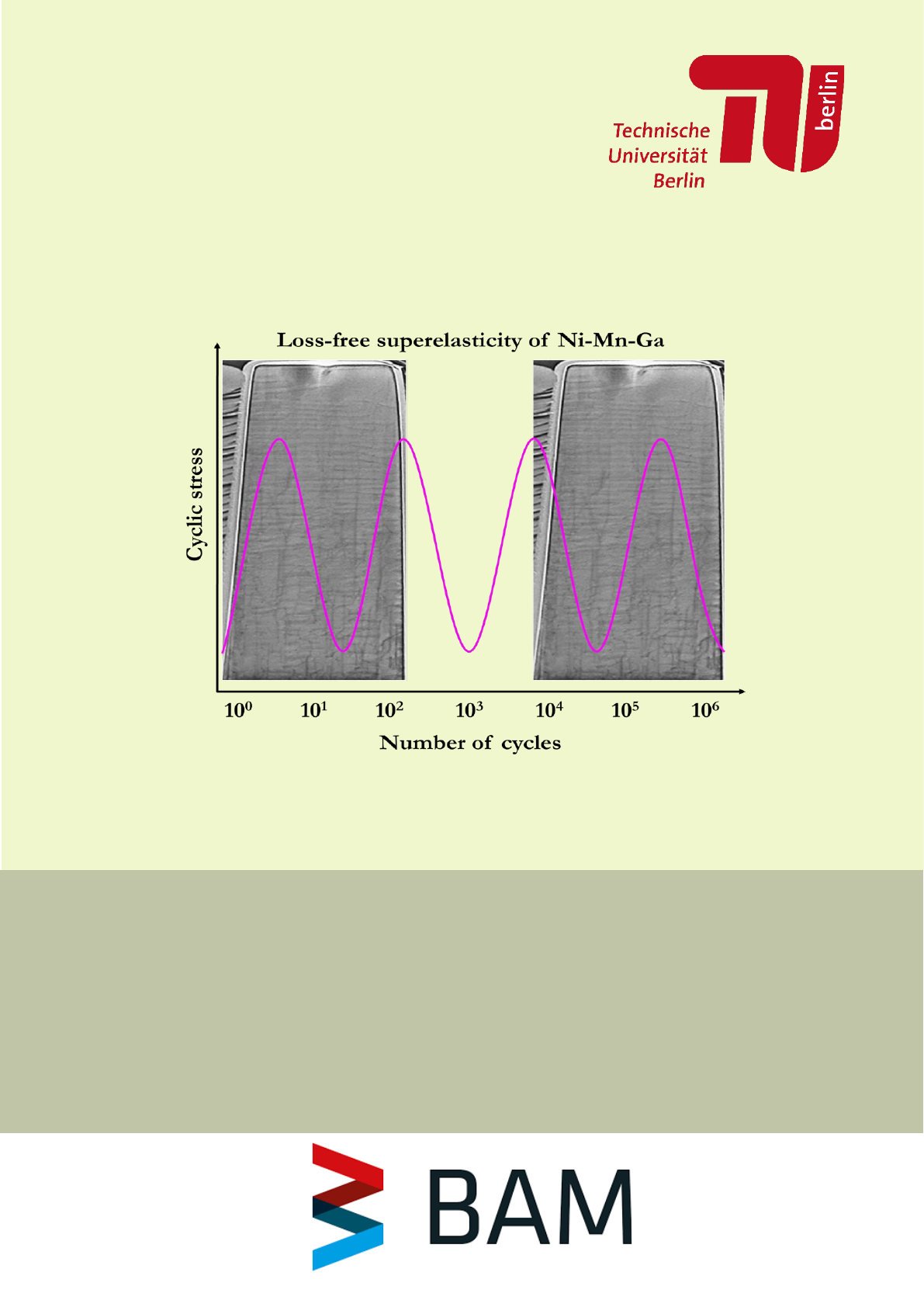
withstand up to a million superelastic cycles without any significant reduction (~ 2–3%) in its initial
switching strain. A similar response is also observed even when dislocation and slip bands are
introduced. This increase in plastic strain eventually leads to lower phase transformation stress.
There is no presence of residual martensite, which can be identified through STEM either for 106
cycles microcrystal or pre-deformed microcrystal. The hysteresis response of the microcrystal is five
times smaller compared to its bulk counterpart. The transformation stress is roughly twice compared
to the bulk value, and it deforms in the range of 1-1.4 GPa, which results in a significant size-affected
stress range for mechanical switching.
For tensile testing, we used the free-standing film, demonstrating 30% engineering strain. However,
due to contaminating nano-scale surface layers arising either during film fabrication or during tensile-
sample preparation, detailed quantitative testing could not be carried out meaningfully.

Adnan Fareed Small-scale mechanical properties and functional fatigue of Ni-Mn-Ga
2
Table of Contents
Abstract .................................................................................................................................I
Table of Contents .................................................................................................................2
LIST OF ABBREVIATIONS ...................................................................................................5
Chapter 1: INTRODUCTION AND SCIENTIFIC BACKGROUND .........................................7
1.1 Shape memory alloys .................................................................................................8
1.2 Magnetic shape memory alloys ................................................................................ 11
1.3 Ni-Mn-Ga microstructure and thin films growth challenges .................................. 15
1.4 Adaptive martensite concept.................................................................................... 17
1.5 Thin film fabrication challenges ............................................................................... 19
1.6 Objectives of this thesis ........................................................................................... 20
CHAPTER 2: EXPERIMENTAL METHODS ........................................................................ 24
2.1 Samples material and characterization ................................................................... 24
2.2 AFM analysis ............................................................................................................. 29
2.3 FIB milling .................................................................................................................. 30
2.4 TEM analysis ............................................................................................................. 31
2.5 Nanoindentation and associated data analysis ...................................................... 34
2.5.1 Deformation modes .............................................................................................. 35
2.5.2 Data processing ................................................................................................... 38
2.5.3 Maximum Likelihood Estimation (MLE) .............................................................. 40
2.6 Microcompression and micro-tensile testing .......................................................... 43
2.6.1 Microcompression testing ................................................................................... 43
2.6.2 Temperature dependent nanoindentation and compression testing ............... 46
2.7 Tensile testing and analysis ..................................................................................... 48
CHAPTER 3: RESULTS AND DISCUSSION ....................................................................... 52
3.1 Constrained incipient phase transformation in Ni-Mn-Ga films: A small-scale
design challenge ....................................................................................................... 52
3.2 Small-scale functional fatigue of a Ni-Mn-Ga Heusler alloy ................................... 68
3.3 Ni-Mn-Ga free-standing film behavior in Tension ................................................... 89
SUMMARY AND OUTLOOK ............................................................................................... 96
LIST OF PUBLICATIONS .................................................................................................... 96
Reference List .................................................................................................................. 101

Adnan Fareed Small-scale mechanical properties and functional fatigue of Ni-Mn-Ga
3
Acknowledgments
I want to express my heartfelt thanks to everyone who joined me on this journey, beginning
with my supervisor, Professor Robert Maaß. His support, invaluable guidance, and exceptional
mentorship throughout my doctoral research have been instrumental in shaping this
dissertation. Your expertise, encouragement, and unwavering commitment to excellence have
been the driving force behind my success. I am grateful for the opportunity to be your first
graduate at BAM and for your continued encouragement and support.
I extend my appreciation to Prof. Isabella Gallino for her supervision at TU Berlin and to Dr.-
Ing. Sören Müller for graciously accepting the role of committee chair on short notice. I am
thankful to our project collaborator colleagues, PD Dr. Sebastian Fähler, Dr. Heiko Reith, and
Satyakam Kar, for providing us with the samples and working with us on the papers. I am also
thankful to Dr. Tilmann Hickel and Dr. Sourabh Kumar for collaborating with us on the first
paper and providing us with simulation data. I want to express my gratitude to Dr. Julian M.
Rosalie for his support with TEM data and input on the work throughout my time at BAM.
Thanks to all the group members, especially Birte, for always helping with small tasks, either
work-related or German bureaucracy. Thanks to Reza, Sydney, Vara, Yuki, and Zengquan for
everything, giving your nanoindenter slot, and supporting me in many other ways. Thank you
for all the science group discussions, the monthly dinners, and the weekly lunch gatherings.
You guys are all fantastic colleagues and good friends. I would also like to thank our former
department assistant, Ms. Wiedmann, and our current department assistant Catherine for
helping with department affairs and handling all the matters regarding inventory orders and
business travel. Thanks to all the department colleagues who assisted and supported me
during my work. I am thankful to René Hesse for his help with TEM sample preparation and
FIB training and his willingness to assist with minor issues in the laboratory. I also want to
thank Dorothee Silbernagl for providing AFM training and measurements. Thank you to
Leonardo and Anna for their insightful scientific discussion. Additionally, I would like to express
my appreciation to M. Griepentrog for Nanoindentation training and to Oliver Schwarz for his
support at the nanoindenter lab throughout my work. I am also grateful for the financial support
provided by the BAM-IFW (Grant No. MIT1-2063-IFW) funding scheme and for the institutional
support from BAM.
I want to express my gratitude to my parents, Fareed Ullah and Shahjeera Bibi, for their
unwavering support and encouragement throughout my educational journey. I dedicate this
degree to them for their emotional and financial assistance, which helped me attain this
milestone. I would also like to thank my siblings for their constant support and inspiration during
Loading more pages...